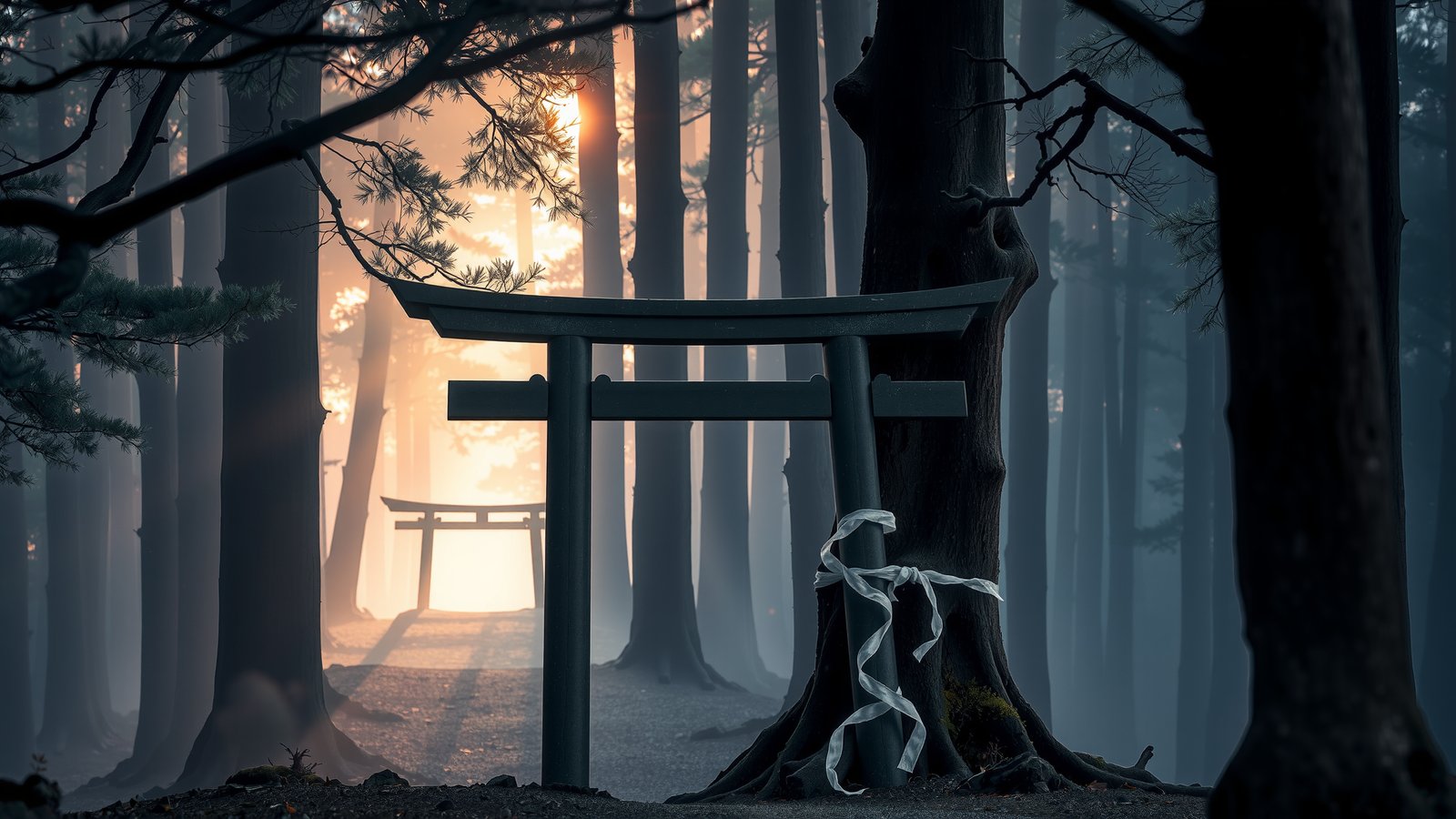
Stand in front of
a very large tree
and
your voice
drops.
Nobody taught you
to do that.
It happens
anyway.
It happens
at waterfalls.
It happens
in front of
very old stone.
Shinto is the name
Japan gave that reaction
and then carried
for more than
a thousand years.
There is
no founder.
There is
no single
holy book.
What there is
is forest,
and water,
and stone,
and
the way a voice
goes quiet
near them.
Which means Shinto asks you
to believe something
after
your body has
already
agreed.
💎 The One Line That Holds This Article
Shinto is not something to believe in. It is the name given to the way a human being goes quiet in front of something larger — kept alive for a thousand years.
The Answer, in Three Lines
Shinto has no founder, no single scripture, and no conversion procedure. At its center are the eight million kami — the sense that forests, water, stone, wind and even people can be sacred. If you visit a shrine, three things are enough: bow at the torii, rinse your hands, then bow twice, clap twice, bow once. Everything else is better learned by walking slowly through the grove.
The 30-Second Summary
- Shinto has no founder, no single canonical scripture, and no membership. It is a religion that was simply already there
- Its center is the eight million kami (yaoyorozu no kami). Kami are countless — and not necessarily good (violent kami are still kami)
- The Kojiki (712) and Nihon Shoki (720) preserve the myths, but they are state-compiled histories, not scriptures
- The original shrine was not a building. It was a rock, a tree, a waterfall — sacred sites with no hall at all
- The sacred grove (chinju no mori) is not decoration. Japan has roughly 80,000 shrines, and a patch of forest survived at each one
- Standard etiquette: bow at the gate → rinse hands → two bows, two claps, one bow. But Izumo Taisha and Usa Jingū use four claps
- The core concept is purification (harae, misogi) — Shinto is less about judging wrongdoing than about washing it off
- Festivals encode a rhythm of hare and ke — the extraordinary exists so the ordinary can continue
- Claims that shrine bells ring at a specific “healing frequency” have no measurement-based support we can verify
- Walking in forests is widely reported to calm people, but the scientific evidence is moderate at best — it cannot be stated as a health effect
1. What Shinto Actually Is — Japan’s Oldest Layer, With No Founder
Most of the world’s
major religions
have
someone who
started them.
The Buddha.
Jesus.
Muhammad.
Shinto has
nobody.
It has no
scripture either.
The Kojiki and the Nihon Shoki
are
not books
of teaching.
They are histories
containing myth.
Nowhere do they say
“live like this.”
There is almost
no moral code.
So —
what is there?
Places.
And
a way of behaving
in them.
Shinto was carried forward
not as doctrine
but as
etiquette.
You bow
before you
think about it.
You wash your hands
before you
think about it.
That reversal —
body first,
understanding later —
is the single most
Shinto thing
about Shinto.
Zen made a similar move
with “just sit”
(Zazen: A Complete Introduction
),
but Shinto is
older,
and explains
even less.
2. The Eight Million Kami — What It Means for Gods to Be Uncountable
Yaoyorozu no kami —
the eight
million kami.
The number is not
a count.
It means
too many
to count.
This is where Shinto
parts company
with monotheism.
The divine is
not one.
And —
not only good.
The kami who brings
the storm.
The kami who brings
the plague.
Those are kami too.
The Japanese word kami
does not map cleanly
onto “God.”
The Edo-period scholar
Motoori Norinaga
defined it
roughly like this:
anything possessing
extraordinary power,
which inspires awe.
Note what is
missing:
morality.
Which is why
a huge rock,
an ancient tree,
a waterfall,
the sea —
can all be kami.
And so can
a person.
Sugawara no Michizane
was a human being.
He is now enshrined
as Tenjin.
That capacity to
keep adding
is a large part of why
Shinto survived
a thousand years
of everything else.
3. A History of Shinto — From Forest Worship to Syncretism to the Modern State
Shinto’s history
is
not a clean line.
Think of it in
four layers
and it becomes
navigable.
| Layer | What happened | What remains today |
|---|---|---|
| Ancient (to c. 6th c.) | Mountains, rocks, trees and water venerated directly. No buildings yet | Ōmiwa Shrine (Mt. Miwa itself), sacred rocks, sacred trees |
| Nara–Heian (8th–12th c.) | Fusion with Buddhism (shinbutsu shūgō); kami understood as manifestations of buddhas (honji suijaku) | Buddhist traces inside shrines; guardian shrines inside temples |
| Medieval–Edo (13th–19th c.) | Shinto theory formalized; mass pilgrimage to Ise becomes popular culture | Pilgrimage associations, Ise’s special status |
| Modern (1868–1945) | Forced separation of kami and buddhas, anti-Buddhist destruction, then State Shinto | Today’s standardized shrine forms; postwar separation of religion and state |
The most commonly
missed fact here
is
how long the fusion
lasted.
For over a thousand years
Japanese people prayed to
kami and buddhas
without separating them.
Buddhist elements still
visible at shrines
are
not confusion.
They are
the original condition.
The separation came in
1868,
by government order.
About a hundred and fifty
years ago.
After that, Shinto was
absorbed into the state —
and in
1945
that arrangement
ended.
Esoteric Buddhism carried much of that fused era
(Esoteric Buddhism and Shingon: A Complete Introduction
).
Shinto is ancient.
Its present form is not.
Hold both facts
and shrines become
much easier
to read.
4. Shrine or Temple? — What Happens Inside the Torii
“Which one is
which again?”
A fair question.
They were fused for
a millennium.
Here is the
practical table.
| Aspect | Shrine (Shinto) | Temple (Buddhist) |
|---|---|---|
| Entrance | Torii gate | Sanmon / mountain gate |
| Object of reverence | Kami — nature, ancestors, historical figures | Buddhas and bodhisattvas, with visible form |
| Sacred object | Mirror, sword, jewel — or a mountain. Usually never shown | A statue. Often viewable |
| Central building | Honden — people do not enter | Hondō — people enter and sit |
| Sound of worship | You clap | You do not clap |
| Relation to death | Death treated as impurity to keep at distance | Handles funerals and memorial rites |
| Clergy | Kannushi, gūji, miko | Monks, priests, abbots |
The clearest tell
is
whether you make
a sound.
At a shrine
you clap.
At a temple
you do not.
But the deeper
difference is this:
nobody enters
the honden.
A temple hall is
a room built
for people to sit in.
A shrine’s inner sanctuary
is built
for people
to stop outside of.
That stopping —
standing at the rail
and going
no further —
may be the most
Shinto gesture
there is.
For how to read Zen temples, see
Visiting Japan’s Zen Temples
.
5. The Sacred Grove — Why Every Shrine Has a Forest
Every shrine
has trees.
Even a tiny urban
shrine wedged between
apartment blocks
holds an implausible
density of
green.
This is the
chinju no mori
— the sacred grove.
It is not
landscaping.
It is the
sacred precinct.
The forest came
first.
The buildings came
later.
And something
interesting followed.
Japan has roughly
80,000 shrines.
Each one kept
its grove.
Which means Shinto
accidentally became
the largest
conservation mechanism
in the country.
The vegetation scientist
Akira Miyawaki
spent decades documenting
that these groves
often preserve
potential natural
vegetation —
what the land would grow
if left alone.
Everything around them
was cleared, rebuilt,
paved.
The shrine forest
stayed as it was.
Why?
Because people were
uneasy about cutting it.
Not law.
Not a protected-area
designation.
Just
a reluctance to
touch it —
holding a forest
for a thousand years.
As technologies go,
that is a
remarkably durable
one.
6. Rocks, Trees and Waterfalls — The Shrine With No Building
If you want to see
the oldest form
of Shinto,
visit a shrine
with no shrine
in it.
They still exist.
- Iwakura — a massive boulder treated as the seat of a kami. A rope around it, and nothing else
- Sacred trees — a great trunk wrapped in straw rope. The tree itself is the point
- Waterfalls — at Nachi, the waterfall is the sacred body
- Mountains — Ōmiwa Shrine in Nara has no honden at all. Mount Miwa behind it is the sacred body
The Ōmiwa case is
quietly astonishing.
There is no
inner sanctuary.
Past the worship hall
there is no
building —
there is a
mountain.
That is the
original form.
It explains the idea of
yorishiro,
the vessel a kami
descends into.
A kami is
not permanently
resident.
It arrives
when needed.
Into a rock.
Into a tree.
Into a roped-off
space.
Which means the
straw rope
is
not a fence.
It is a sign saying
“you may
land here.”
Not built to contain
the sacred —
built to
receive it.
And that instinct
is still in us.
It is the reason
your voice drops
under a
very old tree.
7. Shrine Etiquette — From the Torii Gate to the Hall
“I don’t know the
etiquette, so I don’t
go in.”
Common.
There are
three things
to know.
- Bow at the torii. The gate is a boundary, not a door. A small bow before passing through. The center of the path is the kami’s path — walk to one side
- Rinse at the water pavilion. Left hand → right hand → rinse the mouth → left hand again → tip the ladle to rinse the handle. Many shrines have removed ladles in recent years — simply rinsing under running water is fine
- At the hall: two bows, two claps, one bow. Bow deeply twice, clap twice, hold your hands together and pray, then one final deep bow
Offerings are
placed, not
thrown.
There is no
required amount.
And one
exception.
Izumo Taisha and
Usa Jingū use
two bows,
four claps,
one bow.
Large shrines often post
their own instructions —
if there is a sign,
the sign wins.
On the way out,
turn at the gate
and bow once more.
That is all of it.
Honestly:
if you get a step
wrong,
nobody will
correct you.
What matters is not
the sequence.
It is
not being
in a hurry.
8. Purification — The Japanese Design for “Washing It Off”
The key to Shinto
is not sin.
It is
impurity (kegare).
Christian sin is
something to be
forgiven.
Shinto impurity is
something to be
rinsed away.
Closer to laundry
than to judgment.
It is a genuinely
unusual design.
Impurity did not only
come from wrongdoing.
Death.
Blood.
Illness.
Disaster —
attached to people
who had done
nothing at all.
(And it must be said
plainly that this idea
produced real
discrimination
in Japanese history.)
Hence the need for
harae — purification,
and
misogi — washing.
The origin is
mythological.
Izanagi, returning
from the land
of the dead,
washed himself
in a river.
From that washing were born
Amaterasu,
Tsukuyomi
and Susanoo —
the central kami
of Japanese myth.
He washed,
and gods
came out.
That image went
very deep.
Taking shoes off
at the door.
Washing hands before
eating.
Resetting everything
at New Year.
The year-end
deep clean.
Impurity accumulates.
You rinse it off
on a schedule.
The idea is still
running
in ordinary
Japanese life.
Those few seconds
at the water pavilion
are a
repetition of a myth
older than
the written record.
9. The Sound of Shinto — Bells, Claps and the Low Voice of Prayer
A shrine is a
well-designed
acoustic space.
Listen in order
and it becomes
obvious.
- Gravel — the approach path crunches underfoot. That sound functions as the signal that you have left ordinary space
- The bell — rung before praying. A diffuse, slightly impure metallic sound
- The clap — you strike your own hands. The sound is yours
- Norito — the priest’s long low recitation. Meaning aside, it reaches the body as low frequencies rich in overtones
- Gagaku — the ryūteki flute, hichiriki reed and shō mouth organ. The shō’s clusters are deliberately blurred by Western harmonic standards
And here, one
honest note.
You may encounter claims that
a shrine bell rings at
a specific “purifying frequency.”
We can find no
measurement-based
support for this.
Bell tone varies completely
with alloy,
shape
and size.
They are not tuned
to any shared
frequency.
Does that make it
meaningless?
No.
Because sound switches
a space
not through its
frequency value
but through its
structure.
A silent forest.
One metallic sound
inside it.
The contrast
is what moves
your attention.
On natural sound specifically, see
The Science of Nature Sounds
.
And then the
clap.
It is a sound
you make
yourself.
Nobody produces it
for you.
It is the only moment
in the whole ritual
where you are
the sound source —
which makes those
two dry strikes
land
a little
differently.
10. Festivals — The Rhythm of Hare and Ke
The folklorist
Kunio Yanagita
divided Japanese time
into
hare and
ke.
Ke — ordinary
days.
Hare — the
extraordinary.
A festival is a device for
punching holes
in the ordinary
on a schedule.
And crucially,
a festival is
not escape.
The extraordinary exists
so that the ordinary
can continue.
| When | Observance | The core idea |
|---|---|---|
| January | First shrine visit, bonfire of old charms | Return the year to zero |
| February | Setsubun | Drive out at the seasonal seam |
| End of June | Nagoshi no Harae | Rinse off six months. Passing through the grass ring |
| July–August | Summer festivals, Obon (Buddhist fusion) | Get through heat and epidemic season |
| Autumn | Harvest festivals, Niiname-sai | Gratitude for the harvest |
| End of December | Great Purification, deep cleaning | Flush the whole year |
Read down the column
and the pattern
is unmistakable:
almost every Japanese
observance is a way
of cutting time.
The year is not
allowed to run
continuously.
It is severed at
the end of June
and again at
the end of December.
Nagoshi no Harae
is the clearest case.
On June 30,
a great ring of woven grass
stands at many shrines.
You walk a figure eight
through it,
three times.
That is all —
and
half a year
is closed.
Modern life may simply
lack the cuts.
The sensation that a year
slid past undivided
is not unrelated
to the
absence of festivals.
On seasonal and bodily rhythm, see also
Living With the Moon’s Rhythm
.
11. Misconceptions and Cautions — What Can and Cannot Be Claimed
Let me draw the
lines clearly.
Common misconceptions
- Shinto is not simply “primitive nature worship.” It absorbed theory, institutions and politics over centuries
- Shinto is not equivalent to Japanese national character. It was bound to the state in the modern era, and that history is still debated
- You do not need to be a believer to enter a shrine. There is essentially no conversion procedure to undergo
- Amulets do not guarantee outcomes. Treating them as a way of marking a decision is the reasonable reading
- There is no scientific evidence that praying at a shrine grants wishes. It can still function meaningfully as a way of drawing a line
Forests and health — what the evidence supports
- Reasonably supported — studies report improvements in subjective stress and relaxation in green environments. The health benefits of walking itself are comparatively well established
- Moderate to limited — studies reporting reduced salivary cortisol or altered NK-cell activity in forest settings exist, but sample sizes are small and replication is insufficient
- Not supportable — “forest bathing cures illness” or “it boosts immunity, so you’re protected.” This is not a substitute for medical care
Practical cautions
- Keep quiet in the precinct. Avoid extended photography at the worship hall, and tripods generally
- Respect off-limits areas. Some shrines maintain forbidden ground; the boundary is not decorative
- During rites, stay out of the way. A ceremony is something being performed, not staged for viewers
- Waterfall austerities and cold-water purification carry real physical load. Anyone with cardiac, blood-pressure or respiratory concerns — and anyone alone — should not attempt them
12. Shinto and the Cosmos — The Cave of Heaven, and a World That Keeps Its Dark
Now we step
outside science.
Japanese myth contains
a scene called
Ame-no-Iwato —
the heavenly rock cave.
Amaterasu, the sun,
hides inside it.
The light
goes out.
The world becomes
dark.
The eight million kami,
at a loss,
gather outside and
throw a party.
Ame-no-Uzume
dances,
and the gods
laugh.
Amaterasu, curious about
the laughter,
opens the stone
a crack —
and they draw
her out.
What is remarkable here
is that
the darkness is
never defeated.
Nobody fights
evil.
They make noise
until the light
comes back
on its own.
Among the world’s myths,
that is an unusual
solution.
And there is a
second thing.
The Japanese kami are
not beings of
light only.
Susanoo, Amaterasu’s
brother,
rampages and is
expelled from heaven.
Then later
slays the eight-headed
serpent
and becomes a hero.
Good and destructive
live in the same
god.
Which is not far
from what you feel
looking up
at the night sky.
The cosmos is
beautiful,
and
not kind.
Vacuum.
Extreme cold.
Entirely indifferent
to your plans.
And still, looking up,
awe and reassurance
arrive at once.
Something with
extraordinary power,
which inspires awe.
Motoori’s definition
is something we
still meet
most clear nights.
The dark under the trees,
the dark overhead —
both hold something
that should not
be switched off.
Perhaps Shinto kept
its forests
for a thousand years
in order to
keep some
darkness.
For the wider view, see
Spirituality: A Complete Guide
.
13. Before You Visit a Shrine — A Five-Point Checklist
Check these before
you go.
- Are your shoes right for walking? Approaches are long, graveled and stepped. Heels are punishing. At mountain shrines with long stone stairways, a grippy sole matters for safety — wet moss on old stone is genuinely slippery
- Do you have coins? Offerings, amulets and seal-stamps are still cash-only at most shrines. Carry several small coins; a shrine seal typically runs ¥300–500
- Have you chosen your hour? Early morning is by far the quietest. Grounds are usually open all day, but the shrine office runs roughly 9:00–16:00 — check if seals or amulets are your goal
- Have you checked the festival calendar? On a festival day the grounds are loud and crowded, and quiet walking is impossible. Decide whether you want the festival or the silence — or deliberately aim for the great rite
- Is your day overbooked? Three shrines maximum. From the fourth onward nothing is retained. Fifteen minutes walking one sacred grove stays with you far longer than five shrines counted
Travel light.
Go early.
Those two adjustments
do more than
anything else.
About This Article (Disclaimer and Advertising Notice)
This article is informational content about the history, culture and practice of Shinto. It is not medical treatment, psychotherapy, or religious solicitation. Nothing here regarding shrine visits, forest environments or natural sound is intended to guarantee improvement in illness, symptoms, relationships or finances, and individual experience varies. Research on forest environments and health remains small in scale and should not be generalized. If you are under medical care, follow your physician’s guidance. Waterfall austerities and cold-water purification impose significant physical load; anyone with cardiac, blood-pressure or respiratory concerns, and anyone practicing alone, should avoid them. Etiquette, opening hours, shrine-office hours, festival dates and photography rules vary by shrine and are subject to change. Please confirm official information for each shrine before visiting. This article does not encourage affiliation with, or donation to, any particular religion or shrine.
[Advertising Notice] This article may in future contain affiliate links. Purchases made through such links incur no additional cost to the reader.
14. For Example, Consider a Situation Like This
To make it concrete,
let us imagine one
general situation
(this is a deliberately
generalized, fictional example —
not any real person’s account).
Suppose it is
a Sunday morning
with nothing scheduled,
and you decide to walk
to the neighborhood shrine.
You have no
faith.
You have no
particular
request.
Only the sense that
a week of something
has accumulated.
That is the entire
reason.
At the gate,
you bow.
Nobody is
watching.
It feels
slightly silly.
Then you step onto
the approach
and the sound
changes.
Gravel.
And
the traffic drops
one step back.
It is a small shrine
with only a handful
of trees —
and it happens
anyway.
You rinse your
hands.
The water is
cold.
That coldness is
probably doing
most of the work.
At the hall
you bow twice,
then
strike your hands
together
twice.
The dry sound carries
farther than
you expected.
You cannot think of
anything to ask for.
So
you ask for
nothing.
You stand for maybe
thirty seconds,
bow,
and walk back.
Total time:
seven minutes.
Nothing was
solved.
The problem is
exactly where
you left it.
But passing back out
through the gate,
your back is
a little
straighter
than it was
going in.
That is usually
the size of what
a shrine
hands back.
And it has a way
of
still being there
the next day.
This article does not guarantee any medical or health benefit and is not a substitute for professional medical care. If you have any health concerns, please consult a physician or other qualified professional.
📚 Related Articles
- Zen Temples in Japan: A Complete Visitor’s Guide | Kyoto, Kamakura, Eiheiji, Zazen Sessions and How to Read a Rock Garden
- Esoteric Buddhism & Shingon: A Complete Introduction | Kūkai, Mandalas, Mantras and “Buddhahood in This Very Body”
- Zazen: A Complete Introduction | How to Sit, What to Do If You Can’t Cross Your Legs, and How It Differs from Meditation
- Taisetsu and 963Hz | The Season the Sky Closes — Japan’s Solar Term of Great Snow and the Highest Frequency
FAQ (10 Common Questions)
Q1. Can I visit a shrine if I have no faith?
Yes. Shinto has no conversion procedure and essentially no believer / non-believer distinction. Tourists, once-a-year New Year visitors, and people who bow while walking past have all been equally accommodated for centuries. What is asked is not a declaration of belief but respect for the place.
Q2. How does shrine worship differ from temple worship?
The clearest difference is sound. At a shrine you clap (standard form: two bows, two claps, one bow). At a temple you do not clap — you press your palms together quietly. Shrines are entered through a torii; temples through a mountain gate. If there is a torii, it is a shrine.
Q3. Are there shrines that don’t use two claps?
Yes. Izumo Taisha and Usa Jingū are known for four claps (two bows, four claps, one bow), and other shrines preserve their own forms. In most cases instructions are posted near the hall. If a sign exists, follow the sign.
Q4. The water pavilion has no ladle. What do I do?
Many shrines removed ladles in recent years. If water is simply running, rinse both hands in turn and rinse your mouth (or skip that step). Having performed the act of purification matters more than the details of the form.
Q5. Is the calm I feel in a sacred grove a scientific effect?
Partly supported, but it cannot be stated as fact. Multiple studies report reduced subjective stress in green environments. Physiological findings (cortisol, immune markers) come from small samples with insufficient replication. The benefit of walking itself is comparatively well established. The honest line today: real enough to notice, not strong enough to call treatment.
Q6. Do shrine bells ring at a special frequency?
We can find no support for that claim. Bell tone varies entirely with alloy, shape and size, and there is no shared tuning across shrines. What is understandable — independent of any frequency value — is that a single metallic sound inside a quiet space redirects attention sharply.
Q7. Do amulets and fortune slips work?
They do not guarantee outcomes. An amulet is better understood as a way of externalizing a wish and closing a decision; a fortune slip as a device for settling the mind around whatever it says. Drawing a bad fortune does not cause misfortune, and most shrines invite you to tie it and leave it behind.
Q8. Are there days I should not visit a shrine?
Generally, no. One widely transmitted custom holds that those in mourning refrain from passing through a torii for a period, reflecting Shinto’s treatment of death as impurity. Practice varies by region and shrine — ask at the office if it matters to you. There is also no obligation to go when you feel unwell.
Q9. How do I receive a shrine seal (goshuin)?
Worship first, then present your seal book open at the shrine office. It is a record of a visit, not a stamp rally. Expect ¥300–500, usually cash only, with office hours often around 9:00–16:00, and suspension on festival days. Many shrines now offer pre-written sheets instead.
Q10. Where should I start if I want to learn Shinto?
Going straight to the classical Kojiki text tends to end badly — start with a modern translation or a good introduction. But the most effective study may not be reading at all. It may be visiting one nearby shrine repeatedly, across seasons. Things surface that no book records. Shinto was, after all, transmitted without being explained.
Summary | The Place Where Your Voice Gets Smaller
I have written at length
about Shinto.
The eight million kami.
The sacred grove.
Rock seats and
straw rope.
Two bows, two claps,
one bow,
the great rinse
of midsummer —
but in the end,
Shinto teaches
one thing.
In front of something
large, a person
becomes small
on their own.
That reaction is worth
keeping — not
erasing.
The old ones kept it
as
forest.
Not by statute.
Not by theory.
By reluctance.
So you do not need
expertise.
You do not need
perfect etiquette.
Next time you happen
to pass one —
stop at the torii,
once.
You need not
go in.
If you do,
walk along the
edge of the path.
The gravel
sounds.
The branches move
overhead.
And the traffic is
a little further
away than it was
a moment ago.
Bow once and
go home.
That is enough.
A thousand years ago,
someone stood in that
same spot
and their voice
got smaller too.
References
- Kojiki, translated with an introduction and notes by Donald L. Philippi, University of Tokyo Press, 1968. (Compiled in 712. The oldest surviving Japanese book — the source for the rock cave, the purification of Izanagi, and the eight million kami.)
- Nihongi: Chronicles of Japan from the Earliest Times to A.D. 697, translated by W. G. Aston, Kegan Paul, 1896 (repr. Tuttle). (The 720 court chronicle, offering variant versions of the same myths alongside dynastic history.)
- Helen Hardacre, Shinto: A History, Oxford University Press, 2017. (The current standard English-language history, particularly rigorous on the construction of State Shinto in the modern period.)
- Sokyo Ono with William P. Woodard, Shinto: The Kami Way, Tuttle Publishing, 1962. (A long-lived classic introduction from within the shrine establishment — clear on kami, shrines and ritual basics.)
- Akira Miyawaki, Chinju no Mori (“The Sacred Grove”), Shinchosha, 2000 (in Japanese). (A vegetation scientist’s field survey of shrine forests across Japan, explaining from the botanical side why these groves survived.)
MuZenCosmos — Where the Cosmos Meets Silence | In front of something large, a voice becomes small