In the previous note I wrote that, after measuring every published track, one had gone out clipped: the 8-hour sleep track layering 174, 396 and 432 Hz, which is also the most-viewed long-form video on this channel. This is the record of rebuilding it. The rebuilt version is here. The original (here) stays online for the record, with a pointer to the new version at the top of its description.
What had happened (from the records)
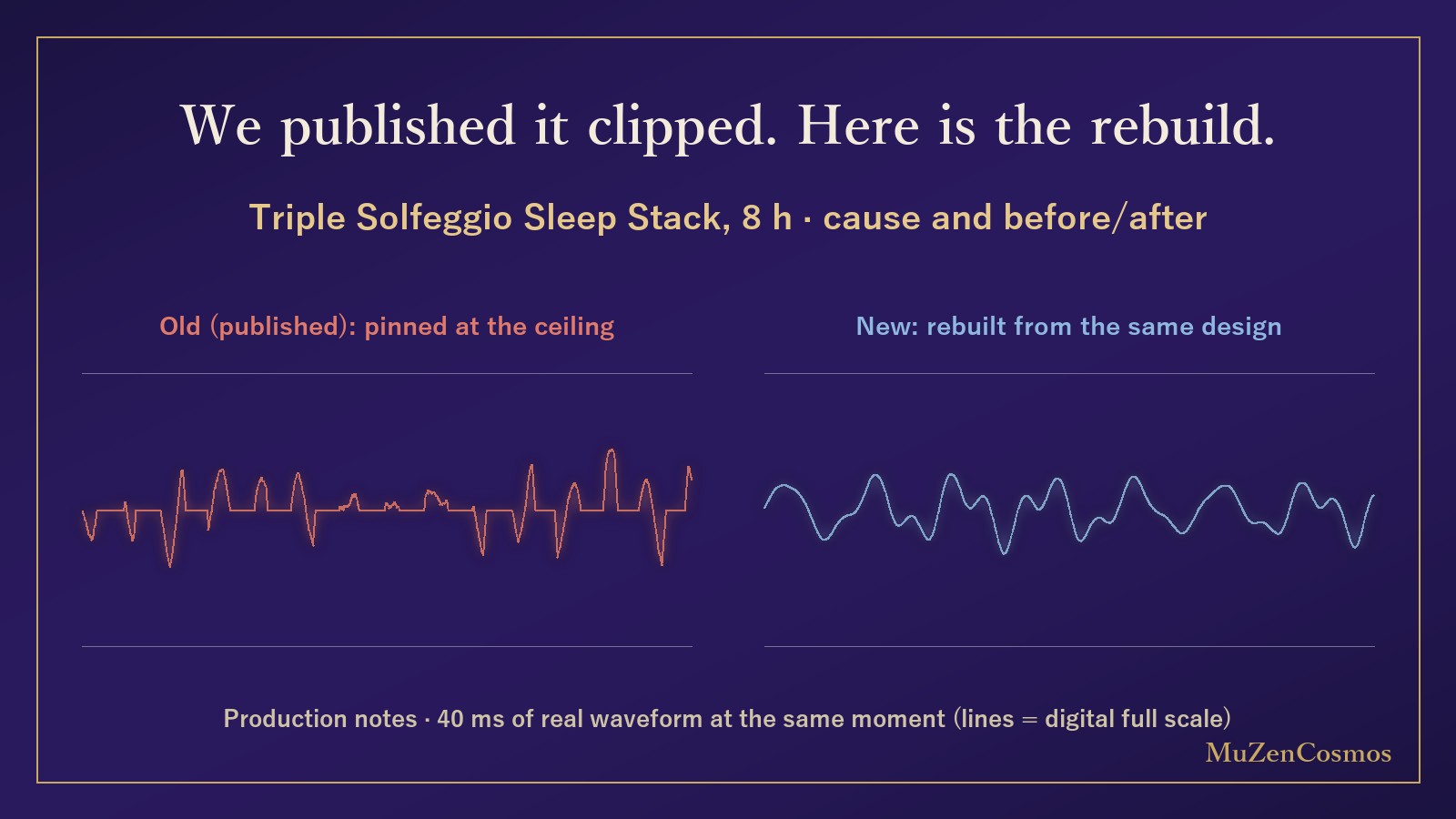
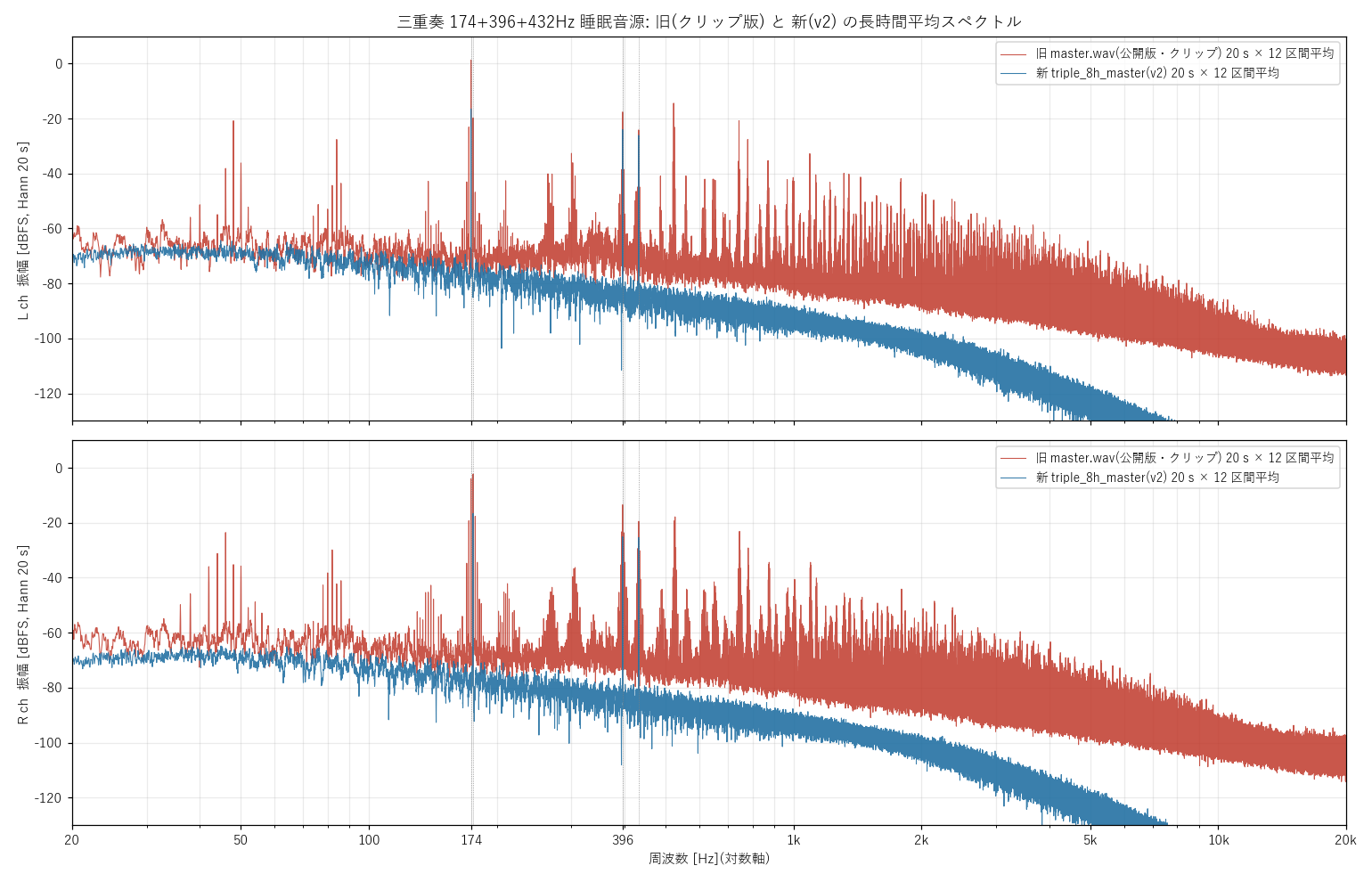
- The signal was pinned at the ceiling. Counting the original master, 51% of all samples sit exactly at 0.99 of full scale. The waveform is close to a square wave. Integrated loudness +0.1 LUFS, loudness range 0.0 LU.
- The cause was far too much reverb. In the step that adds a cathedral-style reverb, the impulse-response generator did not normalise energy, so the wet signal came out tens of dB louder than designed. A later “clip at ±0.99” stage then flattened the distorted result against the ceiling. The defect was already in our internal records, but the fix was opt-in, and this recipe had not opted in.
- It was 6.2 hours instead of 8. The export was a plain WAV rather than RF64, so the file was cut at the 4 GB limit (22,374.7 s, exactly 4 GB worth).
- The checks said “wrong” three times. The post-export check logged “FAIL (no measurement),” a ledger reconciliation in September logged “−0.35 LUFS,” and then the full catalog measurement in October. There was simply no mechanism that stopped publication.
What changed in the rebuild
- The five layers (174/396/432 Hz sustained tones, the 2 Hz left/right offset, brown noise) keep their original frequencies and gains.
- The reverb uses an energy-normalised generator, with the wet level at its design value.
- No normalisation anywhere inside the synthesis. The mix is written as floating point with more than 10 dB of peak headroom, and only one loudness normalisation (two-pass, linear gain) is applied at the end.
- Eight hours synthesised as one continuous run (no loop), exported as RF64.
- The right ear’s 174 Hz replaced with 176 Hz. In the original recipe the right ear received both 174 Hz and 176 Hz, so the right ear alone heard a 2 Hz wobble (56% depth, measured). Now the left carries 174 Hz and the right only 176 Hz, so the 2 Hz difference exists only between the ears, as a binaural beat should (the measurement is in the next production note).
- Finished at the 8-hour-sleep tier: −16.5 LUFS, −2.0 dBTP (deliberately quieter than the −14 used elsewhere; the reasoning is in the previous note).
- After export, a script checks length, loudness, peak, number of over-full-scale samples, the left/right offset, the 2–5 kHz band and chunk-boundary continuity, and nothing proceeds on a fail.
Before and after
| Old (published May 29) | New (rebuilt) | |
|---|---|---|
| Length | 6.2 h (meant to be 8 h; cut short) | 8 h |
| Integrated loudness | +0.1 LUFS | -16.5 LUFS (the −16.5 tier for 8-hour sleep versions) |
| True peak | +0.1 dBTP | -9.7 dBTP |
| Samples pinned at full scale | 50.6% | 0 (max -9.7 dBFS) |
| Loudness range | 0.0 LU (flat, like a square wave) | 1.0 LU |
| Left/right 2 Hz offset (near 174 Hz) | 2 Hz by design | measured +2.000 Hz |
| 2–5 kHz band (where harshness lives) | a comb of distortion harmonics | -61.2 dB (floor only) |
| Video file | no longer on disk | 8 h, 3.02 GB, audio -16.5 LUFS |
Seam check: the synthesis is written in 120-second chunks, so the sample step was measured at all 239 chunk boundaries and stayed within 2.13× the normal in-chunk step (indistinguishable).
How the new version sounds
Drier and quieter than the original. In the old version the distortion read as “thickness,” and the reverb was several times the design amount, so by comparison some listeners may find the new one thin. But this is the sound as designed. Turn the volume up on your device: YouTube does not raise quiet videos, so the −16.5 version arrives 2.5 dB below our −14 tracks.
What remains
- The factory code (the reverb generator’s default, the ±0.99 clip, the behaviour of passing silently when a measurement fails) has not been fixed yet. It is logged as separate work.
- The original stays online, for its view history and as the record of what happened.
- The sound after YouTube’s re-encoding was not measured in this note either.
To check the pitches themselves, see the Frequency Lab. The measurement method is described in Measuring my 528 Hz tracks.
This article does not guarantee any medical or health benefit and is not a substitute for professional medical care. If you have any health concerns, please consult a physician or other qualified professional.