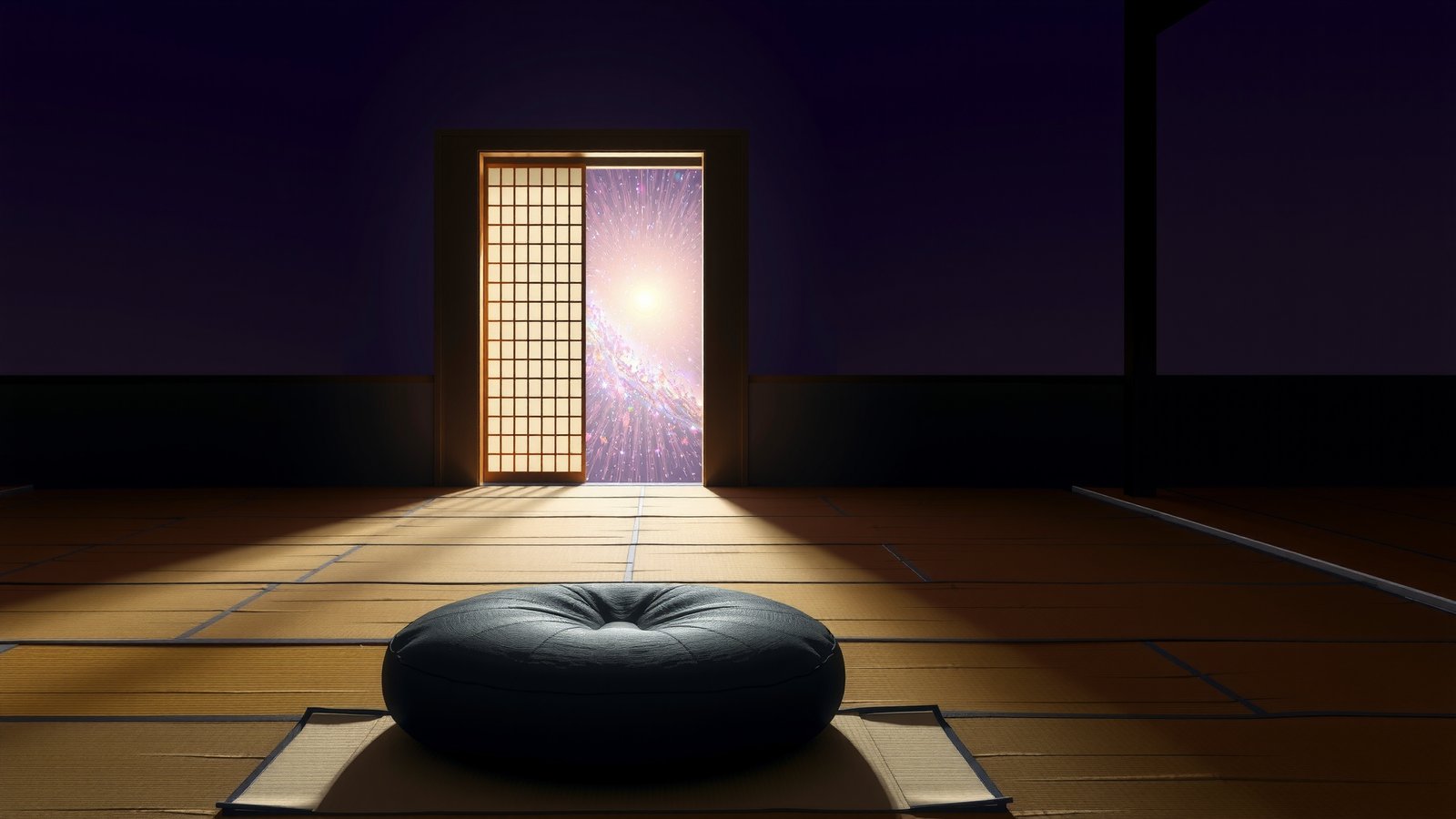
Sit,
and do nothing.
That one simple thing
has become
the hardest thing
we do.
We can justify ourselves
when we are doing something.
But when we are doing nothing,
an explanation
is demanded
almost immediately.
Zazen is an old method
for setting that demand
down.
For fifteen hundred years,
the way of sitting
has barely changed.
💎 The One Line That Holds This Article
Zazen is not a technique for emptying the mind. It is the practice of stopping the attempt to empty it.
The Answer, in Three Lines
Zazen means folding the legs, standing the spine, holding the eyes half-open, and watching the breath without controlling it — and if your legs will not fold, a chair is perfectly acceptable. Wandering thoughts are not to be erased, only not followed. Meditation research as a whole shows moderate evidence for benefit, but nothing can be asserted about zazen alone.
The 30-Second Summary
- Zazen descends from the Indian dhyāna (quiet contemplation), became chan in China, and was refined into its own forms in Japan
- The word is written both 座禅 and 坐禅 in Japanese — the same practice. Soto Zen prefers 坐禅, because that character means the act of sitting itself
- Japan’s Zen schools — Soto (shikantaza), Rinzai (koan) and Obaku — differ down to which way you face: Soto sits toward the wall, Rinzai sits with the wall behind
- The whole method is five points: legs, hands, back, eyes, breath. The hands form the hokkai jō-in, and the eyes stay half-open
- You can practice zazen without crossing your legs. Seiza or a chair is fine. Dogen cared less about the shape than about sitting all the way through
- Thoughts are not to be removed, only not chased. Noticing and returning — that round trip is zazen
- Neuroscience reports that experienced meditators show reduced activity in the default mode network, the circuit that keeps thinking about the self (Brewer et al., 2011)
- But large trials on zazen specifically are scarce, so no claim of effect can be made
- Unpleasant experiences — rising anxiety, resurfacing memories — are occasionally reported. Not forcing anything is the highest form of the practice
- All you need is five minutes, a wall, and a little height under your hips
1. What Is Zazen — Practicing “Nothing”
Zazen means sitting in a settled posture,
with the breath and body composed,
and remaining there
without trying to achieve anything.
Trace the word back
and you arrive at the Indian
dhyāna —
translated into Chinese as chan,
into Japanese as zen.
Its meaning: quiet contemplation.
To be still,
and let thought settle.
Because it was done seated,
it became za-zen —
sitting zen.
One thing is worth saying
before anything else.
Zazen is not a technique
for making the mind blank.
Many people say,
“My thoughts never stop,
so I must not be suited to this.”
But thoughts not stopping
is evidence that your brain
is working correctly.
What zazen does
is not erase thought.
It is to stop being carried off
by thought.
To stay seated.
To stay here.
That is all.
2. Zazen vs Meditation — The Question of Whether There Is a Destination
“How is zazen different
from meditation?”
It is the most common question
of all.
Broadly speaking,
zazen is a form of meditation.
But set beside modern mindfulness,
its attitude
is unmistakably different.
| Aspect | Zazen (Soto shikantaza) | Mindfulness Meditation | Loving-Kindness (Metta) | Yoga Nidra |
|---|---|---|---|---|
| Relation to goals | No goal is set — sitting is itself the point | Cultivates attention and awareness | Cultivates warmth toward others | Guides into deep rest |
| Posture | Seated only (full/half lotus, seiza, chair) | Seated, walking or lying | Mostly seated | Lying on the back |
| Eyes | Half-open | Usually closed | Usually closed | Closed |
| Guidance | None — silence | Audio guidance is common | Silent repetition of phrases | Guidance is essential |
| Attitude to results | Includes not seeking results | Explicitly seeks results | Explicitly seeks results | Explicitly seeks results |
| Background | Buddhism (Zen schools) | Buddhist origin, secularized | Buddhism (Theravada) | Yoga (Tantric lineage) |
The real difference sits
in that last row.
Mindfulness names a destination:
less stress, more focus.
Shikantaza, the practice
Dogen taught,
names none.
Just sit.
You do not sit in order
to attain awakening;
the sitting itself
is already it.
At first glance this is
an extremely unhelpful
teaching.
And yet, as a release from the pressure
to produce a result,
it may be the posture
modern life needs
most.
For the wider doorway into practice, see
A Complete Beginner’s Guide to Meditation
and
Mindfulness Meditation: A Complete Introduction
.
3. The History of Zazen — From Bodhidharma to Dogen
The story begins with
Bodhidharma.
A monk said to have travelled
from India to China
around the sixth century.
At Shaolin on Mount Song, the legend says,
he faced a wall
and sat for nine years.
(Better read not as history
but as a story about
what facing a wall means
in Zen.)
Zen grew enormously in China,
and reached Japan in earnest
in the Kamakura period.
Eisai (1141–1215) brought Rinzai;
Dogen (1200–1253) brought Soto.
Dogen sailed for Song China in 1223
and studied under Rujing
at Mount Tiantong.
What he received there was a phrase:
shinjin datsuraku —
body and mind,
dropped away.
Returning in 1227, he immediately wrote
the Fukanzazengi —
“Universally Recommended
Instructions for Zazen.”
Note the word:
universally.
Japanese zazen begins
with an invitation
to everyone,
not only to monks.
In 1244 Dogen founded Eihei-ji
in the mountains of Echizen.
Nearly eight hundred years later,
people are still sitting there
in the same posture.
4. Soto vs Rinzai — Facing the Wall, or Facing Each Other
Japan has three main Zen schools,
and they genuinely sit
differently.
| Aspect | Soto | Rinzai | Obaku |
|---|---|---|---|
| Japanese founder | Dogen (returned 1227) | Eisai (c. 1191) | Ingen Ryuki (arrived 1654) |
| Core practice | Shikantaza — just sitting | Koan — working with a question | Nembutsu-zen (sitting with recitation) |
| Direction faced | Toward the wall | Back to the wall, facing one another | Retains Ming-dynasty Chinese forms |
| View of awakening | Sitting is already it | Emphasizes kensho, seeing one’s nature | Syncretic |
| Head temples | Eihei-ji, Soji-ji | Myoshin-ji, Kennin-ji, Nanzen-ji | Manpuku-ji |
| Feel for a beginner | Quiet, sparing in explanation | Dialogic, more charged | Distinctive ritual |
So if you are considering
a temple sitting
and wondering whether you face
the wall or not —
that is a matter of school.
Neither is more correct.
In Rinzai you are given a koan,
a question that logic
cannot dissolve,
and you sit with it.
What is the sound
of one hand?
— a question shaped by
Hakuin Ekaku in the Edo period.
In Soto,
no question is handed to you.
The sitting is the question,
and also the answer.
5. How to Do Zazen — The Five Points
Here is the practice itself.
There are only five things
to remember.
① Legs — fold them if they fold, and don’t if they don’t
- Full lotus (kekkafuza): each foot on the opposite thigh. The most stable, and impossible for many hips
- Half lotus (hankafuza): one foot on the opposite thigh. The most common form in Japanese sitting groups
- Seiza: kneeling. Familiar in Japan, and kind to the spine
- Chair zazen: soles flat on the floor, back away from the backrest (see chapter 6)
In every case, raise your hips
until your knees rest
lower than your hips.
Get that right
and eighty percent of the posture
is already done.
② Hands — the hokkai jō-in
Rest the right hand palm-up
below the navel.
Lay the left palm on top of it,
and let the tips of the thumbs
touch lightly.
An oval forms.
That oval
opens when you are getting drowsy,
and presses together
when you are tense.
It is, in other words,
a small instrument
reporting your state.
③ Back — hang it, don’t stack it
If you think “straighten the spine,”
the chest juts and the low back
over-arches.
Instead, imagine
the crown of your head
suspended by a thread
from the ceiling.
Tuck the chin slightly.
Ears over shoulders,
nose over navel.
At the start, sway the torso
widely left and right,
reducing the arc
until you stop
at the center.
This is sayū yōshin —
a way of locating
your own vertical.
④ Eyes — half-open. Not closed
This surprises most people.
In zazen,
the eyes stay open.
Held half-open,
the gaze falls naturally
to the floor about
a meter ahead.
The reason is plain.
Closed eyes invite
sleep — and wider
daydreaming.
Keeping them open is also
the Zen posture itself:
being still
without shutting the world out.
⑤ Breath — settle it, then let it go
Once seated, begin with
kanki issoku —
a narrow mouth,
and a full exhale.
A few times.
Then simply breathe
through the nose.
Do not manage it.
You do not need to breathe deeply.
If the breath is shallow,
let it be shallow.
Watching it
is enough.
6. Chair Zazen — For Anyone Whose Legs Won’t Cross
“I can’t sit cross-legged,
so I assumed zazen
was closed to me.”
We hear this constantly.
To be direct:
a chair is completely fine.
Most temple sitting groups
now provide chairs.
For anyone with knee or hip pain,
or a surgical history,
forcing the legs into a fold
is further from the spirit of Zen,
not closer.
The essentials of chair zazen:
- Keep your back off the backrest (leaning rounds the spine)
- Plant both soles flat on the floor (use a book or block if they don’t reach)
- Knees at about 90°, roughly a fist and a half apart
- Sit forward on the front half of the seat so the pelvis can stand upright
- Hands in the same hokkai jō-in, below the navel
Dogen described the forms
in fine detail
in the Fukanzazengi.
But not because
awakening lives
in the shape of your ankles.
Those forms are the answer
to a practical question:
what lets a person sit,
without pain,
for a long time?
If the answer for you is a chair,
then a chair
is correct.
7. Susokukan — Counting the Breath, the First Tool
Shikantaza asks you
to just sit,
which means, strictly,
doing nothing.
But for a beginner,
“do nothing” offers
nothing to hold.
So Zen has long used
susokukan — breath counting.
The method is bare.
Count each exhale:
one, two, up to ten.
At ten,
return to one.
If you lose the count,
return to one
without reproach.
That is the whole instruction.
The value of counting
is that it tells you
where you are.
If you can count,
the mind is here.
If you cannot,
it had gone somewhere.
Counting is, in effect,
a compass showing the mind’s
current position.
When it grows familiar,
stop counting.
Notice that the breath
is still there
without being counted.
That is the doorway
into shikantaza.
8. What to Do with Wandering Thoughts — Don’t Chase, Don’t Fight
Three minutes in,
they arrive without fail.
Tomorrow’s schedule.
The reply you didn’t make.
What is left
in the refrigerator.
There is
no need whatsoever
to think failed again.
Zen offers an image.
Thoughts are clouds
crossing the sky.
Try to erase a cloud
and the whole sky
becomes a battlefield.
Let them drift,
and the sky
is doing nothing at all.
The actual method
is two steps.
- Notice — the instant you realize you were thinking, you are already back
- Return — to the breath, or the count. Do not grade the noticing
That round trip
is the content
of zazen.
If you returned fifty times
in one sitting,
you practiced
fifty times.
There is also a family of practice
built not around removing thought
but around observing it.
Its attitude differs from zazen,
but the two
illuminate each other.
9. The Science of Zazen — What Happens in Brain and Nervous System
Here we separate
what is known
from what is not.
What research suggests (evidence: moderate)
The finding reported most consistently
across meditation studies
concerns the default mode network (DMN).
The DMN is the circuitry
that keeps thinking about you
when you are doing nothing.
Past regret.
Future worry.
Self-assessment.
— the machinery behind
“my head
won’t be quiet.”
Brewer and colleagues (2011, PNAS)
reported that experienced meditators showed
reduced activity in main DMN nodes
alongside stronger coupling
with regions tied to
self-monitoring and cognitive control.
The second thread is
breath and the autonomic nervous system.
Slow breathing is known to favor
parasympathetic activity
by way of the vagus nerve.
Sitting, standing the spine,
letting the breath deepen on its own —
that alone has a physiological
basis.
What is not known (evidence: weak to unestablished)
- Large randomized trials on zazen specifically are very few. Most findings come from mindfulness-based programs such as MBSR
- So the phrasing “zazen improves X” currently outruns the evidence
- Neuroscience has not measured anything corresponding to “awakening”
- Effect sizes vary widely between studies, and results shift depending on how control groups are designed
The wider picture is in
Meditation and Neuroscience
.
10. The Claimed Benefits of Zazen — Drawing the Line Honestly
An honest sorting
of what is commonly said.
| Common claim | Current standing | Note |
|---|---|---|
| Less reactive to stress | Moderate evidence (meditation broadly) | Zazen-specific testing is limited |
| Attention sustains longer | Moderate evidence | Improvements reported on attention tasks |
| Autonomic balance improves | Weak to moderate | Hard to separate from the breathing itself |
| Better posture and trunk stability | Moderate (practical validity) | A side effect of sitting regularly |
| Deeper sleep | Weak evidence | Evening practice leaves some people more alert |
| Illness is cured | Unestablished | Not a substitute for medical care |
| Awakening is attained | Outside science’s remit | A religious and existential vocabulary |
What MuZenCosmos holds to
is a single rule:
do not say
what cannot be said.
Zazen is a remarkable practice.
Being remarkable,
it needs no
embellishment.
11. Zazen and the Cosmos — Why Sitting Makes You Smaller
Now we step outside
science.
Something curious happens
when you sit.
You become
slightly smaller.
Not in any
diminishing sense.
Before sitting,
our world is
entirely full of us.
Tomorrow’s meeting,
last year’s failure —
all of it inside
my story.
But after thirty minutes,
when you lift your eyes,
there is a tree
moving outside the window.
That tree was there
the whole time you sat.
With no relation
to your story.
Zen called this
“forgetting the self.”
Dogen’s famous lines:
To study the way is to study the self.
To study the self is to forget the self.
(Shobogenzo, Genjokoan)
To learn yourself
is to forget
yourself.
It closely resembles
what happens when we look up
at a sky full of stars.
When your troubles feel small
under the stars,
the troubles have not
been solved.
Only their placement
has changed.
Zazen may simply be
a way of doing the same thing
from the inside,
without going out
to find the stars.
If that view draws you, see
The Complete Guide to Spirituality
.
12. Safety and Cautions for Zazen
Even a quiet practice
has lines worth keeping.
- Do not endure pain. Persisting through heavy numbness can, in some postures, mean compressing a nerve. Change your legs when it becomes strong. The body outranks the form
- Stand up slowly. Rising abruptly after long sitting is a common cause of falls. Stretch the legs, shake them out, then stand
- If you have knee, hip or low-back conditions or surgical history, start with a chair. There is no reason to force a fold
- Unpleasant experiences do occasionally occur. A systematic review of adverse events in meditation practices (Farias et al., 2020) found that roughly 8% of practitioners reported some unpleasant experience — rising anxiety, resurfacing memories, a thinning sense of reality. If you live with strong anxiety, trauma or dissociative tendencies, begin only with professional guidance
- Long or extended silent retreats are not beginner territory. Start with 5–15 minutes. Adding sessions is safer than adding minutes
- Do not substitute it for treatment. If you are under care, speak with your clinician
13. Choosing Your First Zazen Cushion — A Five-Point Checklist
Zazen needs
no expensive equipment.
But whether a zafu suits your body
changes, unmistakably,
whether you keep sitting.
- Is the height right for you? The test is simple: when seated, your knees should rest lower than your hips. The stiffer your hips, the taller you need. Fold a household cushion in half first, learn the height that works, then buy
- Have you checked the filling? Buckwheat hulls settle into a firm, grounded shape but compress over time; kapok keeps springing back; foam stays uniform. It is a choice between “stability by sinking” and “stability by push-back”
- Have you dealt with the hardness of the floor? Sitting straight on hardwood punishes ankles and knees. One layer under the zafu — a cushion or thick mat — changes how sustainable it feels
- If you’ll use a chair, have you checked seat depth and foot contact? A deep, sinking sofa is unsuitable. Choose a flat chair at a height where your soles reach the floor, or add a block
- Does the cover come off and wash? You will use it daily. A removable cover matters more with every month
On building the habit itself, see
Making Meditation a Habit
.
Right height,
one layer underneath,
washable —
meet those three
and your preparation
is complete.
About This Article (Disclaimer & Advertising Notice)
This article is informational content introducing the culture, history and practice of Zen. It is not a substitute for medical care or psychotherapy. Nothing written here about zazen is intended to guarantee improvement in any illness, symptom or psychological condition, and individual responses vary. If you live with persistent anxiety or low mood, with trauma or dissociative tendencies, or are under psychiatric or psychosomatic care, please consult a professional before practicing. Readers with knee, hip or low-back pain or surgical history should choose chair zazen rather than forcing the legs into a fold. This article does not advocate joining any particular school or religious organization.
[Advertising] This article may in future contain affiliate links (links introducing products or services). Purchases made through such links carry no additional cost to readers.
14. Consider, for Example, a Situation Like This
To make it concrete,
let us imagine one general
situation
(a deliberately fictional, generalized illustration —
not anyone’s actual account).
Suppose there are nights when
you get into bed
and your head will not stop.
The body is tired.
You want to sleep, but
tomorrow’s logistics and
today’s conversation
replay in turns.
At such moments,
most people
try to stop thinking.
And the more they try,
the more they notice
that they are still thinking —
a closed loop.
Now suppose you borrow
the form of zazen.
Two things only.
Get out of bed
and sit on the floor.
And count only the exhale,
up to ten.
Not in order to sleep.
You sit in order
not to be trying to sleep.
After five minutes,
very often,
the thoughts have not
disappeared.
But sometimes there is now
a narrow gap
between you and them.
“I’m preoccupied with
tomorrow’s schedule.”
— it becomes sayable.
That is a small migration:
from being inside
the thinking
to watching it.
Whether sleep follows
varies from night to night.
But a sleepless night has changed
from a night spent lying down
to a night spent sitting.
That difference is
not as small
as it sounds.
This article does not guarantee any medical or health benefit and is not a substitute for professional medical care. If you have any health concerns, please consult a physician or other qualified professional.
📚 Related Articles
- Taisetsu and 963Hz | The Season the Sky Closes — Japan’s Solar Term of Great Snow and the Highest Frequency
- Shousetsu and 285Hz | The Season the Rainbow Hides — Japan’s Solar Term of Small Snow and Quiet Repair
- Rittou and 639Hz | The Day Winter Is Named — Japan’s Solar Term of Fire and Gathering
- Soukou and 417Hz | When Dew Becomes Frost — What Japan’s Last Autumn Solar Term Really Means
FAQ (Ten Common Questions)
Q1. What is zazen, exactly?
Sitting in a settled posture, with breath and body composed, remaining present without trying to achieve anything. It descends from the Indian dhyāna (quiet contemplation) by way of China, and developed its own forms in Japan. It is not a technique for emptying the mind, but the practice of stopping the attempt to empty it.
Q2. Is it written 座禅 or 坐禅 in Japanese?
Both, for the same practice. Soto Zen and Zen institutions generally prefer 坐禅, because 坐 denotes the act of sitting itself, while 座 originally meant the seat or place. General Japanese usage favors 座禅 for reasons of standard-character policy.
Q3. How does zazen differ from meditation?
Zazen is a form of meditation, but the relation to goals differs. Where mindfulness names a destination — cultivating awareness — Soto’s shikantaza treats the sitting itself as the whole practice. Zazen is also performed with eyes half-open, and normally without audio guidance.
Q4. Can I practice zazen if I can’t cross my legs?
Yes. Seiza or a chair is fine, and most temple sitting groups provide chairs. What matters is not the shape of your legs but that the knees rest lower than the hips and the spine stands. Enduring pain to achieve a fold moves you away from the spirit of the practice, not toward it.
Q5. How long should I sit?
Five to fifteen minutes is plenty at first. A traditional period in a Zen hall runs about forty minutes — the unit of experienced sitters. Adding sessions works better than adding minutes, and is physically safer.
Q6. What do I do when thoughts come?
Do not try to erase them. The moment you notice you were thinking, you have already returned. The method is two steps: notice → return to the breath or the count. If you returned fifty times in one sitting, you practiced fifty times. The key is not to grade the noticing.
Q7. Are the eyes open or closed?
Half-open, with the gaze falling naturally to the floor about a meter ahead. Closed eyes invite drowsiness and wider daydreaming. The form also expresses something central: being still without shutting the world out.
Q8. Will I be struck with the kyosaku stick?
In ordinary public sittings the stick is used only when a practitioner requests it, usually by placing the palms together. It is not punishment but a help against drowsiness or scattered attention. Placement and form vary by school and hall, and you may simply say beforehand that you would rather not receive it.
Q9. Can a complete beginner attend a temple sitting?
Many temples hold beginner sessions that open with an explanation of the forms. Wear something loose that covers the knees. Reservation requirements, chair availability and timing vary by temple, so check in advance.
Q10. Do I need religious belief to practice zazen?
No. Dogen titled his instructions universally recommended precisely because the practice is open. That said, zazen grew up inside Buddhism, and approaching that background with respect tends to deepen the sitting rather than complicate it.
In Closing | Sitting Is Not an Answer. It Is a Posture
We have gone a long way
into the details.
What is worth carrying away
is one thing.
It is enough
to sit.
You need not sit well.
The thoughts need not stop.
The legs need not fold.
Nothing needs
to work.
For fifteen hundred years,
countless people have sat
in this same posture,
never quite getting it right,
and gone on sitting.
Tonight, you can stand
at the very back
of that line
for five minutes.
That is the whole method.
One cushion on the floor.
(Or a chair —
that is fine.)
Suspend your back
from the ceiling,
hold the eyes
half-open,
and look at the floor
a meter ahead.
Then count the exhale:
one,
two,
up to ten.
When you lose it,
return to one.
— that is all.
When you finish,
look once
out of the window.
Through all five minutes
that you sat,
the sky was there
the entire time.
Remembering that
is the quietest gift
zazen
gives back to us.
References
- Dogen, Fukanzazengi (“Universally Recommended Instructions for Zazen”), c. 1227. (Written immediately after Dogen’s return from China; the founding text on posture, breath and attitude in Japanese zazen.)
- Dogen, Shobogenzo, various editions. (The fascicles “Genjokoan,” “Zazengi” and “Zazenshin” set out shikantaza and the phrase shinjin datsuraku, body and mind dropped away.)
- James H. Austin, Zen and the Brain: Toward an Understanding of Meditation and Consciousness, MIT Press, 1998. (A neurologist’s large-scale attempt to hold his own Zen practice and brain science side by side.)
- Judson A. Brewer, Patrick D. Worhunsky, Jeremy R. Gray, Yi-Yuan Tang, Jochen Weber & Hedy Kober, “Meditation experience is associated with differences in default mode network activity and connectivity,” PNAS, 108(50), 2011, pp. 20254–20259. (The key study reporting reduced default mode network activity in experienced meditators.)
- Miguel Farias, Edward Maloney, Mansur Ali & Thomas Nicholson, “Adverse events in meditation practices and meditation-based therapies: a systematic review,” Acta Psychiatrica Scandinavica, 142(5), 2020, pp. 374–393. (A systematic review of the frequency and character of unpleasant experiences in meditation practice.)
MuZenCosmos — Where the Cosmos Meets Silence | Sitting is not an answer. It is a posture.