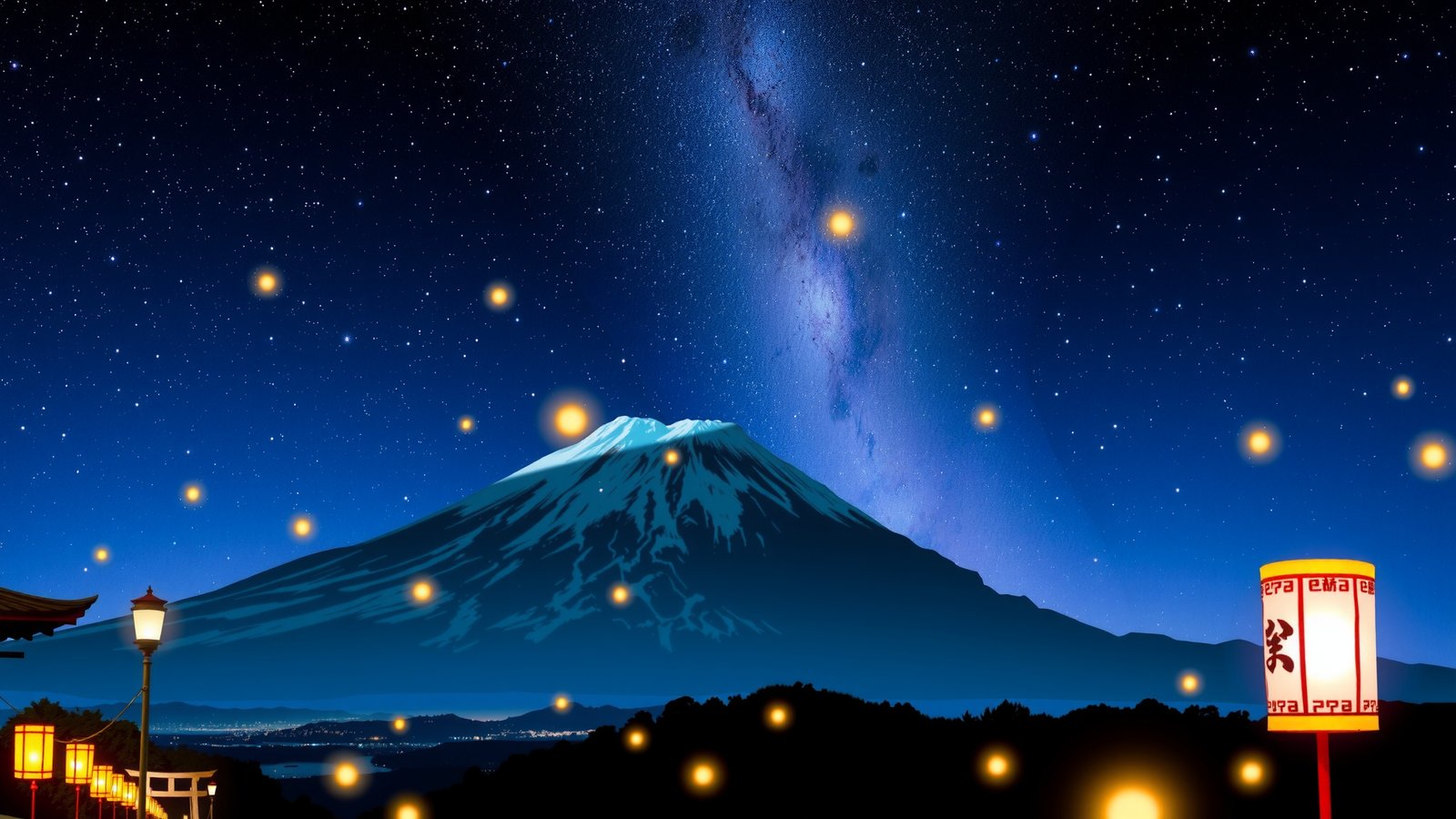
Companion article for “Fuji and the Milky Way (432Hz),” “Summer Festival Lanterns (528Hz),” and “Fireworks and the Cosmos (963Hz)” — a seasonal hub
Summer in Japan and Frequency — Tasting Fuji’s Starry Sky, Festival Lanterns, and Fireworks Through Sound
The cicadas’ drone,
come evening,
gives way to the chirp of bell crickets.
Japanese summer holds
three scenes.
A quiet Milky Way,
lying beyond the silhouette of a mountain.
The warm glow of lanterns,
lighting a festival night.
And fireworks —
blooming for an instant across the sky,
then gone.
In this article,
we’ll trace those three scenes
alongside the symbolic meanings of
432Hz, 528Hz, and 963Hz —
tasting Japanese summer,
one sound at a time.
This article’s answer (in 3 lines)
Japanese summer holds three scenes — Mt. Fuji and the Milky Way (stillness), festival lanterns (joy), and fireworks (impermanence) — each loosely paired here with the symbolic meanings of 432Hz, 528Hz, and 963Hz. This article gathers three companion videos into one seasonal story and entry point. Neither the frequencies nor the cultural themes are presented as guaranteeing any measurable effect.
💎 Key takeaway
Japanese summer shows us stillness, joy, and impermanence — three very different feelings — all at once, through a mountain, a festival, and a firework.
30-Second Summary
- This article gathers three scenes of Japanese summer — Mt. Fuji and the Milky Way, summer festival lanterns, and fireworks — into a single seasonal hub
- 432Hz is one tuning standard for the note A, often described as “a tone that harmonizes with nature”
- 528Hz is perhaps the best-known Solfeggio tone, often called the frequency of “love,” “transformation,” and “joy”
- 963Hz is considered the highest tone in the Solfeggio system, associated with “return to source” and a cosmic perspective
- Fuji and the Milky Way ↔ stillness; festival lanterns ↔ joy and connection; fireworks ↔ impermanence and cosmic scale — three themes that loosely echo the three frequencies
- The fleeting bloom of a firework can be read alongside Japan’s long-standing aesthetic of mono no aware / impermanence
- This summer’s series also includes upcoming videos on toro nagashi (floating lanterns for Obon) and Tanabata, making this article the entry point (hub) for the whole series
- All of this is offered as symbolic framing, not a scientific claim of measurable effect
1. Touring Summer in Japan Through Three Frequencies — About This Article
MuZenCosmos has been running an ongoing series called
“Japan × Cosmos,”
layering Japanese culture over cosmic themes and frequency.
So far, we’ve explored companion articles on
Amaterasu, Kannon, the Great Buddha,
the katana, ninja, samurai, mandala, Shinto prayers, and the Heart Sutra —
Japan’s mythology, faith, and traditions.
This time, our subject is
the season of summer itself.
From late July through August,
the MuZenCosmos YouTube channel
will release three companion videos:
- Fuji and the Milky Way (432Hz)
- Summer Festival Lanterns (528Hz)
- Fireworks and the Cosmos (963Hz)
This article is the seasonal entry point (hub)
that gathers all three together.
Before or after watching each video,
we invite you to sit with
why each frequency was paired with each scene.
This summer’s series also includes
videos themed around toro nagashi
(floating lanterns for the Obon season)
and the traditional Tanabata festival,
both coming soon.
We’ll return to those
later in this article.
2. Fuji and the Milky Way — What Is 432Hz, and What Stillness Do the Mountain and Stars Teach
On a summer night in Japan,
step even a little away from city lights,
and you may see the Milky Way
lying beyond the silhouette of Mt. Fuji.
The mountain does not move.
It simply remains.
The stars, meanwhile,
trace a slow arc across the sky,
at a pace unchanged for tens of thousands of years.
This coexistence — something unmoving
alongside something quietly circling —
may be one of the quietest gifts
Japanese summer has to offer.
432Hz is one tuning
for the reference note A.
Today, most of the world’s orchestras
and instruments are tuned to
A=440Hz, the international standard (ISO 16),
but in 19th-century Italy,
composer Giuseppe Verdi
argued that A=432Hz
should be the national standard —
a tuning sometimes called “Verdi’s pitch.”
432Hz has also attracted numerology-style associations —
432 × 60 = 25,920, a number close to
the period of Earth’s axial precession —
and is sometimes described as
“the frequency that harmonizes with nature“
or “the frequency of the cosmos.”
To be honest with you:
there is no scientific proof
that 432Hz is superior to 440Hz.
Strictly speaking, 432Hz is not part of
the Solfeggio frequency system at all —
it is a tuning standard for instruments,
which places it on different footing
from 528Hz or 963Hz.
For more on this distinction, see our companion piece,
432Hz vs 440Hz: The Truth About Tuning.
Even so, gazing at Mt. Fuji —
a mountain that does not move —
alongside the slowly circling Milky Way,
while 432Hz plays softly in the background,
is, we believe, a fitting way
to symbolically taste
a sense of harmony with nature.
▼ We invite you to experience Fuji and the Milky Way alongside 432Hz in the companion video.
🎵 Listen Along with This Article
Experience this article’s theme through sound.
🔔 Subscribe to MuZenCosmos for new healing soundscapes.
3. Summer Festival Lanterns — What Is 528Hz, and How It Connects People to Each Other
The moment taiko drums
drift through the evening air,
the whole atmosphere shifts, just slightly.
The lanterns at a summer festival
are each, on their own, a small light —
but strung together, swaying,
they wash the whole festival street
in warm orange.
Children laughing in yukata,
the smell of festival food stalls,
the circle of the bon dance —
a summer festival is not something
one person can complete alone.
It becomes a festival
only because people gather,
and stay together.
528Hz is perhaps
the best-known tone
in the Solfeggio frequency family,
often called the “love frequency“
or the “transformation frequency.”
Some modern proponents have linked it
to DNA repair —
a claim that is not scientifically established.
For the fuller science-and-symbol treatment, see
528Hz: The Meaning and History of the Frequency of Love and Harmony.
Here, we don’t frame 528Hz as
“a tone that repairs all things,”
but rather as
“a tone that symbolizes connection between people” —
paired here with the glow of festival lanterns.
Just as each lantern is small on its own,
yet together lights up the whole night —
528Hz, too, is offered here
not as a tone that completes something within one person alone,
but as one that finds its meaning through connection with others.
▼ We invite you to savor summer festival lanterns alongside 528Hz in the companion video.
🎵 Listen Along with This Article
Experience this article’s theme through sound.
🔔 Subscribe to MuZenCosmos for new healing soundscapes.
4. Fireworks and the Cosmos — What 963Hz Effects Are Said to Be, and What Impermanence a Single Instant Can Teach
A firework is
most beautiful
the moment it blooms —
and in that same instant,
it is already
carrying its own disappearance.
A great flower opens across the night sky,
and seconds later,
there is nothing left where it was.
Japan holds a long-standing aesthetic
known as mukojō, or impermanence.
Kamo no Chōmei opened his Hōjōki with the line:
“The flowing river never stops, and yet the water passing, moment to moment, is never the same.”
Everything changes.
No two moments are identical.
Fireworks may be
one of the most visually direct expressions
of this sense of impermanence.
963Hz is considered
the highest tone
in the modern Solfeggio frequency system.
Within that tradition, 963Hz has been described as connected to:
- The crown chakra (the energy center at the top of the head)
- “Returning to source“
- A connection to cosmic consciousness
Claims of 963Hz effects —
that it “awakens consciousness”
or “connects you to the cosmos” —
are not scientifically proven claims.
For more, see our companion piece,
963Hz: The Highest Tone and Its Cosmic Connection.
What matters here is pairing
the fleeting beauty of a firework
with the “broader perspective“
that 963Hz is said to symbolize.
Each individual firework is brief —
but seen from the vantage point
of the whole night sky,
and beyond that, the cosmos itself,
that very brevity can emerge
as a beautiful way of being.
That is the poetic pairing
this chapter offers.
▼ We invite you to experience fireworks and the cosmos alongside 963Hz in the companion video.
🎵 Listen Along with This Article
Experience this article’s theme through sound.
🔔 Subscribe to MuZenCosmos for new healing soundscapes.
5. Three Summer Scenes × Frequency Correspondence Table — Stillness, Joy, and Impermanence
Per our v2.6 structural rule,
here is a comparison table mapping
Japan’s three summer scenes
to their symbolic tuning/Solfeggio associations.
| Summer Scene | Frequency (as symbol) | Symbolic Theme | In a Word |
|---|---|---|---|
| Fuji and the Milky Way | 432Hz (symbol of tuning / harmony with nature) | Stillness — the unmoving and the ever-circling | What the mountain and stars teach: “calm” |
| Summer festival lanterns | 528Hz (symbol of transformation / love) | Joy — connection between people | What the light draws in: “warmth” |
| Fireworks and the cosmos | 963Hz (symbol of return to source / cosmic consciousness) | Impermanence — a shift toward the wider view | What a single instant teaches: “expansiveness” |
This mapping is offered strictly as a poetic aid, not as a claim of medical or paranormal effect.
6. Five Habits for Spending Summer Nights With Sound — How to Listen to 432Hz, 528Hz, and 963Hz
A few practical suggestions:
- On a cooling evening: play 432Hz, picture Mt. Fuji and the Milky Way, and simply sit quietly for a while
- While looking at festival photos or memories: play 528Hz, and think of the people you’ve seen this year — or hope to see soon
- After a fireworks show: play 963Hz, and reflect on the light that vanished — beautiful precisely because it was brief
- Don’t chase perfect silence: let the hum of a fan or air conditioner, or distant festival drums, remain part of summer’s soundscape
- On a weekend, listen to all three in sequence: 432Hz → 528Hz → 963Hz, tracing summer’s arc from “stillness” to “joy” to “impermanence”
These are offered as relaxation practices,
not as guarantees of any therapeutic outcome.
7. Toward Toro Nagashi and Tanabata — Summer’s Story Continues
Fuji and the Milky Way.
Summer festival lanterns.
Fireworks and the cosmos.
These three videos
are not the end of the story.
MuZenCosmos is also preparing a video
themed around toro nagashi
(floating lanterns released during the Obon season),
and another themed around the traditional
Tanabata festival —
the story of the Weaver Star and the Cowherd Star —
both coming soon.
Toro nagashi will be paired
with a frequency symbolizing
“letting go,”
and Tanabata with one symbolizing
“reunion and connection.”
When those videos are released,
we’ll introduce them here,
or in a new companion article.
Japanese summer, we’ve come to feel,
is a season made of
many overlapping stories
that no single scene can fully tell.
If themes of cosmic consciousness resonate with you,
you may also enjoy
Accessing Cosmic Consciousness.
And if you’d like a fuller introduction to Solfeggio frequencies themselves, see our
Solfeggio Frequencies: The Complete Beginner’s Guide.
8. What Can and Cannot Be Said — An Honest Approach to Summer Scenes and Frequency
Here is the honest line MuZenCosmos holds to.
What can be said
- Mt. Fuji and the Milky Way, festival lanterns, and fireworks are all real scenes and events of Japanese summer
- “Impermanence” (mukojō) is a long-standing aesthetic in Japanese culture, rooted in works like the Hōjōki, and fireworks are often described symbolically in this light
- Within Solfeggio tradition, both 528Hz and 963Hz carry established symbolic associations
- 432Hz is a real historical tuning standard, supported over the centuries by musicians including Verdi
- Quiet listening time itself is associated, in some research, with relaxation benefits
What cannot be said
- There is no scientific proof that 432Hz is superior to 440Hz
- The claim that 528Hz “repairs DNA” has not been scientifically verified
- There is no scientific proof that listening to 963Hz “awakens consciousness” or “connects you to the cosmos”
- There is no direct historical link between fireworks, festivals, Mt. Fuji, and any of these frequencies
- Music or frequency cannot guarantee good fortune or the fulfillment of wishes
9. Japanese Summer as a Living Tradition — Not a Passing Trend
Summer festivals, fireworks displays,
and the toro nagashi lantern release held during Obon
are not events created for tourism.
They are traditions
carried on, region by region, for decades — often centuries.
The practice of watching Mt. Fuji
alongside the Milky Way
has also long been cherished
among climbers and local residents alike.
In writing about these summer scenes,
we’ve made a point
to avoid caricature or sensationalism,
and to treat this season and its traditions
with the respect they deserve.
If you’re interested in Japanese mythology and faith more broadly,
we hope you’ll also enjoy our earlier “Japan × Cosmos” articles
on Amaterasu, Kannon, the Great Buddha, and others.
10. Consider a Hypothetical Scenario (Illustrative Example Only)
Imagine, for example, someone
who has missed two consecutive Japanese summers
due to a long-term work posting overseas.
Out there, it can be hard to notice
the seasons changing —
some years, you might realize summer had already ended
without noticing it had started.
In a situation like that,
coming across
a “Fuji and the Milky Way” video
might bring something back.
Hearing 432Hz
while watching footage of Mt. Fuji
could suddenly bring back
the memory of Japanese summer —
the cicadas, the smell of sparklers.
Going on to watch
“Summer Festival Lanterns” and
“Fireworks and the Cosmos” as well,
and making it a habit
to play all three on weekend evenings,
could feel like the music
bringing the season back —
and might even spark a thought like,
“next year, I really will go home.”
For someone living far from home,
the idea of fireworks —
beautiful precisely because they’re brief —
can resonate in a very personal way.
11. Frequently Asked Questions
Q1. What is 432Hz?
432Hz is one tuning for the reference note A. Today’s international standard is A=440Hz, but the A=432Hz tuning proposed by Verdi in the 19th century is often described as “a tone that harmonizes with nature.” There is no scientific proof that it is superior.
Q2. Why is 528Hz called the “love frequency”?
Modern proponents linked it to imagery of transformation, love, and repair. Claims about DNA repair are not scientifically verified, and the honest approach is to treat this as symbolic language.
Q3. What effects is 963Hz said to have?
Within Solfeggio tradition, it’s associated with the crown chakra, “return to source,” and cosmic consciousness. These are not scientifically proven effects — they’re offered here as symbolic associations.
Q4. When can you see Mt. Fuji and the Milky Way together?
Generally, the sky is clearest and the Milky Way easiest to observe around new moons in July and August. Since visibility depends heavily on weather and location, please read this article as a symbolic pairing of scenery and sound rather than a stargazing guide.
Q5. What do the lanterns at a Japanese summer festival mean?
They’re part of traditions carried out by local communities, often tied to gratitude toward ancestors or deities, and prayers for a good harvest. The glow of the lanterns is often described symbolically as illuminating the connection between people.
Q6. Is it true that fireworks symbolize impermanence?
Fireworks themselves carry no inherent religious meaning, but their quality of “blooming for an instant, then vanishing” is frequently paired, in cultural commentary, with Japan’s long-standing sense of impermanence, as expressed in works like the Hōjōki.
Q7. Are 432Hz, 528Hz, and 963Hz all part of the same Solfeggio system?
Not strictly. 528Hz and 963Hz belong to the modern Solfeggio frequency system, while 432Hz is a tuning standard for the note A — a different kind of frequency altogether. This article presents all three together as symbols, while being clear about that distinction.
Q8. Where can I watch the three videos featured in this article?
They’re being released on the MuZenCosmos YouTube channel from late July through August. Each is embedded at its corresponding section of this article.
Q9. Will there be videos about toro nagashi or Tanabata too?
Yes — both are planned as part of this summer’s series and are coming soon. We’ll introduce them here, or in a new article, once they’re released.
Q10. Does simply listening to these sounds guarantee a scientific effect?
No. MuZenCosmos highlights research suggesting that quiet listening time itself is associated with relaxation, while being careful not to overstate the symbolic meanings of frequency as proven effects. These pairings are offered as a poetic way of experiencing the season, not a guarantee.
12. Conclusion — Stillness, Joy, Impermanence: Three Sounds for a Summer Night
Picture, once more,
a summer night.
The quiet Milky Way,
lying beyond Mt. Fuji.
The warm glow of lanterns,
lighting a festival street.
And fireworks,
blooming for an instant across the sky,
then gone.
These three scenes teach
three very different feelings:
stillness, joy, and impermanence.
And yet, all three
can exist within
the very same summer night.
If you sense summer
outside your window tonight —
let 432Hz settle your day into stillness,
let 528Hz bring someone to mind with warmth,
and let 963Hz open a wider view,
so that you can hold
even a little tenderness for the fleeting.
Japanese summer is a season
that holds
stillness, joy, and impermanence
all at once.
And this story
is not finished yet —
it continues on,
toward toro nagashi,
and toward Tanabata.
References
- Kamo no Chōmei, Hōjōki, 1212 — a classical work embodying Japan’s aesthetic of impermanence, opening with “the flowing river never stops”
- Motoori Norinaga, Shibun Yōryō, 1763 — a work of literary theory articulating the aesthetic of mono no aware
- ISO 16:1975, Acoustics — Standard Tuning Frequency (Standard Musical Pitch) — the acoustic standard establishing A=440Hz internationally
- Jonathan Goldman, Healing Sounds: The Power of Harmonics, Healing Arts Press — on sound, overtones, and healing culture
- Joachim-Ernst Berendt, Nada Brahma: The World Is Sound, Destiny Books — a foundational work on sound and cosmology
MuZenCosmos — Where the Cosmos Meets Stillness | Stillness, Joy, Impermanence: Three Sounds for a Summer Night
🎵 Listen Along with This Article
Experience this article’s theme through sound.
🔔 Subscribe to MuZenCosmos for new healing soundscapes.
This article does not guarantee any medical or health benefit and is not a substitute for professional medical care. If you have any health concerns, please consult a physician or other qualified professional.