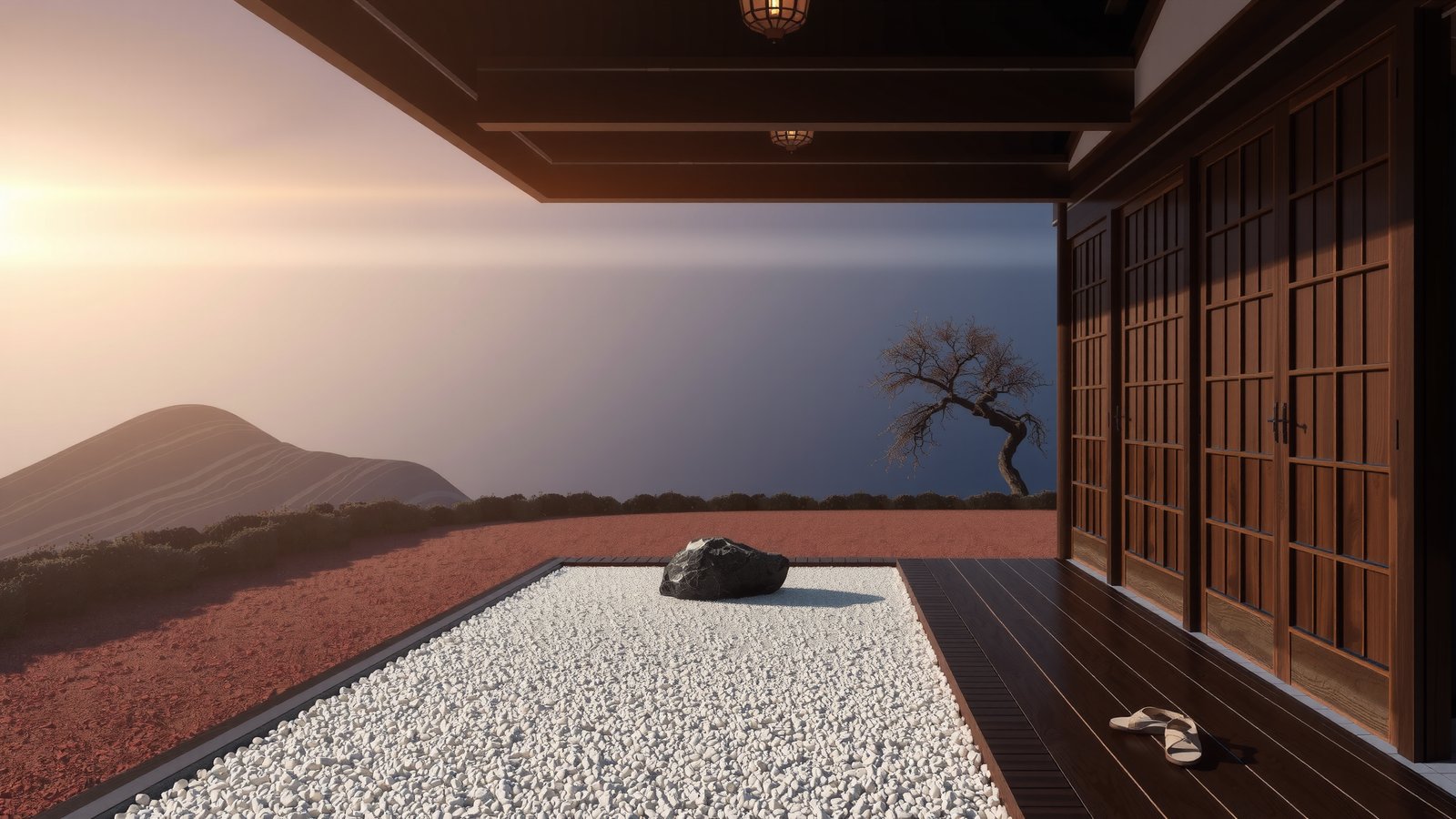
The moment
you pass through
the gate,
the volume
drops by one step.
Some places
do this.
The traffic is
still there.
The voices are
still there.
But
you are hearing them
differently.
A Zen temple
is a device
for exactly that.
For nearly a thousand years,
these places have been
engineering the way
a person goes quiet
using nothing but
architecture and stone.
Which is why
visiting them
is not about
counting famous sites.
It is about
finding out how quiet
you are able to get.
💎 The One Line That Holds This Article
A Zen temple is not a place to look at. It is a place that measures how still you can become.
The Answer, in Three Lines
Japanese Zen runs in three schools — Rinzai, Sōtō and Ōbaku — and their temples genuinely feel different. If it is your first time, book a temple that opens its zazen sessions to the public (Kyoto and Kamakura have many). Looking at the garden is worth doing on its own, but sit for fifteen minutes and the same garden becomes a different garden.
The 30-Second Summary
- The point of visiting Zen temples is not the buildings — it is learning how you personally go quiet in that space
- Japan has three Zen schools: Rinzai (Eisai), Sōtō (Dōgen) and Ōbaku (Ingen). Gardens, sitting posture, even the food differ
- Rinzai uses kōan and sits facing inward, toward each other. Sōtō sits facing the wall, “just sitting.” That is the first fork in the road
- In Kyoto — Tenryū-ji, Kennin-ji, Nanzen-ji, Ryōan-ji; in Kamakura — Kenchō-ji, Engaku-ji. All hold public sessions or events (always confirm dates on the temple’s official site)
- A dry landscape garden is not a scene reproduced. It is a scene with the water removed — a garden about what is absent
- At Eiheiji in Fukui you can stay overnight and enter part of the monastic daily schedule
- Public zazen usually runs 30 minutes to an hour, with beginner instruction. Ordinary comfortable clothing is fine
- Photography rules, silence rules and hours vary by temple. Remember one thing — these are working monasteries — and you will not go far wrong
- Season and hour change everything. Arriving at opening time is the single most effective choice you can make
- But visiting a Zen temple does not solve anything. The place is only a trigger
1. What Zen Temple Visiting Actually Is — Between Tourism and Worship
People who come to Zen temples
tend to arrive
with one of
three faces.
The tourist.
The worshipper.
And the person who is
neither.
That third one
is, I suspect,
the largest group.
No belief
to speak of.
And yet
not quite able to treat
the place as scenery.
Taking photographs,
and somehow
uneasy about it.
That in-betweenness
is not something
to apologize for.
Zen is a form of Buddhism
that
does not begin
with believing.
Sit first.
Understanding
can come later,
or not at all.
By that standard,
walking through a gate
without knowing why
is already
a rather Zen thing
to do.
For the sitting itself,
the previous article in this series —
Zazen: A Complete Introduction
— covers the practice.
This one is
the map for
taking it outside.
2. What Makes a Zen Temple Different — The Layout Is the Philosophy
Zen temples
are built
in a straight line.
Sanmon gate → Buddha hall → Dharma hall.
Straight up
from the approach.
Little ornament.
The colors are
wood, earth
and roof tile.
This is not
a matter of taste.
It is doctrine.
Where esoteric Buddhism moved
toward saturating a space
with color and sound —
covered in
Esoteric Buddhism and Shingon
— Zen moved
in the direction of
taking things away.
There is also one building
only Zen temples have:
the sōdō, the monks’ hall,
where they sit, eat
and sleep.
And it belongs to
the three halls of silence:
the monks’ hall,
the bath,
and the toilet.
In those three places,
no one speaks.
What is striking is that
the list includes
the bath and the toilet.
Zen does not accept
that practice happens
only in designated hours.
The places where you
let your guard down
are precisely
where the practice is.
3. Rinzai, Sōtō and Ōbaku — The First Fork in the Road
“Zen temple” sounds like
one category.
There are three schools,
and
they feel
noticeably different.
| Rinzai | Sōtō | Ōbaku | |
|---|---|---|---|
| Brought to Japan by | Eisai (1141–1215) | Dōgen (1200–1253) | Ingen Ryūki (1592–1673) |
| Period | Early Kamakura | Early Kamakura | Edo period (arrived 1654) |
| Principal temples | Kennin-ji, Nanzen-ji, Myōshin-ji, Daitoku-ji, Kenchō-ji, Engaku-ji | Eiheiji (Fukui), Sōji-ji (Yokohama) | Manpuku-ji (Uji, Kyoto) |
| Core practice | Kōan — sitting with a question | Shikantaza — just sitting | Sitting combined with nenbutsu chanting |
| Which way you face | Inward, toward each other | Toward the wall | Ming-dynasty Chinese style |
| Garden character | Dry landscape; composed, sharp | Plain, minimal ornament | Chinese in feel, with color |
| Food culture | Shōjin cuisine, ancestor of kaiseki | The tenzo (cook) tradition | Fucha ryōri — Chinese-style vegetarian |
If you cannot decide,
use this:
Want to bring a question?
Go to a Rinzai temple.
Want to bring nothing at all?
Go to a Sōtō temple.
Want to be startled?
Go to Manpuku-ji.
Ōbaku temples look
visibly foreign
among Japanese temples —
the curve of the roofs,
the window shapes,
the enormous wooden fish
struck to mark the hours.
The surprise Edo-period visitors felt
is still sitting there,
unchanged.
4. Kyoto — The Five Mountains, and a Garden Made of Stone
Kyoto holds
the highest density
of Zen temples
anywhere on earth.
In the Muromachi period
the shogunate ranked them:
the Five Mountains of Kyoto —
Tenryū-ji, Shōkoku-ji, Kennin-ji,
Tōfuku-ji, Manju-ji.
Nanzen-ji was placed
above the five,
in a category of its own.
For a first visit,
choose three temples with
different personalities.
| Temple | School | What to see | The quality of its silence |
|---|---|---|---|
| Kennin-ji | Rinzai, Kennin-ji branch | Kyoto’s oldest Zen temple (1202); Wind and Thunder Gods screen (reproduction on display); the ○△□ garden | In the middle of the city, yet time runs slower inside |
| Ryōan-ji | Rinzai, Myōshin-ji branch | The rock garden — fifteen stones — and Kyōyōchi pond | Crowded, but another world at opening |
| Tenryū-ji | Rinzai, Tenryū-ji branch | Musō Soseki’s Sōgenchi garden, borrowing Arashiyama as backdrop | A silence that opens outward |
The rock garden at Ryōan-ji
is the most famous
dry landscape garden
in the world.
Fifteen stones,
arranged so that
from any viewpoint,
one stays hidden.
Many books explain this
as a symbol of
incompleteness.
But we do not reliably know
who made it,
or exactly when.
It has been looked at
for five hundred years
without that being settled.
Which is, I think,
more Zen
than any explanation.
5. Kamakura — The Valley Where Japan First Sat Down
If Kyoto is Zen
completed,
Kamakura is Zen
beginning.
Japan’s first full
Zen monastery is
Kenchō-ji (1253),
founded by
Lanxi Daolong,
who came from China.
Japanese Zen, in other words,
started
in a foreign voice.
Engaku-ji (1282)
was built to memorialize
the dead of the Mongol invasions —
both sides,
without distinction.
That phrase — without distinction —
may be the truest summary
of what Zen brought
to this country.
The geography matters here.
Kamakura’s temples sit in yatsu,
narrow valleys closed on
three sides by low hills.
The wind stops
at the back of them.
Not Kyoto’s
expansive stillness, but
a stillness that is
enclosed and sheltered.
Both Kenchō-ji and Engaku-ji
hold regular public zazen sessions
(confirm schedules officially before going).
On walking as practice, see
Walking Meditation
.
In Kamakura the temples are
within walking distance of each other,
so the moving between them
can become part of the practice.
6. Staying at Eiheiji — One Night Inside a Training Monastery
In the mountains of Fukui
stands Eiheiji,
founded by Dōgen
in 1244.
It is not a
sightseeing temple.
Several hundred
unsui — training monks —
still live their
full daily schedule there.
Overnight stays (sanrō)
are possible
by reservation
(availability and conditions change; check official information).
Roughly:
- Arrive by late afternoon; receive instruction on conduct
- Yakuseki — the evening meal, vegetarian
- Evening zazen
- Lights out early — around 21:00
- Wake around 3:30–4:00 a.m.
- Gyōten zazen — sitting before dawn
- Chōka — attending morning sutra chanting
- Breakfast, then down the mountain
The hardest part
is not the sitting,
and not the hour.
It is
the length of time
without a phone.
For a modern person,
that may be the single
least familiar
discipline in the building.
On longer silence, see
Meditation Retreats
.
7. How to Read a Dry Landscape Garden — Looking at What Is Missing
A karesansui garden
makes a water landscape
without water.
White gravel is
water.
Stones are
islands, or
mountains.
The raked lines are
waves.
Every guidebook
says this much.
But the real interest
is not there.
It is that
the water
is missing.
Water in a garden
is a luxury.
It makes sound.
It reflects light.
It carries the season.
The dry landscape garden
removed the single most
pleasurable element.
And by removing it,
the water appears
inside the person
looking.
That is the invention.
Three practical notes:
- Sit down to look. Most of these gardens are composed for the eye height of someone seated on the veranda. Walking past, you are outside the intended frame
- Pick one point and hold it. Do not try to see the whole. Choose a single stone. After a while, the rest begins to move
- Stay fifteen minutes. Three minutes will not open it. Most visitors leave after five — simply remaining changes what you see
8. Your First Public Zazen Session — The Flow, and the Etiquette That Isn’t Scary
“I don’t know the etiquette”
is the number one reason
people never go.
You can relax.
Public sessions are built
on the assumption
that you don’t know.
Roughly how it goes:
- Reception — usually free to about ¥1,000. Reservations are increasingly required
- Instruction — posture, hand position, how to receive the stick
- Entering the hall — bow with palms together, take a seat quietly
- Sitting — one round is typically 15–25 minutes; some temples do two
- Kinhin — slow walking between rounds
- A short talk by the priest. For some visitors this is the best part
- Leaving — bow, and go out quietly
About the kyōsaku,
the stick on the shoulder.
It is not
a punishment.
At most temples you
request it yourself
with a bow.
Meaning: if you don’t ask,
it doesn’t happen.
Ordinary comfortable clothes
are fine.
But you will be
crossing your legs,
so tight skirts, slim trousers
and thick belts
make it harder than it needs to be.
Socks are usually
kept on,
though some temples specify.
And the one genuinely
important rule:
do not arrive late.
The silence begins
the moment the session does.
Walking in afterward
breaks it
for everyone.
9. Other Ways In — Copying Sutras, Temple Food, Tea
If sitting still feels
like too much,
Zen temples have
several other doors.
- Shakyō (sutra copying) — the easiest entry point. Trace the Heart Sutra with a brush. Usually ¥1,000–2,000, sometimes without reservation. With the hands occupied, the mind settles more easily
- Shōjin cuisine — no meat, no fish. In Zen, cooking is practice; Dōgen wrote an entire text of instructions for the tenzo, the monastery cook
- Fucha ryōri — the Chinese-style vegetarian meal of the Ōbaku school, served on shared platters. Surprisingly convivial
- Tea — it was Eisai, founder of Japanese Rinzai, who spread tea drinking in Japan. A bowl of matcha at a Zen temple is part of that history
- Just looking at the garden — also a completely legitimate door
Sutra copying is easier
than zazen.
That is simply true.
When the hands
have work,
people become
quiet.
10. Choosing Season and Hour — The Same Temple Becomes a Different Temple
The single most effective
variable in visiting Zen temples
is when you go.
| When | Character | Best for |
|---|---|---|
| Opening time | Fewest people; cold air, distant sound | Anyone whose goal is silence (most recommended) |
| Rain / rainy season | Moss and stone darken and deepen; crowds thin | Garden viewers |
| Autumn colors (November) | Overwhelmingly beautiful, overwhelmingly crowded | Scenery seekers |
| Deep winter (Jan–Feb) | Bitterly cold floors; zazen gets serious | Practitioners |
| Late afternoon | Low light, long shadows, thinning crowds | Photographers |
If you have
only one day,
go at opening.
The rock garden at Ryōan-ji
at 8 a.m. and at 2 p.m.
is not the same garden.
Silence, it turns out,
can be bought
with timing.
11. Conduct and Cautions — These Are Living Monasteries
Let me draw
the lines clearly.
Please do
- Remember these are working monasteries. People still live and train in most of them
- Check posted photography rules. Interiors, Buddha images and monks’ halls are usually off limits; some temples permit gardens only
- Keep silence in the three silent halls — and quietly elsewhere too
- Respect closing times. Arriving just before the gate closes disrupts the staff closing up
- Rules on shoes, food and smoking vary. Follow the signage
Common misunderstandings
- Visiting a Zen temple does not produce enlightenment. It is a trigger, not a mechanism
- Zazen is not “making the mind blank.” Thoughts arriving is normal
- Sutra copying is not calligraphy. Skill is irrelevant
- Enduring pain is not the practice. If your legs go numb, shift position
Health notes
- If you have knee, hip or lower back trouble, look for temples offering chair zazen — many do
- Long periods of seiza can cause numbness and falls when standing. Do not push through
- Winter halls are genuinely cold. Layers and thick socks
- Avoid long retreats during periods of psychological instability, and consult a professional if needed
12. Zen Temples and the Cosmos — On the Act of Placing a Stone
Now beyond
what science covers.
Standing before
a dry landscape garden,
something strange
happens.
You lose the scale.
The stone in front of you
might be fist-sized.
It might be
a mountain.
The gravel might be gravel.
It might be
an ocean.
It might be
a galaxy.
That ambiguity is
not a failure.
It is deliberate
empty space
left by the designer.
Human beings have long
placed something small
in order to say
something enormous.
Esoteric Buddhism
painted mandalas.
Zen
placed stones.
Different methods,
identical move:
build a scale model
of the world,
and sit in front of it.
And the decisive part —
the person sitting
becomes part
of the model.
You believe you are
looking at the garden
from outside,
and at some point
you are inside it.
It is very close to
what happens
looking up
at a night sky.
Perhaps the reason these gardens
still make people quiet
is not only that they
are beautiful.
You lose track
of your own size.
Which also means
losing track of
the size of
your problems.
The wider view is in
The Complete Guide to Spirituality
.
13. Before You Go — A Five-Point Checklist
Confirm these
before leaving.
- Can you sit in what you’re wearing? You will cross your legs, so stretchy trousers or a loose skirt are ideal. Thick belts, tight denim and short hemlines make public zazen genuinely uncomfortable. Wear shoes you can slip on and off — Zen temples involve far more entering and exiting than you expect, and laces get old fast
- Did you pack thick socks? Temple floors are cold year-round and brutal in winter; some halls forbid bare feet. A spare pair in the bag pays for itself on a rainy day
- Did you confirm the zazen schedule officially? Most temples now require reservations. Specific weekdays, once-monthly sessions and hard cut-off times are normal. Check the temple’s own site or phone line — not an old social media post
- Do you have cash? Admission, sutra-copying fees and offerings are still cash-only at many temples. Bring coins. The same goes for goshuin seals
- Is your schedule too full? Three temples a day, maximum. From the fourth onward, nothing stays with you. Fifteen minutes of sitting at one temple leaves a deeper mark than walking through five
Travel light.
Plan less.
It is the only reliable
technique here.
About This Article (Disclaimer & Advertising Notice)
This article is informational content introducing the history, culture and practical logistics of Japan’s Zen temples. It is not medical advice, psychotherapy, or religious solicitation. Nothing here regarding zazen, sutra copying or temple stays is intended to guarantee improvement in illness, symptoms, relationships or finances, and individual experience varies. If you have knee, hip or lower back conditions, or are under medical care, choose a posture that does not strain you and consult your physician as appropriate. Avoid extended temple stays or silence during periods of psychological instability. Temple hours, admission fees, zazen schedules, photography rules and overnight availability change — always confirm current official information before visiting. This article does not encourage affiliation with, or donation to, any particular school or temple.
[Advertising Notice] This article may in future contain affiliate links. Purchases made through such links incur no additional cost to readers.
14. Consider, for Example, a Situation Like This
To make it concrete,
imagine one general scene
(this is a deliberately fictional, generalized example, not anyone’s actual account).
Suppose someone takes
half a day off work
on a weekday
to attend a public zazen session
for the first time.
The night before,
they nearly cancel
several times.
They don’t know the etiquette.
They’ll stand out.
And anyway —
what is this
supposed to accomplish?
They go anyway.
Inside the hall,
a handful of people
already seated.
All ages,
all kinds of clothing,
and nobody
looks up.
They sit.
The bell sounds.
And
the first five minutes
are regret.
The legs hurt.
The breath is shallow.
The head is entirely full of
an email that was supposed
to go out this morning.
Ten minutes in,
still loud.
Around fifteen minutes,
the outside sounds
come back.
A bird.
Wind.
A car somewhere.
All of it audible
when a moment ago
it was not.
What is happening here
is not mystical.
The volume of the thinking
has dropped,
that’s all.
But the difference
is unmistakable.
The bell sounds.
The session ends.
Standing up,
the legs are numb.
Nothing has been
solved.
Only this: walking back out
through the gate,
the sound of the street
is slightly further away
than it was going in.
That is usually
the whole of what
a Zen temple sends home with you.
And it lasts
considerably longer
than you would expect.
This article does not guarantee any medical or health benefit and is not a substitute for professional medical care. If you have any health concerns, please consult a physician or other qualified professional.
📚 Related Articles
- Esoteric Buddhism & Shingon: A Complete Introduction | Kūkai, Mandalas, Mantras and “Buddhahood in This Very Body”
- Zazen: A Complete Introduction | How to Sit, What to Do If You Can’t Cross Your Legs, and How It Differs from Meditation
- Taisetsu and 963Hz | The Season the Sky Closes — Japan’s Solar Term of Great Snow and the Highest Frequency
- Shousetsu and 285Hz | The Season the Rainbow Hides — Japan’s Solar Term of Small Snow and Quiet Repair
FAQ (10 Questions)
Q1. Can I visit Zen temples without being a believer?
Entirely. Zen is a tradition that does not start from belief — you sit first, and understanding comes later or not at all. Public zazen sessions are normally open regardless of faith. The only thing asked of you is respect for the fact that people still train there.
Q2. Rinzai or Sōtō — which should a beginner choose?
Rough guide: Sōtō if you want to just sit (facing the wall, shikantaza), Rinzai if you want to bring a question (kōan practice, sitting facing inward). That said, for a first visit, choose by convenience and schedule rather than school. If it doesn’t suit you, try the other one next time.
Q3. Do zazen sessions need reservations, and what do they cost?
Reservations are increasingly required. Cost is typically free to about ¥1,000, sometimes plus separate admission. Schedules, cut-off times and capacity vary enormously between temples and do change — always confirm on the temple’s official site or by phone before going.
Q4. I’m nervous about being struck with the stick.
At most temples the kyōsaku is given only to those who request it with a bow. It is not punishment but a way of resetting drowsiness or drift. If you don’t ask, it won’t happen. If you’re unsure, ask during the pre-session instruction.
Q5. My legs hurt and I can’t cross them. Can I still take part?
Yes. Many temples provide chair zazen, and some permit kneeling benches or a simple cross-legged posture. If you have knee, hip or back problems, mention it when you reserve. Enduring pain is not the practice.
Q6. How am I supposed to look at a dry landscape garden?
Sit on the veranda and lower your eye line — most are composed for exactly that height. Don’t try to take in the whole thing; choose a single stone, and the surroundings begin to move. And stay fifteen minutes. Three minutes will not open it.
Q7. Can I stay overnight at Eiheiji?
There is an overnight system called sanrō (reservation required). You join part of the schedule: evening meal, evening zazen, a 3:30–4:00 a.m. wake-up, pre-dawn zazen and morning chanting. It is not a hotel stay — you are entering a training monastery. Availability and conditions change, so check official information.
Q8. Should I start with sutra copying or zazen?
If in doubt, sutra copying. With the hands occupied, settling is easier than in zazen. Most temples charge ¥1,000–2,000, lend all materials, and place no value at all on your handwriting. Moving from copying to sitting later is a very natural sequence.
Q9. Can I take photographs at Zen temples?
It varies by temple and by area within it. Gardens permitted, interiors not, is the common pattern; monks’ halls and Buddha images are usually off limits. Check the signage, and when in doubt, don’t. Assume photography during a zazen session is not permitted.
Q10. Will visiting a Zen temple make my problems lighter?
No promises. There is no scientific evidence that visiting a temple resolves difficulties, and the effects of quiet environments and seated practice on mind and body rest on moderate evidence at best in meditation research. What many people do report is that the volume of the worrying drops a little. The place is only a trigger — but triggers matter.
Summary | Walking Back Out, the Street Sounds Further Away
We have covered
a great deal —
three schools,
the ranked Five Mountains,
how to read stone gardens,
the etiquette of sitting.
But in the end,
visiting Zen temples
teaches
exactly one thing.
The silence is not
in the place.
It is in you,
and the place
only reminds you.
Which means
that not being able to
get to Kyoto,
or never finding a session
that fits your schedule,
matters less
than you think.
Step through the gate
of the small temple
near where you live,
and stand there
for three minutes.
Something
of the same kind
still happens.
If you have half a day free
sometime soon —
go
at opening time.
No one is there yet.
The gravel has just been raked,
and the lines are
still perfectly
sharp.
Sit on the veranda,
choose one stone,
and stay
fifteen minutes.
Possibly
nothing will happen.
But walking back out
through the gate,
you will notice that
the sound of the street
is a little further away
than it was going in.
Seven hundred years ago,
someone sat on that
same veranda
and carried home
the same silence.
References
- Dōgen, Shōbōgenzō. English: Treasury of the True Dharma Eye, edited by Kazuaki Tanahashi, Shambhala, 2010. (The foundational Sōtō text — the source of “just sitting” and of treating all daily activity as practice.)
- D. T. Suzuki, Zen and Japanese Culture, Princeton University Press, 1959. (The classic account of Zen’s influence on Japanese art, gardens, tea and swordsmanship — the starting point for reading temple space.)
- Heinrich Dumoulin, Zen Buddhism: A History, Volume 2: Japan, World Wisdom, 2005. (The standard scholarly history of Japanese Zen, covering Eisai, Dōgen and Ingen.)
- François Berthier, Reading Zen in the Rocks: The Japanese Dry Landscape Garden, translated and with a philosophical essay by Graham Parkes, University of Chicago Press, 2000. (A philosophical reading of karesansui, including a careful survey of the competing theories about Ryōan-ji.)
- Shunmyō Masuno, Musō Soseki: The Zen Monk Who Perfected the Japanese Garden, NHK Books, 2005 (in Japanese). (The designer of Tenryū-ji and Saihō-ji, discussed by a contemporary Zen priest who is himself a garden designer.)
MuZenCosmos — Where the Cosmos Meets Silence | Walking back out, the street sounds further away