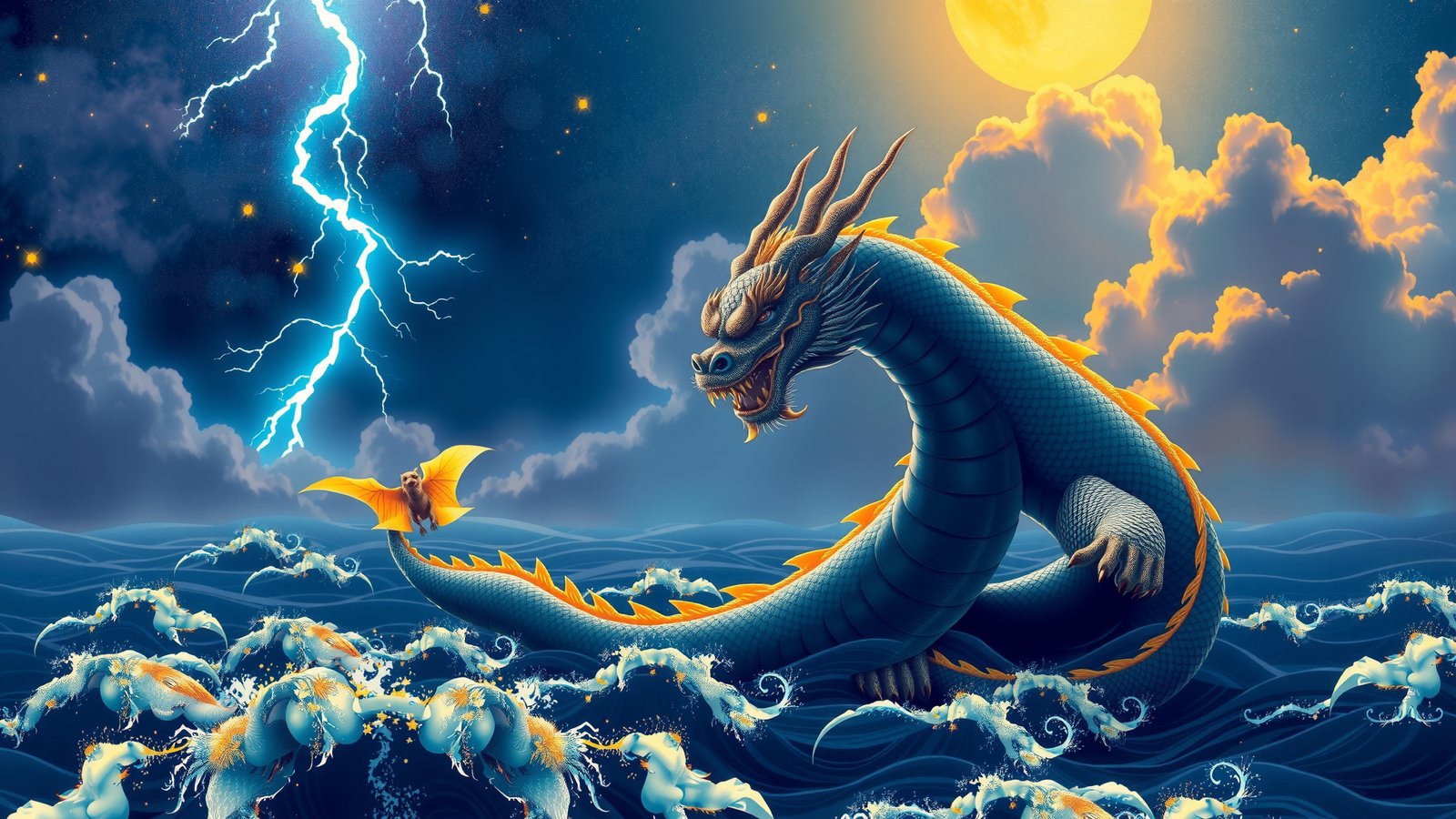
When the rain,
stopped falling for too long.
People looked up
to the sky.
Japan has always been
a country of water.
Water that feeds the rice fields.
Water that sustains life itself.
And the being long said
to govern that water
is called Ryujin (龍神) —
the dragon god.
Today we’ll also talk
about the number 888.
But first,
something needs to be said plainly.
**888Hz is not part of
the traditional nine-tone Solfeggio system.**
This article does not hide that fact.
Instead, it traces
**where the number 888
actually came from** —
and why it eventually got
attached to “abundance.”
The Answer, in 3 Lines
Ryujin is Japan’s ancient water deity, long prayed to for rain and harvest, and still honored at shrines today. 888Hz is not part of the traditional nine Solfeggio tones — the “abundance frequency” label emerged more recently from cultural associations with the number 8 (a lucky, “spreading” shape in Japan, a homophone for prosperity in Chinese, and the modern spiritual concept of “angel number 888”). This article treats that as an origin story, not a promise of wealth or luck.
💎 The Key Line of This Article
What Ryujin has always governed isn’t wealth that sits still — it’s abundance that keeps circulating, the way water does.
30-Second Summary
- Ryujin is Japan’s ancient deity of water, rain, and thunderclouds, long prayed to for rain and bountiful harvests
- Water deities like Kuraokami-no-kami appear in the Kojiki, at shrines such as Kifune Shrine in Kyoto
- Dragon-god worship overlaps with serpent worship and water-spirit belief, with distinct local legends across Japan
- 888Hz is not part of the traditional nine-tone Solfeggio system (174–963Hz)
- The number 8 has long carried lucky associations — its “widening” shape in Japan, and a prosperity-sounding homophone in Chinese
- The modern spiritual idea of “Angel Number 888” (symbolizing a cycle of abundance coming full circle) helped popularize calling 888Hz an “abundance frequency”
- This is an origin story, not a claim that listening to 888Hz brings wealth or luck
- There is no historical connection between Ryujin worship and the number 888
1. What Is Ryujin — Japan’s Ancient Water Deity
Ryujin is the deity
long believed to govern
water, rain, and thunderclouds
in Japan.
Often depicted as a serpent or dragon,
Ryujin held enormous significance
in an agricultural society
where rain was life itself.
When drought persisted,
crops withered
and communities suffered.
That is why people across Japan
turned to the dragon gods
said to dwell in deep pools,
waterfalls, and remote mountains,
offering prayers for rain.
Ryujin was never
a fantastical creature invented for entertainment.
It’s worth remembering, first,
that this has been
a being rooted in daily life and faith
for a very long time.
2. The Origins of Ryujin Worship — Water Deities in the Kojiki
The Kojiki records that when
Izanagi no Mikoto
slew the fire god Kagutsuchi,
among the deities born from that act
were water deities named
Kuraokami-no-kami
and Takaokami-no-kami.
The character “龗 (okami)”
is believed to mean “dragon,”
making these deities
one of the mythological origins
of Ryujin in Japan.
At Kifune Shrine in Kyoto,
these deities are enshrined,
and the imperial court historically
made it a site for both
rain-invoking and rain-stopping prayers.
Records suggest a black horse
was offered during droughts,
and a white horse
during prolonged rains —
evidence that Ryujin worship
was directly tied
to practical, everyday needs.
3. Dragon Legends Across Japan — Suwa, Hakone, and Enoshima
Ryujin legends take on
distinct local color
across Japan.
- Suwa Taisha (Nagano): Lake Suwa, said to be home to a dragon deity, is known for “Omiwatari,” a natural ice-cracking phenomenon interpreted as the passage of the gods
- Kuzuryu Shrine, Hakone (Kanagawa): a nine-headed dragon that once ruled Lake Ashi was subdued and later enshrined as its guardian deity
- Enoshima’s Five-Headed Dragon legend (Kanagawa): a raging five-headed dragon encounters the goddess Benzaiten descending from heaven, transforms, and becomes a guardian of the village and sea
- Niukawakami Shrine (Nara): an imperially-linked water shrine where black horses were offered during drought, and white or red horses during prolonged rain
What these stories share
is a structure in which
a raw, untamed force of nature
transforms into
a protective, generous presence
through encounter and relationship.
▼ We’ve prepared a video that lets you experience the world of Ryujin and 888Hz.
[VIDEO_PLACEHOLDER]
4. What Ryujin Symbolizes — Abundance as Circulation, Not Accumulation
Ryujin worship has endured
not simply because
dragons “bring rain.”
Beneath that,
it’s said,
lies a deeper insight
into the nature of water itself.
- Water never stays in one place — it becomes cloud, becomes rain, becomes river, returns to the sea
- Dragons are depicted as beings that move between sky and earth, water and thunder
- A good harvest was prayed for not as hoarded wealth, but as a blessing meant to circulate and be shared
- The raging dragon (flood, drought) and the generous dragon (rain, harvest) are told as two faces of the same being
This can be read as
the quiet wisdom of water-deity worship:
that true abundance isn’t
something to accumulate,
but something to keep circulating.
If you’re interested in themes of cosmic consciousness and manifestation,
see also our article on
5. What Is 888Hz — A Number Outside the Solfeggio System
Here, we need to be direct.
**888Hz is not part of
the traditional nine-tone Solfeggio system
(174, 285, 396, 417, 528, 639, 741, 852, 963Hz).**
If you’d like to understand
the Solfeggio system from its foundations,
see our
Beginner’s Guide to Solfeggio Frequencies.
For the basics of frequency itself,
our article
What Is Hz? An Introduction to Frequency
may also help.
The name “888Hz” didn’t emerge
from Solfeggio’s academic or traditional lineage —
it came from
a separate cultural current,
which we’ll trace carefully
in the next section.
6. What 888Hz Is Said to Do (Where the Evidence Actually Stands)
“Listening to 888Hz brings financial luck.”
“888Hz is the frequency of good fortune.”
You may have seen
claims like these.
But MuZenCosmos owes you
an honest account.
What is said (as an origin story)
- In Japan, the number 8 has long been considered lucky because its written form widens toward the bottom — a shape called suehirogari, symbolizing expanding prosperity
- In Chinese-speaking cultures, the pronunciation of “8” resembles the word for prosperity, making it a widely favored number
- In modern spiritual culture, “Angel Number 888” is often described as a symbol of “a cycle of abundance coming full circle”
- These layered associations with luck are, as far as can be traced, how a frequency bearing the digits 888 came to be called the “abundance frequency”
What cannot be claimed (not scientific fact)
- There is no scientific evidence that listening to 888Hz brings financial luck or good fortune
- The claim that 888Hz belongs to the traditional nine Solfeggio tones is factually incorrect
- Numerology is a cultural and symbolic framework — it does not guarantee any physical effect
In short, 888Hz is best understood
not as “a sound that attracts abundance,”
but as “a sound whose number happens to symbolize abundance.”
That distinction is the most honest way
to approach it.
7. The Symbolic Connection Between Ryujin and 888Hz
To be direct:
**there is no historical or textual connection
between Ryujin worship and the number 888.**
Ryujin worship traces back
to at least 712 CE, when the Kojiki was written —
and likely much earlier,
into the memory of agricultural societies.
The modern association of luck with 888,
by contrast,
is a product of
the angel-number culture that spread
in the late 20th and early 21st centuries.
The two emerged
from entirely different eras and cultures.
And yet,
when overlaid as narrative structures,
a gentle resonance appears.
- The water Ryujin governs = abundance that never stops circulating
- The shape of “8” (widening downward) = flow expanding from narrow to wide
- The “cycle coming full circle” of Angel Number 888 = the circulating blessing that Ryujin embodies
In other words, the reading that
“**just as the dragon circulates water,
the number 888 symbolizes an abundance that fills and cycles**”
is not an academic claim,
but one poetic thread connecting two symbols —
please receive it in that spirit.
8. Ryujin × 888Hz Symbolic Comparison Table — Four Angles on Origin and Limits
Following the v2.6 framework,
here is a comparison organizing fact, origin, symbolism, and limits.
| Perspective | Ryujin Worship | The Name “888Hz” | Honest Framing |
|---|---|---|---|
| Origin | Agricultural water-deity worship; water gods appear in the Kojiki | Modern spiritual culture, including angel numbers | Entirely different eras and cultures |
| Position in the system | Distinct local traditions within Shinto and folk belief | Not part of the traditional nine Solfeggio tones | 888Hz is a recently coined, derivative label |
| Symbolic theme | Circulating blessing, rain and harvest, a bridge between sky and earth | Suehirogari (expanding prosperity), a cycle reaching fullness | Both share the poetic thread of “circulating abundance” |
| What can be stated as fact | Rain rituals historically took place | 888Hz is sometimes called the “abundance frequency” as a cultural fact | Neither domain allows a claim about actual effects |
※ This comparison is offered strictly as a poetic thread, not a claim that Ryujin or any frequency guarantees financial luck or good fortune.
9. Spending Time With Ryujin and 888Hz — One Way to Bring the Symbolism Into Daily Life
Here is one concrete example.
- Near water: spend quiet time by a river, sea, or lake, reflecting on the “circulating water” that Ryujin has long governed
- While playing 888Hz: reframe abundance as something to let flow, rather than something to grasp
- Gratitude first: honor the order embedded in Ryujin worship — gratitude for blessings received, before any wish is made
- Don’t force meaning: simply enjoying the sound or the number itself is enough
These are offered as practices
for relaxation and reflection —
not as a guarantee of financial luck
or good fortune.
10. What Can and Cannot Be Said — An Honest Reckoning With Ryujin and 888Hz
Here is the honest line
MuZenCosmos holds to.
What can be said
- Ryujin worship is a real, ancient Japanese water-deity tradition tied to prayers for rain and harvest
- Shrines such as Kifune, Suwa Taisha, and Kuzuryu Shrine in Hakone are places where Ryujin is still actively worshipped today
- Both Japanese and Chinese cultures have long held lucky associations with the number 8
- It is a cultural fact that Angel Number 888 is widely discussed in modern spiritual culture as a symbol of abundance
What cannot be said
- It is factually incorrect that 888Hz belongs to the traditional nine Solfeggio tones
- There is no scientific proof that listening to 888Hz brings financial luck or good fortune
- There is no direct historical connection between Ryujin worship and the number 888
- Music, frequency, or number sequences do not guarantee financial luck or good fortune
11. The Cultural Background of Ryujin Worship — Rain Rituals and Gratitude, Still Practiced Today
Across Japan,
festivals and rituals
related to Ryujin
continue to this day.
The water festival at Kifune Shrine,
rain-invoking dances preserved in various regions,
and autumn festivals giving thanks for the harvest —
these are not relics of the past,
but **living traditions still woven
into local life**.
In presenting Ryujin in this article,
we want to reaffirm our commitment
to avoiding caricature or sensationalism,
and to introducing this belief
with the respect it deserves.
If you’d like a systematic overview of spirituality more broadly,
see our
Complete Guide to Spirituality.
12. Consider This Scenario (A Hypothetical Example)
Consider, for example, someone running a small business who feels stuck a few years into it, troubled by a persistent sense that “I’m working hard, but nothing seems to flow.”
Money, opportunities, connections — everything can feel stuck, and the harder one tries to grasp it, the worse it may seem to get.
In a moment like this, encountering the idea of Ryujin worship might resonate: the notion that water spills the moment you try to grip it, but flows properly on its own if you let it be.
From that point on, whenever the number 888 appears, it could serve as a small reminder: “flow, don’t grip.”
This isn’t about believing that 888Hz holds power to bring good fortune — it’s simply that seeing the number offers a moment to loosen one’s grip.
Over time, some people find they approach their work with noticeably less tension in their shoulders.
13. Frequently Asked Questions
Q1. What kind of deity is Ryujin?
Ryujin is Japan’s ancient deity of water, rain, and thunderclouds. In agricultural society, where rain meant life itself, Ryujin was worshipped across the country as the object of prayers for rain and abundant harvests.
Q2. Does Ryujin appear in the Kojiki?
Yes. Water deities named Kuraokami-no-kami and Takaokami-no-kami, born when Izanagi slew the fire god Kagutsuchi, are considered one origin of Ryujin. These deities are enshrined at Kifune Shrine in Kyoto.
Q3. What dragon legends exist across Japan?
Suwa Taisha’s Omiwatari phenomenon, the nine-headed dragon legend of Kuzuryu Shrine in Hakone, and the five-headed dragon legend of Enoshima are among many distinct local stories, sharing a common structure of a wild dragon transforming into a guardian through relationship.
Q4. Is 888Hz part of the Solfeggio frequencies?
No. 888Hz is not part of the traditional nine-tone Solfeggio system (174–963Hz). This needs to be stated clearly as a matter of fact.
Q5. Why is 888Hz called the “abundance frequency”?
It likely emerged from a combination of longstanding lucky associations with the number 8 in Japanese and Chinese culture, and the modern spiritual concept of “Angel Number 888” as a symbol of abundance.
Q6. Will listening to 888Hz bring financial luck?
This has not been scientifically proven. It is presented here purely as a cultural association with numbers, not as a guarantee of financial luck or good fortune.
Q7. What is Angel Number 888?
It’s a concept within modern spiritual numerology, often described as symbolizing “a cycle of abundance reaching fullness.”
Q8. Is there a direct historical relationship between Ryujin worship and 888Hz?
No. Ryujin worship dates back to agricultural societies of great antiquity, while the lucky associations with the number 888 spread through spiritual culture from the late 20th century onward. This article presents the two as overlapping poetic symbols, not a historical relationship.
Q9. Are Ryujin-related festivals still held today?
Yes. Rituals such as the water festival at Kifune Shrine, offering thanks for rain and harvest, continue to be held across Japan today. This is a living tradition, not a historical relic.
Q10. What meaning might the Ryujin story hold for us today?
The structure — that true abundance isn’t something to grasp, but something to keep letting flow, like water — can be read as a universal theme relevant to modern work and life.
14. Conclusion | Abundance Is Something That Circulates
At the end of this story,
remember once more:
what Ryujin has always governed
is **not wealth that sits still,
but water that keeps circulating**.
The number 888, too,
did not originate
within the Solfeggio tradition.
And yet,
the shape of “widening prosperity,”
and the symbol of “a cycle reaching fullness,”
both share one thing with the wisdom
Ryujin has long carried:
they keep flowing, keep expanding.
If, right now,
you find yourself
**gripping abundance so tightly
it only makes things harder** —
tonight,
in a quiet place,
simply look at the number 888.
And gently remember —
not to grasp,
but to let it flow.
Abundance may not be
something to fight over,
but **something that keeps circulating,
like water,
between you and everything around you**.
Ryujin still resides,
quietly,
wherever water continues to flow.
References
- Ō no Yasumaro (compiler), Kojiki, 712 CE — the original text recording Kuraokami-no-kami and Takaokami-no-kami as water deities
- Kenichi Tanigawa (ed.), Japan’s Kami: Shrines and Sacred Places, Hakusuisha — folkloric research on Ryujin and water-deity worship
- Hiroko Yoshino, Snake: Japanese Serpent Worship, Kodansha Gakujutsu Bunko — a key work connecting serpent worship to dragon-deity worship
- Doreen Virtue, Angel Numbers 101, Hay House — a representative work of modern numerology culture, including Angel Number 888
- Jonathan Goldman, Healing Sounds: The Power of Harmonics, Healing Arts Press — an introduction to sound, overtones, and healing culture
MuZenCosmos — Where Cosmos Meets Stillness | Abundance Is Something That Circulates
This article does not guarantee any medical or health benefit and is not a substitute for professional medical care. If you have any health concerns, please consult a physician or other qualified professional.
📚 Related Articles
- Accessing Cosmic Consciousness: A Practical Approach to Transpersonal Experience
- Moon Phases and Consciousness: Tuning to Life’s Cycle Through New Moon and Full Moon Meditation
- Synchronicity Complete Guide: Reading Meaningful Coincidence Through Jungian Psychology
- The Law of Attraction: Reading Manifestation Through Science
🎵 Listen Along with This Article
Experience this article’s theme through sound.
🔔 Subscribe to MuZenCosmos for new healing soundscapes.