The answer in three lines
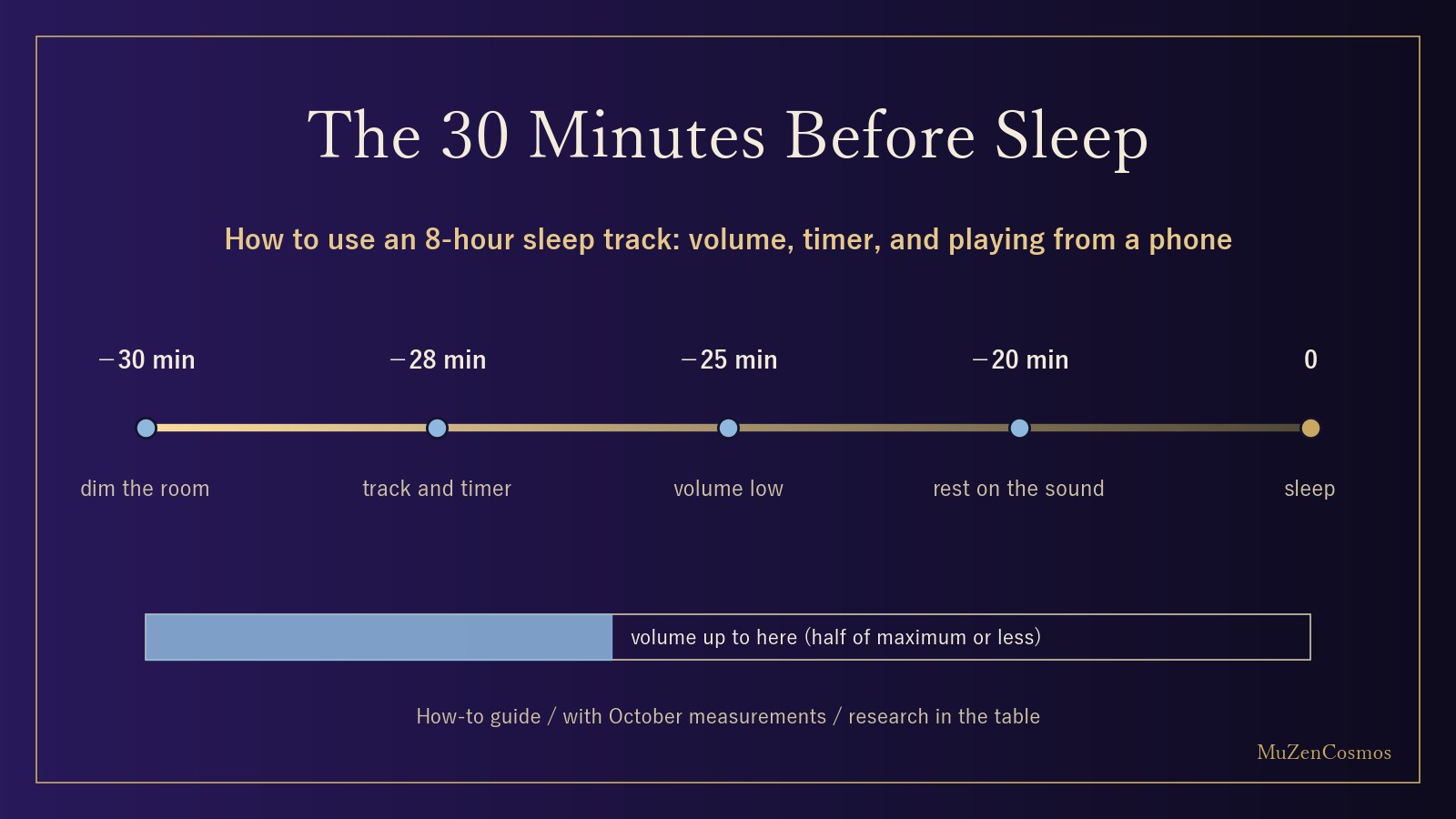
- Thirty minutes before bed, dim the lights and the screen and start a track at a volume you can hear without trying. Set a stop timer for 60 to 90 minutes.
- On a single phone speaker, some tracks lose their title tone (table below). Anything that plays left and right separately, headphones or two separated speakers, is fine.
- In research, listening to music before bed improved how well people felt they slept, but not measured sleep time (Cochrane 2022). No study shows that a particular frequency helps sleep.
This is a how-to for our 8-hour sleep tracks. No effect is promised. If you cannot sleep for days on end, see a doctor rather than relying on sound.
The steps (from 30 minutes before bed)
- Minus 30: darken the room and the screen. Turn off the ceiling light and set the phone brightness near its lowest. You can turn the phone face down and keep only the sound.
- Minus 28: pick a track and set a timer. Choose one from the table below. A stop timer (60 to 90 minutes) makes it less likely that the sound wakes you later and gives your ears a rest. If you want it all night, use the lowest volume in the next step.
- Minus 25: set the volume. From a room speaker, clearly quieter than conversation. From earbuds, quiet enough that you can still hear a clock or a car outside. Half of the phone maximum or less is a reasonable ceiling.
- Minus 20 onward: get into bed and rest your attention on the sound. Do not try to sleep. When you notice thinking, come back to the sound. That is all.
- Zero: sleep. The timer stops the sound. If you wake in the night and the sound bothers you, stop it and let the room be silent.
Thirty minutes is a guide. The studies used 25 to 60 minutes a day (table below).
Choosing a track (our 8-hour tracks, with October 2026 measurements)
When we re-measured our published tracks in October, some lost their title tone on devices that combine left and right into one speaker (a phone speaker or a small single speaker). On anything that plays the two channels separately, every track plays as titled.
| Track | On a single phone speaker |
|---|---|
| 174 Hz, 8 hours (rain and a low tone) | title tone holds on any device |
| 396 Hz, 8 hours | title tone holds on any device |
| 432 Hz, 8 hours | title tone slightly weaker on a single speaker (−3.8 dB) |
| 528 Hz Deep Sleep, 8 hours | headphones recommended (title tone −8.1 dB on a single speaker) |
| Triple 174+396+432 Hz, remastered | title tone holds on any device |
Which one is a matter of taste. Names such as deep rest for 174 Hz are names, not effects. If in doubt, start with the lowest and quietest, 174 Hz. How the 8-hour tracks are built is in a production note, and how their loudness is matched is in the −14 LUFS note.
What the research shows (checked on PubMed, November 2026)
| Study | What was tested | Reported result | Points to note |
|---|---|---|---|
| Jespersen et al. 2022 Cochrane systematic review | 13 randomised trials, 1,007 adults with insomnia symptoms, listening to recorded music for 25 to 60 minutes a day for three days to three months | Self-rated sleep quality (PSQI) improved compared with no music (moderate certainty). Self-reported time to fall asleep and total sleep time improved slightly; in the three studies that measured sleep with instruments there was no difference. No adverse events reported | The music varied from study to study; none tested a specific frequency or pure tone. Participants knew they were listening to music, so expectation cannot be ruled out |
In short, the habit of listening to quiet sound before bed has accumulating evidence for feeling better rested. No study shows that a particular pitch such as 528 Hz or 174 Hz helps sleep. These steps are a suggestion for marking the end of the day with sound.
Playing from a phone
- Volume: sleep is also when your ears rest. Half of the maximum or less, and ideally a stop timer.
- A single speaker: the tracks marked headphones recommended above lose their title tone on a phone speaker. Separately, very low tones such as 7.83 Hz do not play from a phone at all (production note).
- Sleeping with earbuds: if your ear hurts lying on its side, try thin earbuds, a speaker under the pillow, or a sleep headband.
- Notifications: use do-not-disturb so alerts do not cut in.
FAQ
Q. Should it play all night? A. The studies used 25 to 60 minutes. The 8-hour tracks exist for people who dislike the sound stopping; all night is not required. For your ears, a timer is the kinder choice.
Q. How many nights until it works? A. The studies ranged from three days to three months, so no number can be given. If it does not suit you after three nights, switch to silence or a different sound.
Q. I still cannot sleep. A. Sound is not a treatment. If it goes on for more than two weeks, see a doctor.
Related: the science of sleep and the hearing age test. You can play the pitches in the Frequency Lab.
This article does not guarantee any medical or health benefit and is not a substitute for professional medical care. If you have any health concerns, please consult a physician or other qualified professional.