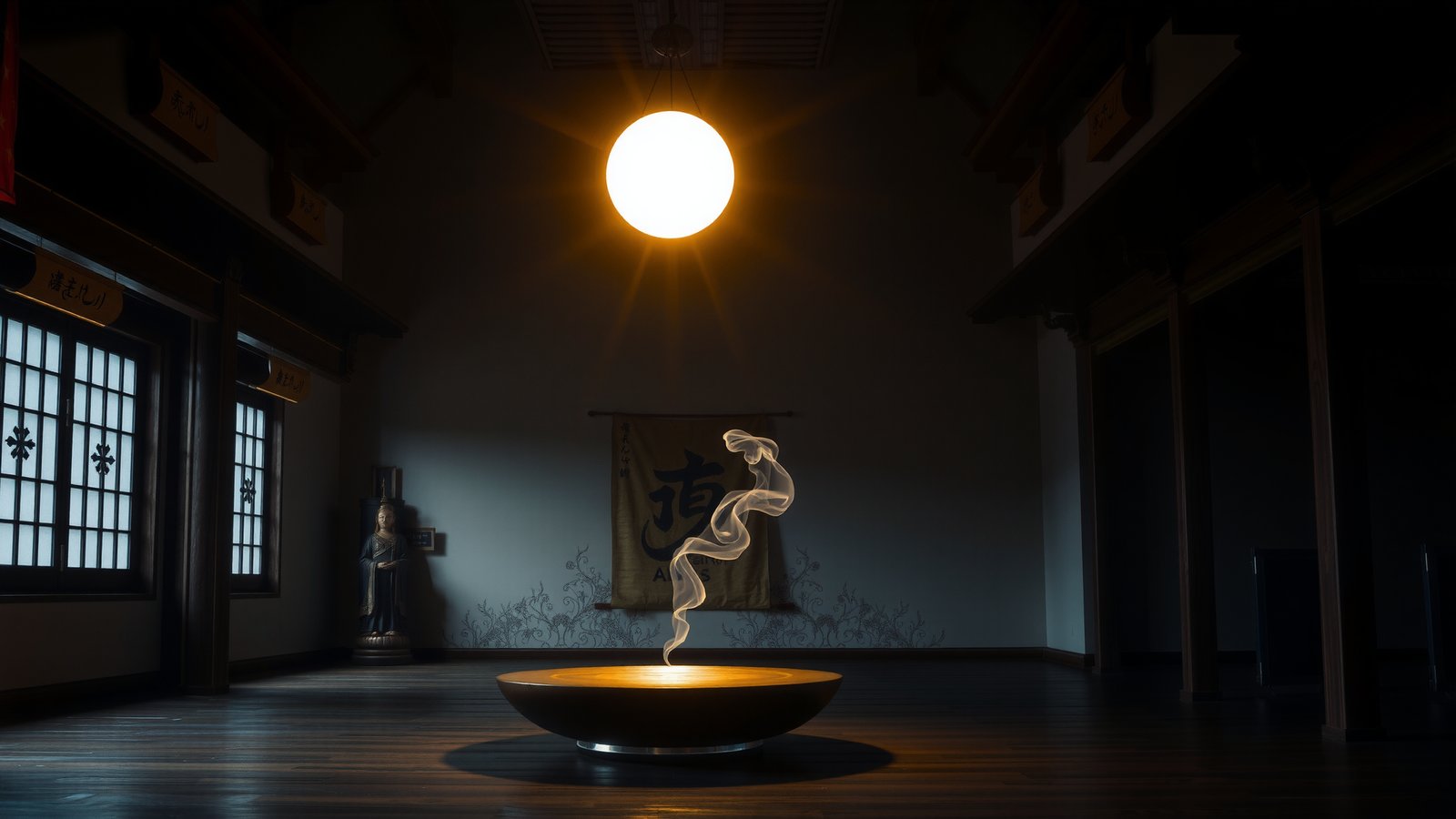
If you have ever stood in a Japanese temple
and heard low voices
moving in waves —
On abokya
beiroshanō…
you will know
that the meaning
does not arrive.
And yet
something in the body
answers anyway.
Esoteric Buddhism is what happens
when a tradition spends
twelve hundred years
building a system
around that answer.
Zen strips everything away
until nothing remains
to hold on to.
Esoteric Buddhism goes
in the opposite direction.
Sound, color, form, body —
it uses all of them,
all the way down.
💎 The One Line That Holds This Article
Esoteric Buddhism is the boldest move in Japanese Buddhism: it pulled awakening back from a distant destination into the body you are sitting in right now.
The Answer, in Three Lines
Esoteric Buddhism sees Mahāvairocana — the working of the universe itself — as the central Buddha. In Japan it runs in two streams: Kūkai’s Shingon school (tōmitsu) and Tendai esotericism (taimitsu). Its practice is the three mysteries: a mudra in the hands, a mantra in the mouth, and an image in the mind — all at once. The goal is not a future life but awakening in this very body (sokushin jōbutsu).
The 30-Second Summary
- Mikkyō translates as “secret teaching,” but nothing is being hidden — it names the part of experience that language cannot carry
- Ordinary (exoteric) Buddhism teaches through words and reasoning; esoteric Buddhism mobilizes body, sound and image
- Japan has two esoteric lineages: Shingon, founded by Kūkai (774–835), and the esoteric strand within Tendai
- At the center stands Mahāvairocana — not a savior figure, but the activity of the cosmos given a Buddha’s form
- A mandala is not decoration but a map of the world: the Womb Realm shows compassion unfolding, the Diamond Realm shows wisdom structured — always as a pair
- The core practice is the three mysteries: mudra (body), mantra (speech), visualization (mind), performed simultaneously
- Mantras are never translated. In this tradition the sound itself is held to do the work
- Sokushin jōbutsu means becoming Buddha in this very body — Kūkai gave it a full theory in the Sokushin jōbutsu gi
- The one practice widely open to beginners is Ajikan, a quiet visualization of a full moon and the Sanskrit letter A
- But claims that rituals cure illness or grant wishes have no scientific support. Meet this tradition as culture and practice, not as a mechanism
1. What Esoteric Buddhism Is — Not Hidden, Just Beyond Words
Mikkyō — “secret teaching.”
That word
causes almost all
the misunderstanding.
Nothing is being
withheld.
It is called secret because
some things break
when you say them.
You can read a description
of a piece of music
with total attention
and still
lose to the first second
of hearing it.
That is the territory
this tradition works in.
So in esoteric Buddhism,
doing comes before
reading.
You fold your hands.
You make a sound.
You burn incense.
You sit in front
of a painting.
You learn with
the whole body.
That, in one sentence,
is the method.
2. Exoteric vs. Esoteric — Subtraction, and Everything at Once
Buddhism is often divided
into exoteric and esoteric.
| Dimension | Exoteric (Zen, Pure Land, etc.) | Esoteric (Shingon, Tendai esotericism) |
|---|---|---|
| How it is transmitted | Open scriptures and words | Master to student, through the abhiṣeka initiation |
| Central Buddha | Śākyamuni, Amitābha, others | Mahāvairocana (the cosmos as activity) |
| Time to awakening | The far end of long practice | This very body, now |
| The body | Something to settle and quiet | The vessel of awakening itself |
| The senses | To be restrained | Deliberately mobilized |
| Means of expression | Sutras, sermons | Mandala, mantra, mudra, chant |
If exoteric Buddhism moves by
taking away,
esoteric Buddhism moves by
using everything there is.
Read this beside
Zazen: A Complete Introduction
and the contrast is startling —
two doors this different,
inside one tradition.
Neither is higher.
They are temperaments.
Some people settle
in an empty room.
Others find their focus
inside sound and color.
3. Kūkai — Who Sailed at Thirty-One and Came Back in Two Years
Japanese esoteric Buddhism
begins with one person.
Kūkai (774–835),
known afterward as
Kōbō Daishi.
Born in Sanuki province
on Shikoku,
he entered the imperial university
at eighteen —
the road to a government career.
And then he left it.
Reading his early work,
the reason seems to be
that words were not
enough.
In Sangō shiiki,
written at twenty-four,
he set Confucianism, Daoism
and Buddhism side by side
and concluded that Buddhism
went deepest.
He practiced in the mountains,
and then —
in 804, at thirty-one,
he boarded a ship for Tang China.
In the same fleet, on another vessel,
sailed Saichō,
the future founder of Tendai.
In Chang’an, Kūkai met
Huiguo of Qinglong Temple,
and what happened next
is one of the pivotal events
in Japanese religious history.
Huiguo is said to have looked at him
and declared, in effect,
“I have been waiting for you.”
Within months he transmitted
the entire esoteric teaching.
He died that same year.
Kūkai returned to Japan in 806 —
a twenty-year study assignment
abandoned after two.
It was a violation
of his orders.
But he came home with sutras,
ritual implements and mandalas,
opened Mount Kōya,
and made Tō-ji in the capital
a center of esoteric practice.
In 835 he entered
final meditation on Kōya.
In Shingon, he is not said
to have died.
He is said to be
still sitting.
Twelve centuries later,
meals are still carried to him
on Mount Kōya
every single day.
4. Tōmitsu and Taimitsu — Japan’s Two Esoteric Streams
| Dimension | Tōmitsu (Shingon) | Taimitsu (Tendai esotericism) |
|---|---|---|
| Founder | Kūkai | Saichō, developed by Ennin and Enchin |
| Center | Mount Kōya, Tō-ji | Mount Hiei |
| Position | Esotericism is the center | Esotericism enfolded within the Lotus Sutra |
| Main scriptures | Mahāvairocana Sutra, Vajraśekhara Sutra | The same, practiced alongside the Lotus |
| Stance | Esotericism is distinct and superior | Exoteric and esoteric are equal |
| Cultural legacy | Kōya faith, Kōbō Daishi devotion, mountain asceticism | Tendai original enlightenment thought; later Kamakura Buddhism |
Saichō and Kūkai
were close at first.
The elder man
asked the younger
for teachings.
Then they parted.
At the center of the break
was a single question:
can esoteric Buddhism
travel through books?
Saichō asked to borrow texts.
Kūkai answered, in effect,
“this does not pass through writing —
receive it from a master.”
That was not a personal quarrel.
It was an argument about
what esoteric Buddhism is.
And it is still live today.
What you can learn
by reading,
and
what you can only learn
by doing.
Esoteric Buddhism bet
everything on the second.
5. Mahāvairocana — Calling the Universe a Buddha
At the center stands
Mahāvairocana —
Sanskrit for
“the great illuminating one.”
Here is the interesting part.
Mahāvairocana
is not a historical person.
Unlike Śākyamuni, he was not
born and did not die.
Mahāvairocana is
the fact that the universe
is working at all,
given the form of a Buddha.
Stars igniting.
Wind moving.
A heart beating
in a chest.
All of it is understood as
that Buddha’s activity.
Which means
you are already
inside it.
This is not a savior
arriving from outside.
It is a name for
what is already the case.
That feeling sits very close
to the wordless thing
that happens when you
look up at a night sky.
For the same territory
from another angle, see
Accessing Cosmic Consciousness
.
6. What a Mandala Means — Two Maps, One Center
A mandala is not
ornament or abstraction.
It is a map of the world.
The Sanskrit root suggests
“that which possesses the essence” —
and also “circle, having a center.”
In Japanese esotericism
they come as a pair.
| Dimension | Womb Realm Mandala | Diamond Realm Mandala |
|---|---|---|
| Source | Mahāvairocana Sutra | Vajraśekhara Sutra |
| What it shows | Compassion — the world growing | Wisdom — the world seen through |
| Structure | Unfolds outward from the center, like a flower | Nine ordered assemblies |
| Image | A life developing in the womb | A diamond that cannot be broken |
| Feeling | Warm, expanding | Geometric, severe |
| Center | Mahāvairocana | Mahāvairocana |
The remarkable thing is that
the center is the same.
A world softly spreading outward,
and a world tightening into structure.
Esoteric Buddhism says these are
one thing seen twice.
Tenderness and rigor.
Expansion and architecture.
Neither is sufficient alone.
And in practice, one does not
look at a mandala.
One enters it —
not reading the map
but walking inside it.
7. The Three Mysteries — Bringing Body, Speech and Mind Into One
The whole practice can be stated
as the three mysteries:
- Body — forming a mudra with the hands
- Speech — reciting a mantra
- Mind — visualizing the Buddha or the seed syllable
All three
simultaneously.
This is the invention.
Ordinary life is
scattered.
The hands hold a phone,
the mouth says something else,
the mind is elsewhere entirely.
The three mysteries are a technique
for collecting those three
into one point.
And the tradition does not describe
this as climbing toward a Buddha.
The term is sanmitsu kaji —
the Buddha’s activity (ka)
and the practitioner’s receiving (ji)
meeting.
Not approaching.
Noticing what was already there.
Which is, at a surprising depth,
the same shape as Zen’s
“we do not sit in order to awaken.”
Utterly different methods.
Nearly the same destination.
8. What a Mantra Is — And Why It Is Never Translated
Shingon literally means
“true word” — the Japanese rendering
of mantra.
The school takes its name
from this.
The defining feature of a mantra
is that it is not translated.
The widely recited
Kōmyō Shingon runs:
On abokya beiroshanō
makabodara mani handoma
jinbara harabaritaya un
It can be rendered roughly as an appeal
to the unfailing one, to the great seal,
the jewel, the lotus, the radiance —
but the tradition holds that
translating it changes
what it does.
Why?
Because in esoteric Buddhism,
sound is part of reality,
not a pointer toward it.
Kūkai’s Shōji jissō gi
argues exactly this:
voice, letter and reality
are not three separate things.
A bold claim.
And it runs straight into
the territory this site has always covered —
sound and frequency.
Science has something modest
to offer here.
Bernardi and colleagues
(BMJ, 2001) found that reciting
the rosary or a yoga mantra
slowed breathing to roughly
six breaths per minute,
with measurable effects on
cardiovascular rhythms.
A small fMRI pilot study by
Kalyani et al. (2010) reported
reduced activity in parts of
the limbic system during “OM” chanting.
But — to be exact —
neither shows that mantras
“work.”
They show that slow, regular
vocalization affects breathing.
Still, it is quietly striking
that a twelve-hundred-year-old practice
had breath as its point
of contact.
More on sound and the body in
The 136Hz OM Frequency
and
Overtone Chanting and Meditation
.
9. Sokushin Jōbutsu — “In This Very Body”
The most famous phrase in
Japanese esoteric Buddhism is
sokushin jōbutsu:
becoming Buddha
in this very body.
By the standards of the time,
awakening required
an almost unimaginable
span of time —
lifetimes of accumulated merit,
with the goal far beyond them.
Kūkai inverted it.
His Sokushin jōbutsu gi
can be compressed to three moves:
The six elements — earth, water, fire,
wind, space, consciousness — are the same
in a Buddha and in me.
The four kinds of mandala
contain everything.
When the three mysteries meet,
it appears immediately.
In other words:
the materials are
already here.
What is missing is not time
but a way of noticing.
Put in modern language,
the boldness becomes visible.
Not “happiness will come
one day,” but
“it is already here.”
Saying that with a straight face
was not easy then,
and is not easy now.
One caution, though.
Sokushin jōbutsu does not mean
that effort is unnecessary.
Shingon training is among
the most demanding
in Japanese Buddhism.
To know that it is already there,
people give their lives.
That paradox sits at the center
of the whole tradition.
10. How to Practice Ajikan — A Quiet Doorway
Most esoteric practice is
transmitted directly from a master
and should not be imitated
from a book.
But one practice is
genuinely open to everyone:
Ajikan — the A-syllable visualization.
Temples on Mount Kōya and
across Japan hold public sessions.
The broad shape of it:
- Sit quietly — seiza, cross-legged, or a chair. Let the spine stand
- Picture a moon disc — a round white full moon at the level of the chest
- Place the letter A — a golden Sanskrit a floating at its center
- Sound it on the out-breath — “aaah,” gently, a few times
- Expand — the moon slowly widens past the room, past the roof, filling the sky
- Return — bring it back to its original size, and stop
Why the letter A?
Because it is the first sound
of the Sanskrit alphabet,
and simultaneously the
prefix of negation.
The beginning of everything,
and the negation of everything —
both living in one syllable.
Looking at that letter
is the whole practice.
And if the imagery feels heavy,
just hold a white full moon
in your chest.
Three minutes is plenty.
11. Mandalas and the Cosmos — Why the Map Is Round
Now past the edge
of what science covers.
Look at a mandala
from across a room
and it may feel
oddly familiar.
A center, and rings
widening out from it.
— The shape of a galaxy.
— The shape of a cell.
— The shape of an eye.
Nobody twelve hundred years ago
was drawing a galaxy.
But that human beings keep
drawing centers that expand
is simply a fact.
Esoteric Buddhism took that shape
and declared it
the structure of the world.
Mahāvairocana at the center,
countless Buddhas widening outward.
And here is the decisive part:
you are drawn in it too.
A mandala has
no outside.
The one looking
is already
inside the picture.
Which is very close to
what a night sky does.
We think we are watching
the universe from outside.
We are watching it
from within.
Part of the cosmos,
looking at the cosmos.
Perhaps that diagram, drawn
twelve centuries ago, is simply
that fact, painted.
The wider view lives in
The Complete Guide to Spirituality
.
12. Honest Lines — What Is Known, and What Is Not
This is a field that attracts
misunderstanding.
So let me be exact.
What is reasonably supported (moderate to weak)
- Slow repetitive vocalization can lower respiratory rate and affect cardiovascular rhythms (Bernardi et al., 2001)
- Sitting quietly in a settled posture has moderate evidence behind it in the meditation literature generally
- Ritual and repetition correlating with psychological steadiness is widely discussed in the psychology of religion
What is not established (weak to unproven)
- There is no scientific evidence that ritual prayer cures illness
- Whether a specific mantra grants a specific wish is outside the scope of scientific testing
- Neuroscience cannot measure anything corresponding to sokushin jōbutsu
- Clinical research on esoteric Buddhist practice specifically is almost nonexistent
Practical cautions
- Be wary of groups charging large sums for prayers, talismans or initiations. Established temples publish their fees and do not make extravagant demands
- Do not substitute this for medical care. If you are under treatment, follow your physician
- Do not attempt advanced ritual practice from a book. A teacher has always been required — not for gatekeeping, but because the demands on body and mind are real
- Avoid long visualization sessions during psychologically unstable periods
- Approach with respect. Mandalas and mantras belong to a living faith
Say only what can be said.
That is the line
this site keeps.
13. Five Checks Before You Buy Anything
- Have you chosen an experience before a book? Look for an Ajikan session, a sutra-copying session, or a public goma fire ritual before ordering anything. This is a religion of the body. Confirm whether reservations are required
- Does your introductory book name its translator and supervising scholar? This field is full of unreliable material. Choose books supervised by academic researchers or ordained clergy; established academic imprints are a good signal
- If you buy a mandala print, is it the pair? Displaying only the Womb or only the Diamond gives you half the worldview. They have always been a set. Book plates are entirely sufficient to begin
- Is the incense too strong? Breathing deepens during visualization, so scent registers more intensely than usual. Sandalwood and aloeswood have deep ties to this tradition, but start with very little — and take particular care during pregnancy, with asthma, or in rooms with pets
- Do you know which mala matches your school? Shingon’s formal rosary is the 108-bead furiwake juzu, but a simple non-denominational mala is completely fine. What matters is not the form but how it settles in your hand
On living with scent, see
The Complete Guide to Aromatherapy
.
Experience first,
books second.
With this tradition,
that order is genuinely faster.
About This Article (Disclaimer and Advertising Notice)
This article introduces the history, thought and culture of esoteric Buddhism. It is not medical advice, psychotherapy, or religious solicitation. Nothing here is intended to guarantee improvement in illness, symptoms, finances or relationships, and individual responses vary. If you are receiving treatment, follow your physician’s guidance. Avoid extended visualization during periods of psychological instability, and consult a professional if needed. This article does not encourage joining any school or organization, or purchasing any specific ritual service or object.
[Advertising] This article may in future contain affiliate links. Purchases made through such links never cost readers anything additional.
14. Let’s Imagine a Situation Like This
To make this concrete, picture one
generalized scene
(this is a deliberately fictional, generalized illustration — not anyone’s real account).
Suppose you step into a temple
while traveling
and find yourself present at a
goma fire ritual.
Flames climb.
A drum sounds.
A low voice moves in waves.
The meaning is
entirely unavailable to you.
Nothing parses as language.
Zero percent.
And yet —
your spine straightens
without being asked.
Your breathing has gone
deeper
without any decision
on your part.
Most people, at this point,
want to say
“I felt some tremendous power,”
or, in the other direction,
“it’s just theater.”
What makes esoteric Buddhism
interesting is that it offers
a third reading.
Sound moves the body.
Fire occupies the eye.
Incense enters the breath.
Every sense is being pointed
in one direction at once.
And for a while, body, speech
and mind — usually scattered —
arrive at the same point.
That state is exactly what
the tradition calls
the three mysteries.
Nothing supernatural
may have happened.
But something happened
in you, and it was real.
Esoteric Buddhism simply
never separated
those two.
This article does not guarantee any medical or health benefit and is not a substitute for professional medical care. If you have any health concerns, please consult a physician or other qualified professional.
📚 Related Articles
- Zazen: A Complete Introduction | How to Sit, What to Do If You Can’t Cross Your Legs, and How It Differs from Meditation
- Taisetsu and 963Hz | The Season the Sky Closes — Japan’s Solar Term of Great Snow and the Highest Frequency
- Shousetsu and 285Hz | The Season the Rainbow Hides — Japan’s Solar Term of Small Snow and Quiet Repair
- Rittou and 639Hz | The Day Winter Is Named — Japan’s Solar Term of Fire and Gathering
FAQ (10 Questions)
Q1. What is esoteric Buddhism?
A stream of Buddhism that transmits, through body, sound and image, what words and reasoning cannot carry. It is called “secret” not because anything is hidden, but because language destroys what it tries to hold. In Japan its two pillars are Shingon (tōmitsu) and Tendai esotericism (taimitsu).
Q2. How does Shingon differ from Zen?
They run in nearly opposite directions. Zen subtracts; esoteric Buddhism mobilizes. Zen makes sitting itself the practice (shikantaza); Shingon performs mudra, mantra and visualization simultaneously. Yet their conclusion — that awakening is here rather than far away — lands startlingly close together.
Q3. Who was Kūkai?
A monk born in Sanuki in 774 who left the path to government office for Buddhism, sailed to Tang China in 804 and received the esoteric transmission from Huiguo. Returning in 806, he opened Mount Kōya and made Tō-ji a center of practice. He left marks on calligraphy, engineering and education, and entered final meditation in 835 — in Shingon, he is still sitting.
Q4. What does a mandala mean?
Not decoration but a map of the world. The Womb Realm mandala depicts compassion unfolding; the Diamond Realm mandala depicts wisdom structured. They are used as a pair, and Mahāvairocana sits at the center of both. Crucially, the viewer is understood to be inside the picture.
Q5. Why are mantras not translated?
Because this tradition holds that the sound itself does the work. Kūkai argued in the Shōji jissō gi that voice, letter and reality are inseparable. Translation may convey meaning while losing the function of the sound.
Q6. How do I recite the Kōmyō Shingon?
“On abokya beiroshanō makabodara mani handoma jinbara harabaritaya un.” There is no fixed speed or count; slowly, within a comfortable breath is the basic guidance. Meet it as a practice that settles breath and voice, not as a spell for outcomes.
Q7. Does sokushin jōbutsu mean becoming a Buddha without dying?
It means awakening is possible in this very body. Kūkai argued it through the six elements, the four mandalas and the three mysteries. It does not mean effort is unnecessary — Shingon training is famously rigorous. The structure is paradoxical: giving everything in order to notice what is already the case.
Q8. Can beginners practice Ajikan?
Yes. Most esoteric practice requires direct transmission, but Ajikan is offered publicly at temples across Japan. At home, begin by holding a white full moon at the chest and breathing quietly for about three minutes. Avoid long sessions during psychologically unstable periods.
Q9. Do ritual prayers grant wishes?
This has not been scientifically demonstrated. These rituals carry twelve centuries of cultural depth, but there is no evidence that they produce specific outcomes. Be especially cautious of any group demanding large fees or purchases. Meet the tradition as culture and practice.
Q10. Do I need faith to encounter esoteric Buddhism?
No. Mount Kōya and temples throughout Japan hold sessions open regardless of belief. But this is a living faith, and approaching it with respect turns out to be the deepest way to encounter it.
In Closing | You Are Already Inside It
Mandalas.
Mantras.
The three mysteries.
Buddhahood in this very body.
All of it says
one thing
from different angles:
you are not looking
from outside.
You are already
inside.
When Kūkai said
“this very body,”
what he removed was
distance.
The distance between
awakening and yourself.
The distance between
the cosmos and yourself.
What if that distance
was never there.
Tonight, if you have
three minutes —
sit somewhere quiet
and picture,
at the level of your chest,
a round white
full moon.
The size of a palm.
With each breath
it widens, slowly.
Past the room.
Past the roof.
Filling the whole sky.
And then, gently,
back to where it began.
That is all of it.
Twelve hundred years ago,
on a slope on Mount Kōya
where the trees had not yet
been cleared,
one man was holding
the same moon
in his chest.
And it still rises
in yours.
References
- Kūkai, Sokushin jōbutsu gi, Shōji jissō gi, Unji gi. Available in Japanese with commentary as Kūkai Collection vols. 1–2, ed. Miyasaka Yūshō, Chikuma Gakugei Bunko, 2004. (The primary sources for the theory of awakening in this very body, and for the doctrine of voice, letter and reality.)
- Matsunaga Yūkei, Mikkyō (Esoteric Buddhism), Iwanami Shinsho, 1991. (An introduction by one of the foremost modern scholars of Shingon.)
- Ryuichi Abé, The Weaving of Mantra: Kūkai and the Construction of Esoteric Buddhist Discourse, Columbia University Press, 1999. (The landmark English-language study of Kūkai’s theory of language and its place in Japanese intellectual history.)
- Luciano Bernardi, Peter Sleight, Gabriele Bandinelli, Simone Cencetti, Lamberto Fattorini, Johanna Wdowczyc-Szulc & Alfonso Lagi, “Effect of rosary prayer and yoga mantras on autonomic cardiovascular rhythms: comparative study,” BMJ, 323(7327), 2001, pp. 1446–1449. (Showed that repetitive recitation slows breathing to roughly six breaths per minute, with measurable cardiovascular effects.)
- Bangalore G. Kalyani, Ganesan Venkatasubramanian, Rashmi Arasappa, Naren P. Rao, Sunil V. Kalmady, Rishikesh V. Behere, Hariprasad Rao, Mandapati K. Vasudev & Bangalore N. Gangadhar, “Neurohemodynamic correlates of ‘OM’ chanting: A pilot functional magnetic resonance imaging study,” International Journal of Yoga, 3(1), 2010, pp. 3–6. (A small pilot fMRI study of brain activity during OM chanting.)
MuZenCosmos — Where the Cosmos Meets Silence | You Are Already Inside It