MuZenCosmos

Frequency & Music

Production Notes: We Chose −14 LUFS, and the Catalog Disagreed — Measuring YouTube’s Volume Correction on My Own Videos

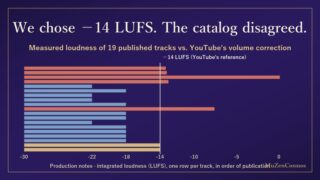
Three months after deciding to master at −14 LUFS, I matched measured masters against YouTube's Stats for nerds for the published long-form tracks: four levels (−22, −18, −13, −14) were mixed, and one track had been published clipped. A record of checking, on my own videos, that YouTube turns down but never up.
Frequency & Music

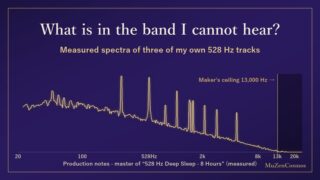
Production Notes: What Is in the Band I Cannot Hear? Measuring the Spectra of Three of My Own 528 Hz Tracks

My ears stop at 13,000 Hz. So what do my own tracks put above that? I measured the masters of three published 528 Hz tracks (Pure 3 h, Deep Sleep 8 h, Autumn Insects) with one procedure and show the charts and numbers, including one result I did not expect.
Frequency & Music

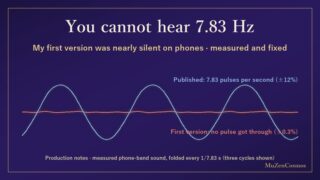
Production Notes: You Can’t Hear 7.83 Hz — Why My First Schumann Resonance Track Was Nearly Silent on Phones, and the Fix

7.83 Hz is below human hearing, so I made it a pulse: 7.83 gentle swells per second. But almost all of the first version sat below 400 Hz, so on phone speakers it was nearly silent and the pulse never arrived. The before/after of adding harmonics, with measured charts and numbers.
Frequency & Music

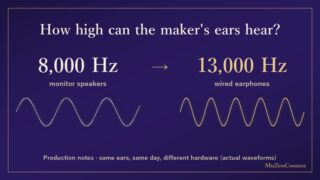
Production Notes: My Ears Top Out at 13,000 Hz — What I Learned Taking My Own Hearing Age Test

I took my own hearing age test: 8,000 Hz on the monitor's built-in speakers, 13,000 Hz on wired earphones. Same ears, a 5,000 Hz gap, and the reason was the hardware. An honest note on what a music maker does about the bands he cannot hear.
Frequency & Music

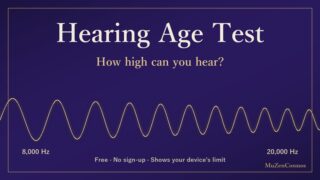
Hearing Age Test — How High Can You Hear? Play 8,000 to 20,000 Hz and Find Out (Free, No Sign-Up, Shows Your Device’s Limit)

A free in-browser tool that checks how high a pitch you can still hear. Set the volume with a 1,000 Hz reference, then step through 8,000 to 20,000 Hz. Shows the highest tone you heard, the commonly used age guide, your device's playback limit, and a check for guessing. Not a medical test.
Frequency & Music

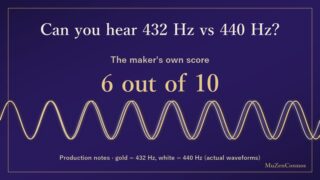
Production Notes: I Built a 432 Hz vs 440 Hz Blind Test, Took It Myself, and Scored 6 out of 10

I built a blind test for 432 Hz versus 440 Hz and took it myself: 6 out of 10. The chance of scoring 6 or more by guessing is about 38%, so that is not a score that shows I can hear the difference. An honest look at why, with the arithmetic and the state of the research.
Frequency & Music

Frequency Lab — Play and Compare the Solfeggio Tones, 432 Hz vs 440 Hz, and Binaural Beats (Free, No Sign-Up)

A free in-browser tool for hearing the nine Solfeggio tones, 432 Hz and 440 Hz as plain sound. Includes a blind test for telling 432 Hz from 440 Hz and a binaural-beat demo. Built by someone who makes frequency music, so you can listen first and read second.
Frequency & Music

What Is Shōmyō? Complete Guide to Japanese Buddhist Chant | Japan’s Oldest Vocal Music

What shōmyō (Japanese Buddhist liturgical chant) actually is — from a branch of Indian linguistics to Mount Hiei and Mount Kōya, the difference between Tendai and Shingon chant, the hakase notation that will not fit on a staff, how reverberation and unison drift create those overtones, and how to listen at home. Honest about what the chanting research can and cannot say.
Zen & Cosmos

What Is Shakyō? Complete Beginner’s Guide | Copying the Heart Sutra by Hand

What shakyō (Japanese sutra copying) actually is — from the state-run scriptoria of Nara to the 262 characters of the Heart Sutra, the four tools you need, the seven steps at your desk, how to write the dedication line, and what happens to the paper afterward. Honest about what the handwriting research can and cannot say.
Zen & Cosmos

What Is Shugendō? Complete Guide | Yamabushi, En no Gyōja, and the Ōmine Ridge

What Shugendō actually is — Japan's mountain asceticism formed from indigenous mountain worship, esoteric Buddhism, Daoism and Shinto. The real En no Gyōja, the 1872 ban that erased the religion, what the yamabushi's costume means, the 170km Ōmine Okugake, the Dewa Sanzan rebirth pilgrimage, the conch and the rokkon shōjō chant. Honest about evidence.