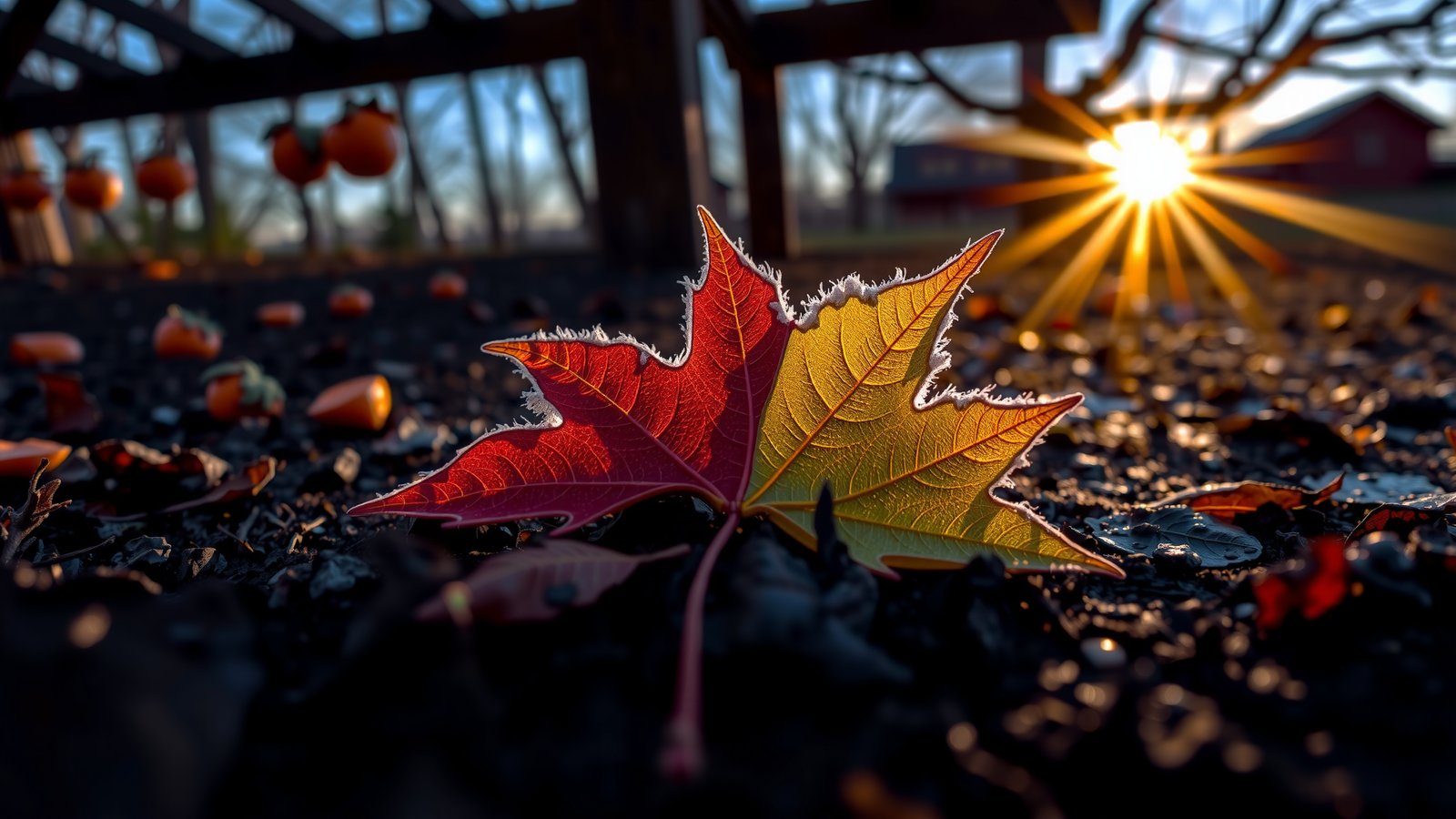
There is a morning
when the drop
on the grass
is no longer round.
Last month
it held light
in the shape
of a sphere.
Around Kanro
it began
to feel cold.
And then,
at some point,
that same drop
stopped flowing.
It has become
a white,
fine,
pointed crystal.
The name given
to that change
is Soukou —
literally,
frost descends.
The last term
of autumn.
What comes next
is already
winter.
What follows is the story
of Soukou,
one of Japan’s 24 solar terms.
And its gentle resonance
with 417Hz,
the tone the modern Solfeggio set
associates with
change.
The answer, in three lines
Soukou is the 18th of Japan’s 24 solar terms, falling when the sun reaches celestial longitude 210° (around October 23 in 2026). It is the final term of autumn: the dew turns to frost, and with the next term, Rittou, the calendar enters winter. Solfeggio 417Hz is traditionally described as a tone of transformation and of shifting a stuck situation — which overlays poetically with frost, water that becomes ice while skipping the liquid stage, and with autumn leaves, which redden while preparing to fall. The two have no historical connection, and nothing here is a claim of effect.
💎 The one line that holds this article
What Soukou teaches is that the most beautiful change happens in the middle of letting something go.
The 30-Second Summary
- Soukou is the 18th of the 24 solar terms, falling when the sun reaches celestial longitude 210°. In 2026 it lands around October 23 (dates shift year to year, so an annual almanac check is recommended)
- It is the last term of autumn. From the next term, Rittou, the calendar’s winter begins
- In the 72 micro-seasons, Soukou moves through frost begins to descend → light rain comes and goes → maple and ivy turn color
- The middle micro-season is the interesting one: rain that starts and stops. Change has an undecided stretch built into it
- Frost does not actually fall. Water vapor in the air turns straight into ice crystals on cold surfaces, skipping the liquid stage entirely
- The red of autumn leaves is newly made. Only after a tree begins preparing to drop a leaf is anthocyanin synthesized from the sugars left inside it
- Solfeggio 417Hz is traditionally linked to transformation, shifting a stuck situation, and loosening old fixations
- Musically, it sits about 7 cents above A♭4 (roughly 415.30Hz) in standard A=440Hz equal temperament — almost the same note, and not quite the same note
- All of this is symbolic language, not an assertion of scientific effect
1. What Soukou Is — The Season the Dew Turns to Frost
Soukou is the 18th of the 24 solar terms,
the ancient division of the year
into 24 parts
based on the sun’s position.
It falls when the sun
passes celestial longitude 210°.
In 2026, Soukou lands around October 23.
(Because the terms are fixed by the sun’s actual position, the date can shift by a day from year to year. The reliable practice is to check each year’s official almanac.)
The meaning of this term
gathers around
a single fact:
it is the end
of autumn.
The autumn that began at Risshuu,
counted through Shosho, Hakuro,
Shuubun and Kanro,
ends here.
The next term is
Rittou —
and from there,
by the calendar,
it is winter.
Set the three late-autumn terms
side by side
and a continuous change
comes into view.
- Hakuro — the dew begins to form
- Kanro — that dew turns cold
- Soukou — that dew becomes frost
Water,
cold water,
ice.
Three stages
of a single drop,
each given
its own name.
For the term immediately before this one, see
Kanro and 174Hz — When the Dew Turns Cold
And for where this drop’s story began, see
Hakuro and 741Hz — The Drop on the Morning Grass
2. Watching Nature in Soukou — The 72 Micro-Seasons and an Undecided Rain
The 24 terms are subdivided again,
three to a term,
into the 72 micro-seasons.
Soukou moves through these three:
- Frost begins to descend — the first frost appears
- Light rain comes and goes — brief showers start and stop
- Maple and ivy turn color — the leaves begin to take on their autumn hues
Of these three,
the one that stays with me
is the middle.
The first is frost —
a movement toward hardening.
The last is color —
a movement toward change.
Both are
definite.
And yet between them sits
a rain that starts
and stops.
Not the steady, patient rain
of the rainy season,
but the sudden shower
that falls hard for a moment
and clears —
what Japanese calls
shigure.
Undecided.
Unsustained.
Returning.
The calendar takes the trouble
to record
that such a stretch exists
on the way from autumn
to winter.
Change does not arrive
in a straight line.
It nearly sets,
loosens,
nearly reverses,
and then somehow
the color
has already
turned.
These three micro-seasons, in order,
read almost like a description of
what transformation
actually looks like.
Elsewhere in this season, you may notice:
- the first white on the morning air, appearing first in mountains and northern regions
- dusk arriving abruptly earlier, so the evening feels shortened
- persimmons, ginkgo, fallen leaves — the color of the ground deepening
3. Does Frost Really Fall? — A Misunderstanding Preserved in a Name
Here is the most interesting thing
about this solar term.
Frost does not fall.
The phrase “frost descends”
is fully settled
in Japanese —
and in English, too, we say
frost falls —
but frost does not come down
from the sky
the way rain
or snow does.
Frost is born
on the surface of things
themselves:
the ground, a leaf,
the roof of a car.
When that surface is cold enough
and water vapor touches it,
the vapor becomes
an ice crystal
directly.
What deserves attention
is that this change
never passes through
liquid water.
Gas, and then solid.
The middle step
is skipped.
(This transition from gas straight to solid is called deposition.)
People long ago
saw the white on the ground
each morning
and reasoned
that it must have
come down,
the way dew seemed to.
And on that understanding
the phrase “frost falls”
has been used
for more than
a thousand years.
Which means the name
Soukou
preserves, intact,
an explanation that is
scientifically slightly wrong.
I do not consider that
a flaw.
The order of it —
touched, seen,
then named —
is still visible
inside the word.
And frost’s behavior —
becoming something else
by skipping a stage —
turns out to rhyme,
unexpectedly,
with the theme of the tone
we come to next.
One practical note:
the calendar may say Soukou,
but in lowland areas the first frost
is usually observed in November
or December.
A calendar name tends to arrive
a little earlier
than the feeling of the place.
That, too, is basic
to reading the 24 terms.
4. How Autumn Leaves Work — The Most Beautiful Color Is the Color of Letting Go
The final micro-season of Soukou:
maple and ivy turn color.
It is worth looking
carefully
at how this happens.
As daylight shortens
and temperatures drop,
a tree begins preparing
to release its leaves.
At the base of each leaf,
a dividing layer forms —
the abscission layer —
and the flow of water
to the leaf
narrows.
Within that process,
the green pigment (chlorophyll)
breaks down first.
And as it goes,
the yellow pigments (carotenoids)
that were in the leaf all along
become visible.
This is the yellow
of ginkgo and birch.
So far, the story is
“something hidden
is revealed.”
But red
is different.
The red of maples arises when
anthocyanin is
newly synthesized
from the sugars
remaining in the leaf.
In other words:
- yellow is a hidden color, uncovered
- red is a color manufactured during the preparation to fall
Inside a leaf it has already decided
to let go of,
the tree is going to the trouble
of making
a new color.
Why anthocyanin is there at all
remains open:
it may protect the leaf
from strong light,
it may deter insects,
and several hypotheses
compete without resolution.
For deep color, the conditions
generally required are:
- ample daytime sunlight
- low nighttime temperature
- adequate moisture
Which is to say:
the wider the gap between
day and night, the deeper
the autumn color.
A gentle, mild autumn
does not produce it.
As science alone,
before any metaphor,
I find that
beautiful.
5. What 417Hz Is — Transformation, and Moving a Stuck Situation
417Hz is the second
of the six frequencies
most often presented
as the Solfeggio set:
396, 417, 528, 639, 741, 852.
In the traditional framing,
417Hz is associated with:
- transformation (encouraging change)
- shifting a situation (undoing a deadlock)
- loosening fixations and old impressions
In chakra frameworks it is often
laid over the
second chakra (Svadhisthana, the sacral center).
For more on this tone, see
417Hz — The Frequency of Transformation
and
The Complete Guide to 417Hz
Now a brief word
about tuning.
In standard A=440Hz
equal temperament,
A♭4 sits at about 415.30Hz.
417Hz is roughly
7 cents above that.
Seven cents is a difference
you notice only by
listening carefully.
So 417Hz can be produced,
very nearly,
by playing an A♭
on a piano.
But not exactly.
It is a fraction
higher.
Strangely enough,
that position — almost identical,
and yet not identical —
resembles the theme
of transformation itself.
Not a great relocation,
but a very slight
shift.
— On a Soukou morning,
what happened to a single drop
of water
was, in temperature,
a matter of
a few degrees.
6. What Is Claimed About 417Hz — Drawing the Evidence Line
Here is an honest accounting,
in the MuZenCosmos manner.
What is said (its place in the tradition)
- In the modern Solfeggio tradition, 417Hz is frequently introduced as “the tone that encourages change” or “the tone that moves a situation”
- It is also described as a tone that loosens past impressions and fixations
- There is research suggesting that listening to music can influence mood and the experience of tension. But that finding concerns music listening in general, not “417Hz specifically”
- A steady sustained tone can serve as a cue for shifting attention. This, too, is a property of sound environments in general, not of one frequency
What cannot be said (this is not a scientific claim)
- There is no established scientific evidence that 417Hz acts directly on memory or trauma
- Explanations that 417Hz works on cells or DNA lack peer-reviewed support
- No causal relationship has been demonstrated between listening and a situation changing
- The Solfeggio system itself is a relatively recent tradition reconstructed from the late twentieth century onward — not an academic tuning handed down unchanged for millennia
So 417Hz is best understood
not as a magic tone that moves a life,
but as
“a symbolic tone for setting the wish to change quietly down somewhere.”
Even with that line drawn,
the impulse to think about change
just before a season finishes turning
feels
entirely natural.
7. The Symbolic Link Between Soukou and 417Hz
To be honest with you:
there is no historical or
documentary connection between
the solar term Soukou and
Solfeggio frequencies.
The 24 terms were systematized
in ancient China.
Leaf-viewing grew into a custom
in Japan from the Heian era onward.
The modern Solfeggio framework
spread from the late
twentieth century onward.
They come from entirely
different eras and cultures.
But laid over one another
as structures of theme,
a gentle resonance appears.
- Frost becomes ice without passing through water = change does not arrive in the order we expect. It rhymes with 417Hz’s theme of a shift
- The red of autumn leaves is created during the preparation to fall = releasing and making happen at the same time
- 417Hz sits just 7 cents off A♭ = transformation begins not as a large move but as a slight deviation
So the suggestion is this:
“Play 417Hz softly
and bring to mind one thing
you are in the middle of letting go“
is a way of spending an evening
that can be held poetically alongside
what Soukou has always carried:
autumn ends, and we cross into winter.
This is not an academic claim,
only one way of reading
symbol against symbol.
8. Kanro / Soukou / Rittou × Frequency — A Symbolic Comparison
Per the v2.6 rules, here is a comparison table
placing Soukou between its neighbors.
| Aspect | Kanro (before Soukou, ~Oct 8) | Soukou (~Oct 23) | Rittou (after Soukou, ~Nov 7) |
|---|---|---|---|
| How the season feels | The morning dew turns distinctly cold | The dew becomes frost; autumn nears its end | Winter begins by the calendar; the trees go bare |
| Signs in nature | Geese arrive, chrysanthemums open, insects call at the door | First frost reported, showers that come and go, maple and ivy coloring | Sasanqua blooms, the north wind starts, fallen leaves gather |
| Observances and harvest | Jūsan’ya (the Thirteenth Night / Chestnut Moon), autumn festivals | Leaf-viewing, hanging dried persimmons, the autumn doyō, closing the harvest | Inoko, opening the hearth, the start of winter preparation |
| Symbolic frequency (example) | 174Hz (safety, foundation) | 417Hz (transformation, shift) | — |
| Posture of mind | Acknowledge the cold; begin warming within | Hold letting go and coloring anew in the same hand | Accept the quiet as the shape of winter |
※ This mapping is a poetic guideline only, not a claim that frequencies can alter a season.
9. Spending Soukou with 417Hz — Small Habits for Not Rushing Change
A few concrete suggestions.
- In the morning, go looking for something white: A roof, a car window, the edge of a fallen leaf. First frost does not arrive everywhere at once; it starts wherever cools fastest. Simply finding the year’s first cold spot changes how the day looks
- At night, play 417Hz softly and bring to mind one thing you are letting go of: There is no need to resolve it. Just name it. Not changing it — setting it down. Neither high nor low, 417Hz sits quietly behind this kind of work
- Pick up a single fallen leaf: A leaf that fell already colored still carries red that was newly made. Falling and coloring share the same surface — and holding that in your hand takes longer than you would expect
For building an evening sound habit, see
These are offered as habits of relaxation and reflection,
not as guaranteed improvements
to health or state of mind.
10. Safety and Cautions
A few lines worth holding
in this particular season.
- Do not make a tone carry “I must change.” 417Hz is introduced as a tone of transformation, but listening guarantees no shift in circumstances. Turned into fuel for impatience, sound stops being a tool for rest
- Keep the volume steady. If you play something before sleep, barely audible is enough. As nights lengthen, you will fall asleep with playback running more often. Decide the timer first
- Do not push the body through a sudden chill. Around Soukou the gap between midday and morning–evening temperatures is among the widest of the year. The old advice to keep the neck, wrists, and ankles warm works especially well now
- When leaf-viewing, watch your footing and the sunset time. Stones and roots under fallen leaves are genuinely slippery, and dusk is arriving rapidly earlier. In the mountains it goes dark about an hour sooner than you think
- Do not try to solve a late-autumn dip with sound alone. As daylight shortens, mood becomes more variable. If low mood persists beyond two weeks, please consult a professional rather than a frequency. 417Hz is not a substitute for medical or psychological care
11. Cultural Background — Frost and Hard Ice, Leaf-Hunting, and Dried Persimmons
Life around Soukou carries
three distinct
textures.
The first is a phrase.
The Chinese classic
the I Ching
contains the line
“Treading on frost,
hard ice arrives.”
If you feel frost
underfoot,
know that thick ice
is coming.
Read the great change
while the sign is still small.
It has been quoted
for centuries
as a warning
of exactly that kind.
Frost is thin.
By midday
it is gone.
And yet the classic says:
do not take
that thinness lightly.
The second is
leaf-hunting.
Curiously, Japanese does not say
leaf-viewing
the way it says
flower-viewing
or moon-viewing.
It says
momijigari —
leaf-hunting.
The explanations offered are that
Heian aristocrats described
going out among plants
with the same word used
for pursuing game,
or that they literally
broke off branches
to hold and admire
in the hand.
Either way,
autumn leaves were treated
not as something to wait for
but as something to go and meet.
Because the window before they fall
is short,
we are the ones
who move.
The third is
the dried persimmon.
Around Soukou, peeled astringent persimmons
appear hanging from eaves
across Japan.
Astringent persimmons
cannot be eaten
as they are.
The tannins in them
act too strongly
in the mouth.
But as they dry,
those tannins shift into a form
that no longer dissolves readily,
and they
stop being perceived
as astringency.
What remains is
a dense, concentrated
sweetness.
No sugar was added.
The sweetness was there all along,
and became visible
once the astringency withdrew.
Cold wind and time
are the only ingredients.
For the season called
“frost descends,”
there may be no more fitting
food than this.
12. Sound at the End of Autumn — A 5-Point Selection Checklist
After Soukou,
the air of the room
and the warmth of the bed
both need switching
to winter settings.
Five points for tuning sound
and body together.
- Can what you play before sleep stop itself? The longer the nights, the more often you fall asleep with playback running. Choose a timer, a sleep setting, or an auto-stop before you start listening
- Is your heating fighting the sound you want? Air conditioners and heaters fill a wide band of low frequencies. Rather than raising the track, lowering the fan speed is often the kinder choice for your ears
- Are you watching humidity as well as temperature? Heating dries the air, and a dry throat or nose makes sleep shallower. Some nights, humidity matters more than sound
- Do you have a way to warm only your feet? You do not need to heat the whole room; warm ankles change the whole sensation. Socks, a hot water bottle, a lap blanket — keep one local warming tool on hand
- Are you set up to let morning light in? As daylight shortens, morning light becomes more valuable. Consider sleeping with the curtain slightly open
None of this requires
expensive equipment.
“Stops on its own,
warm at the feet,
light in the morning” —
satisfy those three,
and your Soukou evening
is entirely sufficient.
About This Article (Disclaimer & Advertising Notice)
This article is informational content introducing the symbolic meanings of culture, calendar, and frequency. It is not a substitute for medical care or counseling. Nothing written here about 417Hz or the 24 solar terms is intended to guarantee improvement in any condition or symptom, and individual experience varies. If low mood or physical discomfort persists, please consult a medical professional before relying on sound. Those with chronic conditions or hearing concerns should consult a specialist before listening.
[Advertising] This article may in future contain affiliate links (links introducing products or services). Purchases made through such links carry no additional cost to readers.
13. For Example, Consider a Scene Like This
To make it concrete,
let us imagine one general situation
(this is a fictional, generalized example,
not any specific person’s account).
Suppose there is something
you want to change
and cannot.
A habit you know
you should stop.
A relationship you have decided
several times to release.
A job you cannot settle
on staying in
or leaving.
In every case,
it is tempting to conclude
that the missing ingredient
is decisiveness.
If I would only decide harder.
If I would only do it all at once.
But walk outside
around Soukou
and look up
at colored leaves,
and something
becomes noticeable.
Those leaves
did not decide.
No tree woke one morning
and resolved,
“right —
I let go starting today.”
Daylight shortened,
nights cooled,
the flow of water
narrowed by degrees,
and inside that process
the color changed.
And when the color
had fully turned,
the leaf
fell —
naturally.
Letting go had been happening
as a process,
not as a decision.
Play 417Hz softly,
and bring to mind
one thing you are
undecided about.
Without producing an answer.
Just bringing it to mind.
Nothing, in all likelihood,
will change
that night.
But the state of
“I still cannot decide”
becomes possible to see
not as a failure
but as a color
in mid-change.
And the point to hold onto:
the sound does not
decide in your place.
417Hz is only
a background against which
you allow yourself
not to hurry.
This article does not guarantee any medical or health benefit and is not a substitute for professional medical care. If you have any health concerns, please consult a physician or other qualified professional.
📚 Related Articles
- The Ninja and 417Hz: What the Stillness of Shadow Teaches About Letting Go
- Kanro and 174Hz | When the Dew Turns Cold — What Japan’s “Cold Dew” Solar Term Really Means
- Shuubun and 528Hz | The Day Light and Dark Weigh the Same — What Japan’s Autumn Equinox Solar Term Really Means
- Hakuro and 741Hz | The Single Drop on the Morning Grass — What Japan’s “White Dew” Solar Term Really Means
FAQ (10 Questions)
Q1. What is Soukou?
It is the 18th of Japan’s 24 solar terms, falling when the sun passes celestial longitude 210°. It is the last term of autumn, marking the period when dew turns to frost. From the next term, Rittou, the calendar enters winter.
Q2. When is Soukou in 2026?
Around October 23, 2026. Because the terms are set by the sun’s position, dates can shift by a day from year to year, so checking an annual almanac is recommended.
Q3. How is Soukou different from Kanro?
Kanro is when the dew turns cold; Soukou is when that dew becomes frost. Hakuro, Kanro, and Soukou can be read as names given, in order, to the stages of a single drop: forming, chilling, freezing.
Q4. What are the 72 micro-seasons within Soukou?
Frost begins to descend → light rain comes and goes → maple and ivy turn color. The distinctive feature is the undecided micro-season in the middle: showers that start and stop.
Q5. Does frost really fall from the sky?
No. Frost forms on cold surfaces — ground, leaves, glass — when water vapor in the air turns directly into ice crystals without passing through liquid water. The phrase “frost falls” preserves an older understanding.
Q6. Does the calendar’s Soukou match the actual first frost?
In most places, no. In lowland areas the first frost is usually observed between November and December. A calendar name normally arrives a little earlier than the feeling of the place.
Q7. Why do autumn leaves turn red?
As a tree prepares to drop a leaf, the green pigment (chlorophyll) breaks down and the yellow pigments (carotenoids) already present become visible. The red of maples, by contrast, is created when anthocyanin is newly synthesized from sugars remaining in the leaf. Red is not an uncovered color but a manufactured one.
Q8. What kind of frequency is Solfeggio 417Hz?
It is the second of the six commonly presented tones, traditionally symbolizing transformation, the shifting of a situation, and the loosening of fixations. Its value sits about 7 cents above A♭4 (roughly 415.30Hz) in standard A=440Hz equal temperament.
Q9. Does listening to 417Hz change your situation?
There is no established scientific evidence for that. Research does suggest that listening to music can influence mood and the experience of tension, but that concerns music listening in general, not “417Hz specifically.” It is more honest to receive 417Hz as a symbolic tone for setting the wish to change quietly down.
Q10. Is there any direct historical link between Soukou and 417Hz?
No. The 24 solar terms were systematized in ancient China, leaf-viewing grew as a Japanese custom, and the modern Solfeggio framework emerged from the late twentieth century onward. This article lays them together as poetic symbols only.
Conclusion | In the Middle of Letting Go, the Most Beautiful Color
We tend to imagine change
as a decision.
Decide, and it changes.
Cannot decide, so cannot change.
And so we conclude
that a self which cannot decide
has not yet
begun anything.
But the Soukou landscape
says otherwise.
A leaf does not decide to fall
and then color.
The process of coloring
was itself
the preparation to fall.
And the color
of that middle stretch
is the most beautiful
of the year.
The same is true
of frost.
Water never resolved
to become ice.
It only got
a few degrees
colder.
And with that alone,
skipping the middle stage,
it had become
something else.
Change proceeds
outside of decisions,
too.
Tonight,
if there is something
you cannot settle,
play 417Hz softly
and bring it to mind,
just once.
You do not have to
produce an answer.
That “not yet decided”
is already
mid-change —
simply being able to think that
lightens the evening
a little.
And tomorrow morning,
when you go outside,
go looking for the places
that cool fastest.
The first point to turn white
this year is the first character
of the season
that is coming.
References
- Leonard G. Horowitz & Joseph S. Puleo, Healing Codes for the Biological Apocalypse, Tetrahedron Publishing, 1999. (The source in which the current Solfeggio values were widely introduced; the derivation is numerological and has not undergone acoustic verification.)
- Yoshiro Okada, Encyclopedia of the Calendar, Tokyodo Shuppan. (A reference work on the lunar calendar, the 24 solar terms, the 72 micro-seasons, and traditional observances.)
- National Astronomical Observatory of Japan (ed.), Chronological Scientific Tables (Rika Nenpyo), Maruzen, published annually. (Primary reference for each year’s solar-term timings and for normals such as first-frost dates.)
- Akimi Shirai (text) & Kazuhiro Ariga (illustrations), Enjoying Japan’s 72 Micro-Seasons: Living with the Old Calendar, Toho Shuppan, 2012. (An accessible introduction to the nature, observances, and seasonal foods of each micro-season.)
- Marco Archetti et al., “Unravelling the evolution of autumn colours: an interdisciplinary approach,” Trends in Ecology & Evolution, 24(3), 2009. (A review of competing hypotheses on autumn leaf pigments — the basis for saying anthocyanin’s role remains unresolved.)
MuZenCosmos — Where the Cosmos Meets Stillness | In the Middle of Letting Go, the Most Beautiful Color