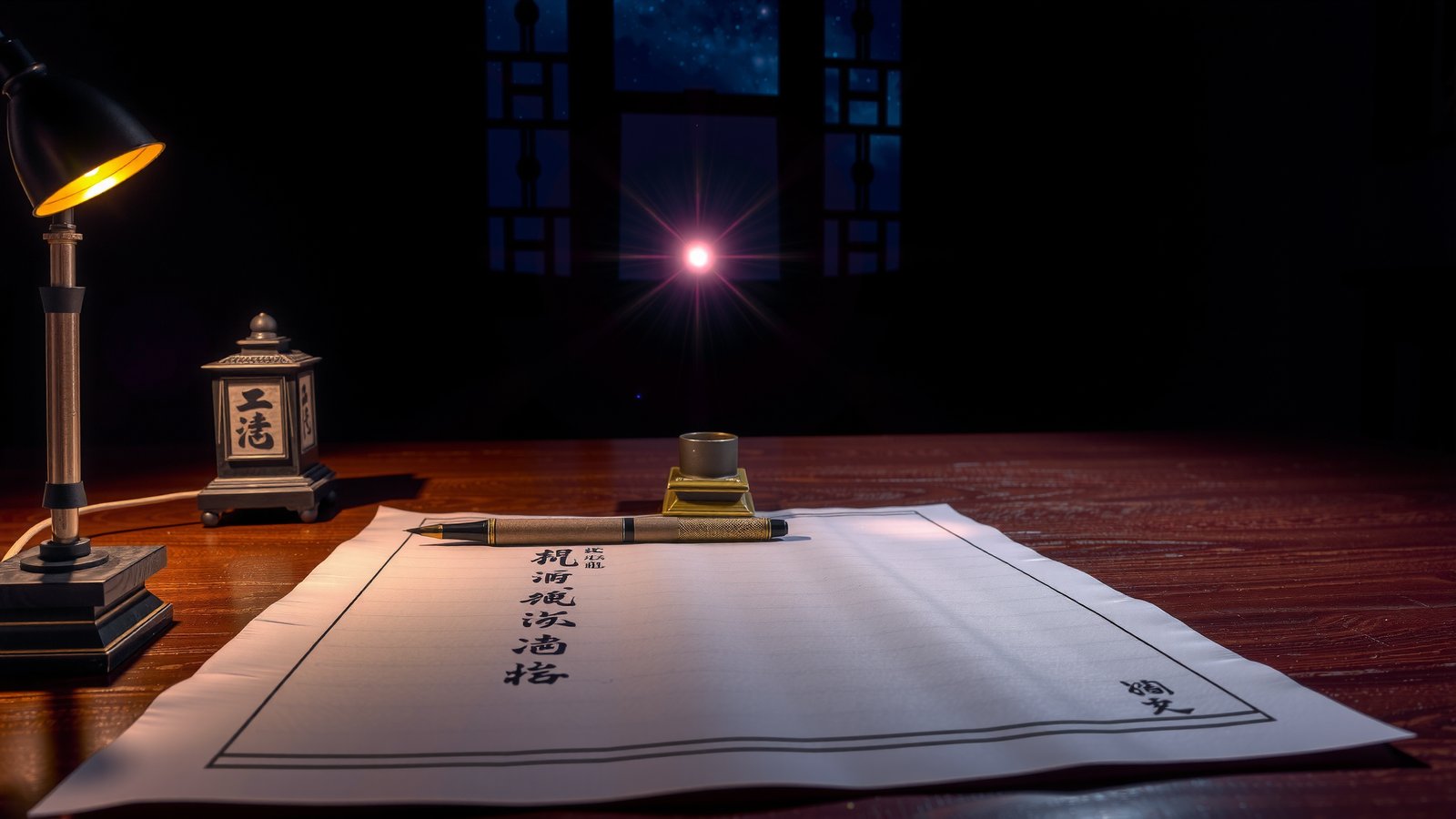
The brush tip touches the paper. And for that moment, the thinking stops. One character. Then another. The stop lasts maybe three seconds before your mind wanders off again. But you are going to repeat it several hundred times.—And then you look up, an hour has gone, there are two hundred and sixty-two characters on the page, and the room has gone very quiet.
That is what shakyō is.
💎 The one line that matters Copying a sutra looks like simple transcription, but what is actually happening is this: you are forced down to the speed of one character at a time, and you have to match it.
The Answer in Three Lines
- Shakyō is copying a Buddhist sutra by hand, one character at a time. It began as reproduction in a world without printing and became practice and prayer once printing made the copying unnecessary.
- The text almost everyone copies today is the Heart Sutra — about 262 characters, finishable in 60 to 90 minutes even the first time.
- You need almost nothing. Tracing paper and a brush pen, and you can start tonight at your kitchen table.
1. What Shakyō Actually Is — Not Reading, Copying
Shakyō means copying a sutra out by hand, one character at a time. That is the whole definition. You do not need to understand it. You do not need to believe anything. That is why it is easy to start — and it is also the most misunderstood part. Most people ask the obvious question: what is the point of writing something you cannot read?
Here is what you find out by doing it. Not being able to read it is the feature. When you copy text you understand, you read ahead. Your mind gets in front of your hand. And once the mind is in front, the writing itself stops holding your attention. Classical Chinese characters block that.
Each character arrives as itself, and nothing more. So your attention stays on the stroke you are making. Structurally, this is what sitting meditation does with the breath. If zazen (Article 154) concentrates by giving you nothing to do, shakyō concentrates by giving you one small thing to do.
Some people get louder in their heads when they sit still. Some people cannot stand having idle hands. There is a meditation built for those people, and it fits on a desk.
2. The History — From State Scriptorium to Private Prayer
Sutra copying began for an unglamorous reason: there was no printing. If you wanted the text to exist somewhere else, someone had to write it out. The practice came to Japan with Buddhism, via China and the Korean peninsula. The oldest surviving dated example in Japan is a copy of the Kongōjō darani kyō, dated 686 CE.
By the Nara period, copying was a government operation. There were official scriptoria staffed by professional copyists. And remarkably, we know the details — because the Shōsōin documents preserved the paperwork: name rosters, paper and brush allocations, wages, days worked. The records indicate copyists had daily output expectations, and that miscopying could cost them pay.
Which means, at the time, this was not meditation. It was a job. The character of shakyō changed when printing spread. Once nobody needed the copies, what remained was the act of writing itself — kept alive as memorial, petition, and training. What outlived the purpose turned out to be the durable part.
That happens to a lot of things we now call tradition.
3. Why the Heart Sutra — What 262 Characters Buys You
Overwhelmingly, the text copied today is the Heart Sutra (Hannya Shingyō), in the translation attributed to Xuanzang. There are several reasons. It is short. About 262 characters, depending how you count. It fits on one sheet and finishes in one sitting — which matters enormously for whether a practice survives contact with real life.
It is complete. Not an excerpt of something longer. It opens, it develops, it closes. It is central. It compresses the prajñāpāramitā teaching on emptiness, including the famous line usually rendered “form is emptiness, emptiness is form.” I said you do not need the meaning. Still, one thing is worth knowing before you start, because it changes how the writing feels.
What the text keeps saying is no. No eye, no ear, no nose, no tongue, no body, no mind. No form, no sound, no scent, no taste, no touch, no object of mind. This is not a declaration of nothingness. It is a way of saying: not as a fixed, independent thing. The mountain ascetics tried to confirm that with their legs. Esoteric Buddhism (Article 155) approached it through mantra and image. Same direction, different doors.
While you write, those 262 characters pass through your hand. You do not have to understand them. The passing-through is the part that stays.
4. Tracing, Copying, Drawing — Three Formats Compared
“Shakyō” covers several different practices.
| Format | What it is | Difficulty | Time | Best for |
|---|---|---|---|---|
| Tracing sheets (nazori) | The text is printed faintly; you trace it | Easy | 40–60 min | Every first-timer |
| Model underneath | A model sheet sits under blank paper | Medium | 60–90 min | Second time onward |
| Model beside you | You copy from a model placed to the side | Hard | 90+ min | People with brush experience |
| Shabutsu (Buddha drawing) | Tracing or drawing a Buddhist image | Medium | 60–120 min | People who prefer images to text |
| One stone, one character | A single character on a stone, offered | — | Event-based | Temple ceremonies |
For the first attempt, use tracing sheets. Do not deliberate. The reason is simple: when you are not deciding what the character should look like, all of your attention goes into making the stroke. “Will this look bad?” is the single most disruptive thought available during shakyō. Tracing removes it before it starts.
5. The Tools — Four Items Is the Whole Kit
The barrier to entry is remarkably low.
| Item | Role | What to get first |
|---|---|---|
| Copying paper | Ruled, usually with a faint model | A tracing-type pack of ~20 sheets |
| Brush pen or small brush | The writing tool | A fude (bristle-tip) brush pen, fine |
| Felt underlay | Protects the desk, steadies the stroke | Felt, not plastic |
| Paperweights | Keep the sheet still | Two of them |
Optional: ink stick and inkstone, incense, a small dish of water. Grinding ink is traditional, and the grinding itself is a settling ritual. On days you have the time, do it. On days you do not, a brush pen costs you nothing that matters. The number one reason people stop is that setup feels like work.
Keep the kit small enough to leave out. Paper and pen at the front of the drawer. That one detail changes the odds more than willpower does.
6. How to Do Shakyō — Seven Steps at Your Desk
Etiquette varies by temple and school. This is the basic home version. Step 1: Wash your hands, rinse your mouth. It looks ceremonial. It is functional: it tells your body a different kind of time is starting. Step 2: Clear the desk. Everything except the paper and the tools goes out of sight. Put your phone in another room — face-down is not enough.
Step 3: Sit straight. Spine up, both feet on the floor, square to the paper. Don’t hunch; it shortens your breathing. Step 4: Palms together, breathe a few times. Less a religious act than a marker for the start. Three slow exhales. Step 5: Write. Title first, then the body. If you make a mistake, do not restart. Being unable to erase is part of the practice. If it bothers you, there is an old convention: write the correct character small, to the right of the error.
Step 6: Write the dedication, date, and your name. One or two lines at the end (see chapter 9). Step 7: Palms together to close. Look at the finished sheet for a moment before you put it away. Expect 40–60 minutes for tracing, around 90 working from a model. You are allowed to stand up partway through. And if you cannot finish in one sitting, splitting it across days is still shakyō.
7. The Structure of Writing Meditation — Compared to Sitting
Shakyō gets called a “moving meditation” because the anchor for your attention is outside your body. Lined up, the differences are sharp.
| Aspect | Zazen | Breathwork | Mantra / chanting | Shakyō |
|---|---|---|---|---|
| Attention anchor | Breath, posture | Count and length | Voice and sound | Brush tip and paper |
| Body state | Still | Still | Still, light voicing | Only the hand moves |
| Handling distraction | Notice, return | Restart the count | Restart the phrase | The hand keeps going, so you return on your own |
| How it ends | By the clock | By count | By repetitions | When the text ends |
| What remains | Nothing | Nothing | Nothing | A sheet of paper |
| Suits | People who can be still | People who like counting | People with a private space | People who need to move their hands |
Look at the last two rows. The ending arrives by itself. And there is an object at the end. The two reasons people give up on sitting meditation are almost always “I never know when to stop” and “it doesn’t feel like I did anything.” Shakyō answers both structurally, not motivationally.
You are done when the text is done. The paper is the receipt. That is a design solution. People don’t fail at practice because their willpower is defective; they fail because the practice was never shaped to survive an ordinary week. Shakyō comes pre-shaped. For the sitting side of the same coin, see Mindfulness Meditation: A Complete Introduction (Article 121).
8. What the Evidence Does and Does Not Support
This section is going to disappoint some readers, and it should. There is almost no reliable research on shakyō itself. Claims that copying sutras dissolves stress or “activates the brain” circulate widely, but they are typically unsourced, or they borrow a conclusion from a study about something else.
There is, however, adjacent work worth knowing. On handwriting: Mueller and Oppenheimer reported in 2014 that students taking lecture notes by hand outperformed laptop note-takers on conceptual questions. The proposed mechanism is that handwriting is slow, so you must summarize before you write — and the summarizing is what deepened understanding.
On brain activity: van der Meer and colleagues reported in 2017, using high-density EEG, that handwriting and drawing produced different activity patterns from typing in frequency bands associated with learning and memory. Both are studies of learning, not of contemplative practice. Transferring them wholesale to shakyō would be exactly the move this article is criticizing.
To summarize honestly:
| Claim | Strength of evidence |
|---|---|
| Handwriting outperforms typing in some learning contexts | Moderate (Mueller & Oppenheimer, 2014, and others) |
| Handwriting produces distinguishable brain activity patterns | Moderate (van der Meer et al., 2017 — small sample) |
| Steady repetitive tasks help stabilize attention | Weak to moderate |
| Shakyō reduces stress or anxiety | Unproven — direct studies barely exist |
| Shakyō cures illness or improves fortune | Unproven |
What can be said with confidence is only this: One hour existed in your day with no screen in it, doing exactly one thing. It is hard to believe that is worthless. It is also not something current science can put a number on — and that line is where honesty sits.
9. The Dedication Line — What to Write at the End
The last lines of a copied sutra carry the dedication (ganmon). There are formal conventions; at home you have more latitude. The basic shape:
For: ________________ (the intention, or the person)
                        Date
                        Your name
Traditional intentions include:
- For the safety of my household
- For the spirits of the ancestors
- For the repose of ______ (a specific person who has died)
- For the fulfillment of a wish held in the heart
Your own words are equally acceptable. “For my mother’s surgery to go well.” “For getting through this year without breaking down.” Shakyō accepts both. One observation, offered gently: Some people find the dedication line is the part that helps. Most of us go weeks without putting a wish into words. Writing one line, to no one in particular, in the corner of a page — that does something independent of whether the wish is granted.
It tells you what you are currently protecting.
10. What to Do With the Finished Sheet
You have options, and they are broader than most people think. Option 1: Offer it at a temple. Many temples accept copied sutras, usually with a small offering; some accept them by mail. The Japanese pilgrimage “stamp book” takes its name from this older practice of depositing copied sutras.
Option 2: Keep it at home. On a household altar if you have one; otherwise wrapped in paper somewhere clean. Option 3: Dispose of it. This surprises people, but it is fine. Temples hold ceremonial burnings, and respectful disposal as paper is also acceptable. What matters is not ending up unable to write because you cannot throw anything away. Shakyō is not an accumulation practice. The hour is the object. The paper is its shadow.
If you want to offer one in person, Zen Temple Pilgrimage in Japan (Article 156) covers how to find temples that accept them.
11. How to Keep It Going — One Line a Day Counts
People stop for one reason: there is no hour available. There is a quiet way around this. Write one line a day. The traditional format is seventeen characters per line. Seventeen characters takes under three minutes. At roughly seventeen lines to the sheet, that finishes a Heart Sutra in about two weeks.
Writing the whole thing at once is climbing a mountain. One line a day is stepping out the front door every morning. Both are valid forms. Practical notes for continuing:
- Fix the time, not the amount — a set hour beats a set quota
- Leave the tools out — every put-away lengthens the distance to next time
- Do not count sheets — the moment it becomes a tally, it becomes work again
- Sound is allowed — quiet ambient sound is fine if silence unsettles you; anything with lyrics competes for the same channel as the characters
- On bad days, just look at the paper — that also counts
12. Where to Do It — Temples, Sessions, and by Mail
Home is easiest, but do it once in a temple if you can. The difference is the room: tatami, incense, distant sounds, other people’s brushes. The quality of the attention is simply not the same as at your desk.
| Type | Character | Booking | Typical cost |
|---|---|---|---|
| Tourist temple session | Full kit provided, beginner-friendly | Often walk-in | ¥1,000–3,000 |
| Zen temple copying group | Frequently paired with zazen | Usually required | ¥1,000–3,000 |
| Dedicated copying hall / circle | Guided, recurring | Required | Varies |
| Copy at home, mail it in | You write at home and post it | Not needed | Offering only |
Dates, fees, what to bring and whether you must book vary by temple and change over time. Always check the temple’s official information before you go. The famous temples of Kyoto and Nara mostly offer sessions. But a monthly copying group at an ordinary neighborhood temple is often quieter, cheaper, and far easier to keep attending.
13. Choosing Your First Kit — A Five-Point Checklist
Get these five right and the first kit will not disappoint you.
- Is the paper the tracing type? For the first attempt, yes, without debate. The text is printed faintly and you trace it. Choose a size that fits the whole Heart Sutra on one sheet — versions split across multiple pages break the session in half
- Is the brush pen a bristle (fude) tip, fine? Hard-tip pens are easier but produce no pressure variation, so the line goes flat. A genuine bristle tip in a fine size matches the character size used in copying paper. Refillable cartridges last far longer
- Is the underlay felt? On plastic the brush slides and the stroke will not settle. Thick felt absorbs the pressure. Many kits include one — check the contents list before buying
- Do you have two paperweights? One weight leaves the far side of the sheet floating. Paper shifting mid-stroke is the single most reliable way to lose your concentration. Two bar-type weights, top and bottom
- Does the whole kit fit in one box? This is quietly the most important item. If starting means pulling one box out of a drawer, you will start. If it means gathering four things from three places, the three minutes of gathering will cool the impulse
Tracing paper. Fine bristle brush pen. All in one box. That is a complete first kit.
14. Misconceptions and Cautions — Being Clear About Both
Common misconceptions
- “You need to be a Buddhist” — you do not. Most temple sessions do not ask about your faith or tradition
- “Bad handwriting is disrespectful” — shakyō is not calligraphy. Careful and skillful are different things
- “A mistake means starting over” — it does not. Write the correct character small, to the right
- “It’s pointless if you can’t read it” — not reading it is precisely what keeps your attention on the stroke
- “Copying it makes wishes come true” — shakyō is not a wish-granting device. It is a place to put a wish into words
About your body and mind
Shakyō is not a substitute for medical care. If you are being treated for depression or an anxiety disorder, follow your clinician’s guidance first. Practical cautions matter too. Long stretches head-down in one position load the neck, shoulders, lower back and eyes. Stand up every 30 minutes. If your eyes get tired, stop there — the session is still complete.
You do not need to kneel. A chair and a table are entirely sufficient. If your knees or back are a concern, do not force yourself onto the floor. And when your mood is very low, long sessions are not the thing to push. Repetitive quiet tasks can, in some states, feed rumination rather than settle it. On those days, a vocal practice such as mantra meditation (Article 63) — or simply a walk outdoors — may serve you better.
About This Article (Disclaimer & Advertising Notice)
This article is informational content about the history, culture and practice of sutra copying. It is not medical advice, psychotherapy, or religious solicitation. Nothing here about handwriting research is intended to guarantee improvement in any illness, symptom, relationship or financial situation, and individual experience varies. Research directly examining shakyō is essentially nonexistent at present; the studies cited concern learning contexts. If you are under medical care, follow your clinician’s instructions first. Prolonged writing in a fixed posture loads the neck, shoulders, back and eyes — take regular breaks. Session dates, fees, required items, booking policies and mail-in procedures differ by temple and change over time. Always confirm current details with the temple’s official information before visiting. This article does not encourage conversion to, or donation toward, any particular religion or sect.
[Advertising Notice] This article may in future contain affiliate links to products or services. Purchases made through such links carry no additional cost to you.
Consider, For Example, a Situation Like This
To make it concrete, here is one generalized scene (this is a hypothetical, generalized illustration — not anyone’s actual account). Suppose it is eleven at night, you cannot sleep, and you are sitting at your desk anyway. Tomorrow’s schedule keeps surfacing. A conversation from this afternoon is on its fourth replay.
The room is silent and your head is not. You open the drawer. Paper. Brush pen. One sheet. Two paperweights. The first character goes down thicker than you wanted, and it bothers you. The second character. Still bothering you. Around character ten, you notice it has stopped bothering you.
Character thirty. You are looking at nothing but the tip of the pen. You can hear the paper.—You could not hear the paper before. Past a hundred, this afternoon’s conversation comes back. But your hand does not stop. You remember it and keep writing. And then you come back to the character.
You finish all two hundred and sixty-two, write the date, write your name. An hour, nearly, has gone. Nothing has been solved. Tomorrow’s schedule is unchanged. The conversation did not un-happen. But there is an hour’s worth of characters on the desk. And usually — sleep is closer than it was.
Shakyō does not write down the answer. It just turns the volume of the thinking down for an hour.
This article does not guarantee any medical or health benefit and is not a substitute for professional medical care. If you have any health concerns, please consult a physician or other qualified professional.
📚 Related Articles
- What Is Shugendō? Complete Guide | Yamabushi, En no Gyōja, and the Ōmine Ridge
- What Is Shinto? A Complete Guide | The Eight Million Kami, Sacred Groves, and How to Visit a Shrine
- Zen Temples in Japan: A Complete Visitor’s Guide | Kyoto, Kamakura, Eiheiji, Zazen Sessions and How to Read a Rock Garden
- Esoteric Buddhism & Shingon: A Complete Introduction | Kūkai, Mandalas, Mantras and “Buddhahood in This Very Body”
FAQ (10 Questions)
Q1. Do I need to be Buddhist? Does my tradition matter?
No. Most temple sessions welcome anyone regardless of faith, and the Heart Sutra is read across many schools. If you are unsure about a specific temple, simply ask — they will tell you kindly.
Q2. My handwriting is bad. Should I still do this?
Yes. Shakyō is not calligraphy. What is asked for is care, not skill — and trying to look accomplished is the most reliable way to break your own concentration. Tracing sheets remove the question entirely.
Q3. Is a brush pen acceptable, or must I grind ink?
A brush pen is completely acceptable, and many temple sessions now supply them. Grinding ink is a lovely settling ritual, not a requirement. Prioritize whatever you will actually keep doing.
Q4. I made a mistake. Do I start over?
No. The old convention is to write the correct character small, to the right of the error. Accepting that it cannot be erased is part of the practice.
Q5. How long does it take? Can I stop halfway?
Roughly 40–60 minutes tracing, around 90 from a model. Stopping partway is fine. Writing one line a day and finishing a sheet over two weeks is a legitimate way to do it.
Q6. Can I copy something other than the Heart Sutra?
Yes. Very short texts such as the ten-phrase Kannon sutra, or short mantras, are sold as copying sheets and are gentle starting points if 262 characters feels like too much for a first session.
Q7. Do I have to offer the finished sheet at a temple?
No. Offer it, keep it, submit it for ceremonial burning, or dispose of it respectfully as paper — all are acceptable. What matters is not becoming unable to write because you cannot part with anything.
Q8. What should the dedication say? Are there rules?
Formal phrasings exist, but your own words are fine. Intention, date and name is a complete dedication. On days when nothing comes to mind, date and name alone will do.
Q9. Should I do it every day?
There is no rule. Some people copy weekly; some write a single line each morning. A fixed time of day holds better than a fixed quantity. If you lapse, restarting simply continues where you were.
Q10. Can I do this with children or older family members?
Yes. Short texts and illustrated tracing sheets exist for children. Because sustained fixed posture is tiring, cap the session at around 30 minutes, and for older family members use a chair, a table, and good lighting.
Conclusion | A Character Only Advances by One Character’s Worth of Time
The strangest thing about shakyōis that you cannot hurry it. However urgent you feel, the brush moves one character at a time. You cannot write two at once. You cannot skip ahead to the end. A character only advances by one character’s worth of time. Everything else we live inside is built the opposite way. Tabs open in parallel, notifications interrupt, summaries arrive before the text does. Speed is treated as good more or less unconditionally.
Shakyō is the simplest available way to step off that. No sitting posture to master, no mountain to climb, no silent retreat to find. Paper, a brush pen, and an hour. The Nara-period copyists did this as employment. For them it was not meditation and not training; it was labor, with line quotas and pay docked for errors.
And yet what survived thirteen centuries later was the writing itself. Some things outlast their purpose. This is one of them. For the wider view across contemplative traditions, see The Complete Guide to Spirituality (Article 91). Tonight, before you sleep, write one line. Seventeen characters.
Under three minutes. When you finish, and look at the paper for a moment, the room will be quieter than it was. Stars move at about this speed, too.
References
- Hajime Nakamura and Kazuyoshi Kino (trans., annot.), Hannya Shingyō / Kongō Hannya Kyō, Iwanami Bunko, 1960
- Tokoo Sakaehara, Shōsōin Monjo Nyūmon (An Introduction to the Shōsōin Documents), Kadokawa Sensho, 2011
- Donald S. Lopez Jr., The Heart Sūtra Explained: Indian and Tibetan Commentaries, State University of New York Press, 1988
- Mueller PA, Oppenheimer DM. “The Pen Is Mightier Than the Keyboard: Advantages of Longhand Over Laptop Note Taking.” Psychological Science, 2014;25(6):1159-1168.
- van der Meer ALH, van der Weel FR. “Only Three Fingers Write, but the Whole Brain Works: A High-Density EEG Study Showing Advantages of Drawing Over Typing for Learning.” Frontiers in Psychology, 2017;8:706.
MuZenCosmos — Where the cosmos meets stillness | A character only advances by one character’s worth of time