2026-10

Frequency & Music

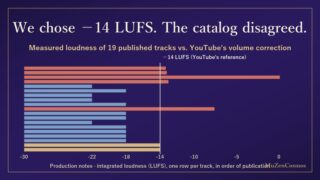
Production Notes: We Chose −14 LUFS, and the Catalog Disagreed — Measuring YouTube’s Volume Correction on My Own Videos

Three months after deciding to master at −14 LUFS, I matched measured masters against YouTube's Stats for nerds for the published long-form tracks: four levels (−22, −18, −13, −14) were mixed, and one track had been published clipped. A record of checking, on my own videos, that YouTube turns down but never up.
Frequency & Music

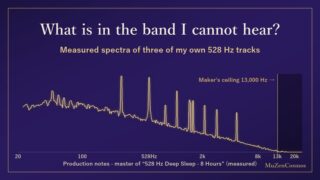
Production Notes: What Is in the Band I Cannot Hear? Measuring the Spectra of Three of My Own 528 Hz Tracks

My ears stop at 13,000 Hz. So what do my own tracks put above that? I measured the masters of three published 528 Hz tracks (Pure 3 h, Deep Sleep 8 h, Autumn Insects) with one procedure and show the charts and numbers, including one result I did not expect.
Frequency & Music

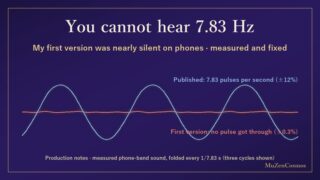
Production Notes: You Can’t Hear 7.83 Hz — Why My First Schumann Resonance Track Was Nearly Silent on Phones, and the Fix

7.83 Hz is below human hearing, so I made it a pulse: 7.83 gentle swells per second. But almost all of the first version sat below 400 Hz, so on phone speakers it was nearly silent and the pulse never arrived. The before/after of adding harmonics, with measured charts and numbers.
Frequency & Music

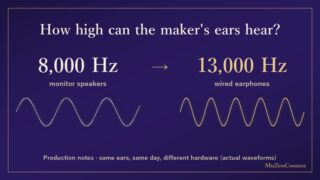
Production Notes: My Ears Top Out at 13,000 Hz — What I Learned Taking My Own Hearing Age Test

I took my own hearing age test: 8,000 Hz on the monitor's built-in speakers, 13,000 Hz on wired earphones. Same ears, a 5,000 Hz gap, and the reason was the hardware. An honest note on what a music maker does about the bands he cannot hear.
Frequency & Music

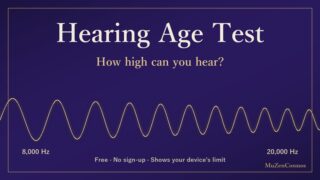
Hearing Age Test — How High Can You Hear? Play 8,000 to 20,000 Hz and Find Out (Free, No Sign-Up, Shows Your Device’s Limit)

A free in-browser tool that checks how high a pitch you can still hear. Set the volume with a 1,000 Hz reference, then step through 8,000 to 20,000 Hz. Shows the highest tone you heard, the commonly used age guide, your device's playback limit, and a check for guessing. Not a medical test.
Frequency & Music

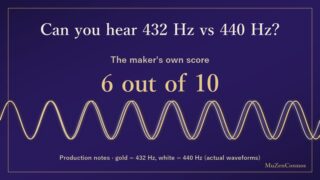
Production Notes: I Built a 432 Hz vs 440 Hz Blind Test, Took It Myself, and Scored 6 out of 10

I built a blind test for 432 Hz versus 440 Hz and took it myself: 6 out of 10. The chance of scoring 6 or more by guessing is about 38%, so that is not a score that shows I can hear the difference. An honest look at why, with the arithmetic and the state of the research.
Frequency & Music

Frequency Lab — Play and Compare the Solfeggio Tones, 432 Hz vs 440 Hz, and Binaural Beats (Free, No Sign-Up)

A free in-browser tool for hearing the nine Solfeggio tones, 432 Hz and 440 Hz as plain sound. Includes a blind test for telling 432 Hz from 440 Hz and a binaural-beat demo. Built by someone who makes frequency music, so you can listen first and read second.