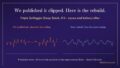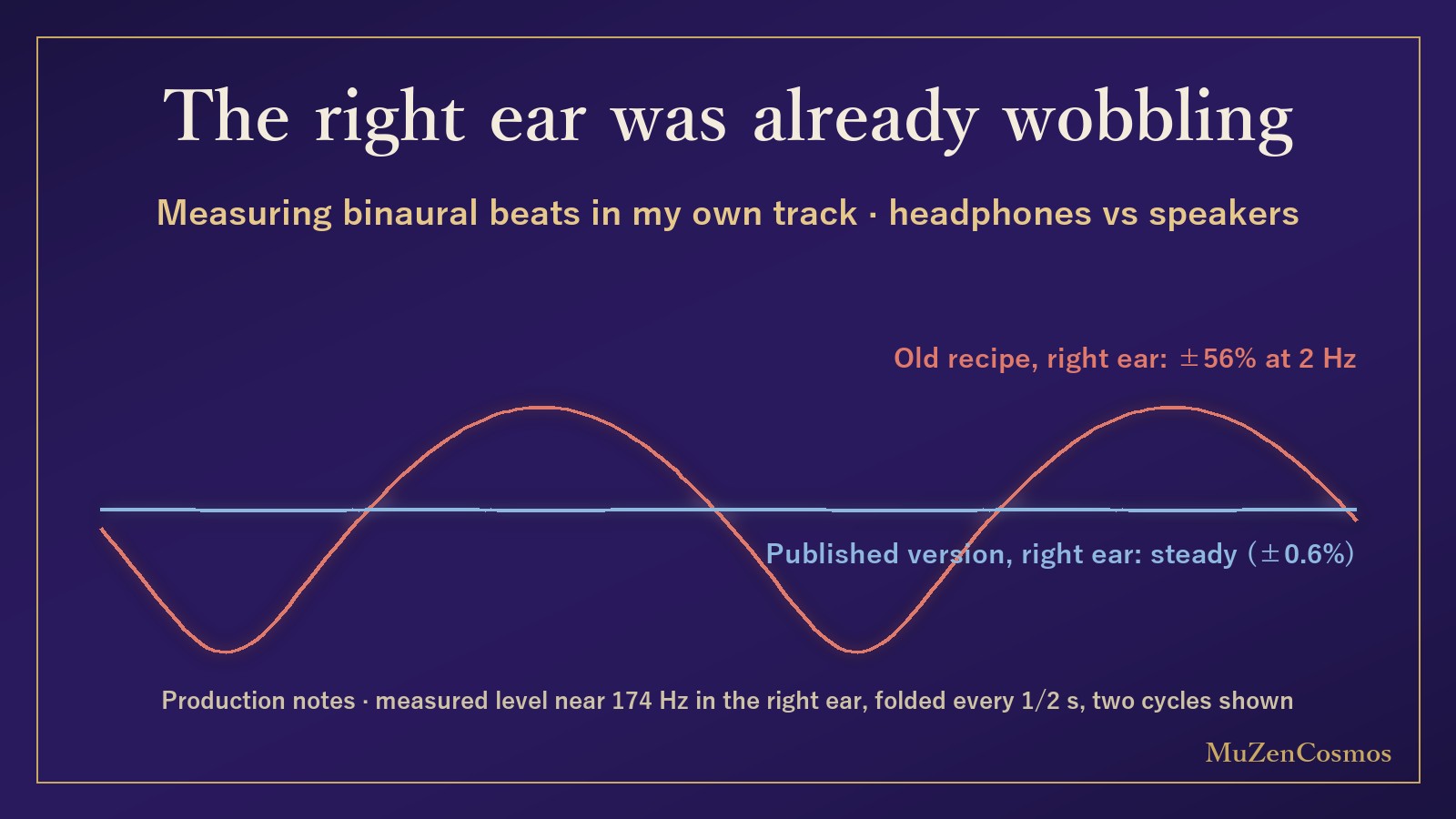
To write about binaural beats, I first measured my own track: an 8-hour sleep piece layering 174, 396 and 432 Hz with a 2 Hz left/right offset. The result: the sound reaching the right ear was already wobbling at 2 Hz on its own. As a binaural beat, it was built wrong. Here is how I measured it and what changed after the fix.
A binaural beat vs. an ordinary beat
A binaural beat plays two slightly different pitches separately to each ear, say 174 Hz on the left and 176 Hz on the right. The sound reaching each ear is a steady tone with no wobble. Yet a fluctuation at the difference, two per second, is perceived. A 2023 systematic review describes this as perceptible for differences of roughly 1 to 30 Hz (Ingendoh et al. 2023).
If 174 Hz and 176 Hz are played into the same ear, or from the same speaker, they mix in the air and the sound itself gets louder and softer twice a second. That is the ordinary acoustic beat, also called a monaural beat. The wobble is in the sound before it reaches you, so a microphone can measure it.
So in a correctly built binaural beat, neither the left-ear signal nor the right-ear signal should wobble at 2 Hz. Measure that, and you know whether it is built right.
Method
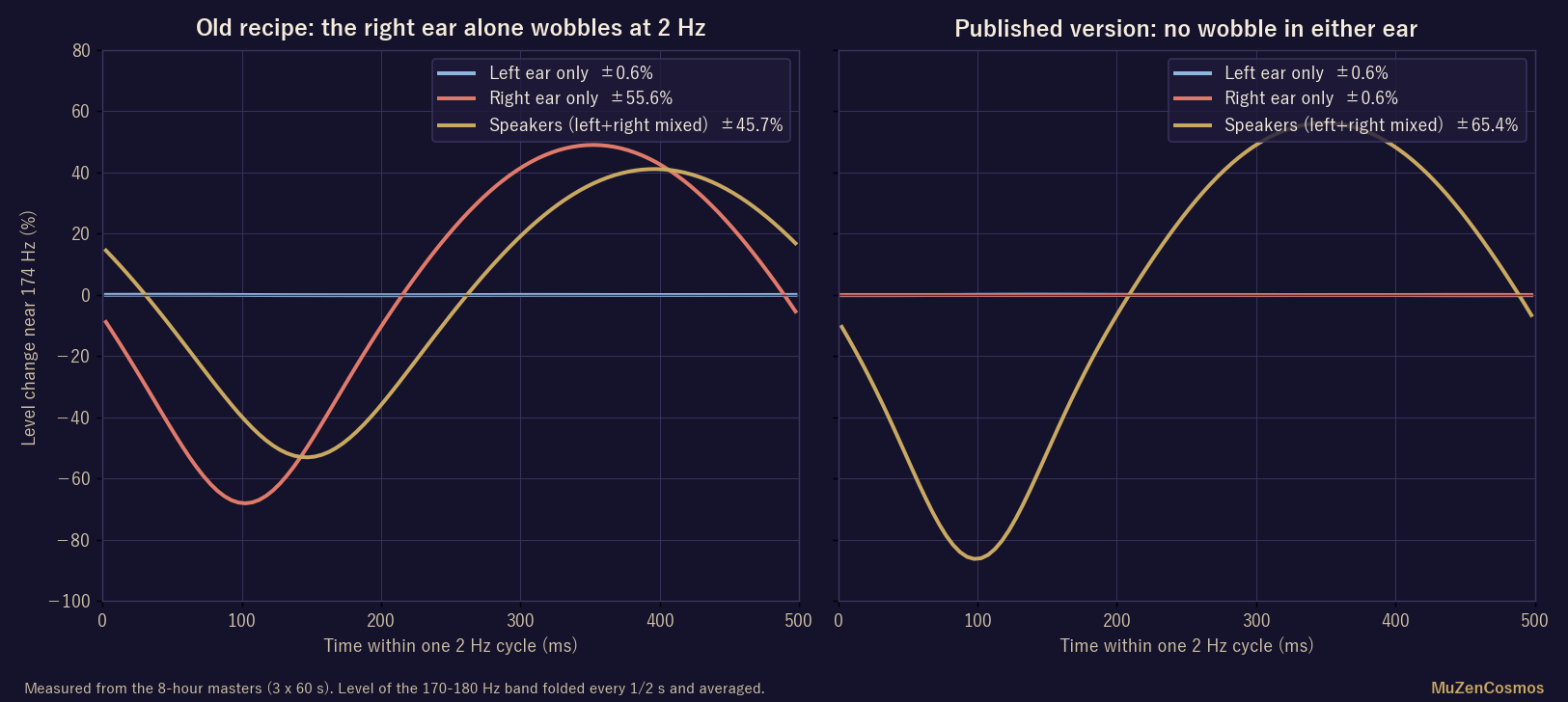
From the 8-hour master I took three 60-second segments and measured, for the left channel alone, the right channel alone, and left plus right (close to what speakers produce), how deeply the level near 174 Hz swings twice per second. The chart shows that swing folded every 1/2 s and averaged.
Results
| Old recipe | Published version | |
|---|---|---|
| 2 Hz swing, left ear only | ±0.6% | ±0.6% |
| 2 Hz swing, right ear only | ±55.6% | ±0.6% |
| Left + right mixed (speakers) | ±45.7% | ±65.4% |
| 174 Hz level in the right ear | -22.6 dBFS | -76.1 dBFS (essentially none) |
| 176 Hz level in the right ear | -18.9 dBFS | -16.6 dBFS |
| 174 Hz level in the left ear | -15.7 dBFS | -16.6 dBFS |
Why the right ear was wobbling
The track has a sustained 174 Hz layer, and it was in both channels. On top of that, for the binaural part, 174 Hz was added on the left and 176 Hz on the right. So the right ear received both 174 Hz and 176 Hz, and two tones in one ear make an ordinary beat. The left/right pitch difference was exactly 2.000 Hz as designed, but separately, the sound inside the right ear was wobbling. The original version published in May was built the same way.
The fix
I replaced the right ear’s sustained 174 Hz with 176 Hz, so the left carries only 174 Hz and the right only 176 Hz. During the rebuild I also found that sending these two tones through the reverb made the left and right reverb tails interfere differently, leaving the right side 5 dB quieter. So these two tones now bypass the reverb, while the other layers (396 Hz, 432 Hz, noise) keep their reverb. The left/right level difference is now within 0.2 dB. The corrected version is here, and the full rebuild is documented in the previous production note.
The channel’s other tracks
I measured the seven 20-minute focus tracks the same way. Their descriptions say “monaural beats (no headphones needed)”, and measured, both ears do swing by the same amount. They are what they say they are.
What research says
One idea is that listening to binaural beats pulls brainwaves toward the beat frequency. A 2023 systematic review of 14 EEG studies found 5 consistent with that idea, 8 contradicting it and 1 mixed, and noted that the studies differed so much in how the beats were made and measured that they are hard to compare (Ingendoh et al. 2023, PLOS ONE). This note checks how the sound is built; it does not address what it does to a listener.
For listeners: how to check for yourself
- Binaural beats are meant for headphones or earphones. On speakers the two sides mix and you hear an ordinary (monaural) beat.
- Try a track labelled “binaural” with only one earbud in. If you hear a regular pulsing in one ear alone, the track is not a pure binaural beat (some are deliberately made as monaural beats).
- You can try separate left and right tones in the binaural section of the Frequency Lab. The basics are in our binaural beats guide.
What this measurement does not tell
- I measured the master before upload, not the sound after YouTube’s re-encoding.
- The swing depth is measured on the band near 174 Hz only, not on the overall level including noise and other layers.
- How deep a swing people actually notice was not measured here.
This article does not guarantee any medical or health benefit and is not a substitute for professional medical care. If you have any health concerns, please consult a physician or other qualified professional.