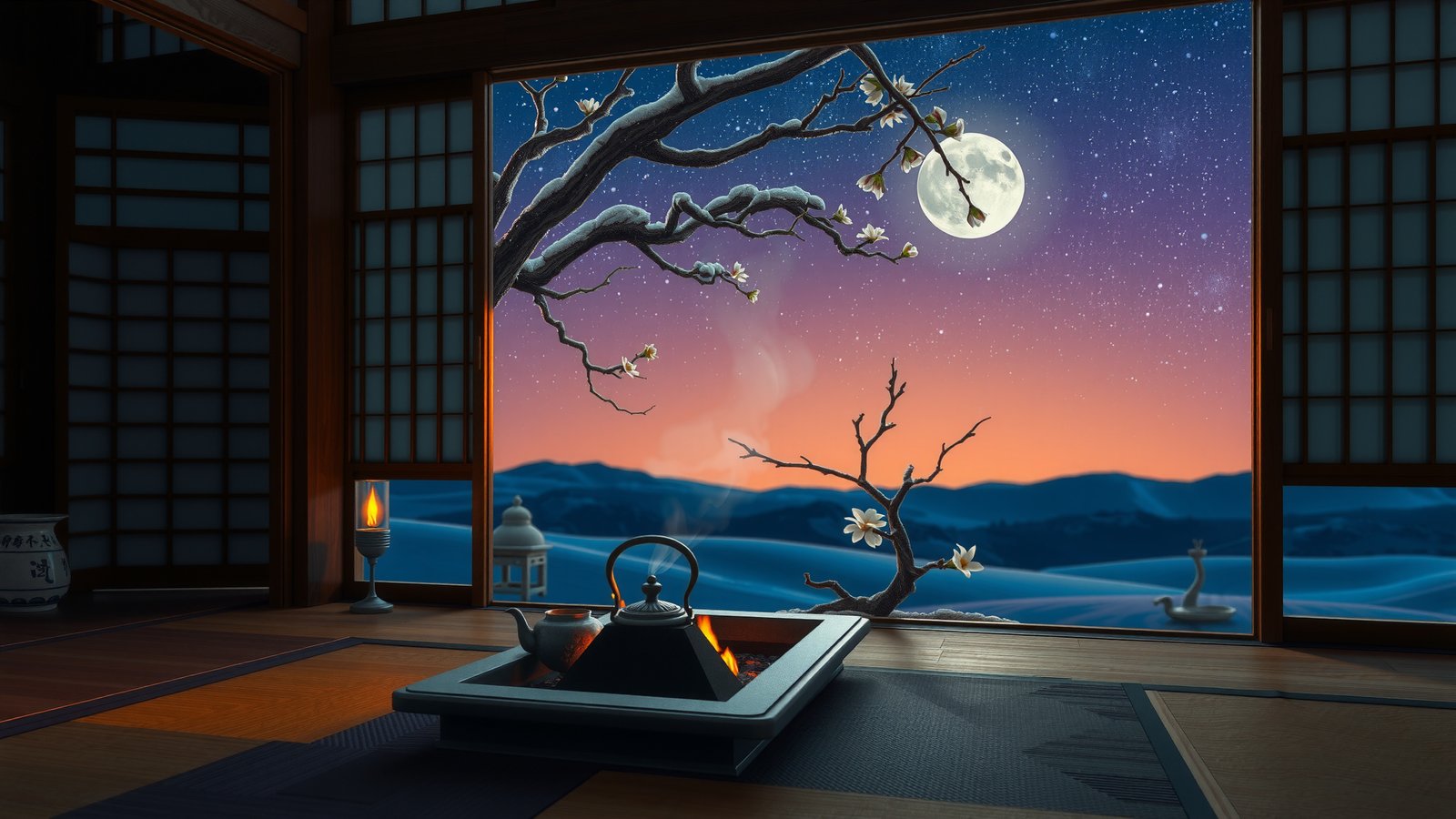
There is a morning
when you open the window
and the quality of the air
has changed.
Not cold,
exactly.
Dry.
The wind that felt
faintly damp yesterday
goes straight past
your cheek today.
From that morning on,
the stars begin
to look
suddenly
close.
And people,
for no reason
they can name,
feel like
reaching out
to someone.
The name given
to that doorway
is Rittou —
literally,
“winter stands.”
The beginning of winter,
on the calendar.
What follows is the story
of the solar term Rittou.
And its slow resonance
with 639Hz —
the Solfeggio tone
traditionally said
to stand for
connection.
The answer, in three lines
Rittou is the nineteenth of the 24 solar terms, the day the sun reaches 225° of celestial longitude (around November 7 in 2026). On the calendar, winter begins here: sasanqua camellias bloom, and the ground starts to freeze. Solfeggio 639Hz is traditionally associated with relationship, connection and harmony — which sits poetically alongside Rittou’s rites of fire and gathering (Robiraki and Inoko). There is no historical link between the two, and nothing here claims an effect.
💎 The one line of this article
What Rittou teaches is that the coldest night is the night you are most directly connected to the sky. Which is why people gather around a fire.
The 30-Second Summary
- Rittou is the nineteenth of the 24 solar terms — the day the sun reaches 225° of celestial longitude, around November 7 in 2026 (dates shift by a day depending on the year, so an annual almanac is the reliable source)
- It is one of the four “standing” terms (Risshun, Rikka, Risshuu, Rittou) — the doorway into a season rather than its middle
- Its three micro-seasons are “camellias begin to bloom” → “the earth begins to freeze” → “the golden cup blooms”
- That “golden cup” is not the marigold it sounds like — it is said to describe the narcissus, whose small yellow corona was likened to a cup of gold
- Japan’s meteorological agency announces the season’s first winter wind (“kogarashi No. 1”) for only two regions — Tokyo and Kinki. It is not a nationwide term
- Clear, still nights are the coldest ones. With no clouds to reflect it back, the ground’s heat escapes straight into space — radiative cooling
- 639Hz is traditionally described as the tone of relationship, connection and harmony
- In equal temperament at A=440Hz, it falls almost exactly between E♭5 (about 622.25Hz) and E5 (about 659.26Hz) — a tone belonging to neither key
- All of this is symbolic language, not a claim of scientific effect
1. What Rittou Is — The Day Winter Is Named
Rittou is the nineteenth of the 24 solar terms,
the traditional East Asian division
of the year into 24 parts
based on the position
of the sun.
It marks the day the sun passes
225° of celestial longitude.
In 2026, Rittou falls around November 7.
(Because these dates depend on solar position, they can shift by a day from year to year. The annual almanac published by a national observatory is the dependable reference.)
Rittou is one of the
four “standing” terms —
Risshun, Rikka, Risshuu, Rittou —
the four doorways
of the year.
What is striking
is that Rittou is not
“the day it got cold.”
It is
the day it will get cold.
In early November,
many years are still mild
at midday.
And yet the calendar
declares winter
ahead of
the body.
Why?
Because the solar terms are measured
by the height of the sun,
not by temperature.
Heat lags behind light.
The ground and the sea
hold what they absorbed,
then release it slowly —
and that delay
is the gap
between the almanac
and the skin.
Rittou, then, is
the day the light becomes winter,
before the air does.
For the term just before this one, see
Soukou and 417Hz — When Dew Becomes Frost
2. The 72 Micro-Seasons of Rittou — Camellia, Frozen Ground, and a Cup of Gold
Each solar term divides again
into three micro-seasons.
For Rittou, they run:
- Tsubaki hajimete hiraku — camellias begin to bloom
- Chi hajimete kōru — the earth begins to freeze
- Kinsenka saku — the golden cup blooms
Two of these three
are easy to misread.
The first:
the characters read literally
as “mountain tea,”
a Chinese term for
the camellia family.
But the flower that actually opens
in Japan at this hour of the year
is usually the sasanqua
(Camellia sasanqua) —
and the old name has been carried over
to the flower at hand.
The third:
“golden cup” is
not the marigold
whose Japanese name
sounds identical.
Look into a narcissus
and you find,
at the center of the white petals,
a small yellow
cup.
That corona was likened
to a cup of gold,
and the micro-season
took its name.
So the sequence reads:
bloom (camellia),
freeze (earth),
bloom (narcissus).
Flowering appears
twice
inside a season
that is hardening.
Winter is not the season
when things stop.
It is the season when
what blooms
changes.
3. The First Winter Wind — And Why Only Two Regions Announce It
Around Rittou,
the Japanese news begins
to mention
“kogarashi No. 1” —
the season’s first
withering wind.
What surprises many people
is that this announcement is made
for only two regions:
Tokyo and Kinki.
There is no
“first winter wind”
for Hokkaido
or for Kyushu.
The reason usually given
is that kogarashi was never
a nationwide technical term —
it was a local word,
grown from how a particular place
experiences its own weather.
Conditions vary by region,
but broadly the wind must arrive
- within a defined window
from mid-autumn into early winter - under a winter pressure pattern
(high to the west, low to the east) - from a direction between
west-northwest and north - at a maximum speed of
roughly 8 meters per second or more
Some years,
no wind qualifies —
and the season passes
with no No. 1 at all.
What is worth pausing on
is the impulse itself:
someone decided
to number the wind.
Wind cannot be seen.
It leaves no shape.
And still, people wanted
to count
the first breath
of the year.
To count something
is to enter
a kind of
relationship with it.
You give it a name,
assign it a number,
and quietly assume
you will meet again
next year.
4. Why the Winter Sky Turns Clear — And Why the Stars Will Not Hold Still
After Rittou,
the night sky changes.
Not because there are
more stars.
Because the air
has changed.
Under a winter pressure pattern,
dry continental air
flows in.
Cold air can hold
far less water vapor,
and less vapor means
less to scatter
and blur
the light.
Colder ground also weakens
the vertical mixing of air,
so dust and smoke
are stirred up less.
The result is a sky
of high transparency.
And yet —
here is the contradiction —
winter stars twinkle
more, not less.
Clear, but restless.
The usual explanation is the jet stream,
which sits strongly overhead
in this season.
When fast, turbulent air moves
high above you,
starlight passing through it
shimmers.
So the winter sky is
easy to see through,
and never still.
Transparency and calm
turn out to be
two different things.
Which is not so far
from what happens
between people.
The better you come to see someone,
the more of their
unsteadiness
you can see too.
Clarity does not
promise quiet.
5. Radiative Cooling — The Coldest Night Is the Connected One
From Rittou onward,
the morning chill
becomes unmistakable.
And strangely,
the morning after a clear day
is the coldest.
The mechanism is
radiative cooling.
By day, the ground absorbs
heat from the sun.
By night, it releases that heat
as infrared radiation.
When clouds are present,
part of that outgoing heat
is reflected back down.
A cloud layer works
like a blanket
over the ground.
On a clear night,
there is no blanket.
The ground’s heat travels
straight out into space,
with nothing
in the way.
So it cools.
And if the wind is weak,
the chilled air is never stirred,
it pools at ground level,
and the cold deepens further.
Here is the heart
of this article.
The coldest night
is the night the ground and the cosmos
are directly connected.
That the clearest, most star-filled nights
are the cold ones
is not a coincidence.
Seeing well and losing heat
are two faces
of a single fact:
that nothing
stands between.
That the distance
has closed.
— And on exactly those nights,
human beings
gather around fire.
They grew cold,
so they moved closer.
That the rites of Rittou
cluster around fire and company
is probably
no accident at all.
6. What 639Hz Is — The Tone of Relationship
639Hz is the third
of the six Solfeggio tones
most often listed —
396, 417, 528, 639, 741, 852.
In the traditional telling,
it is associated with
- relationship between people
- connection and harmony
- being understood, and speaking
In chakra systems it is often laid
over the fourth chakra
(Anahata, the heart).
For more on this tone, see
639Hz — The Frequency of Connection and Love
and
The Complete Guide to 639Hz
A short note on tuning.
In equal temperament with A=440Hz:
- E♭5 is about 622.25Hz
- E5 is about 659.26Hz
639Hz falls
between them.
Roughly 46 cents above E♭,
roughly 54 cents below E.
A semitone is 100 cents —
so 639Hz sits almost exactly
in the middle of two
neighboring keys.
Last month’s 417Hz was
only 7 cents from A♭:
almost the same note.
639Hz is the opposite case.
It is as far as possible
from both.
A piano cannot
play it.
And still, no position
could suit the theme
of relationship
more precisely.
A relationship does not live
inside either person.
It appears in the place
that belongs to
neither of them.
7. What Is Said About “639Hz Effects” — Drawing the Honest Line
Here is our honest accounting
of the claims made for 639Hz.
What is said (its traditional position)
- In the modern Solfeggio tradition, 639Hz is presented as a tone for repairing relationship and for speaking what is unsaid
- Placed at the heart chakra, it is described as balancing receiving and offering
- That shared musical experience — singing together, listening together — can affect feelings of social connection has some research support in choral and music-therapy literature. That finding is about shared music, not about 639Hz specifically
- A steady background tone may make a conversation feel less tense. Again, that is a general property of sound environments, not of one frequency
What cannot be said (not a scientific claim)
- There is no established scientific evidence that 639Hz repairs human relationships
- Claims that it moves another person’s feelings or attracts connection lack peer-reviewed support
- No causal link has been demonstrated between listening and improved relationships
- The Solfeggio system itself is a relatively modern reconstruction popularized in the late twentieth century — not an unbroken ancient tuning system
So 639Hz is best held
not as a magic tone
that changes relationships,
but as
a symbolic tone for quietly
remembering someone.
That said,
the pull toward company
as the cold arrives
is an entirely
natural feeling.
8. The Symbolic Link Between Rittou and 639Hz
To be direct:
there is no historical or textual link
between the solar term Rittou
and Solfeggio frequencies.
The 24 solar terms were systematized
in ancient China.
Robiraki and Inoko grew
in medieval Japan and after.
The modern Solfeggio system spread
from the late twentieth century.
Different eras.
Different cultures.
But laid side by side
as structures of theme,
a soft resonance appears.
- Radiative cooling means nothing stands between ground and sky — connection shows up first as cold
- The cold drive people toward the fire — closeness usually begins on the side of weakness
- 639Hz falls between two keys — a relationship cannot exist in one person’s territory alone
So the suggestion is this:
“Play 639Hz softly,
and bring to mind one person
who has drifted a little further away.“
Held against Rittou’s own theme —
opening the fire, inviting people in —
the two can be
tasted together, poetically.
Not as an academic claim.
As one way of reading
symbol
against symbol.
9. Soukou, Rittou and Shousetsu × Frequency — A Symbolic Comparison
Per the v2.6 rule, a comparison table
placing Rittou between its neighbors.
| Aspect | Soukou (before, ~Oct 23) | Rittou (~Nov 7) | Shousetsu (after, ~Nov 22) |
|---|---|---|---|
| Felt season | Dew turns to frost; autumn nears its end | Winter begins on the calendar; the air dries and clears | Cold rain begins to carry snow |
| Signs in nature | First frost, intermittent drizzle, maples and ivy coloring | Sasanqua blooms, the ground begins to freeze, narcissus opens | Rainbows grow rare; north wind strips the leaves |
| Work and rites | Leaf-viewing, drying persimmons, closing the harvest | Robiraki, Inoko, opening the kotatsu, Shichi-Go-San | Harvest thanksgiving; winter preparations completed |
| Associated tone (example) | 417Hz (change, turning) | 639Hz (relationship, connection) | — |
| Inner posture | Hold letting go and new color at the same time | Know that the cold earns you the right to come closer | Count quietly what is diminishing |
※ This mapping is a poetic guideline only, not a claim that a frequency can alter a season.
10. Living with Rittou and 639Hz — Small Habits of Fire and Memory
A few concrete ways
to spend this term.
- Make the first heating of the year slightly ceremonial: before you flip the switch, look around the room and take one deep breath. Robiraki was never only about swapping equipment — it was a way of telling yourself the season had turned. A few seconds is enough
- At night, play 639Hz softly and bring to mind one person who has drifted further away: you do not have to contact them. You do not need a reason to. Remembering is far enough. Neither low nor high, 639Hz sits quietly behind this kind of thinking
- On a clear night, step outside for five minutes: after Rittou the air dries and the stars come close. If you feel the cold, that cold is evidence that nothing stands between. Knowing that chill and clarity are one thing changes what the cold means
On building an evening habit around sound, see
And for those who want a more careful form of “bringing someone to mind,” there is an old one:
These are offered as habits
of rest and reflection.
They do not guarantee
improvement in physical
or psychological
condition.
11. Safety and Cautions
A few lines worth holding
at this time of year.
- Inspect heating equipment before you use it. Do not run a device that has been stored for six months for hours on end straight away. Dust burning off, unfamiliar noises, a frayed cord — stay nearby for the first thirty minutes. That the old rites tied fire-opening to fire protection reflects a real seasonal danger
- Pair heating with ventilation. Rooms with combustion heaters need regular air exchange. Playing music encourages sealed windows — let a timer double as your ventilation cue
- Do not load “I must fix this relationship” onto a tone. 639Hz is presented as the frequency of connection, but listening guarantees no change. Turned into a source of urgency, sound stops being rest
- Do not push your body through sudden cold. Moving from a warm room into a cold one puts real strain on the body. Around bathing and early-morning departures especially, shrink the temperature gap
- Do not treat low mood at the start of winter with sound alone. Shorter daylight makes mood fluctuation more likely. If low mood persists beyond two weeks, consult a professional rather than a playlist. 639Hz is not a substitute for medical care or counseling
12. Cultural Background — Robiraki, Inoko, and the Opening of the Kotatsu
The customs around Rittou
cluster around one thing:
fire.
The first is
Robiraki — “opening the hearth.”
In the world of tea,
the portable summer brazier
is put away,
and the sunken hearth
cut into the tatami
is opened for
the cold months.
At the same time comes
Kuchikiri —
the cutting of the seal
on the jar of new tea
picked in early summer
and left to rest.
Because the two coincide,
Robiraki has long been called
“the New Year
of tea people.”
The year begins
again, there.
The second is
Inoko.
On the day of the boar
in the tenth lunar month,
at the hour of the boar,
people ate
inoko mochi —
a custom traced back
to the Chinese genchō.
The boar, which bears
many young,
became a symbol of
descendants and continuity.
And in five-phase thought,
the boar belongs to
the element of water.
Water governs fire.
So a fire lit on that day
was believed to be
spared from
burning down the house —
which is why Robiraki
and opening the kotatsu
came to be scheduled
on the day of the boar.
In parts of western Japan,
children still go from house to house
striking the ground with a roped stone —
the inoko-tsuki.
The third is
Shichi-Go-San, November 15.
Once the hearth is lit
and the house is warm,
families go out together
to mark a child’s growing up.
— Set side by side,
these customs share one feature.
Not one of them
can be done alone.
Opening a fire.
Handing out rice cakes.
Walking a child somewhere.
The cold drove people
indoors,
and indoors,
they drifted
toward each other.
The rites at the start of winter
may simply be
the name given
to that movement:
they grew cold,
so they came closer.
13. The Sound Environment of Early Winter — A 5-Point Checklist
After Rittou, the air in the room
and the temperature of the bed
both shift to
winter settings.
Five points for tuning
warmth and sound together.
- Do you know what your heater sounds like? Fan noise fills a wide low band. Rather than raising the music, dropping the fan one step often makes the room quieter overall
- Can the sound stop itself? The longer the nights, the more often you fall asleep with something playing. Decide the timer before you press play
- Are you handling humidity before sound? Heating dries the air and irritates throat and nose. The same tone is harder on the ears in a dry room
- Is there localized warmth for feet and back? Warming the ankles down and the back shifts comfort more than raising the whole room. A hot water bottle, a lap blanket, thick socks
- Have you switched the bedroom over? Autumn bedding leaves you cold near dawn. See also How to Set Up Your Bedroom
None of this requires
expensive equipment.
Lower the fan.
Warm your feet.
Let it turn itself off. —
Those three are enough
for a Rittou evening.
About This Article (Disclaimer and Advertising Notice)
This article is informational content introducing the symbolic meanings of culture, calendar and frequency. It is not a substitute for medical care or counseling. Nothing written here about 639Hz or the 24 solar terms is intended to guarantee improvement in physical condition, symptoms or personal relationships, and individual responses vary. If low mood or ill health persists, please consult a medical professional rather than relying on sound. Readers with existing conditions or hearing concerns should consult a specialist before listening. When using heating appliances, follow the manufacturer’s instructions and safety notices.
[Advertising] This article may in future contain affiliate links (links introducing products or services). Purchases made through such links carry no additional cost to the reader.
14. For Example, Consider a Scene Like This
To make the idea concrete,
let us imagine one general situation
(this is a fictional, generalized example
and not the true story of any specific person).
Suppose there is
someone you have not
written back to.
There was no argument.
You did not stop
liking them.
You simply missed
the moment to reply,
and a whole season
went by.
At times like this
we usually
blame ourselves.
If only I were better
at keeping in touch.
But step outside
on a Rittou night,
look up at the stars
in the cold air,
and something
becomes visible.
It is cold
because nothing
stands in the way.
With cloud, the heat
comes back down.
You stay warm.
But then
the sky is
invisible.
— The feeling that someone
has grown distant
also means
you can still see them.
We do not remember
the people
who stopped
mattering.
Play 639Hz softly
and bring their name
to mind,
just once.
You do not
have to write.
You do not have to
decide anything.
Nothing will change
that night.
But the sense of
“they have drifted away”
becomes visible as
not a failure —
a state with nothing
in between.
The important part:
the sound does not
rebuild the relationship
for you.
639Hz is only
the background
against which you allow yourself
to remember.
This article does not guarantee any medical or health benefit and is not a substitute for professional medical care. If you have any health concerns, please consult a physician or other qualified professional.
📚 Related Articles
- Traditional Tanabata and 639Hz | The Night the Stars Reunite, and the Frequency of Connection
- Soukou and 417Hz | When Dew Becomes Frost — What Japan’s Last Autumn Solar Term Really Means
- Kanro and 174Hz | When the Dew Turns Cold — What Japan’s “Cold Dew” Solar Term Really Means
- Shuubun and 528Hz | The Day Light and Dark Weigh the Same — What Japan’s Autumn Equinox Solar Term Really Means
FAQ (10 Questions)
Q1. What kind of day is Rittou?
It is the nineteenth of the 24 solar terms, the day the sun passes 225° of celestial longitude. It marks the beginning of winter on the calendar and is one of the four “standing” terms alongside Risshun, Rikka and Risshuu.
Q2. When is Rittou in 2026?
Around November 7, 2026. Because the solar terms depend on the sun’s position, dates can shift by a day, so an annual almanac is the reliable reference.
Q3. Why is it still warm at Rittou?
Because the solar terms are based on the position of the sun, not on temperature. Ground and sea release stored heat slowly, so air temperature lags behind the light. The calendar normally arrives a little ahead of the body.
Q4. What are the micro-seasons of Rittou?
“Camellias begin to bloom” → “the earth begins to freeze” → “the golden cup blooms.” Notably, flowering appears twice inside a season that is otherwise hardening.
Q5. Is “the golden cup” the marigold?
It is said not to be. “Golden cup” refers to the small yellow corona at the center of a narcissus, likened to a cup of gold. The micro-season marks the narcissus coming into bloom.
Q6. Is the “first winter wind” announced nationwide in Japan?
No. Only two regions — Tokyo and Kinki — receive an official “kogarashi No. 1” announcement. In some years no wind meets the criteria and the season ends with no No. 1 declared.
Q7. Why is the morning after a clear day so cold?
Radiative cooling. Clouds reflect escaping heat back toward the ground like a blanket; on a clear night that blanket is missing and the ground’s heat travels straight into space. Weak wind lets the chilled air pool, deepening the cold.
Q8. What is Solfeggio 639Hz?
The third of the six commonly listed tones, traditionally associated with relationship, connection and harmony. In equal temperament at A=440Hz it falls almost exactly between E♭5 (about 622.25Hz) and E5 (about 659.26Hz) — a pitch no piano key produces.
Q9. Does listening to 639Hz improve relationships?
There is no established scientific evidence for that. Research suggests shared musical experience can affect feelings of social connection, but that is a finding about music in general, not about 639Hz. It is most honest to receive it as a symbolic tone for quietly remembering someone.
Q10. Why were Robiraki and Inoko held on the day of the boar?
Because in five-phase thought the boar belongs to water, and water governs fire. A fire lit on that day was believed to be safe from causing a house fire, which is why hearth-opening and kotatsu-opening became tied to it.
Closing | They Grew Cold, So They Came Closer
We tend to read distance
as our own
failing.
I am not good at keeping in touch.
I did not say enough.
And so we decide
a relationship that has cooled
is finished.
But the Rittou sky
says otherwise.
The night the stars
are clearest
is the night that is
coldest.
Because nothing stands
in the way,
the heat escapes —
and for exactly that reason,
what is far away
is sharply
visible.
**Being cold
and being connected
turned out to be
one single fact.**
And on those nights,
people opened the fire.
Put away the brazier,
laid charcoal in the hearth,
handed out rice cakes,
took a child by the hand
and went out.
They grew cold,
so they came closer.
Every rite at the start of winter
is built in that order.
Tonight,
if there is someone
who has drifted a little,
play 639Hz softly
and bring them to mind
just once.
You do not have
to write.
That you can still remember them
is the proof that
you can still see them.
And tomorrow,
if the sky is clear,
step outside for
five minutes.
That cold is the signal
that nothing at all
stands in between.
References
- Leonard G. Horowitz & Joseph S. Puleo, Healing Codes for the Biological Apocalypse, Tetrahedron Publishing, 1999. (The source through which the modern Solfeggio numbers were widely popularized; note that its derivation is numerological rather than acoustically verified.)
- Yoshiro Okada, Koyomi wo Shiru Jiten (An Encyclopedia of the Japanese Calendar), Tokyodo Shuppan. (A reference work on the old calendar, the 24 solar terms, the 72 micro-seasons and traditional annual observances.)
- National Astronomical Observatory of Japan, ed., Rika Nenpyo (Chronological Scientific Tables), Maruzen (published annually). (Source for the exact dates of the solar terms and climatological normals such as first frost and first snow.)
- Akihiro Shirai (text) & Kazuhiro Ariga (illustration), Nihon no Shichijuni-kō wo Tanoshimu (Enjoying Japan’s 72 Micro-Seasons), Toho Shuppan, 2012. (An accessible introduction organized by micro-season, covering nature, observances and seasonal foods.)
- Kunio Yanagita, Nenchū Gyōji Oboegaki (Notes on Annual Observances), Kodansha Gakujutsu Bunko, 1977. (A foundational folklore study covering Inoko, genchō and fire-protection beliefs at the start of winter.)
MuZenCosmos — Where the Cosmos Meets Stillness | They grew cold, so they came closer