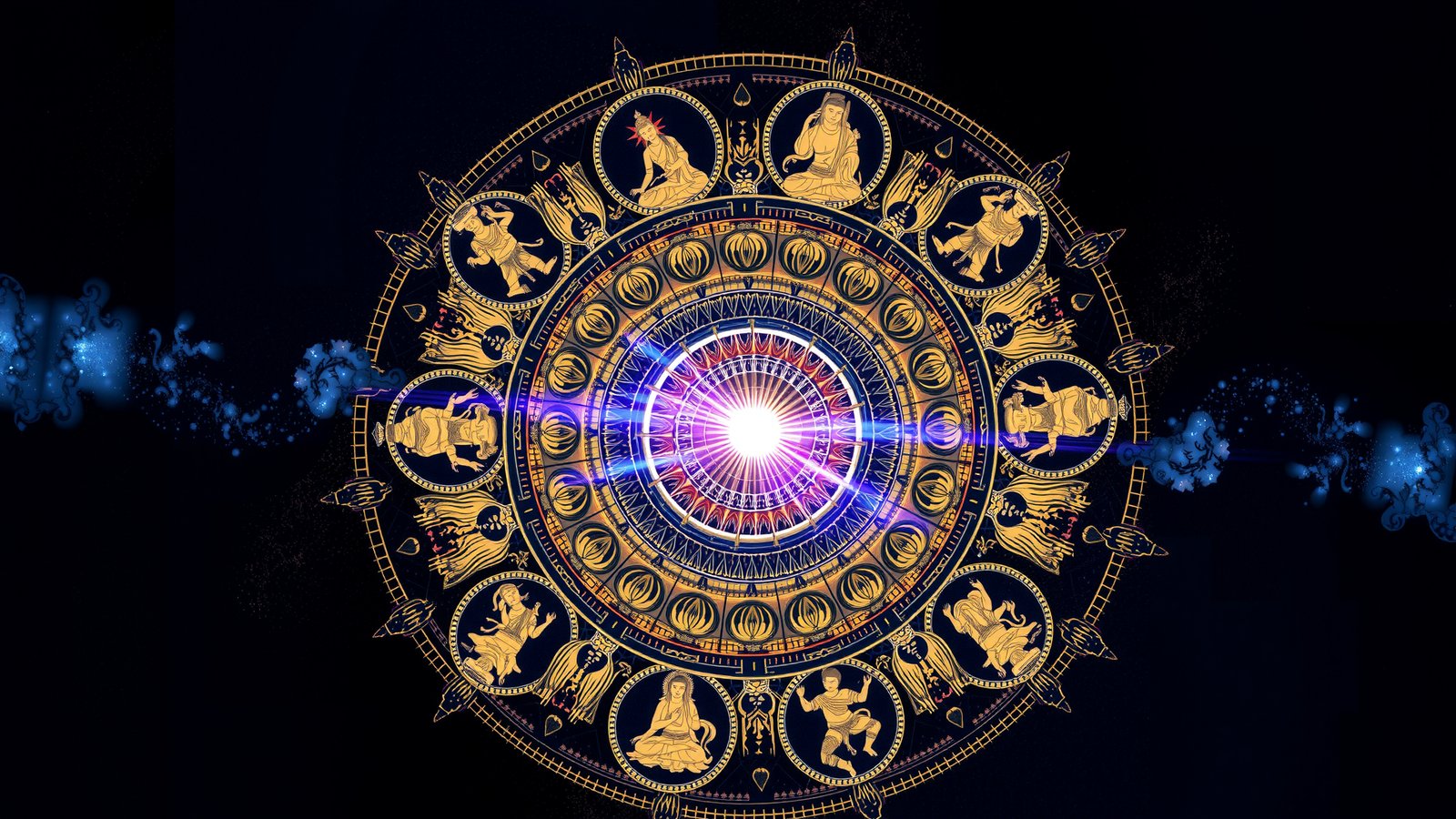
Japan × Cosmos Series, Wave 2, Article 1
Mandala and 852Hz: The “Map of the Cosmos” Kūkai Carried Home
Twelve centuries ago,
a monk crossed the sea.
At the end of a voyage
that could easily have killed him,
what he carried home
was neither gold
nor weaponry,
but a single image.
And yet it was no ordinary picture.
Within it,
the very order of the cosmos
had been drawn.
This is the story of the Womb Realm Mandala,
the esoteric Buddhist system of visual practice
that the monk Kūkai (Kōbō Daishi)
brought back from Tang China.
And it is also, quietly,
a story that still asks something of us today:
the question of the order within.
This article’s answer (in 3 lines)
The mandala is a piece of esoteric Buddhist art that Kūkai brought back from Tang China — a visual “map” of the cosmos and the path to enlightenment. In the Solfeggio tradition, 852Hz is associated with “intuition” and “spiritual order,” themes that loosely echo the mandala’s intricate order. There is no historical link between the two; neither is presented here as guaranteeing any effect.
💎 Key takeaway
The mandala teaches that cosmic order is not something out there — it is already reflected within the one who beholds it.
30-Second Summary
- The mandala is a visual representation of the esoteric Buddhist cosmos and the structure of enlightenment — not decorative art, but a genuine tool of meditative practice
- Kūkai (774–835) traveled to Tang China in 804, received the complete esoteric transmission from Master Huiguo at Qinglong Temple in Chang’an, and returned to Japan in 806 with mandalas among his treasures
- Mandalas come in two main forms — the Womb Realm (compassion) and the Diamond Realm (wisdom) — together called the “Ryōkai Mandala”
- At the center of the Womb Realm Mandala sits Mahavairocana (Dainichi Nyorai), from whom compassion radiates outward in concentric order
- The mandala Kūkai personally brought back no longer survives, but the oldest known copy, the Takao Mandala, held at Jingo-ji Temple, is a designated National Treasure
- Mandalas were used as objects of contemplative visualization, helping practitioners internalize cosmic order within their own minds
- Solfeggio 852Hz is, in modern tradition, associated with “intuition” and “spiritual order“
- Pairing the mandala’s geometric order with what 852Hz symbolizes is offered here as a poetic reading, not a claim of historical connection
1. What Is a Mandala — The Cosmos Reflected in a Single Image
The word mandala
comes from Sanskrit,
often translated as
“that which possesses essence”
or “that which is perfectly complete.”
Within esoteric Buddhism
(Shingon and Tendai traditions),
a mandala represents
both the enlightened state of the Buddha
and the structure of the cosmos itself,
condensed into a single image.
It is not a religious painting
meant simply to be admired in a museum.
It is a genuine tool of practice —
something practitioners
actually **gaze upon, visualize,
and internalize.**
As we explore this tradition,
it’s worth remembering:
what follows is not an exotic motif,
but a practice and a faith
carefully carried forward
by Japanese esoteric Buddhist monks
for well over a thousand years.

2. Kūkai and the Mandala — A Perilous Voyage That Brought Home the Whole of Esoteric Buddhism
The story begins
in the early Heian period.
Kūkai (774–835, later known as Kōbō Daishi)
traveled to Tang China in 804
as part of an official delegation.
His destination:
the capital, Chang’an.
There, Kūkai sought out
Master Huiguo,
the rightful heir to esoteric Buddhism’s transmission.
Upon meeting him,
Huiguo is said to have remarked,
“I have been waiting for you.”
Within just a few months,
Huiguo transmitted to Kūkai alone
the full abhisheka (initiation rites)
of both the Womb Realm and Diamond Realm traditions —
an extraordinary act.
Normally, such esoteric teachings
were passed down gradually,
over many years.
Huiguo entrusted them all
to a single disciple, at once.
In 806,
Kūkai returned to Japan.
Among his belongings were
sutras,
ritual implements,
and —
mandalas.
The inventory he submitted to the imperial court upon his return,
the Catalog of Imported Items (Goshōrai Mokuroku),
records these treasures in detail.
Kūkai would go on to establish
Mount Kōya as a center of ascetic practice,
and was later granted Tō-ji Temple in Kyoto
as the foundational seat of esoteric teaching,
firmly establishing the Shingon school.
3. The Structure of the Womb Realm Mandala — A Cosmos of Compassion Radiating from Mahavairocana
Mandalas fall broadly into two types:
the Womb Realm Mandala
and the Diamond Realm Mandala.
This article focuses primarily on the Womb Realm Mandala,
based on the Mahavairocana Sutra,
said to represent the Buddha’s
working of compassion
(its counterpart, the Diamond Realm Mandala,
based on the Diamond Peak Sutra,
represents the Buddha’s working of wisdom).
At the center of the Womb Realm Mandala
lies the Central Eight-Petaled Court,
an eight-petaled lotus platform,
upon which sits
Mahavairocana (Dainichi Nyorai),
the root deity of esoteric Buddhism.
Surrounding this central figure,
four Buddhas and four Bodhisattvas
are arranged in the eight directions.
From there, radiating outward,
numerous “courts” unfold
in concentric or grid-like patterns,
housing hundreds of deities
arranged in careful order.
This structure conveys
the idea that
**compassion radiates outward from a single center,
reaching the entire world in ordered stages.**
What may first appear
as an intricate, complex geometric pattern
is, in fact,
a magnificent blueprint
of how the cosmos itself is ordered.
4. What Was the Mandala Used For — Visualization as a Spiritual Practice
The mandala was never
merely decorative.
Within esoteric Buddhist practice,
it served as an object for contemplative visualization —
gazing upon the image,
and mentally reconstructing its structure
as a form of meditation.
In initiation ceremonies,
a blindfolded practitioner would toss a flower
onto the mandala,
and the deity where it landed
was said to establish
a special karmic bond with that person —
a practice known as tōge-tokubutsu.
Through repeated visualization of the mandala,
practitioners were said to internalize
the vast, complex structure of the cosmos
as an order within themselves.
In other words, the mandala is
a map of “the cosmos out there,”
while simultaneously being
a map of the mind within.
If themes of cosmic consciousness and inner awakening resonate with you,
you may also enjoy Accessing Cosmic Consciousness.
5. The Takao Mandala — Kūkai’s Oldest Surviving Legacy
The mandala Kūkai personally carried back from Tang China
was painted on silk,
and is believed to have deteriorated
over the centuries — it no longer survives.
However, shortly after his return,
Kūkai had copies made
based on what he had seen.
Among these,
the Takao Mandala,
preserved at Jingo-ji Temple in Kyoto,
is considered among the oldest surviving mandalas,
and has been designated a National Treasure.
Painted in gold and silver pigment
on purple silk,
it preserves, to this day,
the esoteric Buddhist art
of the early Heian period.
Alongside the mandalas preserved at Tō-ji,
it is worth adding that these are not
merely museum pieces —
they remain, even now,
living tools of faith,
sometimes still used in religious ceremonies.
6. What Are 852Hz’s Effects — A Frequency Symbolizing Intuition and Spiritual Order
852Hz is, within
the modern Solfeggio frequency system,
often described as symbolizing
the “third eye,”
“intuition,”
and “spiritual order.”
The Solfeggio system
is not an unbroken, ancient scientific tuning,
but rather
**a tradition reconstructed and systematized
within modern healing culture
since the latter half of the 20th century.**
Within that tradition, 852Hz is often positioned
as “a tone that quiets mental noise
and awakens the capacity to see through
to the essence of things.”
For more on this frequency, see
852Hz: The Frequency of Awakening,
and for a broader introduction to the Solfeggio system, see
Solfeggio Frequencies: A Beginner’s Complete Guide.
What matters here is careful phrasing:
not “listening to 852Hz sharpens intuition,”
but “within the Solfeggio tradition,
852Hz has come to symbolize intuition and spiritual order.”
7. Mandala and 852Hz — Two Worlds Loosely Connected by the Word “Order”
To be honest with you:
there is no historical or textual connection
between the mandala and Solfeggio frequencies.
Kūkai brought the mandala to Japan in 806.
The modern Solfeggio system
spread widely only from
the late 20th century onward.
They emerged from
entirely different eras and cultures.
But when we look at
the shape of the structure —
a loose resonance appears:
- The mandala’s intricately arranged deities = an ordered cosmic structure
- The practice of visualizing that order and internalizing it = the awareness 852Hz symbolizes as “spiritual order“
- Focusing one’s attention on the central Mahavairocana = reaching essence through what 852Hz symbolizes as “intuition“
In other words:
“**moving toward inner stillness through the visual order of the mandala,
and touching that stillness intuitively through the symbolic tone of 852Hz**” —
is an experience that can be
poetically layered together,
as one way of reading
symbol alongside symbol —
not an academic claim.
8. Mandala × 852Hz Correspondence Table — Four Stages of Order Radiating from the Center
Per our v2.6 structural rule, here is a comparison table mapping the mandala’s structure to 852Hz symbolism.
| Structure of the Mandala | What It Represents | Symbolic Theme | Corresponding Frequency (as symbol) |
|---|---|---|---|
| Central Eight-Petaled Court | Mahavairocana seated on an eight-petaled lotus | The source of compassion and wisdom, the cosmic center | (silence) |
| Courts radiating from the center | Hundreds of deities arranged in concentric, staged order | Ordered expansion, the unfolding of compassion | Echoes what 852Hz symbolizes as “spiritual order” |
| The act of visualizing the whole mandala | The practitioner internalizes the structure through sustained gazing | Intuition, an awakening that sees through to essence | 852Hz (symbol of intuition and the third eye) |
| Daily life after visualization | Carrying a sense of order back into everyday living | Integration, quiet certainty | The continuation of what 852Hz symbolizes as “order” |
This mapping is offered strictly as a poetic aid, not as a claim of medical or paranormal effect.
9. Listening to 852Hz While Picturing the Mandala — A Few Practical Suggestions
A few practical suggestions for how you might listen:
- In a quiet moment: play 852Hz for a few minutes, close your eyes, and picture a single point of light at the center, with order radiating outward in concentric rings
- When your thoughts feel scattered: let 852Hz play as you quietly ask yourself, “what is at my own center, right now?”
- Recall the mandala’s structure: consider that even the complexity of the outer world may, in fact, be part of an ordered whole
- Don’t force meaning onto it: simply enjoying the sound and the stillness is enough
These are offered as relaxation practices,
not as guarantees of any therapeutic outcome
or spiritual attainment.
10. What Can and Cannot Be Said — An Honest Approach to Esoteric Art and Frequency
Here is the honest line MuZenCosmos holds to.
What can be said
- The mandala is a genuine piece of esoteric Buddhist art and practice, brought from Tang China by Kūkai and preserved as the core of Shingon Buddhism to this day
- Mandalas dating to Kūkai’s era, such as the Takao Mandala, are preserved as National Treasures and are sometimes still used in religious ceremonies
- Within Solfeggio tradition, 852Hz carries an established symbolic association with intuition and spiritual order
- Quiet, focused time spent gazing at an image is associated, in some research, with relaxation benefits
What cannot be said
- There is no scientific proof that listening to 852Hz “measurably improves intuition”
- Simply looking at a mandala does not, by itself, confer Buddhist enlightenment — traditionally, this required formal training under a qualified master
- There is no direct historical link between the mandala and Solfeggio frequencies
- Mandala imagery or Shingon teaching does not guarantee any specific worldly benefit or blessing
11. Respecting Esoteric Buddhist Art — Between Appreciation and Faith
In recent years,
mandalas have increasingly appeared
as motifs in interior design,
art, and wellness products.
Being drawn to their beauty
is entirely natural.
But it’s worth remembering
that mandalas were originally transmitted
within a strict tradition of
master-to-disciple succession,
as sacred images intended for spiritual practice,
not general viewing.
For this reason,
this article intentionally avoids
quoting specific Sanskrit seed-syllables or mantras,
which are traditionally meant to be transmitted
only through a qualified teacher.
We’ve made a point to avoid
caricature or casual treatment,
and to present this tradition
with the respect it deserves.
If you’d like a broader introduction to spirituality as a topic, see our
Complete Guide to Spirituality,
and for more on meditation and the brain, see
Meditation and Neuroscience.
12. A Hypothetical Example: Finding a Center Amid Too Many Priorities
Consider a hypothetical situation: someone facing constant decisions at work and in daily life who feels they have lost track of their own center amid the sheer number of choices.
Looking at a mandala — an intricate image that nonetheless has a clear center and order — can offer a visual metaphor: even something complex can be organized around a single point.
One approach some people describe is a short nightly habit: playing 852Hz while picking out just one thing from the day that truly mattered, treating it as the “center” the rest of the day can arrange around.
This is a generalized, illustrative example rather than an account of a specific individual — it is meant to show one way the structure of a mandala might be used as a simple decision-making metaphor.
13. Frequently Asked Questions
Q1. What exactly is a mandala?
A mandala is a visual representation of both the Buddha’s enlightened state and the structure of the cosmos, condensed into a single image within esoteric Buddhism. It is not simply religious art, but a genuine tool practitioners visualize and internalize.
Q2. How did Kūkai bring the mandala to Japan?
Kūkai traveled to Tang China in 804 as part of an official delegation, received the complete esoteric transmission from Master Huiguo in Chang’an, and returned to Japan in 806 carrying sutras, ritual implements, and mandalas.
Q3. What’s the difference between the Womb Realm and Diamond Realm mandalas?
The Womb Realm Mandala, based on the Mahavairocana Sutra, represents the Buddha’s compassion. The Diamond Realm Mandala, based on the Diamond Peak Sutra, represents the Buddha’s wisdom. Together they form the paired “Ryōkai Mandala.”
Q4. What sits at the center of the mandala?
At the center of the Womb Realm Mandala is the Central Eight-Petaled Court, an eight-petaled lotus platform on which sits Mahavairocana (Dainichi Nyorai), the root deity of esoteric Buddhism.
Q5. Can we still see the mandala Kūkai brought back?
Kūkai’s original mandala no longer survives, but a copy made shortly afterward — the Takao Mandala, among the oldest surviving mandalas — is preserved at Jingo-ji Temple and designated a National Treasure.
Q6. What is Solfeggio 852Hz?
It’s a tone within the modern Solfeggio frequency system, symbolically associated with intuition, the “third eye,” and spiritual order.
Q7. Does listening to 852Hz really sharpen intuition?
This is not a scientifically proven claim. We present it strictly as a symbolic association within Solfeggio tradition, not as a guaranteed effect.
Q8. Is there a real historical connection between the mandala and Solfeggio frequencies?
No. The mandala arrived in Japan in 806, while the modern Solfeggio system emerged from the late 20th century onward — different eras, different cultures entirely. This article presents the two as a poetic layering of symbols, not a historical link.
Q9. Can simply viewing a mandala lead to enlightenment?
Traditionally, esoteric Buddhist practice required formal transmission from master to disciple, and viewing alone was never presented as sufficient. This article treats the mandala as a cultural and historical subject, not a practice guide.
Q10. How might someone combine the mandala and 852Hz in practice?
One suggestion: play 852Hz during a quiet moment while picturing order radiating outward from a central point, echoing the mandala’s structure. This is offered as a habit suggestion, not a guaranteed outcome.
This same approach — a traditional figure read quietly alongside a Solfeggio tone — also shapes Kannon and 528Hz, our piece on Kannon’s thousand hands, and Amaterasu and 963Hz, on Amaterasu’s return from the cave.
14. Conclusion — The Order Was Already Within You
Once more,
remember what Kūkai’s
perilous sea voyage,
and the mandala he brought home,
were truly trying to tell us.
It was not that the cosmos
lies somewhere far away,
sprawling in complexity
and disorder.
The cosmos has a center.
**And that order
is already reflected
within the one who beholds it.**
If your days, right now,
feel as scattered and complex
as a mandala without order —
tonight,
find a quiet place,
and let 852Hz
settle into the room.
And then,
place just one thing,
just one,
at the center of yourself.
Order may not be
a blueprint handed down from outside.
It may be something
**you discover was already there,
the moment you looked quietly enough.**
Just as the light
at the mandala’s center
was there all along.
References
- Kūkai (compiler), Goshōrai Mokuroku (Catalog of Imported Items), 806 CE — the inventory of sutras, ritual implements, and mandalas Kūkai brought back from Tang China
- Yūkei Matsunaga, Kūkai, Iwanami Shinsho, 1997 — a leading introductory overview of Kūkai’s life and esoteric thought
- Motohiro Yoritomi, An Introduction to Mandalas, Chikuma Gakugei Bunko — an accessible explanation of mandala structure and meaning
- Takatoyo Ishida, Studies of the Mandala, Kokusho Kankokai — a scholarly art-historical study of mandalas
- Jonathan Goldman, Healing Sounds: The Power of Harmonics, Healing Arts Press — on sound, overtones, and healing culture
MuZenCosmos — Where the Cosmos Meets Stillness | The Order Was Already Within You
This article does not guarantee any medical or health benefit and is not a substitute for professional medical care. If you have any health concerns, please consult a physician or other qualified professional.
📚 Related Articles
🎵 Listen Along with This Article
Experience this article’s theme through sound.
🔔 Subscribe to MuZenCosmos for new healing soundscapes.