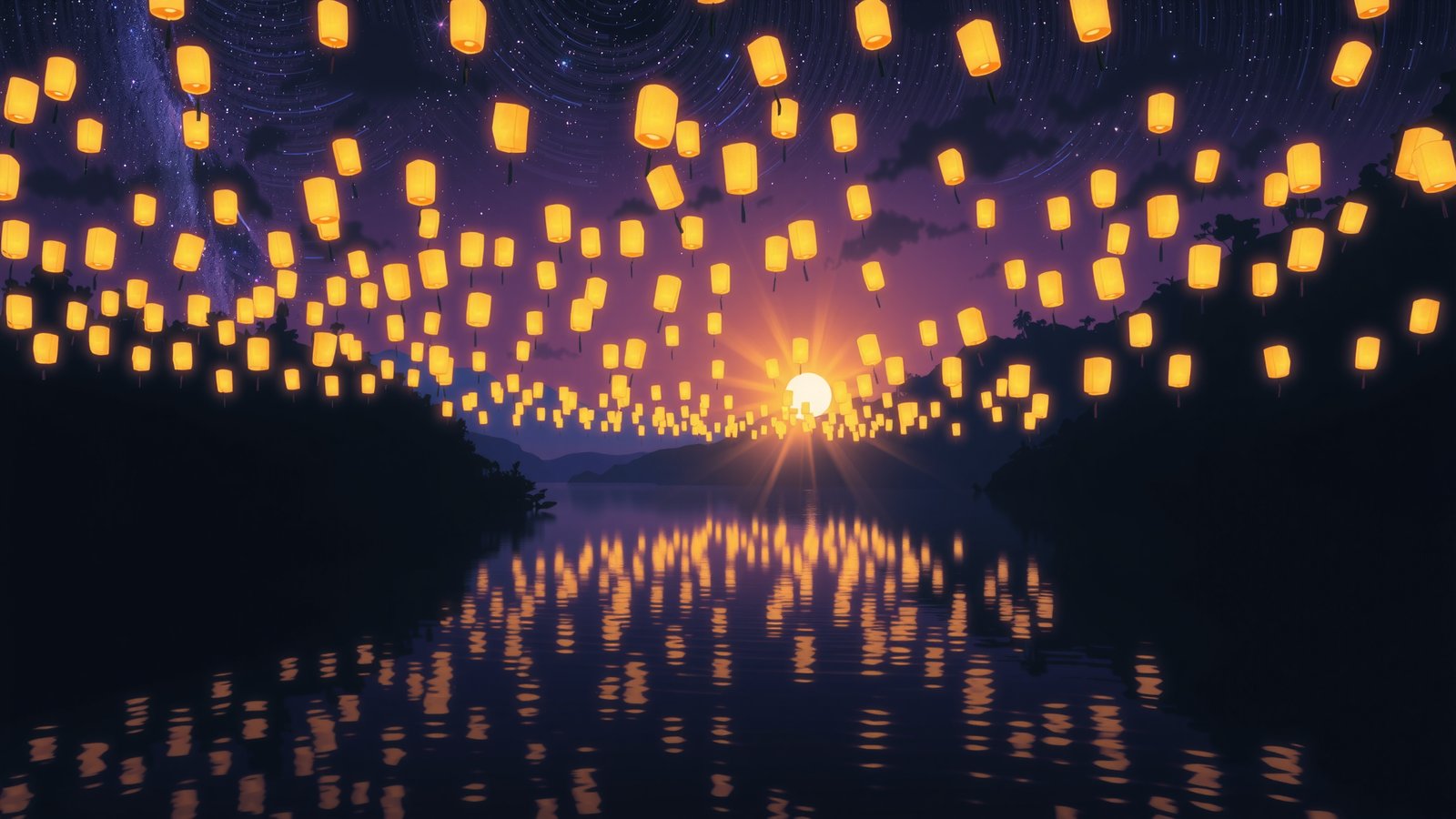
Companion article for the YouTube video “Toro Nagashi (Lantern Floating) 396Hz”
Toro Nagashi and 396Hz: Letting Go on an Obon River
On a summer night,
small lights appear
on the surface of a river —
one, then another.
Inside paper lanterns,
candle flames flicker,
and the light drifts,
slowly,
downstream,
toward the sea.
This is toro nagashi —
a lantern-floating tradition
observed across Japan.
At the close of Obon,
it sends the spirits of ancestors,
who had returned home for a few days,
quietly back
to the world they came from.
This is the story of that tradition,
and of a tone called 396Hz,
which in Solfeggio tradition
is said to symbolize
“the release of fear and guilt.”
And it is also, quietly,
a story about letting go —
something every one of us
eventually has to face.
This article’s answer (in 3 lines)
Toro nagashi is an Obon tradition in which the spirits of ancestors, who returned home for the holiday, are sent back with floating lanterns released onto a river or the sea. In Solfeggio tradition, 396Hz is associated with “releasing fear and guilt,” a theme that loosely echoes the ritual gesture of letting go. Neither the ritual nor the frequency is presented here as guaranteeing any effect — both are offered as quiet prayer and symbol.
💎 Key takeaway
Toro nagashi teaches that letting go is not the same as forgetting — it is seeing someone off gently, by the light.
30-Second Summary
- Toro nagashi is a form of Obon send-off fire, in which lanterns carry ancestral spirits down a river or out to sea
- Obon itself traces to the Buddhist Ullambana Sutra, blended over centuries with Japan’s native ancestor-veneration beliefs
- Regional variations exist — Nagasaki’s boisterous Shoro Nagashi stands in vivid contrast to quieter lantern-floating elsewhere
- In recent decades, many communities have shifted to environmentally managed versions, collecting lanterns downstream rather than releasing them into open water
- The inability to “let go” after losing someone is a completely natural part of the grief process
- In modern Solfeggio tradition, 396Hz is associated with “releasing fear and guilt” and the root chakra
- Read together, toro nagashi and 396Hz form a poetic arc: from releasing something by light to returning, gently, to daily life
- All of this is offered as symbolic framing — not a scientific claim, and not a guarantee about grief or memorial practice
1. What Is Toro Nagashi — Sending Light Down an Obon River
Toro nagashi is a ritual
in which small lanterns,
made of paper or bamboo
and lit with a candle,
are set adrift
on a river, lake, or the sea.
It usually takes place
on the final night of Obon —
August 16 in most regions
(or July 16 in areas that observe Obon by the old lunar calendar) —
and marks the moment when ancestral spirits,
who had returned home for a few days,
are sent back
to the world beyond.
Lanterns are often inscribed
with a family’s name,
a message to someone who has passed,
or a simple note of gratitude
for the year just lived.
The sight of countless small lights,
each carrying someone’s private feeling,
drifting across a dark river,
remains one of the defining images
of the Japanese summer —
still lovingly kept alive
in communities across the country.
2. What Is Obon — Days of Welcoming and Sending Off the Ancestors
To understand toro nagashi,
it helps to understand Obon itself.
Obon is a uniquely Japanese observance
shaped by the blending of
the Buddhist Ullambana Sutra
with Japan’s older tradition of
ancestor veneration.
In its typical form:
- August 13: a welcoming fire (mukaebi) is lit to invite ancestral spirits home
- August 14–15: the family spends time together, spirits presumed present
- August 16: a send-off fire (okuribi) is lit to see the spirits off
(some regions, including parts of Tokyo, observe an earlier “July Obon,” a remnant of the old lunar calendar).
Toro nagashi is how certain regions
carry out this send-off fire,
replacing flame on land
with light on water.
Where Kyoto’s Gozan Okuribi (the “Daimonji” fire) sends spirits off
with fire on a mountainside,
toro nagashi relies on
the river as a road —
a path believed to guide spirits
back to the world beyond.
3. The Origins of Toro Nagashi — Why the River Was Chosen
For centuries, Japanese tradition
has regarded rivers and the sea
as a boundary between this world and the next.
Because water is always moving,
never staying still,
it came to be understood
as something that carries,
and purifies —
a fitting vessel for spirits
within Japan’s folk cosmology.
There is no single, confirmed origin point
for when or where toro nagashi began;
different regions
preserve different local accounts.
Local folklore records do show, however,
that by the Edo period,
the custom of floating lanterns
as part of the Obon send-off
was already established
in various parts of the country.
Folklorists such as Kunio Yanagita
have connected these send-off customs
to Japan’s broader traditional cosmology —
the belief that ancestral spirits
**arrive from, and return to,
the mountains or the sea beyond**.
4. What Lanterns Carry — Gratitude, Farewell, and Letting Go
What people entrust to a lantern
is rarely just “goodbye.”
It often carries:
- Gratitude for a year of quiet protection and presence
- Words that were never quite said
- A soft, unresolved regret over time that couldn’t be spent together
- And a quiet resolve to keep moving forward
Watching a lantern
drift down the river
is often described as
a moment to re-confirm one’s relationship with someone who has passed.
The act of seeing the light off
may function as a small but meaningful
rite of passage —
a way of accepting,
gradually,
that a goodbye has truly happened.
5. Regional Variations — Shoro Nagashi and Local Forms of Toro Nagashi
Toro nagashi
takes strikingly different forms
depending on the region.
In Nagasaki, for instance,
Shoro Nagashi
is a distinctive tradition in which families
who lost someone within the past year
send off elaborate “spirit boats”
amid firecrackers and clanging bells —
a loud, boisterous farewell,
quite unlike the hushed lantern-floating
seen elsewhere.
In Hiroshima, a toro nagashi
is held every year on August 6
to commemorate victims of the atomic bombing —
a somewhat different context
from Obon’s ancestor veneration,
rooted instead in
a prayer for peace.
The same physical gesture — floating a lantern —
can carry very different meanings
depending on region and purpose,
which speaks to the
depth and range of this tradition.
In recent years,
many municipalities have adopted
environmentally managed versions,
collecting lanterns downstream
rather than releasing them all the way to the sea.
The essential experience — seeing a light off —
has been carefully preserved
even as the logistics have changed.
6. The Difficulty of Letting Go — Sitting With Grief
Many people who have lost someone they love
find themselves thinking,
“I should have grieved enough by now, but I still can’t let go.”
Grief researchers have repeatedly noted
that mourning has
no fixed timeline, and no correct order.
Scholar Kenneth J. Doka coined the term
“disenfranchised grief“
to describe sorrow that goes unacknowledged
because society assumes
it should already be “over.”
This may be exactly
where the value of toro nagashi lies:
it offers, once a year,
a sanctioned time to openly grieve.
And it offers something else, too —
the chance to entrust that grief,
not to be carried alone,
but to the river, along with the light.
7. What Is Solfeggio 396Hz — The Traditional Symbol of Releasing Fear and Guilt
396Hz is considered
the lowest tone
in the modern Solfeggio frequency system.
The Solfeggio system itself
is best understood honestly:
it was largely reconstructed
in the latter half of the 20th century,
and is less an unbroken ancient science
than **a tradition that has grown
within modern healing culture**.
Within that tradition, 396Hz is often associated with:
- The root chakra (an energy center linked to stability and safety)
- The release of “fear“
- The release of “guilt“
If you’d like the fuller foundation for this frequency family, see
The Beginner’s Guide to Solfeggio Frequencies.
8. What 396Hz Is Said to Do — How Healing Culture Describes It
Within sound-healing circles,
396Hz is often described as:
- A tone said to soften guilt over past mistakes and regrets
- A tone said to quiet vague, future-facing anxiety
- A tone said to help restore a grounded sense of safety
These descriptions come from
the practitioners and traditions
that have carried Solfeggio forward for decades —
they are **not claims verified
by peer-reviewed scientific research**.
Listening to 396Hz will not, by itself,
make guilt or fear disappear.
That said, there is research suggesting
that quiet listening and stillness
can genuinely support relaxation —
a modest but real observation.
For more on the connection between grief and Solfeggio, see
Solfeggio for Grief.
9. The Symbolic Bridge Between Toro Nagashi and 396Hz
To be honest with you:
there is no historical or textual connection
between toro nagashi and Solfeggio frequencies.
Toro nagashi is a folk tradition
with roots predating the Edo period.
The modern Solfeggio system
only spread widely
from the late 20th century onward.
These come from
entirely different eras and contexts.
But when we look at
the shape of the ritual gesture —
a quiet resonance appears:
- Placing your hands together, entrusting a feeling to the lantern = facing an emotion you’ve been carrying
- The moment the lantern drifts downstream = what 396Hz symbolizes: “releasing fear and guilt“
- The walk home after the light disappears from view = the stillness and safety that can follow letting go
In other words:
“**letting go alongside the lantern,
then sitting with 396Hz in the quiet afterward**” —
is a rhythm that can be
poetically layered over the send-off moment
that toro nagashi already holds at its center.
This is not an academic claim,
but one way of reading
symbol alongside symbol.
10. Toro Nagashi × 396Hz Correspondence Table — Four Stages of Letting Go
Per our v2.6 structural rule, here is a comparison table mapping the ritual’s stages to Solfeggio symbolism.
| Stage of the Ritual | What Happens | Symbolic Theme | Corresponding Frequency (as symbol) |
|---|---|---|---|
| Mukaebi, the welcoming fire (Aug 13) | Ancestral spirits are welcomed home | Reunion, restored connection | (the imagined sound of a warm, gentle light) |
| Time spent together (Aug 14–15) | The family spends time with the spirits | Gratitude, shared memory | Echoes the “connection” theme associated with 528Hz |
| Toro nagashi (night of Aug 16) | Feelings are entrusted to a lantern and set adrift | Letting go, release of fear and guilt | 396Hz (symbol of root/release) |
| The walk home after the light fades | Return to daily life | Stillness, acceptance, moving forward | (silence) |
This mapping is offered strictly as a poetic aid, not as a claim of memorial or psychological effect.
11. What Can and Cannot Be Said — An Honest Approach to Memorial and Frequency
Here is the honest line MuZenCosmos holds to.
What can be said
- Toro nagashi is a genuine Obon send-off tradition, practiced in communities across Japan
- Many toro nagashi observances remain, today, a living tradition, carried forward by families and local communities
- Within Solfeggio tradition, 396Hz carries an established symbolic association with releasing fear and guilt
- Rituals of farewell, and quiet listening more broadly, are noted in some research as potentially supportive during grief
What cannot be said
- There is no scientific proof that listening to 396Hz makes guilt “disappear”
- There is no direct historical link between toro nagashi and Solfeggio frequencies
- Music or frequency cannot substitute for, or guarantee, memorial care for someone who has passed
- Grief has no single “correct” ending, and no ritual or sound can be said to reliably accelerate it
12. A Living Tradition — Approaching Toro Nagashi With Respect
Toro nagashi is often known
as a beautiful summer spectacle,
but at its heart,
it remains, for many families,
an urgent and sincere act of prayer.
In telling this story,
we’ve made a point
to avoid caricature or sensationalism,
and to treat it
with the respect it deserves.
If quiet moonlit stillness speaks to you as well, see
The Science of the Full Moon and Sound.
13. Consider a Hypothetical Scenario (Illustrative Example Only)
Imagine, for example, someone
who lost a parent a couple of years ago.
In the last few weeks, work could easily get in the way,
leaving less time by their side than one would have wanted.
That kind of regret
can stay lodged in the chest
for a long time.
One summer,
attending a toro nagashi
in a parent’s hometown for the first time, alone,
could bring something to the surface.
Writing a name on a lantern,
adding only “I’m sorry, and thank you,”
and watching the light drift down the river
might bring tears that feel larger than expected.
On the walk home,
playing a 396Hz recording
almost without thinking
can feel oddly fitting.
Knowing it’s described as
“a tone for releasing fear and guilt”
might make it feel, in that moment,
like it’s speaking directly to you —
not because of any proven science,
but because, right after watching the lantern drift away,
the sound feels like it’s simply sitting there with you.
Returning to the same toro nagashi
the following year,
one might notice that each year, the shape of carrying a loss
shifts a little.
It isn’t quite letting go,
and more like
renewing, every year, a way of living alongside them.
14. Frequently Asked Questions
Q1. What is toro nagashi?
Toro nagashi is a tradition, practiced across Japan, of sending ancestral spirits back at the close of Obon by floating lit paper lanterns down a river or out to sea. Names and forms vary by region.
Q2. When is toro nagashi held?
Most regions hold it on the final night of Obon, August 16, though areas observing “July Obon” hold it around July 16 instead.
Q3. How is toro nagashi different from Shoro Nagashi?
Shoro Nagashi is practiced mainly in Nagasaki, where families who lost someone within the past year send them off loudly, with firecrackers and bells. It stands in vivid contrast to the quieter lantern-floating found in most other regions.
Q4. Why are lanterns floated on rivers or the sea?
Japanese tradition has long regarded moving water — never staying still — as a boundary between this world and the next, and as something that carries and purifies. Toro nagashi is rooted in this cosmology.
Q5. Is toro nagashi still practiced today?
Yes. It remains a living tradition across Japan, carried forward by communities and families. In recent years, many localities have shifted toward environmentally managed versions that collect lanterns downstream.
Q6. What is Solfeggio 396Hz?
It’s considered the lowest tone in the modern Solfeggio frequency system, associated within that tradition with the root chakra and “releasing fear and guilt.”
Q7. Does listening to 396Hz really make guilt disappear?
This is not a scientifically proven claim. We present it strictly as a symbolic association within Solfeggio tradition, not a guaranteed effect.
Q8. Is there a real historical connection between toro nagashi and 396Hz?
No. Toro nagashi is a folk tradition predating the Edo period, while the modern Solfeggio system emerged from the late 20th century onward — different eras, different contexts entirely. This article presents the two as a poetic layering of symbols, not a historical link.
Q9. Can rituals or sound really help with grief after losing someone?
Some research suggests that quiet ritual and listening time can be a supportive part of the grieving process. But none of this guarantees or accelerates grief’s resolution, and grief has no single correct ending.
Q10. What if I can’t attend a toro nagashi in person?
Many people recreate a similar “send-off” moment at home — lighting a candle quietly, or placing their hands together before a photograph. What matters most, tradition suggests, is less the exact form and more the act of turning attention toward the feeling itself.
15. Conclusion — Light Still Arrives, Even Where the River Carries It
Picture the night river once more.
Eventually, the lantern’s light
fades from view.
But that
is not the same
as disappearing.
The light has simply
**left your hands,
and continued its journey downstream.**
If there is something
you are still holding onto,
unable to release —
should you find yourself
at a toro nagashi this summer,
try quietly entrusting
a few words to the light.
And that night,
as 396Hz plays softly,
remind yourself:
letting go is not the same as forgetting.
The light
moves down the river,
returns to the sea,
and perhaps,
somewhere, continues circling back.
Even on the far side of the lantern’s glow,
that feeling
is still arriving, somewhere.
References
- Kunio Yanagita, Tales of My Ancestors (Senzo no Hanashi), Chikuma Shobo, 1946 — a foundational folklore study of Japanese ancestor veneration and cosmology
- Shigeru Gorai, Burial and Memorial Rites (Sō to Kuyō), Toho Shuppan, 1992 — a folklore study of Japanese funerary and memorial customs
- Kenneth J. Doka, Disenfranchised Grief: Recognizing Hidden Sorrow, Lexington Books, 1989 — the foundational text introducing “disenfranchised grief” in grief studies
- Jonathan Goldman, Healing Sounds: The Power of Harmonics, Healing Arts Press — on sound, overtones, and healing culture
- Joachim-Ernst Berendt, Nada Brahma: The World Is Sound, Destiny Books — a foundational work on sound and cosmology
MuZenCosmos — Where the Cosmos Meets Stillness | Even on the Far Side of the Lantern’s Glow, Light Still Arrives
This article does not guarantee any medical or health benefit and is not a substitute for professional medical care. If you have any health concerns, please consult a physician or other qualified professional.
📚 Related Articles
- 396 Hz vs 417 Hz — Two Kinds of Release: Which Do You Need?
- Solfeggio Frequencies for Anxiety and Stress — 396 Hz & 528 Hz
- What Is 396 Hz? The Solfeggio Frequency for Gently Releasing Fear and Guilt
🎵 Listen Along with This Article
Experience this article’s theme through sound.
🔔 Subscribe to MuZenCosmos for new healing soundscapes.
🎵 Listen Along with This Article
Experience this article’s theme through sound.
🔔 Subscribe to MuZenCosmos for new healing soundscapes.