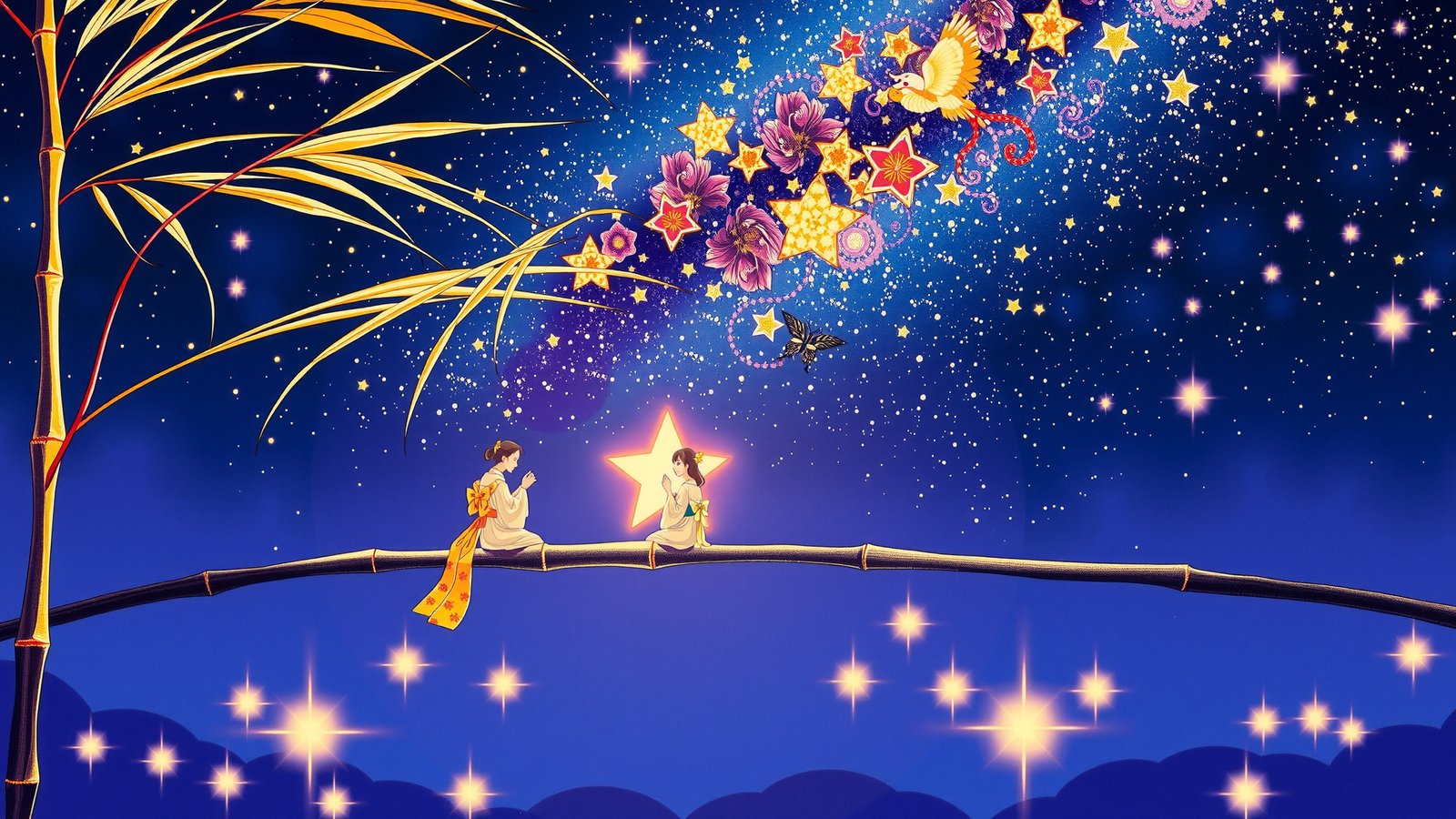
Once a year.
Only once.
There is a night
when they can meet.
Two stars,
separated
by the Milky Way.
Most people know Tanabata
as July 7th.
But look up
at that night’s sky,
and more often than not,
it’s hidden
behind rainy-season clouds.
The truth is,
the original Tanabata —
what’s called
“Traditional Tanabata” —
has always been celebrated
on an entirely different date.
Today, we’ll tell the story of
“Traditional Tanabata,”
observed according to
the lunar calendar.
And we’ll trace its gentle resonance with
639Hz,
the tone often called
“the frequency of connection.”
The Answer, in 3 Lines
“Traditional Tanabata” is the original star festival, celebrated on the 7th day of the 7th lunar month — which falls around August 26th in 2026. The story of Orihime and Hikoboshi, reunited only once a year, symbolizes the universal theme of connection that endures across distance, and Solfeggio 639Hz is traditionally associated with harmony and connection in relationships. There is no historical link between the two, and this article makes no claims about actual effects.
💎 The Key Line of This Article
What Traditional Tanabata teaches is that connection isn’t about being together every day — it’s about something that doesn’t break, even across distance.
30-Second Summary
- Traditional Tanabata is the original star festival, celebrated on the 7th day of the 7th lunar month — falling around August 26th in 2026
- The modern-calendar Tanabata (July 7th) coincides with Japan’s rainy season, often making the Milky Way hard to see
- The Orihime (Weaver) and Hikoboshi (Cowherd) legend blends China’s Qixi festival with Japan’s native Tanabatatsume weaving-maiden tradition
- The story’s core is that the two are separated by the Milky Way and reunited only once a year
- Many of Japan’s largest Tanabata festivals, including Sendai’s, are actually held around the timing of Traditional Tanabata (lunar or month-delayed)
- Solfeggio 639Hz is traditionally described as a tone symbolizing relational harmony and connection
- Overlaying 639Hz onto the Tanabata story offers a poetic reading: “connection preserved across distance”
- All of this is offered as symbolic storytelling, not a scientific claim about effects
1. What Is Traditional Tanabata — The Original Star Festival on the Lunar Calendar
“Traditional Tanabata”
refers to the original Tanabata festival,
celebrated on the 7th day
of the 7th month
of the lunar-solar calendar.
What most people today
celebrate as “Tanabata”
takes place on the
modern-calendar July 7th.
But because the lunar and solar calendars
don’t align,
the 7th day of the 7th lunar month
typically falls in
early to late August on the modern calendar.
**In 2026, Traditional Tanabata
falls around August 26th.**
(Since the lunar calendar shifts
from year to year,
the exact date needs to be
checked annually.)
Throughout this article,
we’ll use the terms
“Traditional Tanabata”
and “lunar Tanabata”
to distinguish it from
the modern-calendar July 7th festival.
2. The Legend of Orihime and Hikoboshi — China’s Qixi and Japan’s Tanabatatsume Belief
The roots of the Tanabata legend
trace back to China.
Orihime (Weaver), a skilled weaver,
and Hikoboshi (Cowherd), a cattle herder,
married —
but then grew neglectful
of their work.
This angered the Emperor of Heaven,
who separated them
across the Milky Way.
Seeing how deeply the two grieved,
the Emperor eventually allowed them
to reunite just once a year,
on the night of July 7th.
This legend arrived in Japan
during the Nara period,
alongside a Chinese custom called
Qixi (Kikkoden),
in which women prayed
for skill in weaving and needlework.
Japan already had
its own belief in the
Tanabatatsume —
a maiden who wove cloth
by the water’s edge
to welcome a visiting deity.
The star legend from China
and Japan’s native Tanabatatsume belief
merged,
giving rise to
the uniquely Japanese festival
we now call “Tanabata.”
The Man’yōshū, Japan’s oldest
poetry anthology,
already contains numerous poems
about Tanabata —
evidence that even in the Nara period,
this story was
**a familiar part of
both belief and aesthetic sensibility**.
3. How It Differs From Modern-Calendar Tanabata — Why “Traditional Tanabata” Is Being Reconsidered
Today, in most parts of Japan,
Tanabata is celebrated on the
modern-calendar July 7th.
But in much of Japan,
July 7th falls
squarely within the rainy season.
Clouds often cover the sky,
and in many years,
the Milky Way and the two key stars —
Vega (Orihime) and Altair (Hikoboshi) —
are barely visible at all.
By contrast,
the 7th day of the 7th lunar month —
the timing of Traditional Tanabata —
typically falls
after the rainy season has ended
in most regions,
when the clear summer night sky
often reveals
the Milky Way in sharp detail.
This is said to be why
many of Japan’s largest Tanabata festivals —
including the Sendai Tanabata Festival
and the Ichinoseki Summer Tanabata Festival —
are held not on the modern-calendar July 7th,
but around the month-delayed date of early August,
or on the actual lunar 7th day.
The National Astronomical Observatory of Japan
publishes the date of
“Traditional Tanabata” every year,
and in recent times,
it has quietly been reconsidered
as **the Tanabata that lets you
actually enjoy the original night sky**.
4. What the Story Symbolizes — A Relationship That Endures Across Distance
The Orihime-Hikoboshi legend
has been passed down
for over a thousand years —
not simply because
it’s “a story about stars.”
Beneath it, it’s said,
lies **a universal theme
of human relationships
everyone experiences**.
- The experience of being separated from someone dear by distance
- Time spent apart becoming a test of the relationship itself
- The promise that reunion is still possible, even just once a year, functioning as a source of hope
- The structure suggesting that the essence of a relationship lies not in “being together every day,” but in “connection that never breaks”
This can be read as
the quiet, trusting story
that Tanabata offers:
**connection lies not in
physical closeness,
but in an unbroken promise**.
If you’re interested in themes of compassion and care,
see also our article on
Loving-Kindness Meditation (Metta).
▼ We’ve prepared a video that lets you experience the world of Traditional Tanabata and 639Hz.
[VIDEO_PLACEHOLDER]
5. What Is 639Hz — A Frequency Symbolizing Connection and Relationships
639Hz is one of the tones
positioned near the middle of the
traditional nine-tone Solfeggio system.
If you’d like to understand
the Solfeggio system from its foundations,
see our
Beginner’s Guide to Solfeggio Frequencies.
For more detail on 639Hz specifically,
see also
639Hz: The Frequency of Connection and Love.
Within modern tradition,
639Hz is often described
as a symbol of
- harmony in relationships
- communication
- heart-to-heart connection
What matters here is avoiding
the definitive claim that
“listening to 639Hz improves relationships,”
and instead offering the careful framing that
“within Solfeggio tradition, 639Hz
has been positioned as a symbol
of connection and harmony.”
6. What 639Hz Is Said to Do (Where the Evidence Actually Stands)
Let’s honestly organize
what is said about 639Hz.
What is said (its traditional positioning)
- Within Solfeggio tradition, 639Hz is often linked to the heart chakra and to harmony in interpersonal relationships
- It is sometimes used in meditation and relaxation settings as “a tone for reflecting on connections with others”
- There are research-based observations suggesting that quiet time spent listening to sound can be expected to have a relaxing effect
What cannot be said (not scientific fact)
- There is no scientific evidence that listening to 639Hz resolves specific relationship problems
- The Solfeggio frequency system itself is a relatively recent tradition, reconstructed from the latter half of the 20th century onward — not an academically established tuning system passed down unchanged for millennia
- There is currently no established scientific consensus that 639Hz produces any specific, measurable effect on the human body or brainwaves
In short, 639Hz is best understood
not as “a magic tone that repairs relationships,”
but as “a symbolic tone for reflecting on the theme of connection.”
That framing is the most honest way
to approach it.
7. The Symbolic Connection Between Traditional Tanabata and 639Hz
To be direct:
**there is no historical or textual connection
between the Traditional Tanabata story
and Solfeggio frequencies.**
The Tanabata legend
arrived in Japan from China
during the Nara period (8th century).
The modern Solfeggio system,
by contrast,
spread from the latter half
of the 20th century onward.
The two emerged
from entirely different eras and cultures.
And yet,
when overlaid as narrative structures,
a gentle resonance appears.
- Orihime and Hikoboshi, separated by the Milky Way = a connection tested by distance
- The single night of reunion each year = the moment 639Hz symbolizes as “a relationship being re-tied”
- The promise of meeting again next year, even after parting once more = the connection itself, persisting without ever breaking
In other words, the practice of
“**listening to 639Hz while reflecting on
the unbroken connection with someone dear**”
is a way of experiencing
the theme Tanabata has long carried —
that relationships endure even across distance —
as a poetic overlay,
not an academic claim.
Please receive it in that spirit,
as one way of reading
two symbols side by side.
8. Tanabata × 639Hz Symbolic Comparison Table — Two Tanabatas, One Frequency
Following the v2.6 framework,
here is a comparison organizing
modern-calendar Tanabata, Traditional Tanabata, and 639Hz.
| Perspective | Modern Tanabata (July 7) | Traditional Tanabata (7th day, 7th lunar month) | Overlap with 639Hz (as symbol) |
|---|---|---|---|
| Season | Rainy season in most regions | Clear summer nights after the rainy season ends | (Visible stars = a symbol of “visible” connection) |
| Night-sky visibility | Milky Way often obscured | Milky Way often clearly visible | A timing when connection is easier to feel |
| Main events | Household/school events with paper strips and bamboo decorations | Large community festivals, e.g. Sendai Tanabata Festival | Symbolizes community connection |
| 2026 date | July 7 (Tuesday) | Around August 26 | A fitting occasion to reflect on the harmony and connection 639Hz symbolizes |
※ This comparison is offered strictly as a poetic thread, not a claim that any frequency improves relationships.
9. Spending Time With Traditional Tanabata and 639Hz — Wishes to the Stars, Connection to the Sound
Here is one concrete example.
- On the night of Traditional Tanabata: in late August, find a spot with little city light, look for the Milky Way, and think of someone you’re connected to
- While playing 639Hz: send a short message to someone you haven’t spoken with in a while
- Write a wish on paper: following the Orihime-Hikoboshi story, put one wish about “connection” into words
- Don’t force meaning: simply enjoying the night sky and the sound, each in its own right, is enough
These are offered as practices
for relaxation —
not as a guarantee
of resolving relationship issues.
10. What Can and Cannot Be Said — An Honest Reckoning With Tanabata and 639Hz
Here is the honest line
MuZenCosmos holds to.
What can be said
- Traditional Tanabata is the original Tanabata festival, celebrated on the 7th day of the 7th lunar month
- The Orihime-Hikoboshi legend is a real tradition formed by the blending of China’s Qixi custom and Japan’s Tanabatatsume belief
- Tanabata festivals across Japan, including Sendai’s, continue today as living regional culture
- Within Solfeggio tradition, 639Hz carries a symbolic meaning tied to connection and relationships
What cannot be said
- It has not been scientifically proven that listening to 639Hz resolves relationship problems
- There is no direct historical connection between the Orihime-Hikoboshi legend and Solfeggio frequencies
- It is factually incorrect to claim the Solfeggio system is an academically established tuning tradition passed down unchanged for millennia
- Music or frequency does not guarantee the repair or fulfillment of relationships
11. The Cultural Background of Traditional Tanabata — Sendai’s Living Festival
Across Japan,
festivals related to Tanabata
remain widespread.
The most representative is
the Sendai Tanabata Festival
in Miyagi Prefecture.
Held every year on the
month-delayed dates of August 6–8,
shopping streets and entire neighborhoods
are filled with
elaborate, colorful Tanabata decorations.
This is not a festival
preserved in a museum,
but **a living tradition,
deeply woven into
the local economy and daily life**.
In presenting the Tanabata legend
in this article,
we want to reaffirm our commitment
to avoiding caricature or sensationalism,
and to introducing this tradition
with the respect it deserves.
If you’re interested in the moon and consciousness,
see our article on
Full Moon and the Science of Sound.
For more on lunar rhythms,
see also
Moon Phases and Consciousness.
12. A Hypothetical Example: Reconnecting Once a Year
Consider a hypothetical situation: a friendship where one person moved abroad for work, and contact between them gradually thinned to just a few times a year.
In such a case, the idea behind Traditional Tanabata — that even a relationship limited to meeting once a year has not actually broken — can offer a reframe: distant friendships as intact rather than fading.
One approach some people describe is marking the date of Traditional Tanabata on a calendar and treating it as a fixed occasion to reach out, no matter how busy life has become. Playing 639Hz while writing a message is sometimes mentioned as a way to lower the pressure of “keeping in touch,” turning it into a small yearly ritual rather than an obligation.
This is a generalized, illustrative example rather than an account of a specific individual — it is meant to show one way the Traditional Tanabata story and a frequency association might be used together as a memory cue for a long-distance friendship.
13. Frequently Asked Questions
Q1. What is Traditional Tanabata?
It’s the original Tanabata festival, celebrated on the 7th day of the 7th lunar month. Unlike the modern-calendar July 7th Tanabata, it typically falls after the rainy season ends, making the Milky Way easier to see in the clear night sky.
Q2. When is Traditional Tanabata in 2026?
It falls around August 26, 2026. Because the lunar calendar’s date shifts relative to the modern calendar each year, the exact date needs to be checked annually.
Q3. What is the Orihime-Hikoboshi legend?
It’s a Chinese legend in which Orihime the weaver and Hikoboshi the cowherd, after marrying, grow neglectful of their duties, anger the Emperor of Heaven, and are separated across the Milky Way — allowed to reunite only once a year, on the night of July 7th.
Q4. Is Tanabata a uniquely Japanese festival?
The story’s origin is China’s Qixi custom, but it merged with Japan’s native Tanabatatsume belief (a maiden weaving by the water to welcome a deity), developing into the uniquely Japanese festival known as Tanabata.
Q5. Why is it hard to see the stars during modern-calendar Tanabata?
July 7th falls during the rainy season in much of Japan, and clouds often obscure the Milky Way in a given year. Traditional Tanabata’s timing tends to fall after the rainy season ends.
Q6. Is the Sendai Tanabata Festival held on the modern or lunar calendar?
It’s held on the month-delayed dates of August 6–8. Many regional festivals across Japan choose dates close to Traditional Tanabata rather than the modern-calendar July 7th itself.
Q7. What is Solfeggio 639Hz?
It’s one of the tones in the modern Solfeggio system, traditionally positioned as a symbol of relational harmony and connection.
Q8. Will listening to 639Hz improve my relationships?
This is not a scientifically proven claim. It is presented here as a symbolic association within Solfeggio tradition, not a guarantee of any definitive effect.
Q9. Is there a direct historical relationship between Traditional Tanabata and 639Hz?
No. The Tanabata legend arrived from China during the Nara period, while the modern Solfeggio system emerged from the late 20th century onward — different eras, different cultures entirely. This article presents the two as overlapping poetic symbols, not a historical relationship.
Q10. What meaning might the Traditional Tanabata story hold for us today?
The idea that “connection lies not in being together every day, but in an unbroken promise” can be read as a universal theme relevant to relationships with family and friends who live far away.
14. Conclusion | The Stars Stay Connected, Even Apart
At the end of this story,
remember once more:
Orihime and Hikoboshi
were not together every day.
For most of the year,
they lived apart,
separated by the Milky Way.
And yet,
their connection
never broke.
If, right now,
someone dear to you
feels **separated
by distance or time** —
around August 26th this year,
on the night of Traditional Tanabata,
find a quiet place
and look for the Milky Way.
And gently,
with 639Hz playing,
bring that person to mind.
Connection may not be
proven by being together
every single day —
it may instead be
**something that continues,
unbroken,
even across distance**.
Tonight, too,
the stars remain
quietly connected,
on either bank
of the Milky Way.
References
- Zong Lin, Jingchu Suishiji (Record of the Seasons of Jingchu), 6th century (China) — a classical text recording the origins of Qixi and related star-festival customs
- Man’yōshū, Nara period — Japan’s oldest poetry anthology, containing numerous poems about Tanabata
- Shinobu Origuchi, The Woman of the Water (in Ancient Studies) — a key folkloric work discussing the Tanabatatsume belief and its connection to Tanabata
- Yoshiro Okada, Encyclopedia of the Calendar, Tokyodo Shuppan — a reference work on the lunar calendar, the 24 solar terms, and traditional seasonal observances
- Joachim-Ernst Berendt, Nada Brahma: The World Is Sound, Destiny Books — a representative work on sound and cosmic consciousness
MuZenCosmos — Where Cosmos Meets Stillness | The Stars Stay Connected, Even Apart
This article does not guarantee any medical or health benefit and is not a substitute for professional medical care. If you have any health concerns, please consult a physician or other qualified professional.
📚 Related Articles
- Accessing Cosmic Consciousness: A Practical Approach to Transpersonal Experience
- Moon Phases and Consciousness: Tuning to Life’s Cycle Through New Moon and Full Moon Meditation
- Synchronicity Complete Guide: Reading Meaningful Coincidence Through Jungian Psychology
- The Law of Attraction: Reading Manifestation Through Science
🎬 The companion video for this article is coming soon
Subscribe to MuZenCosmos to catch the release.