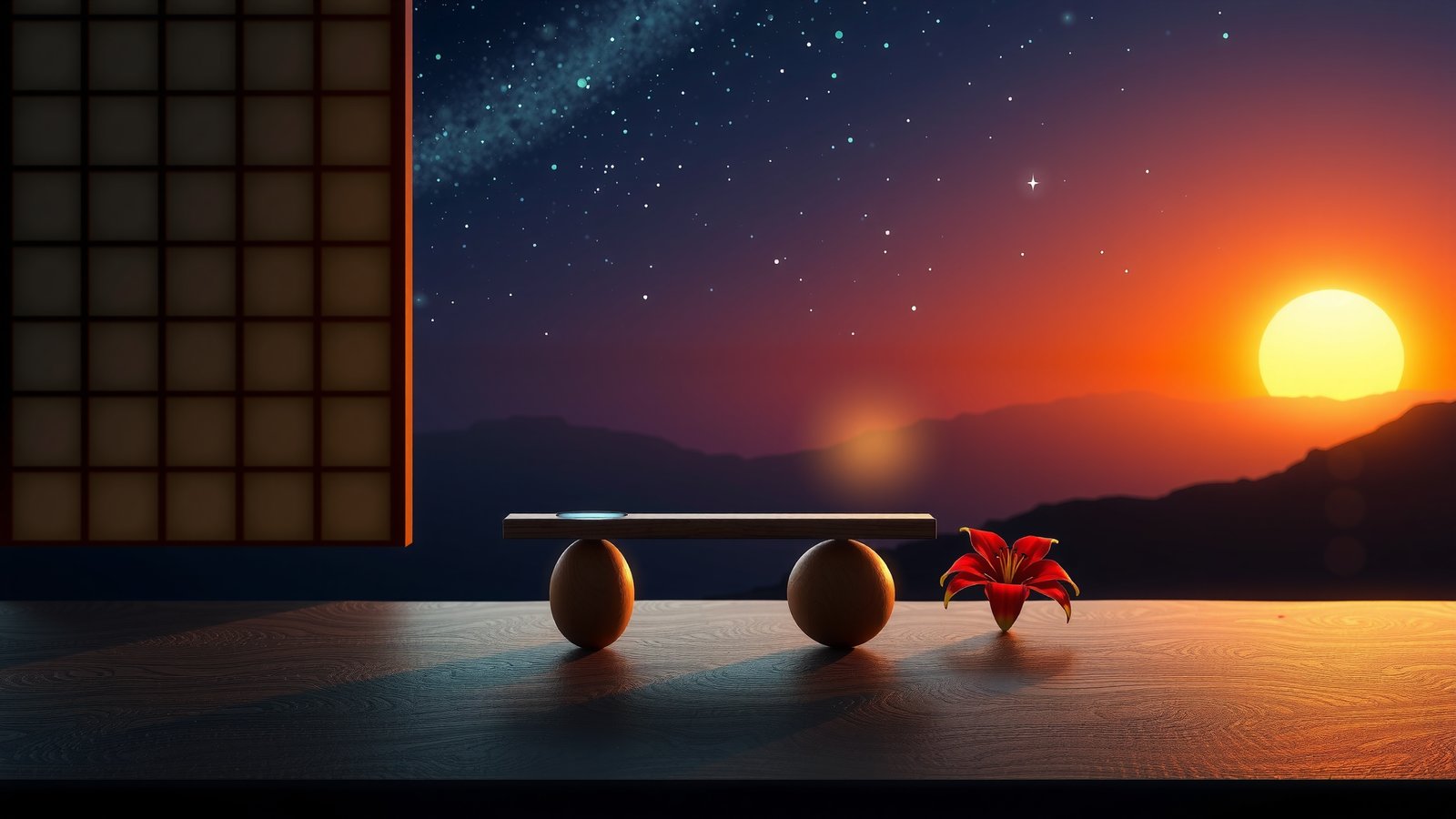
Twice a year,
and only twice,
**daylight and darkness
come to almost exactly
the same length.**
One of those days
is Shuubun.
All summer,
there had been
too much light.
Morning arrived early.
Night was slow
to come at all.
But after Shuubun,
the scale tips
quietly
toward the dark.
This is the day
that tipping
passes through
its exact middle.
The day
that has not yet
leaned
either way.
If Risshuu was the term of noticing,
Shosho the term of releasing,
and Hakuro the term of clearing,
then Shuubun
is the term
of balancing.
What follows is the story
of Shuubun,
one of Japan’s 24 solar terms.
And its gentle resonance
with 528Hz,
the tone often called
the frequency of love and harmony.
The answer, in three lines
Shuubun is one of Japan’s 24 solar terms, falling when the sun reaches celestial longitude 180° (around September 23 in 2026). The sun rises almost due east and sets almost due west, and daylight and darkness come to nearly equal length; in Japan, the seven days centered on this date form the autumn Higan observance. Solfeggio 528Hz is traditionally associated with love, harmony, and transformation, which overlays poetically with a day that holds both halves in equal weight. The two have no historical connection, and nothing here is a claim of effect.
💎 The one line that holds this article
What Shuubun teaches is that harmony is not choosing one side, but that there exists a day on which light and dark can be carried at exactly the same weight.
The 30-Second Summary
- Shuubun is one of the 24 solar terms, falling when the sun reaches celestial longitude 180°. In 2026 it lands around September 23 (dates shift slightly year to year, so an annual almanac check is recommended)
- On this day the sun rises almost due east and sets almost due west, and daylight and darkness come to nearly equal length
- Strictly speaking, however, daylight runs about a dozen-plus minutes longer, for two concrete reasons: how sunrise and sunset are defined, and atmospheric refraction
- In the 72 micro-seasons, Shuubun moves through thunder ceasing its voice → insects sealing their burrows → water beginning to dry from the fields
- The seven days centered on Shuubun form the autumn Higan observance. “Higan” traces to the Buddhist term pāramitā, “reaching the far shore,” and the observance itself developed uniquely in Japan
- The Buddhist principle of the Middle Way has long been read alongside this day of equal halves
- Solfeggio 528Hz is described in the modern tradition as a tone symbolizing love, harmony, and transformation
- Laid over Shuubun, 528Hz offers a poetic reading: returning a self that has tilted too far to the center
- All of this is symbolic language, not an assertion of scientific effect
1. What Shuubun Is — The Day Light and Dark Come Nearly Equal
Shuubun is one of the 24 solar terms,
the ancient division of the year
into 24 parts
based on the sun’s position.
It falls when the sun
passes celestial longitude 180°.
In 2026, Shuubun lands around September 23.
(Because the terms are fixed by the sun’s actual position, the date can shift by a day from year to year. The reliable practice is to check each year’s official almanac.)
On this day,
the sun rises
**almost due east
and sets almost due west.**
It is the day
the sun’s path across the sky
runs
straightest
of the entire year.
And daylight
and darkness
come to nearly
the same length.
The spring equinox
and the autumn equinox
are, in that sense,
twins.
But the same equality
points in
opposite directions.
After the spring equinox,
light increases.
After Shuubun,
darkness increases.
Which means the balance of Shuubun
carries something the spring one does not:
a quiet kind of
readiness,
knowing full well
that the nights
are about to grow longer.
For the term just before Shuubun, see
Hakuro and 741Hz — The Single Drop on the Morning Grass, and the Frequency of Clearing.
2. Observing Shuubun in Nature — The 72 Micro-Seasons, and a Sky Where Thunder Stops
The 24 terms are subdivided further
into the 72 micro-seasons,
and Shuubun moves
through these three:
- Thunder ceases its voice — the thunder that rolled all summer falls silent
- Insects seal their burrows — creatures go into the earth and close the door behind them
- Water begins to dry from the fields — the paddies are drained in preparation for the rice harvest
All three
describe
a stopping.
Thunder stops sounding.
Insects stop being outside.
The fields stop holding water.
Where the spring and summer micro-seasons
are written as addition —
something begins, something arrives —
the Shuubun ones
are written as
subtraction.
And yet
none of it is a sad account.
The sky where thunder has stopped
turns high and clear.
Insects go under
in order to come back in spring.
And in the drained field,
the rice has ripened.
Stopping leads directly
into the next harvest.
That is the order
in which these three
were arranged.
Other changes around Shuubun include:
- Sunset arriving visibly earlier by the day
- A higher-looking sky, with mackerel and scale-patterned clouds
- Night insect song passing its peak and slowly thinning out
3. Daylight Is Actually a Little Longer — The Honest Error Inside “Equal”
Shuubun is explained as
the day light and dark are equal.
Measure it precisely, though,
and **daylight runs
about a dozen-plus minutes longer.**
That is not sloppiness.
It is a difference
with reasons —
two of them.
The first is
how sunrise and sunset are defined.
Sunrise is the moment
the sun’s upper edge
clears the horizon.
Sunset is the moment
the sun’s upper edge
disappears below it.
Measured by the edge,
not the center.
By exactly that much,
daylight
spills over on both ends.
The second is
atmospheric refraction.
The envelope of air
around the earth
acts like a lens
and bends the sun’s light
very slightly.
So there is a stretch of time,
morning and evening,
when the sun is still
physically below the horizon
but is
already visible.
The day on which light and dark
genuinely come out even
arrives
a few days after
the equinox itself.
There is something to love in this.
The fact that nature
**refuses to hand us
a clean and perfect half**
feels, honestly,
like a kind of integrity.
Shuubun is not
a day of flawless equilibrium.
It is
**a nearly equal day,
with just a little more light.**
The balance in our own days
is probably allowed
to be
about that good.
4. The Buddhist View — The Middle Way, and What “Higan” Actually Means
Of all the Japanese words
gathered around Shuubun,
the one set deepest
is Higan.
The term traces back
to the Buddhist word
pāramitā,
rendered in Japanese as
“reaching the far shore.”
Shigan is this shore,
the near side, where confusion lives.
Higan is the far shore.
But the essential point
is that Higan
is not a distant place.
What Buddhism has taught
is less
“go find the boat
that will carry you across”
than
**the crossing itself
is already here,
on this side.**
And at the root
of that crossing
sits the
Middle Way.
In what is described as his first teaching,
the Buddha spoke of a path
that leans neither into
**extreme austerity
nor into indulgence** —
the road that is neither.
This is not
a piece of moderate life advice.
It is
**knowing both poles
and gripping neither.**
An active way
of holding balance.
To think of one’s ancestors,
and of the Middle Way,
on the day light and dark come even —
perhaps that is why Shuubun
has held such a particular place
in Japanese life.
Astronomical equality
and Buddhist centrality
happen to overlap
in a single day.
5. What 528Hz Is — A Frequency Symbolizing Love and Harmony
528Hz is the most widely known
of the nine traditional
Solfeggio frequencies.
Often called
the love frequency
or the miracle tone,
it has occupied the center
of the healing-music world
for decades.
For the system as a whole, see
Beginner’s Guide to Solfeggio Frequencies,
and for 528Hz specifically,
What Is 528Hz? The Frequency of Love and Harmony.
Within the modern tradition,
528Hz is spoken of as symbolizing:
- Love — the kind directed at oneself as much as at others
- Harmony — opposing things holding true at the same time
- Transformation — changing from the inside, without forcing a break
In the Solfeggio tradition,
528Hz is frequently tied
to the fourth chakra (the heart),
which places it
roughly at the body’s
own midpoint.
One thing worth stating precisely.
In the standard modern tuning
of A = 440Hz,
C falls at about
523.25Hz —
not at 528Hz exactly.
A C of 528Hz
requires setting
A at 444Hz.
So 528Hz sits
**slightly off
the current standard tuning.**
That fact is worth knowing —
not as ammunition against it,
but simply as
an accurate premise.
6. What Is Claimed About 528Hz — Drawing the Evidence Line
Here is how MuZenCosmos
honestly sorts
what is said about 528Hz.
What is claimed (its place in the tradition)
- The Solfeggio tradition frequently links 528Hz to the fourth chakra (heart)
- It is used in meditation and yoga settings as “a tone for mending a relationship” or “a tone for stopping self-blame”
- Time spent listening to calm music in a quiet environment does have a body of research behind it regarding eased tension and improved mood — though that research concerns musical experience broadly, not 528Hz specifically
What cannot be claimed (this is not a scientific assertion)
- The claim that 528Hz repairs DNA has no scientific basis. It appears constantly in Solfeggio write-ups and lacks peer-reviewed support
- The claim that 528Hz restructures water molecules is likewise not established scientific knowledge
- The Solfeggio system itself is a comparatively recent reconstruction from the late twentieth century onward — not a scholarly tuning transmitted unchanged across millennia
- There is no established scientific consensus that 528Hz produces any specific measurable effect on relationships or psychological state
So 528Hz is most honestly held
not as a magic tone that heals wounds,
but as
a symbolic tone for looking at the theme of harmony.
And having drawn that line,
the fact that so many people
have kept choosing 528Hz
is **not a fact
that needs disproving.**
What we take as a symbol
was never
science’s decision
to make.
7. The Symbolic Link Between Shuubun and 528Hz
To be straightforward:
there is no historical or documentary
connection between the solar term Shuubun
and the Solfeggio frequencies.
The 24 terms were systematized
in China between the Warring States
and Han periods.
The Higan observance spread in Japan
from the Heian era onward.
The modern Solfeggio system
spread from the late twentieth century.
Three different eras,
three different cultures.
Laid over one another
as thematic structures, though,
a gentle resonance appears:
- Day and night coming even = harmony, the thing 528Hz symbolizes — opposites holding true at once
- Standing between this shore and the far shore = the Middle Way’s refusal to settle on either side
- Knowing the nights will lengthen from here = the theme of transformation, accepting change without halting it
So the suggestion is this:
**play 528Hz softly,
and quietly look at
which way you have been leaning
these past six months.**
That way of spending an evening
can be held poetically alongside
what Shuubun has always carried —
that to balance
is to hold both.
This is not an academic claim.
It is one reading,
tying symbol to symbol.
8. Hakuro, Shuubun, Kanro × Frequency — A Symbolic Correspondence Table
Following the v2.6 rule on comparison tables,
here is Shuubun placed
between its neighbors.
| Aspect | Hakuro (before Shuubun, ~Sept 7–8) | Shuubun (~Sept 23) | Kanro (after Shuubun, ~Oct 8) |
|---|---|---|---|
| How the season feels | Air cools enough for dew to form on morning grass | Daylight and darkness come to nearly equal length | Dew turns cold; mornings and evenings chill in earnest |
| Signs in nature | Dew glinting white; swallows heading south | Thunder falls silent, insects go under, fields are drained | Wild geese arrive; chrysanthemums begin to open |
| Observances and farm work | Chrysanthemum Festival (Sept 9); the seven autumn flowers | Autumn Higan (seven days centered on Shuubun); the rice harvest | The thirteenth-night moon viewing; autumn festivals |
| Symbolic frequency (example) | 741Hz (clearing, expression) | 528Hz (love, harmony) | — |
| Inner posture | Seeing what was invisible, by growing still | Carrying light and dark at equal weight | Admitting the cold, and warming from within |
※ This correspondence is a poetic guideline only. It does not assert that a frequency can alter a season.
9. How to Spend Shuubun with 528Hz — Small Habits for Regaining Balance
A few concrete suggestions.
- Look up today’s sunset time, just once. Around Shuubun, sunset comes startlingly early. Simply knowing what hour the dark arrives can change how an evening is spent
- At night, with 528Hz playing softly, draw a scale. Rule one horizontal line on a page. On the left, write what you overdid these past six months; on the right, what fell short — no more than three each. Not adding more is the whole trick
- During Higan, make time to remember someone. It does not require a grave, or a distance traveled, or hands pressed together. Recall one name and sit with it in silence — that alone is enough of the observance
To follow the theme of connection further, see
639Hz: The Frequency of Connection and Love.
These are offered as habits
of relaxation and reflection.
They do not guarantee
improvement in mood
or in relationships.
10. Safety and Cautions
A few lines worth holding
at this particular time of year.
- Keep the volume comfortable. 528Hz is not a piercing register, but long sessions at high volume still tire the ears. If it feels slightly too quiet, that is about right.
- Keep red spider lilies out of reach. The higanbana blooming around Shuubun is toxic throughout the plant, the bulb especially. Looking is entirely fine; make sure small children and pets do not put any part of it in their mouths.
- Mind how fast autumn dusk falls. The walk home from a stroll or a grave visit gets dark sooner than expected. Plan to be back while it is light.
- Don’t strain to “achieve balance.” Being tilted is not a failure. Noticing the tilt is already half of the return.
- If low mood persists beyond two weeks, please speak with a professional rather than reaching for sound. Shortening daylight is a season when mood shifts more readily. 528Hz is not a substitute for medical or psychological care.
11. Cultural Background — Higan, Ohagi, and the Red Flower on the Paddy Ridge
Higan refers to
the seven days
formed by the equinox itself —
the chuunichi, or middle day —
plus three days on either side.
In 2026 that runs
from roughly September 20
through September 26.
What is striking is that
the Higan observance
developed uniquely in Japan.
No directly corresponding observance
is found in Indian
or Chinese Buddhism.
On the day the sun sets
exactly in the west,
one turns toward
the Western Pure Land —
and that sensibility
crystallized
within Japan’s own landscape.
There are only two days a year
on which you can watch
the sun fall
straight into due west.
That one of them
was made into
a day for thinking of the dead
feels like a choice
more beautiful
than reasoning alone
could produce.
The offering made at Higan
is ohagi.
Its spring counterpart,
botamochi,
uses nearly identical ingredients —
but the names divide
by the season’s flower.
- Spring — named for the peony (botan): botamochi
- Autumn — named for the bush clover (hagi): ohagi
The same food,
**called by different names
in different seasons.**
That habit, too, belongs
to a life lived
alongside a calendar.
The red of the adzuki bean
was long believed
to ward off misfortune,
which is said to be part
of why it was chosen
as an offering.
And it is at this time of year
that the ridges of the rice paddies
are edged in red
by the higanbana,
the red spider lily,
also known as the
manjushage.
It takes its Japanese name
from the uncanny precision
with which it blooms
right at autumn Higan.
The stalk rises
with no leaves at all;
the leaves emerge
only after the flower is gone —
**flower and leaf
never meet.**
Many stories
have been layered
onto that habit
over the centuries.
Its heavy presence along paddy ridges
and graveyards is sometimes explained
by the bulb’s toxicity
keeping moles and mice
at a distance.
A flower that holds
beauty and poison at once,
and carries within it
two things that never meet,
blooming precisely
on the day light and dark
come even.
Nothing embodies
the doubleness of Shuubun
more exactly.
For the wider rhythm of the traditional calendar, see
The Moon’s Rhythm and Daily Life: A Complete Guide.
In writing about these solar terms
and Buddhist observances,
we take care to avoid caricature
or novelty framing,
and to present them
with respect.
12. Sound Environment for the Lengthening Nights — A 5-Point Checklist
From Shuubun onward,
the nights
get longer.
Which means the hours
spent with sound
naturally lengthen too.
Five checks
for keeping longer nights
from tiring your ears.
- Can you hold the volume below normal conversation level? Longer nights mean longer listening. The longer the session, the lower the volume should go
- Is the left–right balance even? One side running louder produces fatigue you never consciously notice. In a season themed on harmony, the first thing worth balancing is your own playback setup
- Is it safe if you fall asleep? Autumn nights invite sleep. Check that no cord can reach your neck, and that a timer will stop playback
- Is the room too reverberant? Once the windows close for the season, room reflections increase. A single curtain or throw can make the same source markedly easier to listen to
- Are you free to stop the sound? The quiet of autumn, as the insect song thins out, is a feast in itself. Stay in a position where you can stop at any moment
None of this requires
expensive equipment.
**Quiet, evenly balanced,
and stoppable at any moment** —
meet those three,
and your sound environment
for the long autumn nights
is entirely sufficient.
About This Article (Disclaimer and Advertising Notice)
This article is informational content introducing the symbolic meanings of culture, the traditional calendar, and frequency. It is not a substitute for medical care or counseling. Nothing written here about 528Hz or the 24 solar terms is intended to guarantee improvement in any condition or symptom, and individual experiences vary. Readers with existing conditions, ear-related concerns, or health worries should enjoy this material after consulting a professional.
[Advertising] This article may in future contain affiliate links (links introducing products or services). Purchases made through such links never incur additional cost to the reader.
13. Let’s Imagine a Situation Like This
To make the idea concrete,
let us picture
one general situation
(a fictional, generalized example — not anyone’s actual account).
Suppose that for six months
you had been
**standing with your weight
on one leg only.**
All of it on work.
Or all of it
on caring for someone.
Not enough to fall over,
but somewhere along the way
you had
**forgotten the other leg
was there.**
One evening around Shuubun,
with 528Hz playing softly,
you rule a horizontal line
on a page
and try to write
three things on each side.
Once you start,
**one side might fill up
immediately.**
The other stays blank
for a while.
And not straining
to fill that blank —
**just looking at it
while it stays empty** —
is probably
the most important part.
The next day,
looking out the window
around sunset,
you might see
the sun going down
**almost exactly
due west.**
Day ending.
Night beginning.
**Both of them
the same length.**
The point is that
**the sound did not
balance anything.**
The scale was already
in your own hands.
528Hz is only
**a lamp
for looking at the tilt.**
This article does not guarantee any medical or health benefit and is not a substitute for professional medical care. If you have any health concerns, please consult a physician or other qualified professional.
📚 Related Articles
- Kannon and 528Hz: A Thousand Hands of Compassion, Alongside the Frequency of Love
- Hakuro and 741Hz | The Single Drop on the Morning Grass — What Japan’s “White Dew” Solar Term Really Means
- Shosho and 396Hz | Gently Releasing the Summer We’ve Been Holding Onto — What Japan’s “Heat Subsides” Solar Term Really Means
- Risshuu and 852Hz | Noticing the First Signs of Autumn at the Height of Summer — What Japan’s “Start of Autumn” Really Means
FAQ (10 Questions)
Q1. What kind of day is Shuubun?
One of the 24 solar terms, falling when the sun passes celestial longitude 180°. The sun rises almost due east and sets almost due west, and daylight and darkness come to nearly equal length.
Q2. When is Shuubun in 2026?
Around September 23, 2026. Because the terms are fixed by the sun’s actual position, dates can shift by a day from year to year, so checking each year’s almanac is recommended.
Q3. Are daylight and darkness truly identical on the equinox?
Strictly speaking, daylight runs about a dozen-plus minutes longer. This is because sunrise and sunset are defined by the sun’s upper edge, and because atmospheric refraction bends the light. The genuinely equal day arrives a few days after the equinox.
Q4. How is Shuubun divided in the 72 micro-seasons?
Into three: thunder ceasing its voice → insects sealing their burrows → water beginning to dry from the fields. Notably, all three describe a stopping.
Q5. When does Higan begin and end?
It runs seven days: the equinox as the middle day, plus three days on either side. In 2026, roughly September 20 through 26.
Q6. What does the word “Higan” mean?
It traces to the Buddhist term pāramitā, rendered as “reaching the far shore” — the far bank, as opposed to shigan, this shore where confusion lives. The Higan observance itself is understood to have developed uniquely in Japan.
Q7. What is the difference between botamochi and ohagi?
The ingredients are nearly identical; the names divide by the season’s flower. Spring takes the peony (botamochi), autumn the bush clover (ohagi).
Q8. What kind of frequency is Solfeggio 528Hz?
The central tone of the modern Solfeggio system, traditionally described as symbolizing love, harmony, and transformation, and frequently linked to the fourth chakra (the heart). Note that in standard A = 440Hz tuning, C falls at about 523.25Hz — not exactly 528Hz.
Q9. Does listening to 528Hz repair DNA?
There is no scientific basis for that claim. It appears constantly in Solfeggio write-ups but is not established, peer-reviewed knowledge. This article presents it strictly as symbolic meaning.
Q10. Is there a direct historical link between Shuubun and 528Hz?
No. The 24 solar terms were systematized in ancient China, the Higan observance developed in Japan, and the modern Solfeggio system emerged from the late twentieth century onward. This article lays them over one another as poetic symbols only.
In Closing | Harmony Is Holding Both at the Same Weight
We tend to think
that finding balance
means
giving one side up.
Working too much,
so stop working.
Thinking too much,
so stop thinking.
But what Shuubun
has always carried
is a different kind
of balance.
On this day,
daylight
does not disappear.
Neither does the dark.
**Both are present,
at the same length,
within the same
single day.**
Nothing was cut away.
It is
**the day both were held
at equal weight.**
Tonight,
if you feel yourself
tilted somewhere,
play 528Hz softly
and rule
one horizontal line
on a page.
It is fine
if only one side
fills up.
Noticing the blank
is already
where balance
begins.
And tomorrow,
near sunset,
look toward the west.
Today’s sun, falling
almost exactly due west,
is dividing day from night
in equal halves,
and saying nothing at all.
References
- Leonard G. Horowitz & Joseph S. Puleo, Healing Codes for the Biological Apocalypse, Tetrahedron Publishing, 1999. (The source in which the current Solfeggio values were widely introduced; the derivation is numerological and has not undergone acoustic verification.)
- Yoshiro Okada, Encyclopedia of the Calendar, Tokyodo Shuppan. (A reference work on the lunar calendar, the 24 solar terms, the 72 micro-seasons, and traditional observances.)
- National Astronomical Observatory of Japan (ed.), Chronological Scientific Tables (Rika Nenpyo), Maruzen, published annually. (Primary reference for each year’s solar-term timings and sunrise/sunset data.)
- Bhikkhu Bodhi, In the Buddha’s Words: An Anthology of Discourses from the Pāli Canon, Wisdom Publications, 2005. (A foundational anthology of early Buddhist teaching, including the Middle Way.)
- Daisy Fancourt & Saoirse Finn, What is the evidence on the role of the arts in improving health and well-being? A scoping review. WHO Regional Office for Europe, Health Evidence Network Synthesis Report 67, 2019. (An international synthesis of evidence on arts, music, and health — useful for drawing the line between what can and cannot be claimed.)
MuZenCosmos — Where the Cosmos Meets Stillness | Harmony Is Holding Both at the Same Weight