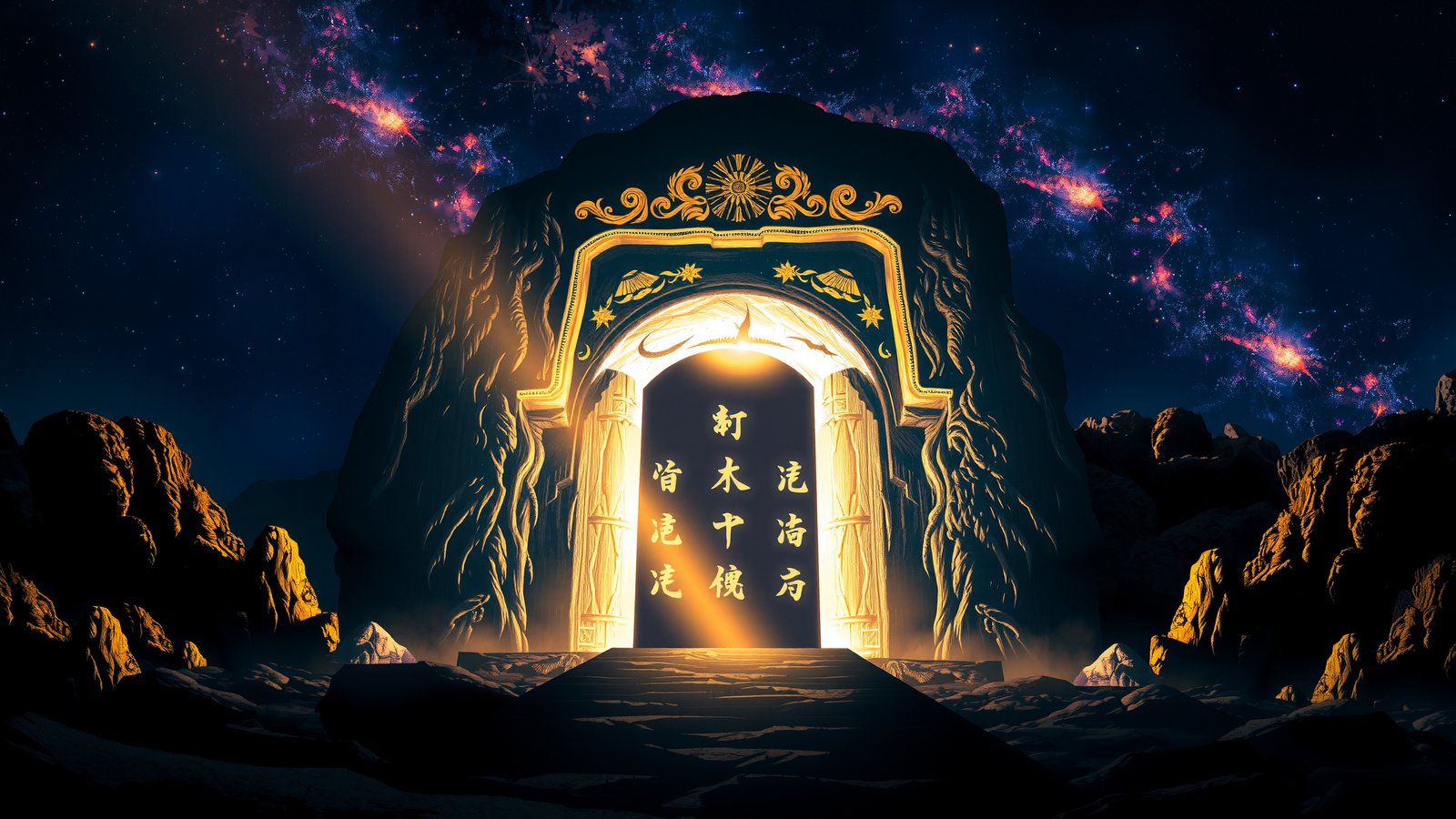
Companion article for the YouTube video “Ama no Iwato (The Cave Door) 852Hz”
Ama no Iwato Opens: 852Hz and the Power of a Story Where a Closed Door Opens
The door was sealed
from the inside.
And yet, the one who opened it
was also acting
from the inside.
In an earlier article, we told the story
of Amaterasu, the sun goddess,
withdrawing into the cave
known as Ama no Iwato,
plunging the world into darkness.
Today, we want to slow down
and look closely at
the single most dramatic moment
in that whole story —
the instant
the door opens.
And we’ll pair that moment
with 852Hz, a Solfeggio tone
associated with
“intuition” and “spiritual order.”
This article’s answer (in 3 lines)
The heart of the Ama no Iwato myth is a specific narrative mechanism: Ame-no-Uzume’s dance and the gods’ laughter sparked a curiosity in Amaterasu strong enough to make her open a sealed door herself. In Solfeggio tradition, 852Hz is associated with “intuition” and “the awakening of spiritual order,” a theme that loosely echoes this moment. Neither the myth nor the frequency is presented here as guaranteeing any effect — both are offered as poetic symbol.
💎 Key takeaway
The Ama no Iwato story teaches that a closed door isn’t opened by outside persuasion — it’s opened by curiosity rising from within.
30-Second Summary
- This article is a companion piece to our earlier article on Amaterasu and 963Hz, zooming in specifically on the moment the cave door opens
- The door wasn’t forced open — it opened because of Ame-no-Uzume’s dance and the uproarious laughter it triggered among the gods
- Amaterasu opened the door herself, drawn by curiosity about why everyone sounded so joyful
- The myth’s setting is not purely legendary — Ama no Iwato Shrine and the Amano-Yasukawara riverbed still exist today in Takachiho, Miyazaki, and remain active pilgrimage sites
- In modern Solfeggio tradition, 852Hz is associated with “intuition,” the “third eye,” and “spiritual order“
- Read together, the myth and 852Hz form a poetic arc: the spark of curiosity, followed by the decision to open the door oneself
- All of this is offered as symbolic framing — not a scientific claim, and not a claim of any mystical connection
1. What This Article Covers — A Companion Piece Focused on “The Moment the Door Opens”
In our earlier article,
Amaterasu and 963Hz: The Cave Myth That Symbolizes the Return of Light,
we told the full arc of the myth —
from Amaterasu’s withdrawal into darkness
to the light’s eventual return.
This time, we want to focus
on the single most striking moment within it:
the instant
Amaterasu opens the door herself.
Why did she open it?
What made that decision possible?
Let’s take a close look
at the mechanics of that opening.
2. The Story So Far — From the Cave’s Closing to Its Opening
According to the Kojiki,
deeply wounded by her brother Susanoo’s
destructive, wild behavior,
Amaterasu withdrew into
Ama no Iwato, a stone cave,
and sealed the door from within.
With the sun goddess in hiding,
the world fell into
complete darkness,
day and night lost their distinction,
and calamity followed calamity, the myth tells us.
The eight million gods, at their wits’ end,
gathered at the Amano-Yasukawara riverbed
and, led by the wisdom god Omoikane,
devised a plan to bring the light back.
(For the full story, see our earlier Amaterasu article, linked above.)
3. The Council at Amano-Yasukawara — Choosing Wisdom Over Force
What’s worth noticing first
is the method the gods chose.
They did not attempt
to force the door open.
Instead, they gathered
at Amano-Yasukawara
and chose
to pool their wisdom.
- Gathering the long-crowing roosters of the eternal realm to call out
- Hanging the Yasakani no Magatama jewel and the Yata no Kagami mirror on a sacred sakaki branch
- Entrusting Ame-no-Uzume with a dance
This can be read as
a quiet piece of wisdom
embedded in the myth itself:
a closed heart cannot be forced open.
4. Ame-no-Uzume’s Dance and the Gods’ Laughter — What Actually Moved the Door
Once preparations were complete,
Ame-no-Uzume
overturned a tub as a stage,
exposed her breasts,
pushed the cord of her skirt down,
and danced —
boldly,
and absurdly.
Seeing this,
the eight million gods,
the Kojiki tells us,
broke into
uproarious laughter.
That laughter — jarringly out of place
given how dire the situation was —
turned out to be
the story’s first real switch.
Ame-no-Uzume’s dance moved the gods
not through beauty or persuasion,
but through absurdity and laughter.
5. The Moment the Door Opens — Curiosity, the Mirror, and the God of Strength
Still inside the cave,
Amaterasu grew curious
at the sound of such joyful noise.
*”The world should be dark without me —
so why does everyone sound so happy?”*
Drawn by that curiosity,
she quietly opens the door.
The Yata no Kagami mirror, placed just outside,
reflects her own radiance back at her.
Captivated by the sight,
she leans in closer —
and in that instant,
the god of strength, Ame-no-Tajikarao,
pulls the door fully open.
What’s worth noting here is that
**it was Amaterasu’s own hand
that opened the door**.
Ame-no-Tajikarao’s strength
was only the final push —
the decision to open the door itself
arose from within.
6. Why Stories Have the Power to Open Doors — Myth and the Human Mind
This myth has been carried forward
for more than a thousand years
for a reason:
many people, at some point in life,
experience
a version of their own cave.
- A season of being wounded, and closing off
- A moment saved not by someone’s argument, but by unexpected laughter or playfulness
- A moment of curiosity, sparked by glimpsing one’s own reflection
- And then, the decision to open the door oneself
In psychology, it’s often noted that
a deeply closed heart
responds less to logical persuasion
and more to
a sense of safety in relationship, and humor.
The Ama no Iwato myth may have been
quietly carrying this insight about the human mind
forward, in narrative form,
for well over a thousand years.
7. Takachiho’s Ama no Iwato Shrine — Where the Myth Still Lives
In Takachiho, Miyazaki Prefecture,
Ama no Iwato Shrine
still stands today,
on the site said to be
the setting of this very myth.
The shrine’s sacred object of worship
is said to be the cave itself,
where Amaterasu is believed to have hidden —
visible across a river,
behind the main shrine hall.
Nearby lies
Amano-Yasukawara,
said to be where the eight million gods gathered to deliberate,
marked today by countless stacked stones
left by visitors —
a place still visited
by many pilgrims,
a living site of faith.
In telling this myth,
we’ve made a point
to avoid caricature or sensationalism,
and to treat it
with the respect it deserves.
8. What Is Solfeggio 852Hz — The Traditional Symbol of Intuition and Spiritual Order
852Hz sits
in the higher range
of the modern Solfeggio frequency system.
The Solfeggio system itself
is best understood honestly:
it was largely reconstructed
in the latter half of the 20th century,
and is less an unbroken ancient science
than **a tradition that has grown
within modern healing culture**.
Within that tradition, 852Hz is often associated with:
- The third eye chakra
- The awakening of “intuition“
- “Spiritual order” and inner awareness
For more on this frequency, see
852Hz: The Frequency of Awakening,
and for a broader chakra framework, see
The Solfeggio–Chakra Guide.
9. What 852Hz Is Said to Do — How Healing Culture Describes It
Within sound-healing circles,
852Hz is often described as:
- A tone said to encourage awareness beneath the surface of ordinary thought
- A tone said to support intuitive insight, seeing a situation from a new angle
- A tone said to help you notice something in yourself you’d been overlooking
These descriptions come from
the practitioners and traditions
that have carried Solfeggio forward for decades —
they are **not claims verified
by peer-reviewed scientific research**.
Listening to 852Hz will not, by itself,
sharpen anyone’s intuition.
If themes of cosmic consciousness and inner awakening resonate with you, see
Accessing Cosmic Consciousness.
10. The Symbolic Bridge Between the Ama no Iwato Myth and 852Hz
To be honest with you:
there is no historical or textual connection
between the Ama no Iwato myth and Solfeggio frequencies.
The Kojiki was compiled in 712 CE.
The modern Solfeggio system
spread widely only from
the late 20th century onward.
But when we look at
the shape of the story —
a loose resonance appears:
- The moment of wondering “why does everyone sound so happy?” = what 852Hz symbolizes: “the awakening of intuition“
- Gazing at one’s own reflection in the mirror = inner awareness, the stirring of spiritual order
- Amaterasu’s decision to open the door herself = the moment intuition becomes action
In other words, this article proposes:
“**852Hz as a tone that gently nudges forward
the intuitive sense that something is shifting, that something isn’t quite right yet**” —
read alongside the myth.
This is not an academic claim,
but one way of reading
symbol alongside symbol.
11. Ama no Iwato × 852Hz Correspondence Table — Four Stages of the Door Opening
Per our v2.6 structural rule, here is a comparison table mapping the myth’s stages to Solfeggio symbolism.
| Stage of the Myth | What Happens | Symbolic Theme | Corresponding Frequency (as symbol) |
|---|---|---|---|
| The council at Amano-Yasukawara | The gods pool wisdom instead of force | Dialogue, collaborative insight | Echoes the “expression” theme associated with 741Hz |
| Ame-no-Uzume’s dance and the laughter | The gods burst into laughter at her absurd dance | Humor, the release of tension | Echoes the “release” theme associated with 396Hz |
| The hand on the door | Drawn by curiosity, Amaterasu opens the cave door | Awakening intuition, noticing | 852Hz (symbol of intuition/third eye) |
| Light fills the world | Order and light are restored | Integration, restored spiritual order | Echoes the “return to source” theme associated with 963Hz |
This mapping is offered strictly as a poetic aid, not as a claim of medical or paranormal effect.
12. What Can and Cannot Be Said — An Honest Approach to Myth and Frequency
Here is the honest line MuZenCosmos holds to.
What can be said
- The Ama no Iwato myth is a genuine mythological record, preserved in the Kojiki and Nihon Shoki
- Ama no Iwato Shrine and Amano-Yasukawara, in Takachiho, Miyazaki, are real places that remain active pilgrimage sites today
- Within Solfeggio tradition, 852Hz carries an established symbolic association with intuition and spiritual order
- Quiet listening time itself is associated, in some research, with relaxation benefits
What cannot be said
- There is no scientific proof that listening to 852Hz “sharpens intuition”
- There is no direct historical link between the Ama no Iwato myth and Solfeggio frequencies
- Music or frequency cannot guarantee divine favor or good fortune
- Humor and laughter cannot be said to reliably resolve every kind of emotional closure
13. Consider a Hypothetical Scenario (Illustrative Example Only)
Imagine, for example, someone going through
a stretch of months after a project failed,
during which they
completely lost confidence in their own judgment.
Every decision might come with a nagging voice saying
“you’ll just get it wrong again,”
making it hard to act on instinct anymore.
In a situation like that,
coming across a video introducing the Ama no Iwato myth
might resonate.
The idea that the door opened not through persuasion or force,
but through simple curiosity,
can be a reminder of how exhausting it is
to search for the “correct” answer all the time.
From a realization like that,
one approach could be playing 852Hz
during a morning routine,
and jotting down
one thing that quietly caught your attention that day —
nothing more.
The point isn’t to reason everything out in advance,
but simply to stop ignoring
those small flickers of unease.
Over a few weeks, this kind of practice
might make it easier to speak up in meetings
with less hesitation.
In the end, it isn’t really about the myth itself.
It’s more like getting permission —
permission to open the door yourself.
14. Frequently Asked Questions
Q1. What is the Ama no Iwato myth?
After Amaterasu withdrew into the cave Ama no Iwato, wounded by her brother Susanoo’s destructive behavior, Ame-no-Uzume’s dance and the gods’ laughter, along with the power of the Yata no Kagami mirror, led Amaterasu to open the door herself, restoring light to the world. It’s recorded in both the Kojiki and Nihon Shoki.
Q2. Why did Ame-no-Uzume’s dance become the trigger for the door opening?
It wasn’t the dance’s beauty that mattered, but its absurdity — the laughter it provoked among the gods sparked Amaterasu’s curiosity from inside the cave. It’s often read as a symbol of humor’s power even in dire situations.
Q3. Was Amaterasu persuaded by someone to open the door?
No. Amaterasu opened the door herself, drawn by her own curiosity. Ame-no-Tajikarao’s strength only provided the final push afterward.
Q4. Does Ama no Iwato Shrine really exist?
Yes. It stands in Takachiho, Miyazaki Prefecture, with the cave itself as its sacred object of worship, and remains an active pilgrimage site. Nearby is Amano-Yasukawara, said to be where the gods held their council.
Q5. What is Solfeggio 852Hz?
It’s a tone in the higher range of the modern Solfeggio frequency system, associated within that tradition with the third eye chakra, intuition, and spiritual order.
Q6. Does 852Hz really sharpen intuition?
This is not a scientifically proven claim. We present it strictly as a symbolic association within Solfeggio tradition, not as a guaranteed effect.
Q7. How is this article different from the Amaterasu article?
Our earlier Amaterasu article covers the full arc of the myth, from the cave’s closing to the light’s return. This article is a companion piece that zooms in specifically on the moment the door opens, paired with a different frequency, 852Hz.
Q8. Is there a real historical connection between the Ama no Iwato myth and 852Hz?
No. The Kojiki dates to 712 CE, while the modern Solfeggio system emerged from the late 20th century onward — different eras, different cultures entirely. This article presents the two as a poetic layering of symbols, not a historical link.
Q9. What can this myth teach us about opening a closed heart?
Its structure suggests that a sense of safety in relationship, humor, and one’s own curiosity tend to spark change more effectively than force or logical persuasion. It also suggests that the decision to open the door always comes from within.
Q10. When is a good time to listen to 852Hz?
One suggestion: play it in the morning, before the day begins, and jot down anything that quietly caught your attention or felt slightly off. This is offered as a habit suggestion, not a guaranteed outcome.
15. Conclusion — A Door Always Opens From the Inside
Remember this once more:
no one
dragged Amaterasu out
from behind that door.
What triggered it all
was nothing more than
the sound of laughter.
But it was
Amaterasu herself
who reached out,
and opened it.
If there’s a door
still closed somewhere within you
tonight —
before searching for the “right” answer,
try listening first
to a small flicker of curiosity.
Tonight, in a quiet place,
with 852Hz playing softly,
gently ask yourself:
what is it that’s caught my attention?
A door
is not something
someone else opens for you.
It may be something
**you can open yourself,
at any time, with your own hand.**
The story of the cave door
is still, quietly,
reminding us of that,
somewhere,
today.
References
- Ō no Yasumaro (compiler), Kojiki, 712 CE — the primary source for the cave-hiding and cave-opening myth
- Prince Toneri et al. (compilers), Nihon Shoki, 720 CE — the official chronicle, including variant versions of the cave myth
- Motoori Norinaga, Kojiki-den, 18th century — the definitive classical commentary on the Kojiki
- Jonathan Goldman, Healing Sounds: The Power of Harmonics, Healing Arts Press — on sound, overtones, and healing culture
- Joachim-Ernst Berendt, Nada Brahma: The World Is Sound, Destiny Books — a foundational work on sound and cosmology
MuZenCosmos — Where the Cosmos Meets Stillness | A Door Always Opens From the Inside
This article does not guarantee any medical or health benefit and is not a substitute for professional medical care. If you have any health concerns, please consult a physician or other qualified professional.
📚 Related Articles
🎵 Listen Along with This Article
Experience this article’s theme through sound.
🔔 Subscribe to MuZenCosmos for new healing soundscapes.