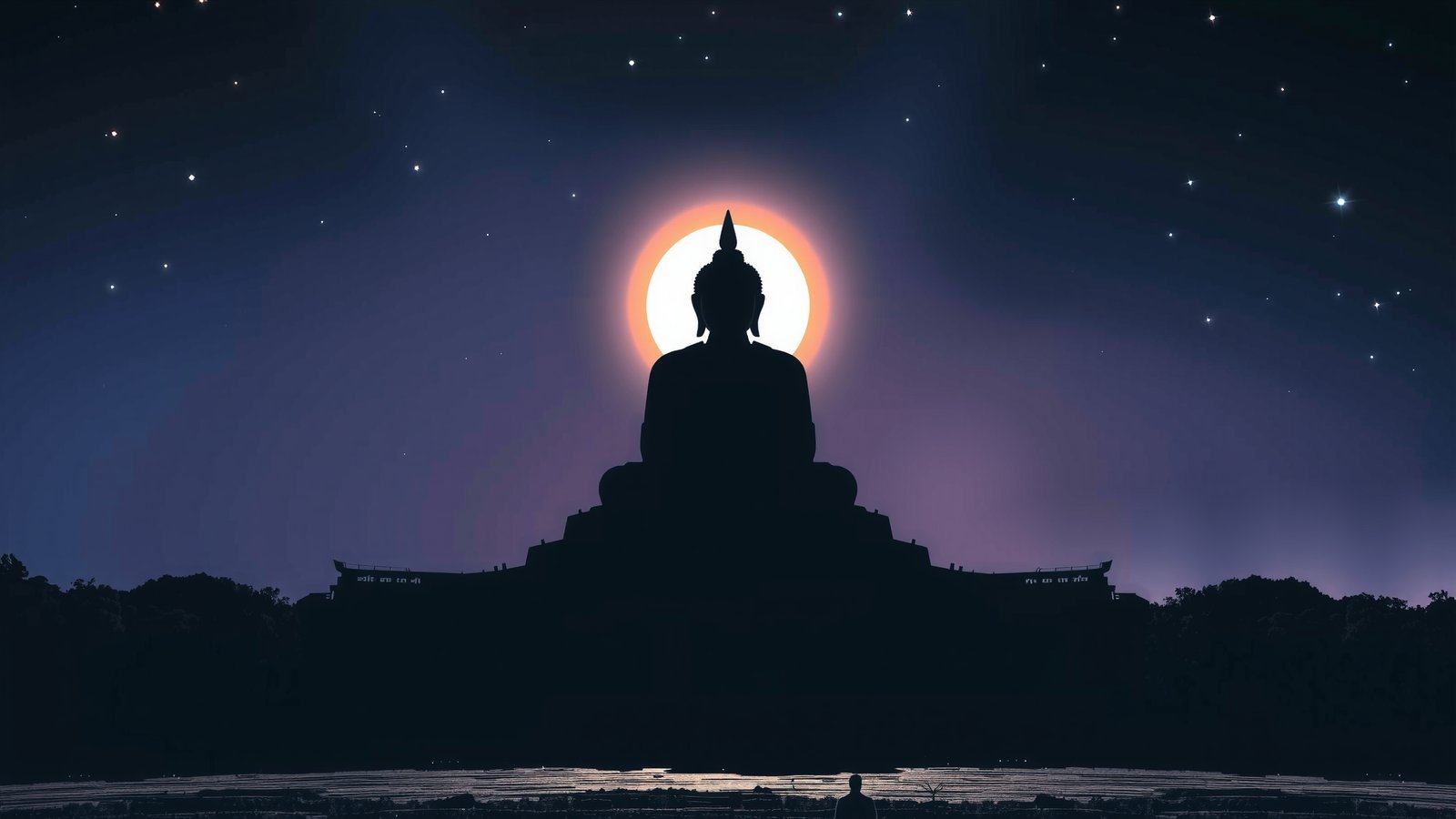
Companion article for the YouTube video “Great Buddha 174Hz · 8-Hour Sleep”
The Great Buddha and 174Hz: A Thousand Years of Stillness, and the Symbol of Deep Rest
There is something
that has sat
in the same place,
without moving,
for a very long time.
Through earthquakes.
Through the fires of war.
Through a thousand years
passing over it.
The Great Buddha
does not move.
This is the story of two Great Buddhas —
one in Nara,
one in Kamakura —
and what their unshaken presence
quietly asks of us today:
a theme of deep rest
and earthlike security.
This article’s answer (in 3 lines)
The Great Buddhas of Nara and Kamakura have sat, seated and unmoving, through earthquakes, war, and storms for over a thousand years — living symbols of stillness, immovability, and acceptance. In the Solfeggio tradition, 174Hz is associated with “grounding” and “deep rest,” which loosely echoes the Buddhas’ unshaken presence. There is no historical connection between the Great Buddha and 174Hz, and neither is presented here as a guaranteed effect — both are offered as poetic symbols.
💎 Key takeaway
What the Great Buddha teaches is that security isn’t something tensely guarded — it’s something that arises simply from remaining, like the earth itself.
30-Second Summary
- The Great Buddha of Nara (Tōdai-ji, the Vairocana Buddha) was consecrated in 752 CE and has been an object of worship for over 1,200 years
- The Great Buddha of Kamakura (Kōtoku-in, the Amida Buddha) was cast around 1252 and has sat exposed to the open sky ever since its hall was lost
- Both share one fact: through disaster and war, they have remained, unmoving, in place
- The Buddhas’ stillness is often read as a symbol of a universal theme: silence, immovability, and acceptance
- Solfeggio 174Hz is, in modern tradition, considered the lowest tone, associated with grounding and deep rest
- Layered onto the Buddhas’ stillness, 174Hz can be read as a movement from the security of having a foundation toward deep rest
- All of this is offered as symbolic framing — not a scientific or devotional claim of guaranteed effect
- As background for an 8-hour sleep track, 174Hz is suggested here as a relaxation habit, nothing more
1. What Is the Great Buddha — Nara and Kamakura, the Search Term Behind Two Statues
When people in Japan say “Daibutsu,” or Great Buddha,
two statues usually come to mind first:
the Great Buddha of Nara (Tōdai-ji)
and the Great Buddha of Kamakura (Kōtoku-in).
The Nara statue is formally known as
Rushana Butsu — the Vairocana Buddha —
described in the Avatamsaka (Kegon) Sutra
as the Buddha who embodies the cosmos itself.
The Kamakura statue depicts
Amida Nyorai, the Amida Buddha,
revered as the one who welcomes
all beings from the Western Pure Land.
Neither is a colossal statue built for spectacle.
Both are, and have long been,
living objects of faith,
carried carefully across the centuries —
worth remembering as we begin.
2. The History of the Great Buddha’s Construction — Emperor Shōmu’s Prayer, and Why Such an Enormous Statue Was Built
In the early 8th century, when the Nara statue was commissioned,
Japan had been repeatedly struck
by a devastating smallpox epidemic,
famine,
and political instability.
In 743, Emperor Shōmu issued an edict
calling on the entire nation
to join in building the Great Buddha,
reportedly welcoming even the humblest contribution —
“even a single blade of grass, a handful of earth.”
Casting was completed in 749,
and in 752,
before monks invited from India and China
and a large gathered crowd,
the eye-opening ceremony (kaigen kuyō) was held.
This is the record
of an entire nation
pooling its prayers
during an age of crisis.
The Kamakura Buddha came roughly
five centuries later,
cast in bronze around 1252,
during the Kamakura period.
Both statues, more than displays of power,
can be understood as
the prayers of people living through uncertain times,
given physical form.
3. A Thousand Years Seated — What It Means for the Great Buddha to Never Move
The Nara Great Buddha’s head fell
in an earthquake in 855.
It was burned in warfare in 1180,
and damaged again by war in 1567.
Each time,
it was repaired
and seated once more
by human hands.
The Kamakura Buddha once stood
inside a large wooden hall,
but repeated storms — and, it is believed,
a tsunami around 1498 —
destroyed the structure entirely.
For more than five centuries since,
it has sat exposed to the open air,
through wind and rain,
with no roof at all.
And still,
the Great Buddha
sits in the same place,
in the same posture.
This is more than a historical record —
it carries a deeper symbolism:
remaining unshaken, in place, even after being broken or losing everything.
▼ We invite you to experience the Great Buddha’s presence alongside the 174Hz soundscape in the companion video (release date to be announced).
🎬 この記事のテーマの動画は近日公開予定です
MuZenCosmosチャンネルを登録して公開をお待ちください。
4. What the Great Buddha Symbolizes — Stillness, Immovability, and Acceptance as a Universal Theme
The Great Buddha has been revered for centuries
not simply because the statue is enormous.
It is because it echoes
a way of being that many of us quietly long for.
- Remaining in the same place, no matter how the era around it changes (immovability)
- Never losing its posture, even after losing its roof, even exposed to the weather (acceptance)
- Making no loud claim, simply being there, quietly (stillness)
- Meeting every visitor with the same gaze, without condition (unconditional acceptance)
This can be read as a quiet story of trust:
security is not the absence of change —
it is having an unshaken foundation within change.
Just as the Great Buddha has remained unmoving for a thousand years —
deep rest, too,
is not something achieved through effort,
but something that arrives naturally
in a place where simply being is permitted.
If themes of cosmic consciousness and inner stillness resonate with you,
you may also enjoy Accessing Cosmic Consciousness.
5. What Is Solfeggio 174Hz — The Traditional Meaning of the Lowest Tone
174Hz is considered
the lowest tone
in the modern Solfeggio frequency system.
It’s worth being honest here:
the Solfeggio system as we know it today
was largely reconstructed
in the latter half of the 20th century.
Rather than an unbroken, ancient scientific tuning,
it is best understood as
a tradition that has grown within modern healing culture.
Within that tradition, 174Hz is often associated with:
- Grounding (a sense of connection to the earth)
- The easing of physical tension
- Deep rest and a sense of security
For more on this frequency, see our companion piece,
174Hz: The Frequency of Deep Rest,
and for the fuller science of sleep, see
The Complete Science of Sleep.
What matters here is the careful phrasing:
not “listening to 174Hz relieves pain,”
but “within the Solfeggio tradition, 174Hz has come to symbolize a sense of foundation and rest.”
6. What 174Hz Is Said to Do — Grounding and Deep Rest as Symbol
174Hz is the lowest tone
among the Solfeggio frequencies,
often described as “nature’s own anesthetic“
or “the frequency of foundation.”
Some modern proponents link it directly
to pain relief —
a claim that is not scientifically established.
MuZenCosmos draws a clear line here between
what can and cannot be honestly said
(see Section 10 below).
Here, we don’t present 174Hz as
“a tone that erases pain,”
but rather as
“a tone that symbolizes putting down roots into the earth, and a deep sense of security” —
a fitting echo for the Great Buddha’s unmoving presence.
For a more practical take on grounding, see
Grounding Meditation.
7. The Symbolic Bridge Between the Great Buddha and 174Hz
To be honest with you:
there is no historical or textual connection
between the Great Buddha and Solfeggio frequencies.
The Nara Buddha’s eye-opening ceremony took place in 752 CE.
The modern Solfeggio system
spread widely only from
the late 20th century onward.
These come from
entirely different eras and cultures.
But when we look at
the shape of the presence —
a loose resonance appears:
- The Great Buddha, seated unmoving for a thousand years = a symbol of an unshaken foundation
- What 174Hz symbolizes as “grounding” = the security of roots reaching into the earth
- The Buddha remaining, just as it is, even after losing its roof = what 174Hz symbolizes: “deep rest“
In other words:
“letting 174Hz carry the body’s tension down into the earth,
and giving yourself permission simply to be, as the Great Buddha has been” —
is a feeling that can be
poetically layered over the image
of a Buddha seated for over a thousand years.
This is not an academic claim,
but one way of reading
symbol alongside symbol.
8. Great Buddha × 174Hz Correspondence Table — Four Stages from Stillness to Rest
Per our v2.6 structural rule, here is a comparison table mapping the Great Buddha’s history to Solfeggio symbolism.
| Stage | What Happens | Symbolic Theme | Corresponding 174Hz Association (as symbol) |
|---|---|---|---|
| The prayer behind construction (752 CE / c. 1252) | Amid epidemic and disaster, people pour their prayers into building the Buddha | A longing for fundamental security | What 174Hz symbolizes: “foundation, a sense of security“ |
| Enduring disaster after disaster (earthquakes, war) | Damaged, then repaired and reseated each time | Immovability, endurance | What 174Hz symbolizes: “easing of tension“ |
| Losing the roof, sitting exposed (Kamakura Buddha, 15th century onward) | Even after losing the building, the posture never changes | Acceptance, being as one is | What 174Hz symbolizes: “grounding“ |
| Remaining seated into the present | Still welcoming people, unchanged, after a thousand years | Deep rest, an unchanging way of being | What 174Hz symbolizes: “deep rest“ |
This mapping is offered strictly as a poetic aid, not as a claim of medical or paranormal effect.
9. How to Listen to 174Hz — Through Eight Hours, With the Great Buddha in Mind
A few practical suggestions:
- Before bed: play 174Hz for a few minutes, and gently notice where in your body tension has gathered today
- Across the full eight hours of sleep: let a long-form 174Hz track play continuously, imagining your body settling into the earth
- With the Great Buddha in mind: just as it has remained unmoving for a thousand years, give yourself permission to do nothing at all, right now
- Don’t force meaning onto it: simply enjoying the tone’s low, steady resonance is enough
These are offered as relaxation practices,
not as guarantees of any therapeutic outcome.
If sleepless nights are a recurring struggle, see
Meditation for Insomnia.
10. What Can and Cannot Be Said — An Honest Approach to the Great Buddha and Frequency
Here is the honest line MuZenCosmos holds to.
What can be said
- The Great Buddhas of Nara and Kamakura are genuine works of Buddhist art and objects of continuous worship spanning close to a thousand years
- Both statues remain, today, living objects of faith, welcoming visitors and worshippers alike
- Within Solfeggio tradition, 174Hz carries an established symbolic association with grounding and deep rest
- Quiet listening time itself, particularly with low, steady tones, is associated in some research with relaxation benefits
What cannot be said
- There is no scientific proof that listening to 174Hz “relieves pain”
- The claim that 174Hz treats any specific physical condition has not been scientifically verified
- There is no direct historical link between the Great Buddha and Solfeggio frequencies
- Music or frequency cannot substitute for faith itself, nor guarantee the Buddha’s blessing
11. The Cultural Background of Great Buddha Worship — A Living Place of Prayer Today
Tōdai-ji in Nara
and Kōtoku-in in Kamakura
are both popular tourist destinations —
and, at the same time,
places where religious services and worship
continue to this day.
Tōdai-ji is registered as a UNESCO World Heritage Site,
as part of the “Historic Monuments of Ancient Nara.”
This is not a relic preserved in a museum.
It is a faith that is still breathing.
In telling this story,
we’ve made a point
to avoid caricature or sensationalism,
and to treat it
with the respect it deserves.
If you’d like a broader introduction to spirituality as a topic, see our
Complete Guide to Spirituality.
12. A Hypothetical Example: Settling the Mind Before Sleep
Consider a hypothetical situation: someone under prolonged work pressure whose mind keeps replaying the day’s events at night, making it difficult to relax into sleep.
For someone in this situation, the Great Buddha of Nara — a figure that has remained still through centuries of earthquakes, wars, and change — can serve as a mental image of “not needing to do anything right now.”
One approach some people describe is picturing this stillness while a long 174Hz track plays before bed, using the image to stop actively trying to fall asleep and instead let the body settle, the way the Buddha simply sits.
This is a generalized, illustrative example rather than an account of a specific individual — it is meant to show one way a historical symbol of stillness might be paired with a low frequency as a bedtime visualization.
13. Frequently Asked Questions
Q1. What is the Great Buddha of Nara?
Formally known as Rushana Butsu, the Vairocana Buddha described in the Avatamsaka Sutra as embodying the cosmos itself. Construction began in 743 under Emperor Shōmu, and the eye-opening ceremony was held in 752. It remains the principal image of worship at Tōdai-ji.
Q2. How is the Great Buddha of Kamakura different?
The Kamakura statue depicts Amida Nyorai and is believed to have been cast in bronze around 1252, during the Kamakura period. The principal image at Kōtoku-in, it lost its hall to repeated disasters and has sat exposed to the open sky since the late 15th century.
Q3. Why was such an enormous statue built?
At the time of the Nara Buddha’s construction, Japan was suffering a major smallpox epidemic, famine, and political instability. Emperor Shōmu is said to have sought to calm the crisis by uniting the nation’s prayers into a single project.
Q4. What do the Great Buddha’s hand gestures (mudras) mean?
The Kamakura Buddha’s right hand forms the Semui-in (“fear not”) mudra and its left hand the Jōin meditation mudra, symbolizing the removal of fear and a state of deep meditative calm. The Nara Buddha holds similarly meaningful mudras of reassurance and wish-granting.
Q5. Is the Great Buddha still an object of worship today?
Yes. Both Tōdai-ji and Kōtoku-in continue to hold religious services and welcome worshippers as living places of faith. Tōdai-ji is also a registered UNESCO World Heritage Site.
Q6. What is Solfeggio 174Hz?
It’s considered the lowest tone in the modern Solfeggio frequency system, associated within that tradition with grounding and deep rest.
Q7. Does listening to 174Hz really ease pain?
This is not a scientifically proven claim. We present it strictly as a symbolic association within Solfeggio tradition, not as a guaranteed effect.
Q8. Is there a historical connection between the Great Buddha and 174Hz?
No. The Nara Buddha’s eye-opening ceremony took place in 752 CE, while the modern Solfeggio system emerged from the late 20th century onward — different eras, different cultures entirely. This article presents the two as a poetic layering of symbols, not a historical link.
Q9. How is 174Hz used as background for an 8-hour sleep track?
One suggestion is to let a low, steady tone play continuously through the full sleep period, offered as a way to ease physical tension over time. This is a habit suggestion, not a guaranteed outcome.
Q10. What does the Great Buddha’s story mean for us today?
Its structure — that security comes not from the absence of change, but from having an unshaken foundation within change — maps onto a universal longing for rest that many people carry. It’s a comforting frame for thinking about our own need to simply be, without striving.
14. Conclusion — It’s Fine, Like the Great Buddha, Simply to Be
As this story closes,
remember this once more:
the Great Buddha is not there
to accomplish anything.
Through earthquakes,
through the fires of war,
through rain and wind after losing its roof —
it has simply
remained, unmoved.
That is all.
If your mind,
tonight,
cannot seem to allow itself to rest —
let the low, steady tone
of 174Hz
settle around you.
And, the way the Great Buddha has done
for a thousand years,
give yourself permission:
you don’t have to do anything.
It’s fine, simply, to be.
Deep rest may not be
an achievement you strive toward —
it may be
something you gently entrust yourself to,
the way the earth is already, quietly, there.
The stillness of a Buddha
seated for a thousand years
is still here,
tonight, too.
References
- Shoku Nihongi (compiled 797 CE) — the official chronicle of the Nara period recording Emperor Shōmu’s edict to build the Great Buddha and its 752 CE eye-opening ceremony
- Kamakura City Board of Education / Kōtoku-in (supervising) — cultural heritage records documenting the casting of the Kamakura Great Buddha and the loss of its hall
- Avatamsaka Sutra (Kegon-kyō) — the doctrinal source describing the Vairocana Buddha depicted at Nara
- Jonathan Goldman, Healing Sounds: The Power of Harmonics, Healing Arts Press — on sound, overtones, and healing culture
- Joachim-Ernst Berendt, Nada Brahma: The World Is Sound, Destiny Books — a foundational work on sound and cosmology
MuZenCosmos — Where the Cosmos Meets Stillness | It’s Fine, Like the Great Buddha, Simply to Be
This article does not guarantee any medical or health benefit and is not a substitute for professional medical care. If you have any health concerns, please consult a physician or other qualified professional.