I recently built a tool called the Hearing Age Test, which checks in the browser how high a pitch you can hear. I built it for one reason: as someone who makes music, I wanted to know whether I was sending people sounds I could no longer hear myself. Here is what happened when I took it.
First try: 8,000 Hz (the monitor’s built-in speakers)
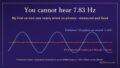
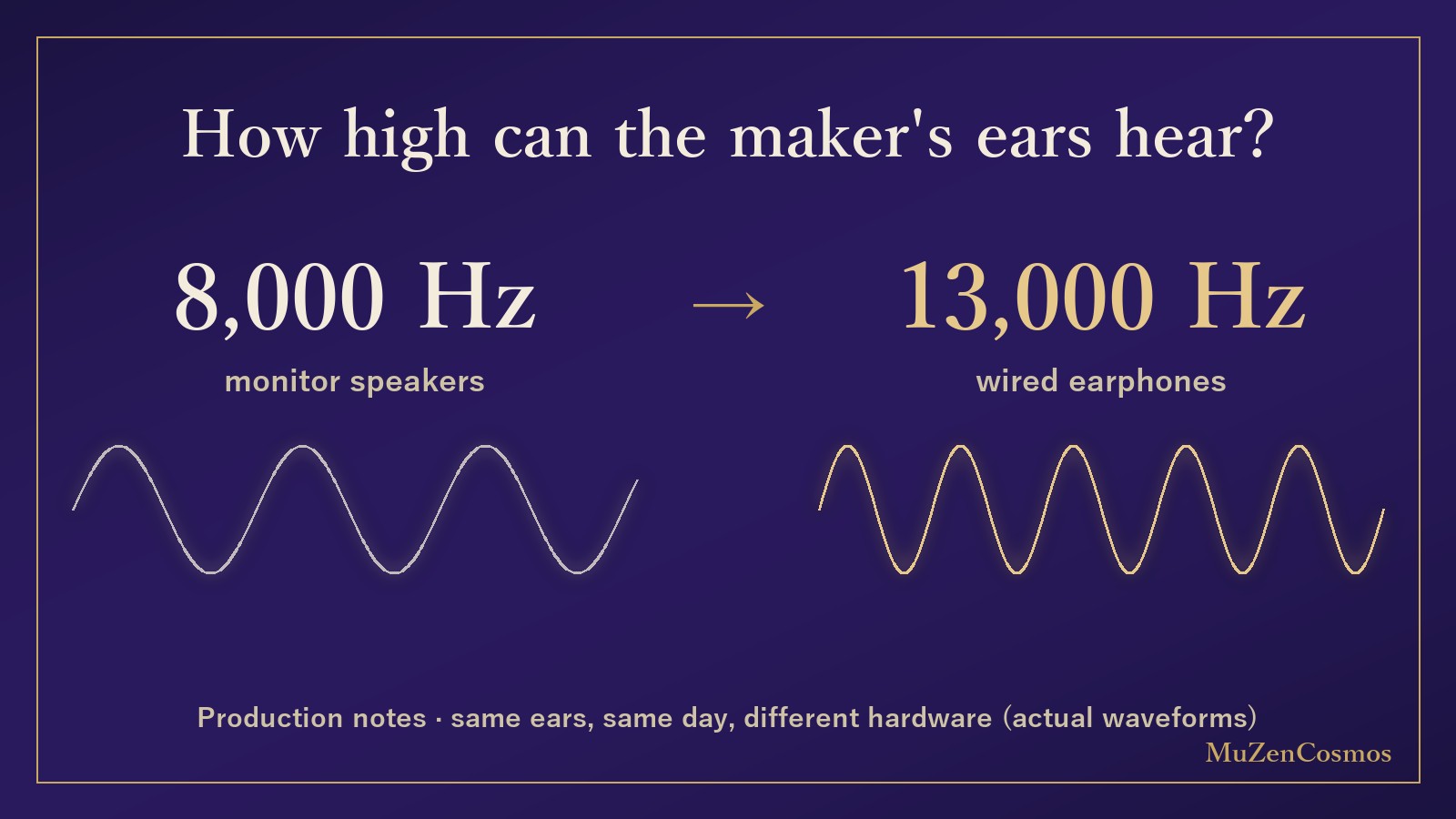
I started with the speakers built into my computer monitor. The reference tone (1,000 Hz) was clearly audible. Going up, I heard 8,000 Hz, and nothing from 10,000 Hz upward. Result: 8,000 Hz. On the age guide, that is “60s and over.”
Second try: 13,000 Hz (wired earphones)
The same day, I repeated the test with wired earphones. Result: 13,000 Hz, “50s” on the guide. The device limit showed 21,600 Hz, so the earphone side had plenty of headroom.
The 5,000 Hz gap was the hardware, not my ears
Same ears, same day, same way of setting the volume, and the result moved by 5,000 Hz. The only thing that changed was the hardware. Small speakers like the ones built into a monitor are weak at high pitches; the signal is there, but they cannot move enough air. The first “8,000 Hz” was the speaker’s ceiling, not mine.
When I built the tool, I put “this device’s upper limit” on the result screen and wrote “suspect the hardware first” in the text. My own result turned out to be the proof.
What to make of 13,000 Hz
The “50s” label is a widely shared rule of thumb, not a medically validated standard. That high pitches fade first with age is well established, but individual variation is large and the same person gets different results with different gear. Another pair of earphones might shift the 13,000 Hz a little. What I can say for sure is only this: in my current setup, my ears seem to top out around 13,000 Hz.
What I decided as a maker
Healing tracks can contain content above 13,000 Hz: the upper overtones of instruments, the hiss in a noise layer, the tail of a reverb. I cannot check that band with my ears. Declaring something I cannot hear to be “fine” is the same as not judging it at all.
So for the bands I cannot hear, I will rely on measurement instead of listening: measure the frequency content of a track and look at what is in the high band, as numbers and a chart. The next article will show that measurement on one of my own 528 Hz tracks.
If you try it
- Use wired earphones or headphones first. A result from speakers or Bluetooth may be the hardware’s limit.
- Do not turn up the volume to catch a tone you cannot hear.
- Treat the result as a rough indication. If you have any concern about your hearing, see an ENT specialist.
Take the Hearing Age Test (free, no sign-up). To check the pitches themselves, see the Frequency Lab.
This article does not guarantee any medical or health benefit and is not a substitute for professional medical care. If you have any health concerns, please consult a physician or other qualified professional.