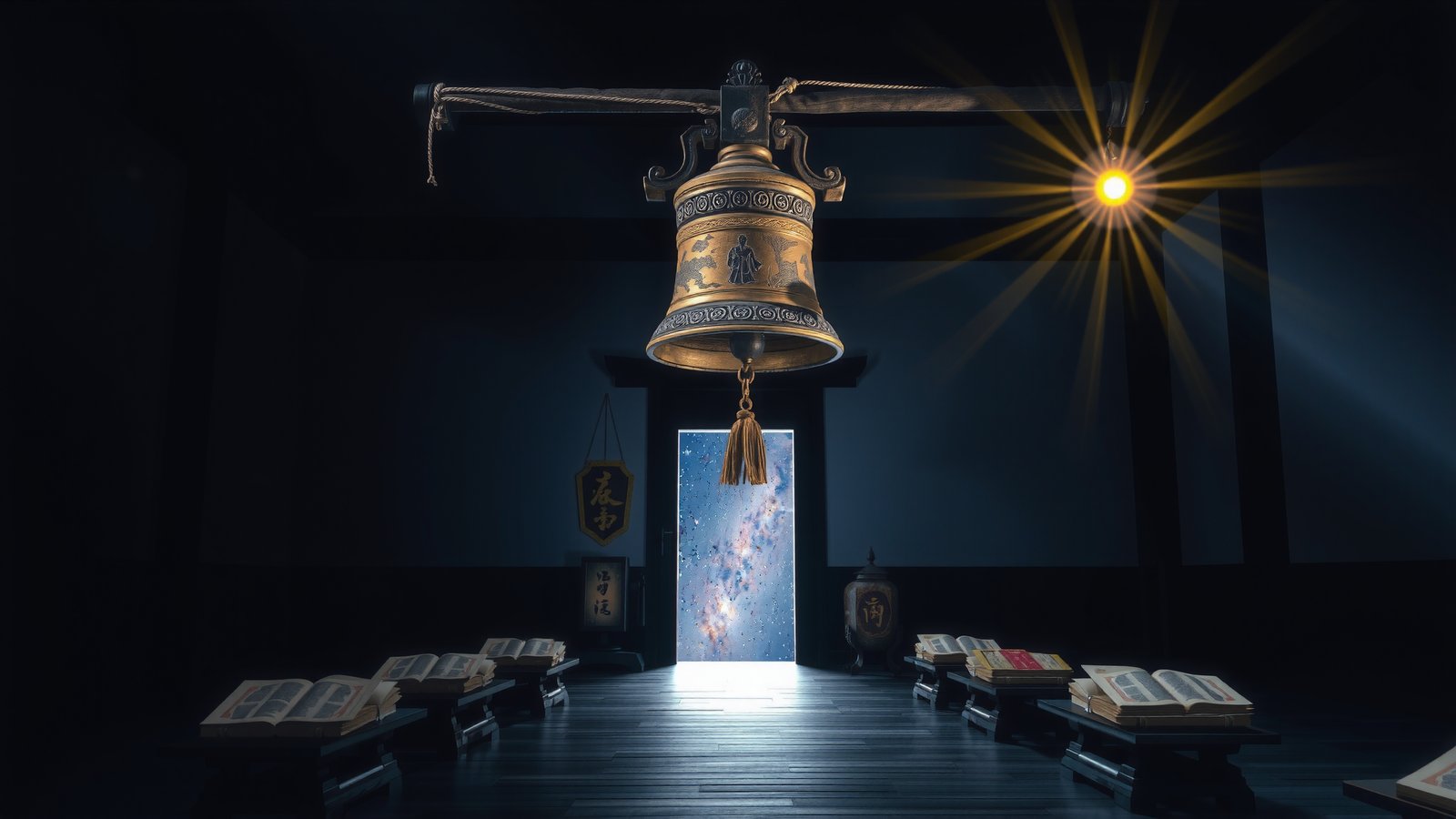
At the start of the service, one voice comes in low. Then another lays itself on top. The same note, supposedly —and yet slightly off. That slight difference climbs into the high wooden ceiling, reflects, comes back, and turns into a slow wave. It is not singing. It is not reading aloud, either.
If you have heard it, you probably had exactly one thought: “What is this?”It is called shōmyō.
💎 The one line that matters Shōmyō is not “sutras recited devoutly.” It is a notated vocal art with its own modal system, transmitted mouth to mouth for over a thousand years — arguably the oldest surviving vocal music in Japan.
The Answer in Three Lines
- Shōmyō is the melodic vocal music chanted by monks in Buddhist services. The word originally meant linguistics and phonetics in ancient India.
- Japan has two main lineages: Tendai shōmyō and Shingon shōmyō. Both are written in hakase notation, which cannot be reduced to a staff.
- The point is not the melody but how voices stack. Slight drift in unison plus long hall reverberation produces the beating and overtones you hear.
1. What Is Shōmyō? — The Difference Between Reciting and Chanting
Shōmyō is vocal music with a fixed melody, chanted by monks during Buddhist services. The clearest way to understand it is to set it beside ordinary sutra recitation. What most people picture is recitation: text delivered on roughly one pitch. The speed may change, but the pitch does not move much.
Shōmyō moves. It rises, falls, stretches, and wavers. Where it rises and how long it is held are fixed for each piece. So shōmyō isnot a matter of feeling, but a matter of prescribed motion. This is the first thing people get wrong. Shōmyō is not “a sutra read with especially sincere feeling.” It is music, with scores, lineages, and years of training behind it.
Monks learn it by listening to a teacher, imitating, and being corrected — because the part that matters most is the part the notation cannot hold.
2. Where the Word Comes From — It Used to Mean Linguistics
Here is a surprise: the word shōmyō did not originally refer to music at all. Ancient India organized monastic learning into five fields, the gomyō (five sciences):
| The five sciences | Content |
|---|---|
| Shōmyō | Language, grammar, phonetics |
| Kugyōmyō | Craft, technology, calendrical science |
| Ihōmyō | Medicine |
| Inmyō | Logic |
| Naimyō | One’s own doctrine |
Shōmyō was the translation of śabda-vidyā — “the science of sound.”How did a branch of linguistics become the name of a musical practice?Because scriptures were carried by voice. Long before they were written down, they were memorized, chanted, and passed from ear to ear. Pronouncing correctly. Holding the right pitch for the right duration.
That was not piety. It was engineering. So a science of sound was required. And as the tradition traveled through China to Japan, the name of the science slid over onto the sound itself. You can still see the moment a word changed meaning.
3. The History of Shōmyō — From the Great Buddha to Gyozan
Shōmyō entered Japan with Buddhism. The 752 eye-opening ceremony of the Great Buddha at Tōdai-ji is remembered as an occasion of extraordinary music, with monks gathered from across the country and gigaku performed. Sound sat at the center of a state ritual. The turning points came with monks who studied in Tang China.
Ennin (794–864) is credited with bringing back the Wutai-shan style of nenbutsu chanting — the inzei lineage, in which the voice is drawn out slowly and at length. Then Ryōnin (1073–1132). He settled at Ōhara, north of Kyoto, and is credited with consolidating the scattered Tendai chant traditions into a coherent system. That is why Ōhara is still known as Gyozan, after the Chinese sacred mountain. Temples such as Raigō-in and Shōrin-in carry the memory.
Shingon chant, meanwhile, developed from what Kūkai transmitted, and the Nanzan Shinryū tradition centered on Mt. Kōya became the mainstream. The remarkable part is that both lineages have continued almost a thousand years, by oral transmission, without a break. The notation was only an aid.
The music itself lived in people’s throats. Through wars, sectarian splits, and the upheavals of the Meiji era, the voices kept being handed over. Continuities like that are rare anywhere in the world. The same structure appears in Esoteric Buddhism: A Complete Introduction (Article 155). Esoteric Buddhism insisted on direct transmission from master to disciple; shōmyō cannot travel any other way. They are two faces of the same idea.
4. Tendai vs. Shingon — Comparing the Two Lineages
“Shōmyō” is often used as one word, but the lineages differ in character.
| Aspect | Tendai shōmyō | Shingon shōmyō |
|---|---|---|
| Center | Mt. Hiei, Ōhara in Kyoto (Gyozan) | Mt. Kōya (Nanzan Shinryū) |
| Origin | Ennin and other Tang-trained monks; consolidated by Ryōnin | Developed from what Kūkai transmitted |
| Notation | Meyasu hakase is generally used | Goin hakase is generally used |
| Sonic impression | Long, drawn-out breath lines stand out | Rises and falls are more sharply articulated |
| Representative services | Hokke Senbō, Reiji Sahō | Rishu Zanmai, Goya Sahō |
| Where to hear it | Tendai temple services, chant concerts | Mt. Kōya and Shingon temple services, chant concerts |
That said, the difference is something you only notice after comparing. What a first-time listener actually receives is not the lineage but the sensation that the whole hall is sounding. Which is probably the correct way to hear it.
5. Hakase — The Notation That Will Not Fit on a Staff
Shōmyō has its own notation, called hakase. Visually, it is a series of short strokes drawn beside the text. The angle, direction, and curvature of each stroke indicate how the voice rises, holds, and bends. The contrast with staff notation is absolute.
| Aspect | Staff notation | Hakase |
|---|---|---|
| What it specifies | Absolute pitch and duration | Motion away from the previous note |
| Reference point | Named pitches (A = 440 Hz, etc.) | The opening voice of the day |
| Reading | The same for any reader | Interpretation varies by lineage and teacher |
| Completeness | Reproducible from the page | Not reproducible from the page |
In other words, hakase does not specify notes. It specifies movement. The opening pitch is set by the voice of the officiating priest on that particular day. It shifts with health, season, and the size of the hall. The concept of absolute pitch simply is not present. We tend to think of music as a collection of pitches fixed in hertz — one reference frequency, and every other note derived from it.
Shōmyō has operated outside that assumption for a thousand years. The reference was never a number. It was the throat of whoever was there.
6. The Modal System — Ryo, Ritsu, and Chūkyoku
The pitch organization of shōmyō is usually explained through three modes: ryo, ritsu, and chūkyoku. The vocabulary is shared with gagaku, the court music tradition, and preserves an old stratum of Japanese music theory. The five degrees — kyū, shō, kaku, chi, u — descend from Chinese theory.
But let us be honest here. Theory and actual sound are quite far apart. However neatly the modes are defined, in practice the voice slides, wavers, and dissolves into the neighboring pitch. Unlike equal temperament, there are no clean steps between one note and the next. So any attempt to transcribe shōmyō onto a staff always loses something.
Several such attempts were made in the modern era. The recurring result was that the part which could not be written down was precisely the part that made it shōmyō. What can be written travels easily. What cannot tends not to survive. Shōmyō never let go of oral transmission. That is almost certainly why.
7. What Actually Happens in the Hall — Reverberation and Beating
This is the heart of the article. That distinctive thickness you hear in shōmyō cannot be explained by vocal technique alone. The building supplies half of it. Break it into parts. First, reverberation. Temple halls are hard wood, earthen walls, high ceilings, almost no absorptive material. Sound is not swallowed; it reflects many times. The previous note is still in the air when the next one starts.
Second, unison drift. Shōmyō is fundamentally unaccompanied unison. Everyone chants the same line. But human voices never align perfectly — pitches differ by a hair, entrances differ by a fraction. Third, beating. When two tones of slightly different pitch overlap, the loudness pulses slowly. This is beating, and it is very likely one source of that characteristic undulation.
Fourth, overtones. A human voice is not a single frequency; it carries integer-multiple components. When many voices overlap and linger in the reverberation, certain overtone bands reinforce one another. All four happen at once. The mechanics of overtones are covered in Overtone Chanting Meditation: A Complete Guide (Article 130).
What is fascinating is that we cannot say this was designed. The halls were not built as acoustic instruments. Yet this resonance emerged, and the melodies were refined on the assumption of it. It is closer to the truth to say the building and the voices spent centuries adjusting to each other.
8. Shōmyō Compared with Other Chant Traditions
Because it involves stacked voices, shōmyō is often lined up beside other traditions. Here is the honest comparison.
| Aspect | Japanese shōmyō | Tibetan Buddhist chant | Gregorian chant | Khöömei (throat singing) |
|---|---|---|---|---|
| Vocal production | Ordinary voice, sustained | Some lineages use extreme low-register technique | Ordinary voice | Specialized throat control |
| Tones per singer | One | Lineage-dependent; multiple components audible | One | Two or more at once |
| How it stacks | Unison drift plus reverberation | Low-register group chanting | Unison (later polyphony) | Usually solo |
| Notation | Hakase (relative) | Notation plus oral transmission | Neumes (relative) | Mostly oral |
| Role of the space | Hall reverberation is essential | Performed indoors | Stone churches supply long reverb | Works outdoors |
One misconception deserves a direct correction. Japanese shōmyō is not a throat-singing technique. It is sometimes described as “overtone chanting,” which is not accurate. The rich overtones you hear in shōmyō come from many voices plus the reverberation of the hall, not from a single singer producing multiple components.
Same perception, different origin. This distinction is not a criticism. It matters because it changes where you should listen. Khöömei asks you to listen to one throat. Shōmyō asks you to listen to the room.
9. What Shōmyō Left Behind in Japanese Music
Shōmyō did not stay inside the temple. Much of Japanese traditional music is understood to descend, at least in part, from it:
- Heikyoku — the biwa-accompanied narration of the Tale of the Heike
- Utai — the vocal portions of nō drama
- Jōruri and gidayū-bushi — the narration of puppet theater
- Wasan and goeika — Buddhist hymns in Japanese
What they share is a position between song and speech. There is no firm beat; the pitch follows the contour of the words; held syllables are held generously. Japanese music seems to have inherited that instinct from shōmyō. It even surfaces in modern concert music. Toshirō Mayuzumi’s Nirvana Symphony (1958) combines sonorities derived from acoustic analysis of temple bells with male chanting modeled on Buddhist liturgy.
A thousand-year-old temple sound, ringing inside a twentieth-century orchestra. Old things rarely survive unchanged. They change shape and reappear somewhere else. That is usually what tradition means.
10. How to Listen to Shōmyō — Where to Put Your Attention
Most first-time listeners try to follow the melody, and fail. The melody does not have a firm shape. Try three stages instead. Stage one: listen to the opening voice. One priest begins alone. This sets the pitch for the day. It is the moment when the structure is most visible, before anything is layered on.
Stage two: listen to the moment of overlap. When other voices enter, the thickness changes. Receive the sensation that the same note is not quite the same note. The drift is not a mistake; it is the material. Stage three: listen to the silence after a phrase. When the voices stop, sound remains in the hall. The length of that decay is the character of the building. Listening to shōmyō is half listening to architecture.
You do not need to follow the words. They are classical Chinese and Sanskrit transliterations, and they do not move at a speed you could follow anyway. As with Mantra Meditation (Article 63), comprehension is simply not a condition of the experience.
11. Choosing Recordings and a Listening Setup — A 5-Point Checklist
At home, the recording and the playback conditions change the experience more than anything else. Check these five things.
- Was it recorded inside a hall? Studio recordings capture the voices cleanly but lose the reverberation, and with it the thickness. Look for “recorded at ◯◯-ji” or “live recording” in the description. Shōmyō recorded without its space is half of itself
- Is the lineage stated? Recordings that specify “Tendai shōmyō,” “Shingon shōmyō,” or a named service are likely performed by trained monastic specialists. A release labeled only “Buddhist chant — healing” may be processed ambient music. Neither is wrong, but know which one you are choosing
- Check for post-processing. Some editions layer synthesizers or nature sounds over the chant. That is fine for sleep, but if you want the chant itself, choose unprocessed recordings — words like “original” or “live” in the notes are the clue
- Speakers suit this better than headphones. The thickness of shōmyō comes from sound mixing in a space. Headphones reveal detail but remove room reflection, which can make it feel flat. Play it on room speakers and sit back a little. If headphones are all you have, avoid the most tightly sealed models
- Set the volume where it feels slightly too quiet. This is the most important item. Shōmyō is not loud in an actual service. A little below conversation level is right. Turn it up and the low-frequency content fatigues your ears within minutes
Recorded in a hall. Lineage stated. Played quietly. Get those three right and your first recording will not disappoint.
12. Hearing Shōmyō Live — Services vs. Concerts
Recordings are useful, but the real space is a different experience. There are three main ways in.
| Type | Character | Booking | Notes |
|---|---|---|---|
| Attending a temple service | The original form; usually free or by donation | Often not required | It is a ritual, not a performance. Follow temple etiquette |
| Shōmyō concerts | Concert-format programs in halls or temples | Ticketed | Often includes commentary — best for beginners |
| Seasonal observances | Shushōe, Nehan-e, Higan-e and similar | Varies by temple | Can be crowded |
For a first encounter, a concert with spoken commentary is the easiest entry. Knowing what a piece is for changes how much of it you can receive. If you attend an actual service, keep one thing in mind. You are not at a performance. The ritual is being conducted for memorial or petition, and you are being allowed to be present. As a rule, refrain from photography and recording, and follow the temple’s instructions without exception.
Dates, venues, and visiting conditions vary by temple and organizer and are subject to change. Always check official information before you go. Temple etiquette in general is covered in Zen Temple Pilgrimage in Japan (Article 156).
13. What the Research Can and Cannot Say
Let us draw the line honestly. There is almost no reliable research on shōmyō itself. You will occasionally see claims that shōmyō “tunes the body with special frequencies.” No evidence is offered for such claims. There is, however, relevant research nearby. Bernardi and colleagues, writing in the BMJ in 2001, reported that reciting rosary prayers or yoga mantras brought breathing to roughly six breaths per minute and produced measurable changes in cardiovascular rhythms. Sustained vocalization necessarily lengthens the exhale — and that showed up in the autonomic measures.
Vickhoff and colleagues reported in 2013 that singers’ heart rate variability tends to synchronize when they sing in unison. Chanting the same line with the same breathing appears to produce physiological entrainment. A small fMRI study by Kalyani and colleagues in 2011 reported differences in limbic activity patterns during “OM” chanting.
None of these studied shōmyō. To summarize:
| Claim | Strength of evidence |
|---|---|
| Slow chanting tends to settle breathing near six breaths per minute | Moderate (Bernardi et al., 2001) |
| Heart rate variability tends to synchronize during unison singing | Moderate (Vickhoff et al., 2013) |
| Chanting alters brain activity patterns | Weak to moderate (Kalyani et al., 2011; small sample) |
| Reverberation and overtones affect subjective absorption | Weak (mostly subjective measures) |
| Shōmyō cures illness or improves fortune | Unproven |
What we can say with confidence is smaller, and truer: A stretch of time appears in the day in which the breath goes out slowly. Listening alone does not change your breathing. But a room with shōmyō playing in it is usually a quiet room, and that has value on its own. Calling it an “effect” and attaching numbers to it is beyond what current science supports.
14. Misconceptions and Cautions
Commonly misunderstood
- “Shōmyō just means reciting sutras.” No. Recitation stays near one pitch; shōmyō is vocal music with a prescribed melodic line
- “Shōmyō is overtone singing.” No. The overtones come from many voices and hall reverberation, not from a throat technique
- “It is tuned to a specific frequency.” No such fact has been established. Shōmyō has no absolute pitch reference; the opening pitch is set by the officiant that day
- “It will always feel healing.” Responses vary. Some listeners find sustained low chanting heavy rather than soothing
- “Anyone can imitate it.” Recording or publishing imitations of liturgical repertoire raises both religious and rights-related concerns. Start by listening
On body and mind
Shōmyō is not a substitute for medical care. If you are under treatment, follow your physician’s guidance. Practical cautions: Do not play it loudly. Sustained low-frequency content at high volume tires the ears quickly. And long sessions of low chanting may not suit you when your mood is very low. If it feels heavy, stop. On days like that, the brighter overtones described in The Complete Guide to Tibetan Singing Bowls (Article 40), or simply a walk outside, may serve you better.
About This Article (Disclaimer and Advertising Notice)
This article is informational content introducing the history, musical structure, and listening practice of shōmyō. It is not medical advice, psychotherapy, or religious solicitation. References to research on singing and chanting are not intended to guarantee improvement in any illness or symptom, and individual responses vary. There is currently almost no research examining shōmyō itself; the studies cited concern mantra recitation and choral singing. If you are receiving treatment, follow your physician’s guidance. Avoid loud or prolonged listening, which places strain on hearing. Dates, venues, visiting conditions, and photography or recording policies for services and chant concerts vary by temple and organizer and are subject to change. Always confirm official information before attending. This article does not encourage conversion to, or donation toward, any religion or sect.
[Advertising] This article may in future contain affiliate links to products or services. Purchases made through such links involve no additional cost to readers.
Consider, For Example, a Scene Like This
To make it concrete, imagine one general situation (this is a fictional, generalized example, not anyone’s actual account). Supposeyou are sitting in a temple hall for a memorial service, for the first time in years. The tatami is cold. Kneeling hurts, and part of you is waiting for it to be over.
Then one voice comes in low. At first you cannot tell what is being said. You try to follow the meaning, and notice that you cannot. A second voice enters. A third. The same note, supposedly —and yet slightly off. The difference climbs to the ceiling, comes back down, and the whole room begins to pulse slowly.
Your knees still hurt. Tomorrow’s work is probably still somewhere in your head. Butfrom the moment you stopped trying to follow it, time has been moving differently. Then the voices stop. And afterward, something is still sounding. Those few seconds of remainder are the quietest part of the whole service.
By the time the service ends and you open the car door outside, you have usually forgotten it. And yet those few seconds stay retrievable, somehow. Shōmyō is a sound that survives that way.
This article does not guarantee any medical or health benefit and is not a substitute for professional medical care. If you have any health concerns, please consult a physician or other qualified professional.
📚 Related Articles
- Production Notes: “28 Images Generated” — Not One Byte of Them Was New
- Production Notes: Assigning Frequencies to the Four Gods — Deciding Sound from Direction, Season and Colour
- Production Notes: An 8-Hour Track Isn’t Made in 8 Hours — Joining a 2.5-Minute Seed 258 Times
- Production Notes: The Day All Nine Clips Broke — Write “Do Not Draw It” and It Gets Drawn
FAQ (10 Questions)
Q1. What is the difference between shōmyō and ordinary sutra recitation?
Whether the pitch is prescribed. Recitation stays near one pitch; shōmyō has fixed rises, falls, and sustained tones for each piece. It has its own notation (hakase) and requires years of training.
Q2. Do I need to understand the words to listen?
No. The texts are classical Chinese and Sanskrit transliterations, and they do not move at a speed you could follow anyway. Listen to the melodic motion, the stacking, and the reverberation. Comprehension is not a condition.
Q3. Should I start with Tendai or Shingon chant?
Either. If pressed, start with whichever has a concert with commentary near you. The difference between lineages becomes audible on its own after a few listenings.
Q4. Is shōmyō a form of overtone singing?
Strictly speaking, no. Unlike khöömei or certain Tibetan practices where one singer produces multiple audible components, the overtones in shōmyō arise from many voices plus hall reverberation.
Q5. Is shōmyō tuned to a specific frequency?
No. There is no absolute pitch reference; the opening pitch is set by the officiating priest’s voice that day. No evidence supports claims of a designed frequency.
Q6. Can I leave it playing in the background?
Yes, but keep the volume low. The low-frequency content makes loud, prolonged listening fatiguing. A little below conversation level is right.
Q7. Is it suitable for playing while I sleep?
Voices can disrupt sleep for some people. Use a sleep timer and let it run for about 30 minutes before sleep. If you specifically want sleep audio, ambient sound usually works better.
Q8. Can I learn to chant it myself?
Some temples and organizations offer shōmyō workshops open to the public. That is a far better path than trying to reconstruct liturgical repertoire alone — more accurate, and more culturally considerate.
Q9. Can I photograph or record a service?
As a rule, no — always follow the temple’s instructions. A service is a ritual conducted for memorial or petition, not a performance. Policies differ by temple.
Q10. Where do I find good recordings?
Look for hall recordings released by temples or Buddhist-affiliated labels. Releases that specify the recording location and the lineage (“recorded at ◯◯-ji,” “Tendai shōmyō,” “Shingon shōmyō”) are more likely to feature trained monastic performers.
Conclusion | A Thousand Years, Carried by Throats Rather Than Pages
The most striking thing about shōmyōis that its notation stayed incomplete. Hakase does not write pitch. It does not write exact duration. What it writes is how to move away from the previous note. So shōmyō can never be reconstructed from the page. You listen to a teacher, imitate, get corrected — it travels from throat to throat, and no other way.
It has been carried like that for a thousand years. We tend to assume that recording something is what preserves it. Write it down, capture it, turn it into data. Shōmyō survived by the opposite method: an incomplete score and a living person. That combination, as it turned out, lasted longer.
Sit in a hall and you can almost see why. The same piece sits at a different pitch depending on the officiant. The thickness changes with the number of voices. The decay changes with the building. It is a different sound every time. It lasted because it was never fixed. For a wider view of Japanese and global wisdom traditions, see The Complete Guide to Spirituality (Article 91).
Tonight, before bed, play one shōmyō track at a low volume. You do not need to follow the words. When the voices stop, listen to the few seconds still sounding in the room. Starlight arrives with about that much delay, too.
References
- Denchū Tennō, Sōichi Iwata, Shōkō Harima, Kanritsu Asuka (eds.), Bukkyō Ongaku Jiten (Dictionary of Buddhist Music), Hōzōkan, 1995
- Alison McQueen Tokita and David W. Hughes (eds.), The Ashgate Research Companion to Japanese Music, Ashgate, 2008 (see the chapter on religious music for shōmyō)
- Bernardi L, Sleight P, Bandinelli G, et al. “Effect of rosary prayer and yoga mantras on autonomic cardiovascular rhythms: comparative study.” BMJ, 2001;323(7327):1446-1449.
- Vickhoff B, Malmgren H, Åström R, et al. “Music structure determines heart rate variability of singers.” Frontiers in Psychology, 2013;4:334.
- Kalyani BG, Venkatasubramanian G, Arasappa R, et al. “Neurohemodynamic correlates of ‘OM’ chanting: A pilot functional magnetic resonance imaging study.” International Journal of Yoga, 2011;4(1):3-6.
MuZenCosmos — Where the cosmos meets stillness | A thousand years, carried by throats rather than pages