In August I published a one-hour track built around 7.83 Hz (the Schumann resonance). The published version is the second one. The first version was nearly silent when played on a phone. Here is what happened, with the measurements.
You cannot hear 7.83 Hz in the first place
The Schumann resonance is a resonance of electromagnetic waves, excited by lightning, in the cavity between the ground and the ionosphere. Its lowest mode is about 7.83 Hz. It is not a vibration of air, not a sound. And the lower limit of human hearing is around 20 Hz, so a 7.83 Hz tone played directly would not be heard at all.
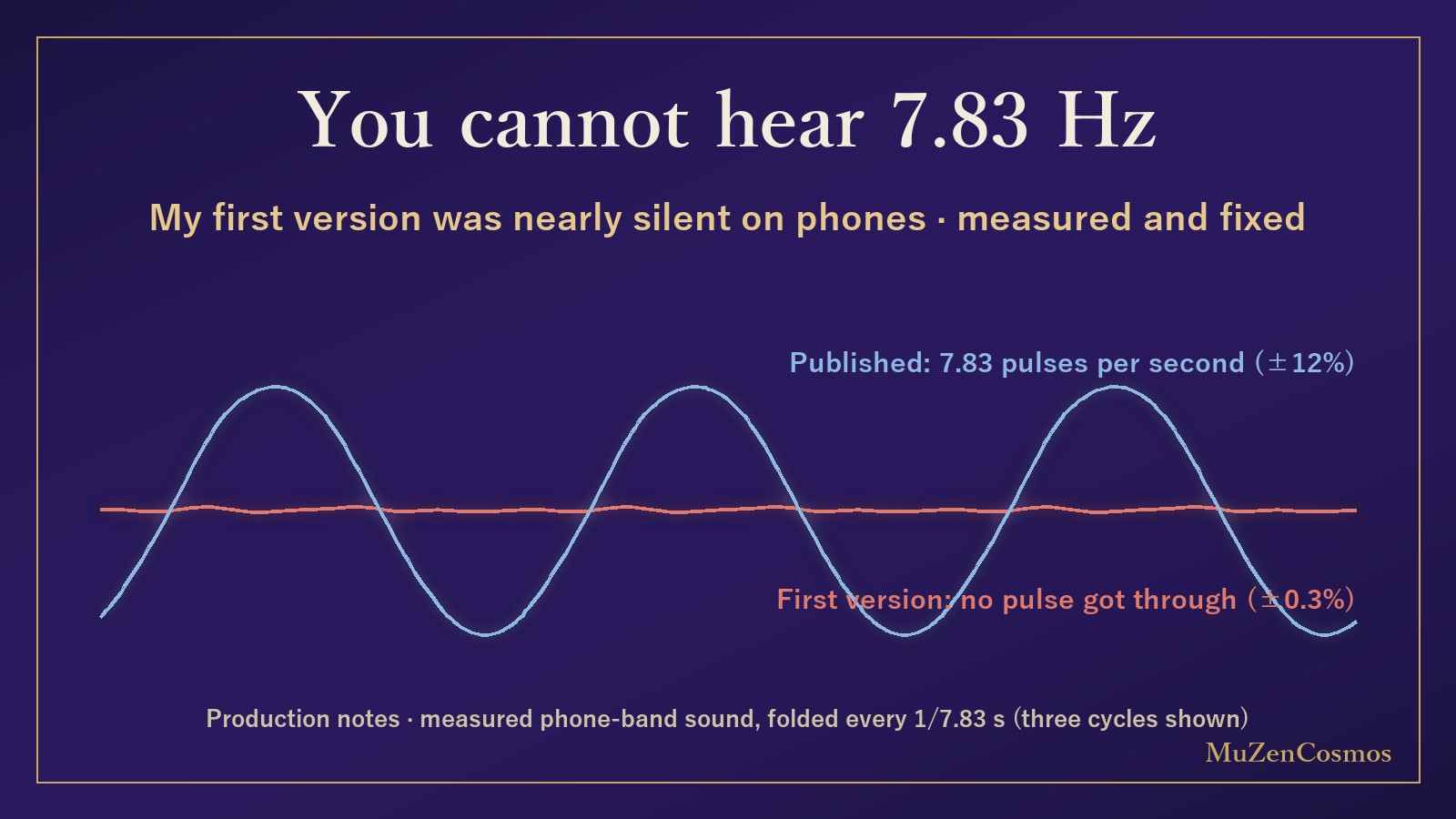
So in this track 7.83 Hz is not a pitch but a pulse: 7.83 gentle swells per second. A low sustained tone at 174 Hz is the base, and its volume rises and falls, very shallowly, 7.83 times a second.
Version one: almost all of the sound sat where small speakers cannot play
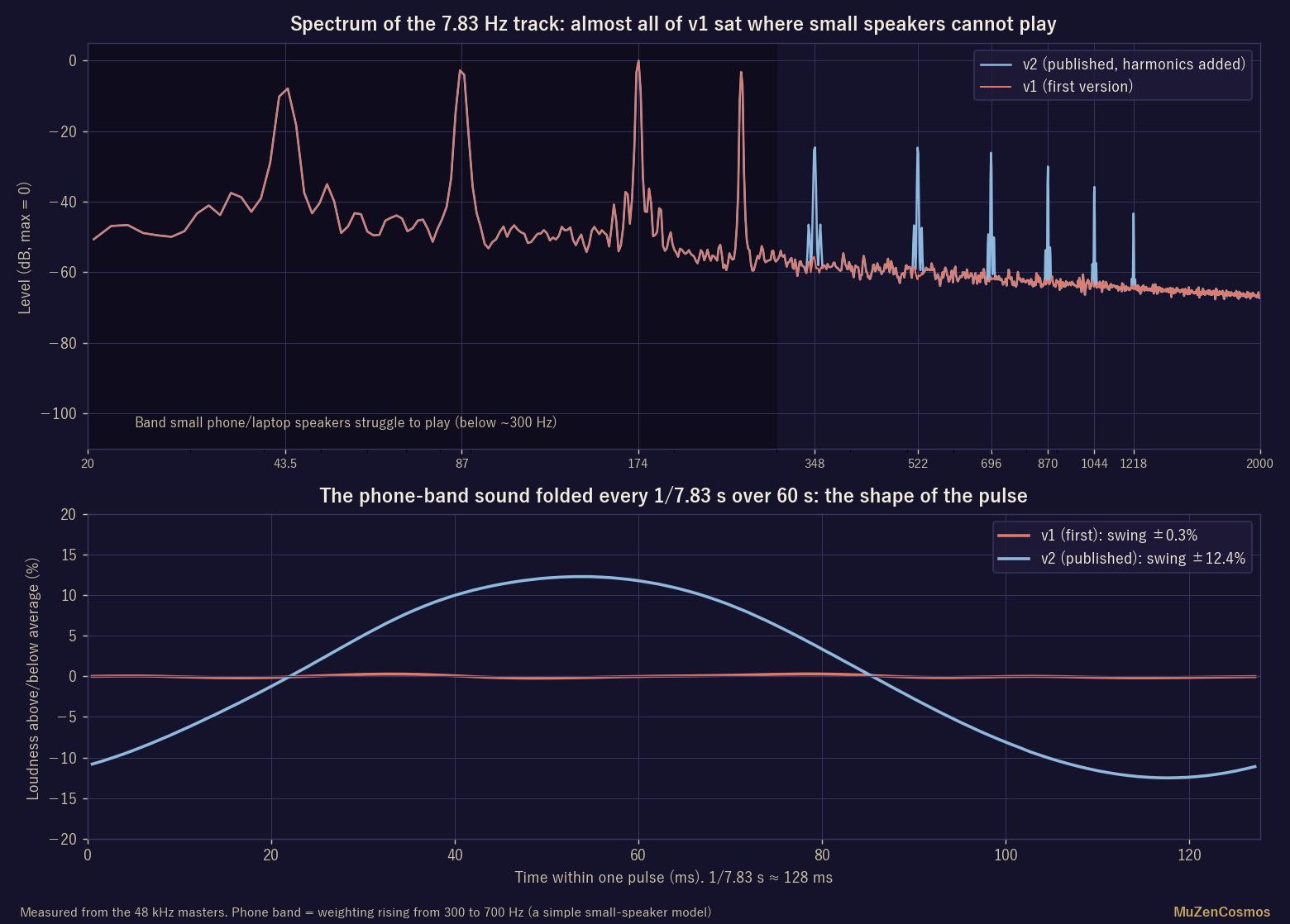
The base was 174 Hz, with 87 Hz and 43.5 Hz below and 261 Hz (a fifth) above, all low tones. Measured, 99.98% of the energy was below 400 Hz. 400 to 1,000 Hz held 0.009%; 1,000 to 4,000 Hz held 0.011%.
The built-in speakers of phones and laptops are small and produce very little below roughly 300 Hz. This version played normally on headphones, but on a phone there was almost nothing for the speaker to play. The 7.83 pulse could not get through either: measuring only the band a small speaker can reproduce, the pulse depth was under 1%, indistinguishable from noise.
In the previous production note, a monitor’s built-in speakers could not play high tones and my hearing test came out at 8,000 Hz. This was the same thing at the low end.
The fix: add only the harmonics of 174 Hz
Without changing the base pitch, I added faint tones at exactly 2 to 7 times 174 Hz (348, 522, 696, 870, 1,044 and 1,218 Hz). Whole-number multiples (harmonics) are part of every instrument’s sound. Even when a small speaker cannot produce 174 Hz itself, the ear recovers the base pitch from the pattern of harmonics. The 7.83 Hz pulse was put on this harmonic layer too, in step with the original.
More harmonics make it louder on a phone, but change the character of a track that is meant to be carried by its low tones. After comparing several trial versions by ear, I chose to keep the harmonics to a minimum.
Before and after
| First version | Published | |
|---|---|---|
| Share of 400–1,000 Hz | 0.009% | 0.330% |
| Share of 1,000–4,000 Hz | 0.011% | 0.027% |
| Loudness of what a small speaker can play | reference | +9.9 dB |
| Depth of the 7.83 Hz pulse there | under 1% (indistinguishable from noise) | ±12.4% (2.2 dB swing, 7.83 Hz) |
| Overall loudness | Both -14.0 LUFS, peak -4.3 dBFS (overall volume unchanged) | |
The harmonic layer is less than 1% of the total power. Even so, what a small speaker can play got about 10 dB louder, and the pulse rose out of the noise.
What this measurement does not tell
- “The band a small speaker can play” is a simple model: a weighting that rises from 300 to 700 Hz. It is not a recording of an actual phone. Real phones differ in how low they go.
- I measured the master before upload, not the sound after YouTube’s re-encoding.
- This note does not address what a 7.83 Hz pulse does to a listener. It only checks whether the pulse arrives at all.
For listeners
On a phone’s built-in speaker, most of a low-tone track simply is not played. Use headphones, earphones or a speaker with real bass. To see how low your own setup goes, play tones upward from 20 Hz in the Frequency Lab. For the high end, try the Hearing Age Test. The Schumann resonance itself is covered in this article.
This article does not guarantee any medical or health benefit and is not a substitute for professional medical care. If you have any health concerns, please consult a physician or other qualified professional.