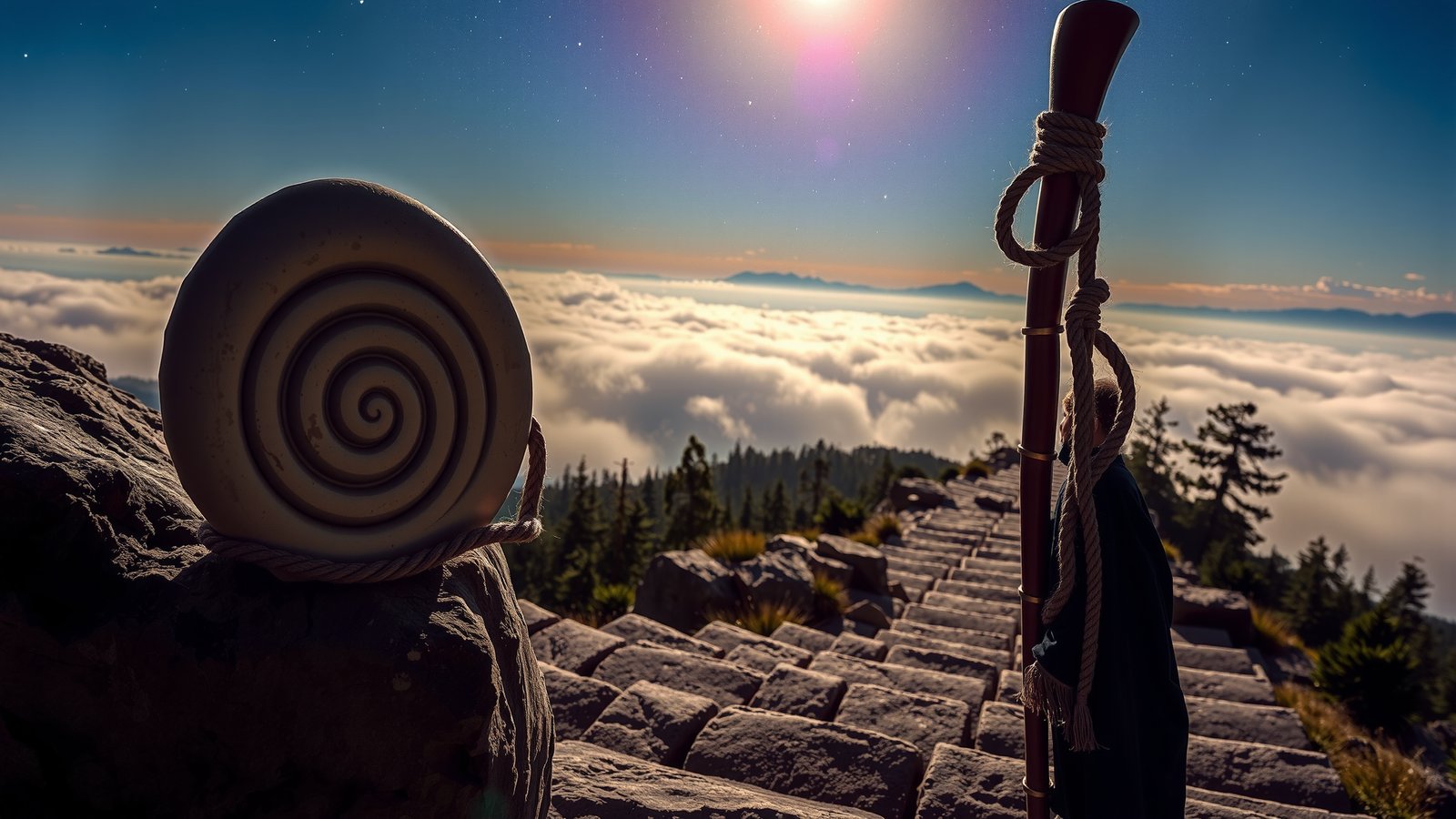
Climb far enough
up a mountain
and at
a certain height
the air
changes kind.
The trees
get shorter.
The wind
starts having
a sound.
And your
own breathing
gets
absurdly
loud.
—Japan took
that switchover
and
turned it into
a religion.
It is called
Shugendō.
You do not
sit.
You do not
read.
You walk.
And then you check
whether the person
who came down
is the same one
who went up.
People have been
running that experiment
for thirteen
hundred years.
💎 The one line that matters
Shugendō puts the whole religion into the body: you enter the mountain and find out. It is not Shinto and it is not Buddhism — it is the third thing those two became when they met above the treeline.
The Answer in Three Lines
- Shugendō is Japan’s mountain asceticism: indigenous mountain worship fused with esoteric Buddhism, Daoism and Shinto, taking shape from the Heian period onward. Practice happens in the mountains, not in a hall.
- Practitioners are called yamabushi. The founder-figure is En no Gyōja — of whom the historical record confirms almost nothing.
- The religion was legally abolished in 1872 and only revived after WWII. Today there are training programs open to ordinary visitors.
The 30-Second Summary
- Shugendō means roughly “the way of training and getting proof.” Not proof on paper — proof you obtain in your own body, on a mountain
- It is neither Shinto nor Buddhism. It is mountain worship + esoteric Buddhism + Daoism + Shinto, fused over centuries into something specifically Japanese
- Of the founder En no Gyōja, the near-contemporary record says one thing: the Shoku Nihongi notes he was exiled to Izu in 699. Everything else is thirteen centuries of accumulated legend
- By the medieval period it had consolidated into two schools: Honzan-ha (Tendai, based at Shōgo-in, centred on Kumano) and Tōzan-ha (Shingon, based at Daigo-ji Sanbō-in, centred on Yoshino and Ōmine)
- The 1872 abolition edict erased Shugendō as a legal denomination. It came back only after 1945
- Principal sacred mountains: Ōmine (Yoshino), Kumano, Dewa Sanzan, Hikosan. Yoshino/Ōmine and Kumano became UNESCO World Heritage in 2004
- The Ōmine Okugake ridge route runs roughly 170 km from Yoshino to Kumano, strung with seventy-five ritual stations
- Dewa Sanzan assigns time to mountains: Haguro = present, Gassan = past, Yudono = future. Walking all three is a “rebirth pilgrimage”
- Shugendō is an audible religion: the conch trumpet, the ringing shakujō staff, and the rokkon shōjō chant that quietly regulates your breathing on a climb
- Sokushin-jōbutsu (becoming Buddha in this very body — a doctrine) and sokushinbutsu (the self-mummified monks of the Yudono lineage — bodies) are completely different things. This is the single most common confusion
- Walking, forest environments and slow chanting have moderate-at-best evidence. Waterfall austerities and fasting have none — they carry real risk
1. What Shugendō Actually Is — A Religion Where Entering the Mountain Is the Practice
The name
says it.
Shu — to train.
Gen — the proof,
the verifiable
result.
Dō — the way.
The way of training
and
finding out
whether
anything
happened.
That is unusual. Most religions ask you to begin with belief. This one asks you to begin with altitude.
You go in.
You walk.
You get cold,
wet,
hungry.
You come down.
And then you
measure — in the
only instrument
available —
your own body.
One of the older names for the practice was tosō, a Buddhist term meaning roughly to shake off. You do not renounce your attachments by declaring them renounced. You walk, and they fall off on their own somewhere around hour four.
This looks like the opposite of zazen (Article 154), where you sit perfectly still and watch the inside. Shugendō is sometimes called “Zen in motion” for exactly that reason.
But the destinations are nearly the same. Both are ways of thinning out the self. One does it by sitting. One does it by climbing.
Which matters, because some people cannot sit. Hold them still and the thinking accelerates. Japan built a road for those people too.
2. Who Was En no Gyōja — One Line of Record, Thirteen Centuries of Legend
Shugendō’s founder-figure is En no Gyōja, “En the Ascetic,” whose name is given as En no Ozunu.
Start with what is verifiable.
The official chronicle Shoku Nihongi records that in 699, a man named En no Ozunu was exiled to the island of Izu, with a note to the effect that he had misled people through sorcery.
That is essentially the entire documentary record.
His birth is traditionally given as 634 — unconfirmed. He is said to have based himself on Mount Katsuragi, to have opened Mount Ōmine, to have commanded two demons named Zenki and Goki, and to have flown.
All of that is
later
sediment.
The Nihon Ryōiki adds a layer. Medieval temple histories add more. The further from 699 you get, the more superhuman he becomes.
The point is not to dismiss this. The fact that thirteen centuries of legend accumulated on one exiled man tells you how badly people wanted the archetype: someone who walks into a mountain and walks out as something else.
In 1799, Emperor Kōkaku granted him the posthumous title Jinben Daibosatsu. The state, eleven hundred years late, formally endorsed the legend.
3. The History of Shugendō — How Mountain Worship, Esoteric Buddhism and Daoism Merged
Nobody designed Shugendō. Things flowed in and eventually set.
Layer one — the mountain itself.
Before Buddhism arrived, Japanese mountains were places you did not go. Where the dead went. Where water came from. Where the weather that governed the harvest was manufactured. This is the same substrate covered in Shinto and Nature Worship (Article 157).
Layer two — esoteric Buddhism.
The Mikkyō that Kūkai and Saichō brought back from Tang China in the early 800s already assumed mountain practice. Kōyasan is a mountain. Hieizan is a mountain. Mantra, mudrā and mandala met indigenous mountain worship almost immediately. Background in Esoteric Buddhism and Shingon (Article 155).
Layer three — Daoism and onmyōdō.
Directions, star worship, the nine-syllable protective formula, longevity techniques. Chinese material is scattered through Shugendō ritual.
Layer four — kami-buddha fusion.
The concept of gongen — a mountain deity understood as a buddha in local form — tied the whole bundle together. Zaō Gongen, Kumano Gongen, Hakusan Gongen. Where there is a Shugendō mountain, there is usually a gongen.
By the late Heian and Kamakura periods, this had hardened into a system, and then into two organizations.
| School | Lineage | Headquarters | Core sacred site |
|---|---|---|---|
| Honzan-ha | Tendai | Shōgo-in, Kyoto | Kumano |
| Tōzan-ha | Shingon | Daigo-ji Sanbō-in, Kyoto | Yoshino / Ōmine |
The Tokugawa shogunate ratified this two-school structure and administered yamabushi through it. In that era a yamabushi was also a working professional: healer, ritualist, herbalist, weather-reader, mountain guide. A religious specialist who was also the person who knew the terrain.
4. Shugendō vs Shinto vs Zen vs Esoteric Buddhism — Four Traditions Side by Side
“Is Shugendō Shinto or Buddhist?” is the question people ask first.
The answer is neither, and both. A table makes it obvious.
| Dimension | Shinto | Zen | Esoteric Buddhism | Shugendō |
|---|---|---|---|---|
| Core practice | Worship, ritual, purification | Seated meditation | Mantra, mudrā, visualization | Walking the mountain; austerities at ritual stations |
| Where | Shrine and sacred grove | Meditation hall | Ritual hall | The mountain itself (buildings are just base camp) |
| Founder | None | Bodhidharma → Dōgen, Eisai | Kūkai, Saichō | En no Gyōja (legendary) |
| Scripture | No single canon | Sitting over texts | Mahāvairocana Sūtra et al. | No single canon; absorbs whatever works |
| The body is | Something to purify | A frame to hold | A site of buddhahood | A tool to be used to its limit |
| Lay access | Anyone may visit | Public sitting sessions | Initiation required | Widely open as experience training |
Read the last column downward and the character emerges.
No building at the center.
No book at the center.
The body, out in front.
5. The 1872 Abolition Edict — Japan Once Deleted This Religion by Law
There is a break in the middle of this history that cannot be skipped.
In 1872, the Meiji government abolished Shugendō as a denomination.
It followed the 1868 separation of kami and buddhas. Practitioners were forced to affiliate with Tendai or Shingon, or to return to lay life as shrine priests or ordinary citizens.
The reasoning
was not
simple.
If the state
is going to be
built on Shinto,
then something
up a mountain
with the kami
and the buddhas
still mixed together
becomes
an
administrative
problem.
The damage was severe. Ritual sites closed. Yamabushi settlements dissolved. Oral transmission broke. At Haguro in the Dewa Sanzan, Buddhist institutions were reconstituted as shrines.
Shugendō re-emerged as an independent denomination only after the war, once freedom of religion was constitutionally secured. Kinpusen Shugen Honshū was established in 1948 with Kinpusen-ji as its head temple; a Shugendō denomination was likewise revived at Haguro. Shōgo-in and Daigo-ji Sanbō-in continue their own lineages.
Which means: the Shugendō we see today was severed once and then reconstructed. Parts of it are not continuous. Worth remembering whenever you read the phrase “an unbroken tradition since ancient times.”
6. The Yamabushi Costume — What Each Item Means
A yamabushi is recognizable at distance. Every element carries assigned meaning (interpretations vary by lineage and era).
| Item | Reading | What it is | Traditional meaning |
|---|---|---|---|
| Tokin | tokin | Small black box on the forehead | The crown of Dainichi Nyorai |
| Suzukake | suzukake | Hemp jacket and trousers | The practitioner’s robe |
| Yuigesa | yuigesa | Pompomed stole across the chest | Said to represent the Womb Realm |
| Horagai | horagai | Conch trumpet | Signal, animal deterrent, the Buddha’s voice |
| Shakujō | shakujō | Ringed staff | Warns insects and animals; announces presence |
| Kongōzue | kongōzue | Wooden staff | Support; also serves as a grave marker |
| Oi | oi | Backpack box | A portable shrine: icon and sutras |
| Hisshiki | hisshiki | Fur pelt at the hip | Seat and insulation |
Notice what nearly every item has in common: it is also functional gear.
The staff
holds you up.
The conch
carries
for kilometres.
The rings on the
shakujō exist so
that
the bear
hears you
first.
The religious meanings were largely layered on top of the utility, later. Mountaineering equipment that became liturgical implements — which is Shugendō’s whole personality in one table.
7. Shugendō Training — Mine-iri, the Ōmine Okugake, and the Ten Realms
The central practice is mine-iri, “entering the peak”: a fixed period inside the mountain, moving between designated ritual stations, then descending.
The flagship route is the Ōmine Okugake.
From Yoshino in Nara to Kumano Hongū in Wakayama, along the spine of the Kii Peninsula: roughly 170 kilometres, strung with seventy-five ritual stations called nabiki, each with its own liturgy.
The route is part of the “Sacred Sites and Pilgrimage Routes in the Kii Mountain Range,” inscribed by UNESCO in 2004.
The doctrine shows most clearly in jikkai shugyō, the Ten Realms training preserved in the autumn mine-iri at Haguro. Practitioners move symbolically through hell, hungry ghosts, animals, asuras, humans, devas, śrāvakas, pratyekabuddhas, bodhisattvas and buddhas — ten worlds, traversed inside one mountain.
You are
smoked.
You fast.
You do not
sleep.
Each austerity
corresponds to
which world
you are
currently
in.
And at the end,
at the station
standing for
buddhahood,
you are
born again.
The essential point: the suffering is not the objective. The Ten Realms make one idea physically legible — that hell and buddhahood sit on a single continuous road. You can fall, and the road still continues from there. The training walks you through it once, in the body, so you know.
That said, fasting, sleep deprivation and cold-water austerities place very heavy loads on the body. Most programs open to visitors today use shortened, safety-adapted forms. If you have any health concern, disclose it to the organizer in advance.
8. Japan’s Principal Shugendō Mountains — Ōmine, Kumano, Dewa Sanzan, Hikosan
| Mountain | Location | Character | Accessibility |
|---|---|---|---|
| Yoshino / Ōmine | Nara | Zaō Gongen; start of the Okugake. Sanjōgatake is still closed to women | Yoshino easy; Sanjōgatake is real mountaineering |
| Kumano Sanzan | Wakayama | Hongū, Hayatama, Nachi, linked by the Kumano Kodō | Very high — routes well maintained |
| Dewa Sanzan | Yamagata | Haguro, Gassan, Yudono; the rebirth pilgrimage | Haguro is stone steps only |
| Hikosan | Fukuoka / Ōita | Heart of Kyushu Shugendō; once hundreds of lodges | Moderate; slope car available |
| Hakusan | Ishikawa / Gifu / Fukui | Home of Hakusan belief, opened by Taichō | Full mountaineering |
| Ishizuchi | Ehime | Highest peak in western Japan; famous chain ascents | Advanced (bypass trails exist) |
If you are choosing a first mountain, choose Haguro.
A stone stairway
through
old cedar.
Two thousand
four hundred
and forty-six
steps.
That is all.
No chains.
No exposure.
And yet something
has been
put back
in order
by the time
you reach
the top.
It is the clearest available demonstration of what these mountains are for.
9. The Dewa Sanzan Rebirth Pilgrimage — Walking Past, Present and Future
Dewa Sanzan has a structure found nowhere else: each mountain is assigned a tense.
| Mountain | Approx. elevation | Assigned time | Meaning |
|---|---|---|---|
| Haguro | 414 m | Present | Happiness in this life |
| Gassan | 1,984 m | Past | The world of the dead; ancestral spirits |
| Yudono | ~1,500 m | Future | Rebirth |
Walk them in order and you die once and come back. The sequence is called the rebirth pilgrimage, and was designated Japan Heritage in 2016.
This is a deeply
cosmic
piece of
design.
On a map,
climbing is
horizontal
travel.
In the body
it is
vertical.
The higher
you go,
the thinner
the air,
the fewer
the sounds,
and
the closer
the sky.
At the summit, the scale of everything below has changed. Change the distance and you change the size of the problem — which is precisely what happens when you look at the moon.
Shugendō does it by earning the altitude on foot. No telescope. Legs.
Yudono has one more rule. “Do not speak of it, do not ask of it.” What is at the sacred object there is traditionally not described by those who have seen it.
By forbidding
the explanation,
only the
experience
survives.
That single rule tells you how much distance Shugendō keeps from language.
10. The Sound of Shugendō — The Conch, the Staff, and Rokkon Shōjō
This is also a religion of sound.
The horagai.
A large sea-snail shell fitted with a mouthpiece. Low, thick, undulating. In the mountains it carries for kilometres, and it was used practically: assembly signal, hazard warning, animal deterrent. Religiously, it stands for the voice of the Buddha preaching.
Acoustically, the conch is extremely rich in overtones — a dense stack of harmonics above the fundamental, which is why it sounds nothing like a pure tone. The mechanism is covered in Overtone Chanting and Meditation (Article 130).
However — claims that the conch produces a specific healing frequency have no confirmed basis. Pitch varies with the player, the individual shell, and the mouthpiece. Honest line: we cannot assert an effect.
The shakujō.
The rings on the staff head ring with each step. This is not a meditation device; it is a presence broadcaster — it moves snakes and insects off the path, gives animals warning, and lets the party judge spacing by ear.
Rokkon shōjō.
The phrase chanted while climbing. The rokkon are the six sense gates — eye, ear, nose, tongue, body, mind — and the chant declares them being purified on the way up.
Repeat it and something practical happens: the breath locks to a steady rhythm. On a steep pitch, breathing stops fragmenting. It is a devotional phrase and simultaneously a very effective pacing technique.
There is a relevant study on slow, steady recitation. Bernardi and colleagues, publishing in the BMJ in 2001, found that both the rosary and yoga mantra recitation converged naturally on about six breaths per minute, with measurable changes in cardiovascular autonomic rhythms.
Whether Shugendō chanting works by the same mechanism is unknown. But the direction — chanting organizes breathing — is not unrelated.
One footnote: you may hear that the Japanese grunt dokkoisho derives from rokkon shōjō. It is a charming story with no confirmed linguistic support. Treat it as folk etymology.
11. Sokushin-jōbutsu vs Sokushinbutsu — The Confusion Worth Clearing Up
This is where Shugendō is most often misunderstood. Two entirely different things share a similar name.
Sokushin-jōbutsu is a doctrine — Kūkai’s teaching that one may become a buddha in this very body, in this life. No waiting for death, no waiting for a next life. It is the engine underneath the decision to walk into a mountain at all.
Sokushinbutsu are bodies.
Mainly in the Edo period, ascetics of the Yudono lineage undertook mokujiki-gyō, the tree-eating discipline: abandoning grains, living on nuts and bark until fat and water were stripped from the body, then entering a stone chamber underground and dying there in meditation. Exhumed years later, those that had desiccated rather than decayed were enshrined as sokushinbutsu.
Around a dozen or so survive, concentrated in Yamagata Prefecture.
One is
a doctrine.
One is
a corpse.
They are
not the
same thing.
And a crucial note: underground entombment is not legally possible in Japan today. Burial law and criminal statutes from the Meiji era onward closed it. Sokushinbutsu are a phenomenon of one specific historical window.
What contemporary Shugendō pursues is the former — coming down the mountain alive, with something changed.
12. Experiencing Shugendō Today — What Is Actually Open to Visitors
“Can I become a yamabushi?” There are stages.
Stage one: join a training experience.
The Dewa Sanzan (Haguro) runs yamabushi training programs open to the public, typically in summer: white garments are lent, and participants spend several days in the mountain with the practitioners. Yoshino/Ōmine, Kumano and Hikosan offer one-day to multi-day programs.
Stage two: join a kō.
Each sacred mountain has lay confraternities called kō. You join a local one and participate in the annual cycle and the mine-iri.
Stage three: ordination and the Shugendō ranks.
Affiliating with a denomination and formally receiving practitioner rank. From here it approaches clerical life.
But you do not have to start at stage one either.
Walk one day
of the Kumano Kodō.
Climb the
Haguro
stairway.
Do a single
section of the
Okugake
as a day hike.
None of this requires any religious step whatsoever. And it is entirely sufficient to test the question Shugendō is built around: am I different coming down than I was going up?
Program dates, fees, capacity and application methods change year to year. Always confirm current details with the temple, shrine or organizing body.
13. Misconceptions and Cautions — What Can and Cannot Be Claimed
Commonly misunderstood
- “Yamabushi are monks.” Not necessarily. Many practise as laypeople. Edo-period yamabushi married and lived in villages
- “Shugendō means austerities.” Austerities are one component, not the centre. The centre is traversing the mountain
- “Becoming a sokushinbutsu is the goal.” No — see the previous chapter
- “An unbroken tradition from antiquity.” It was severed in 1872. The present form includes reconstruction
- “You acquire spiritual powers.” Shugendō lore is full of such claims. None have been demonstrated under verifiable conditions
On the exclusion of women
Mount Sanjōgatake (1,719 m) in the Ōmine range remains closed to women. It is one of very few places in Japan where the practice persists.
There is a long-running debate: one position holds it should be respected as living tradition, another that exclusion by sex should end. Local communities, religious institutions and scholars are not in agreement.
This article takes no side. It reports the facts: the restriction continues at Sanjōgatake, and there is no such restriction on other sections of Ōmine, or at Kumano, Dewa Sanzan or Hikosan. Check current rules for your specific destination.
What the evidence supports
| Claim | Strength |
|---|---|
| Aerobic hill walking benefits cardiovascular health and mood | Strong |
| Time in forest environments is associated with short-term reductions in stress markers | Moderate (studies are small) |
| Slow chanting at roughly six breaths per minute affects autonomic measures | Moderate (Bernardi et al., 2001) |
| Conch tones or specific frequencies heal the body | Unproven |
| Waterfall standing, fasting or sleep deprivation improves health | Unproven — and carries genuine risk |
Cold-water and waterfall austerities stress the heart, blood pressure and respiratory system. If you have a medical condition or take medication, do not attempt them, and never attempt them alone. Shugendō is not a substitute for medical care.
14. A Five-Point Checklist Before You Enter the Mountain
These are sacred sites and they are mountains. Confusing the two is how people get hurt.
- Are you in hiking boots? The Haguro steps and the Kumano Kodō flagstones are startlingly slippery wet. Some sections are fine in trainers — but check that the tread is not worn smooth. For the Okugake or the Ishizuchi chains, mid-cut boots are the floor, not the ceiling
- Do you have a two-piece rain shell? The Kii range and Dewa are among the wettest regions in Japan. An umbrella is useless on a ridge. Pack a separate waterproof-breathable jacket and trousers even on a clear forecast. This is the one item never to cut
- Water and food? There are no vending machines at ritual stations. 1.5–2 litres per person in summer, plus something with salt and sugar you can take fast. Dehydration and low blood sugar take your judgement first
- Headlamp and a paper map? Mobile coverage drops out in these mountains. Download offline maps in advance and carry a backup light source. If you are running late on the descent, this is what decides the outcome
- Is the schedule loose? Do not stack the day. Half a day on Haguro alone will stay with you longer than all three mountains rushed. Build a timetable that still allows you to turn around
Pack to
mountain standard.
Plan
half as much.
Those two things reliably work on these mountains.
About This Article (Disclaimer and Advertising Notice)
This article is informational content introducing the history, culture and practices of Shugendō. It is not medical advice, psychotherapy, or religious solicitation. Nothing here regarding hiking, forest environments, chanting or natural sound is intended to guarantee improvement in any illness, symptom, relationship or financial situation, and individual responses vary. Research on forest environments and health remains small in scale, and generalization requires caution. If you are under medical care, follow your physician’s guidance. Waterfall standing, fasting, cold-weather austerities and chain-assisted ritual sites carry substantial physical load and fall risk; those with cardiac, blood-pressure or respiratory concerns, and anyone alone, should not attempt them. Access restrictions, the presence or absence of gender restrictions, program dates, fees, ascent hours and viewing availability differ by site and by year, and change. Confirm current information with the relevant temple, shrine or organizer, and check weather and trail conditions, before you travel. This article does not encourage affiliation with, or donation to, any religion or denomination.
[Advertising] This article may in future contain affiliate links to products or services. Purchases made through such links incur no additional cost to readers.
For Example, Consider a Scene Like This
To make it concrete, here is one generalized situation
(this is a fictional, generalized illustration, not anyone’s actual account).
Suppose
**you have been
unable to decide
something
for months,
and you are
standing at the
bottom of a
stone stairway
in the morning.**
You have
no faith.
You have
no intention
of
doing
a practice.
You have only
worked out
that thinking about it
indoors
produces the same
lap
every time.
You start
climbing.
For the first
three hundred steps
the thinking
comes with you.
What to say
in that reply.
How to put it
to that person.
Past five hundred,
your breathing
gets loud.
The thinking
loses volume.
One thousand.
Nothing is being
considered
at all.
**Lift the foot.
Put it down.**
That is the
entire contents
of your mind.
The cedars
are very tall.
You can hear wind
in the canopy
while down here
there is
no wind
at all.
Past two thousand,
the sweat
turns cold.
And then
you top out.
You do not have
an answer.
These mountains do not hand out answers.
But on the way back down, this sometimes happens:
the question
has gotten
smaller.
Same problem.
Not one
circumstance
has changed.
Only that
**the position
of the person
looking at it
moved by two thousand
four hundred
steps.**
That is probably what Shugendō has been doing for thirteen hundred years.
The mountain teaches nothing.
It only changes the distance.
This article does not guarantee any medical or health benefit and is not a substitute for professional medical care. If you have any health concerns, please consult a physician or other qualified professional.
📚 Related Articles
- What Is Shinto? A Complete Guide | The Eight Million Kami, Sacred Groves, and How to Visit a Shrine
- Zen Temples in Japan: A Complete Visitor’s Guide | Kyoto, Kamakura, Eiheiji, Zazen Sessions and How to Read a Rock Garden
- Esoteric Buddhism & Shingon: A Complete Introduction | Kūkai, Mandalas, Mantras and “Buddhahood in This Very Body”
- Zazen: A Complete Introduction | How to Sit, What to Do If You Can’t Cross Your Legs, and How It Differs from Meditation
FAQ (10 Questions)
Q1. Is Shugendō a religion? Do I have to join anything?
It is a religion — but no affiliation is needed to attend a training experience or climb a sacred mountain. Denominations exist (Kinpusen Shugen Honshū, Haguro Shugen Honshū, Shōgo-in, Daigo-ji Sanbō-in), but walking the mountains requires no religious step.
Q2. How does someone become a yamabushi?
In stages. The entry point is a public training program at one of the sacred mountains. To continue, you can join a lay kō confraternity, and beyond that affiliate with a denomination and receive formal rank. There is no need to aim at the last stage.
Q3. Is Shugendō Shinto or Buddhist?
Neither. It is a composite of indigenous mountain worship, esoteric Buddhism, Daoism and Shinto. The Meiji separation policy forced it to be filed under one heading or the other, but that was administration, not the religion’s actual nature.
Q4. Is Mount Ōmine still closed to women?
At Sanjōgatake, yes. The debate over whether to preserve or end the practice is unresolved. Note that other sections of Ōmine, and Kumano, Dewa Sanzan and Hikosan, have no gender restriction. Verify the rules for your specific destination.
Q5. Can anyone play a conch? Can I buy one?
They are sold by instrument and Buddhist-supply retailers, so purchase is possible. Producing a note takes practice (the embouchure resembles a trumpet). Be aware they are extremely loud in a residential area. At religious events, do not sound one uninvited.
Q6. What does rokkon shōjō mean, and is it really the origin of dokkoisho?
The rokkon are the six sense gates — eye, ear, nose, tongue, body, mind — and the phrase declares them being purified during the ascent. The dokkoisho etymology is widely repeated but has no confirmed linguistic support; treat it as folklore.
Q7. Can I see a sokushinbutsu?
Several temples in Yamagata Prefecture allow viewing (hours and availability vary). Please remember these are objects of faith, not exhibits. Confirm photography rules and visit quietly.
Q8. Is standing under a waterfall good for you?
There is no sound evidence that it improves health. The abrupt blood-pressure and heart-rate response to cold water is dangerous for people with cardiac conditions or hypertension. If undertaken at all, it should be under experienced supervision and never alone.
Q9. Can ordinary hikers walk the Ōmine Okugake?
Section by section. The full ~170 km is a multi-day advanced route with limited water sources and few escape options. Meanwhile, parts of the Yoshino approach and stretches of the Kumano Kodō are well-maintained day hikes. Start by taking a single section.
Q10. What should I read to learn more?
Miyake Hitoshi’s Shugendō: Its History and Practice is the standard treatment in Japanese; H. Byron Earhart’s study of the Haguro sect is the classic English-language monograph. Read after you have climbed one mountain — it lands differently.
Conclusion | The Mountain Teaches Nothing. It Only Changes the Distance.
Shugendō does not
say
believe.
It says
climb, and then
tell me
what happened.
And whatever did happen up there,
you are the one
who has to
verify it.
As religions go, that is a remarkably crude piece of engineering. No doctrine. No guarantee of salvation. Just a mountain, a route, a shell that sounds, and two thousand four hundred stone steps.
But the crudeness is probably why it survived thirteen hundred years.
Because it does not depend on words.
The state deleted the denomination in 1872 and the mountain stayed. The ritual stations stayed. The stairway stayed. The route went under the grass and stayed. Organizations can be dissolved; the act of climbing turned out to be un-banable.
We now have an abundance of tools — seated meditation, breathwork, sound. All of them work. And still there are nights when the answer will not come indoors.
**For those nights,
Japan has mountains,
and thirteen centuries
of maintained
instructions
for entering them.**
You do not need to undertake a practice. One day-section of a World Heritage trail is enough.
Open a map
this weekend.
A low local hill
is fine.
Go in
early.
**Get to the top.
Come back down.**
The size of the problem will have changed slightly.
It is the same thing that happens when you look up at a star.
**From far enough away,
most things
are small.**
Shugendō was the road for learning that distance with your legs.
For a wider view of the world’s wisdom traditions, see The Complete Guide to Spirituality (Article 91).
The sky
at the top
is always
closer than
you thought.
References
- Miyake, Hitoshi. Shugendō: Sono Rekishi to Shugyō (Shugendō: Its History and Practice). Kodansha Gakujutsu Bunko, 2001.
- Gorai, Shigeru. Yama no Shūkyō: Shugendō Annai (Religion of the Mountains: A Guide to Shugendō). Kadokawa Sophia Bunko, 2008.
- Earhart, H. Byron. A Religious Study of the Mount Haguro Sect of Shugendō. Sophia University, 1970.
- Bernardi L, Sleight P, Bandinelli G, et al. “Effect of rosary prayer and yoga mantras on autonomic cardiovascular rhythms: comparative study.” BMJ, 2001;323(7327):1446–1449.
- Li Q. “Effect of forest bathing trips on human immune function.” Environmental Health and Preventive Medicine, 2010;15(1):9–17.
MuZenCosmos — Where the Cosmos Meets Silence | The mountain teaches nothing. It only changes the distance.