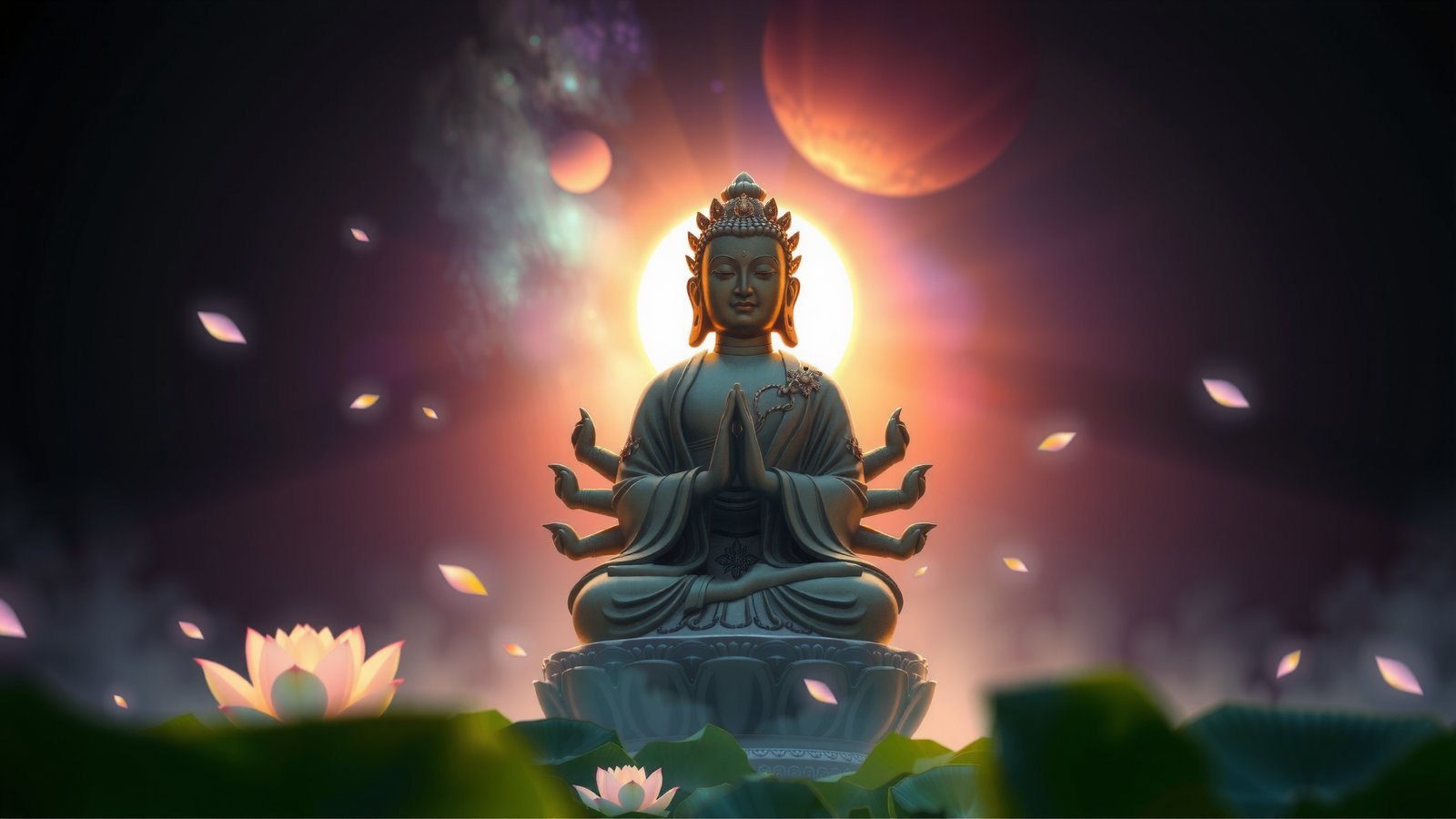
Companion article for the YouTube video “Kannon 528Hz”
Kannon and 528Hz: A Thousand Hands of Compassion, Alongside the Frequency of Love
There is a figure
with a thousand hands.
Each one of those hands
was carved
not to overpower anyone,
but to reach toward someone, gently.
This is the story
of Kannon,
the bodhisattva of compassion
in Mahayana Buddhism —
and especially of Senju Kannon,
the “Thousand-Armed Kannon,”
a figure that has been
deeply, continuously worshipped
for centuries.
And it is also the story
of how that theme —
compassion that reaches everyone, without exception —
loosely echoes a tone
in the Solfeggio tradition known as 528Hz.
Before we begin,
one thing should be said plainly —
this is not a story that treats
an object of faith lightly.
It is a story about
a figure of prayer
still cherished by many people today,
told with the respect it deserves.
This article’s answer (in 3 lines)
The thousand hands of Senju Kannon are a traditional expression, in Buddhist art, of compassion reaching every sentient being without exception. 528Hz, in the Solfeggio tradition, is described as the “frequency of love,” and this article loosely layers the two around a shared theme: compassion that reaches everyone. But there is no historical connection between Kannon worship and 528Hz, and 528Hz’s effects are not scientifically established.
💎 Key takeaway
The thousand hands exist not to display power, but so that not a single person is left without one reaching toward them.
30-Second Summary
- Kannon (Avalokiteśvara) is the symbol of compassion in Mahayana Buddhism, said to perceive the voices and cries of the world and respond with aid
- Senju Kannon, the “Thousand-Armed, Thousand-Eyed Kannon,” visualizes in Buddhist art the vow to save every sentient being without exception
- Kannon remains, today, a living object of worship, enshrined in temples across Japan (including the Sanjūsangen-dō)
- Each of the thousand hands holds a different ritual implement, said to symbolize a different means of relief for a different kind of suffering
- 528Hz is a tone in the Solfeggio tradition often called the “frequency of love” or “frequency of transformation“
- The 528hz effect is sometimes linked to claims of DNA repair, but this is not scientifically established
- Senju Kannon’s “compassion that reaches everyone” and 528Hz’s “frequency of love” can be poetically layered together
- This is not a caricature of a religious figure, but a respectful, symbolic layering of culture and tradition
1. Who Is Kannon — The Bodhisattva Who Perceives Every Sound
Kannon (Kanzeon Bosatsu)
is among the most widely worshipped
bodhisattvas in Mahayana Buddhism.
The name itself
is said to mean
“the one who perceives the sounds
[and voices] of the world” —
worshipped as a figure who hears
the cries of those suffering
and reaches out a hand to help.
Known in Sanskrit as
Avalokiteśvara,
Kannon traveled from India
through China and the Korean peninsula
into Japan,
taking on many forms and names
along the way,
each cherished in turn.
Kannon remains today
the principal deity
at temples throughout Japan,
where people still gather
to press their hands together in prayer —
a living object of faith.
As we explore this figure,
it is worth remembering:
what follows is not
decorative imagery or folklore,
but an object of faith
carried carefully across centuries.

2. What Is Senju Kannon — The Vow Behind a Thousand Hands and Eyes
Kannon appears
in many forms (the “transformation bodies of Kannon”),
each emphasizing
a different aspect of compassion.
Among these, the most famous
is Senju Kannon —
the “Thousand-Armed Kannon.”
Formally known as
“Senju Sengen Kanjizai Bosatsu”
(“the Thousand-Handed, Thousand-Eyed
Bodhisattva of Sovereign Regard”),
this figure is depicted, true to its name,
with a thousand arms,
each palm bearing
an eye.
In actual sculpture,
for technical and artistic reasons,
Kannon is often depicted with
forty-two arms representing
the full thousand symbolically —
since each arm is said to save
“twenty-five realms,”
the math works out:
42 (arms, including the two main ones) × 25 (realms) = 1,000.
The thousand eyes symbolize
the power to perceive
every direction, every circumstance.
The thousand hands symbolize
the power to reach every sentient being,
leaving no one behind.
3. The Vow Behind Senju Kannon — A Prayer to Save Every Being, Without Exception
Buddhist scripture describes
Kannon’s vow:
to save every suffering being,
without leaving a single one behind.
The figure of Senju Kannon
is understood as
a visual expression of this vow —
the ideal of
compassion that reaches everyone.
A single hand
cannot reach every place.
A thousand hands
can.
A single eye
cannot see every hidden suffering.
A thousand eyes
can.
This is not
a display of power
by someone who holds power —
it can be read instead as
a posture of devotion,
reaching toward everyone
who needs help.
Many who stand before
a statue of Senju Kannon
describe feeling overwhelmed
by the sheer number of hands,
and at the same time,
a deep sense of
reassurance.
4. What the Ritual Implements Symbolize — Compassion Tailored to Every Circumstance
Each of Senju Kannon’s hands
holds a different
ritual implement.
- A hand holding a lotus flower = purity, an unstained mind
- A hand holding a sword = the wisdom to cut through delusion and worldly attachment
- A hand holding a rope = the power to pull suffering beings to safety
- A hand holding a water vessel = compassion that quenches thirst
In this way,
each hand is explained
as symbolizing
a different means of relief
for a different circumstance or worry.
This can be understood
as an expression of
finely attuned compassion —
the idea that the hand extended
changes according to
the nature of the suffering.
If you’re curious about the relationship between meditation and neuroscience,
see our companion piece, Meditation and Neuroscience. Practices of holding compassion for others are said to bring their own quiet changes to the mind.
5. The Spread of Kannon Worship, Then and Now — A Living Faith
Kannon worship
runs deep across Japan.
At Sanjūsangen-dō in Kyoto,
1,001 statues of Senju Kannon
stand enshrined,
still visited today
by countless pilgrims —
an active place of worship.
Pilgrimage routes such as the
“Saikoku Sanjūsansho“
(Thirty-Three Kannon Temples of Western Japan)
remain, even now,
a living pilgrimage
that many people actually walk.
This is not
a museum-preserved artifact
of the past.
It is a faith
that is still breathing.
In telling this story,
we have made a point
to avoid caricature or sensationalism,
and to present it
with the respect it deserves.
6. What Is Solfeggio 528Hz — The Traditional Meaning Behind the “Frequency of Love”
528Hz is perhaps
the best-known tone
in the Solfeggio frequency family,
often called the “love frequency“
or “transformation frequency.”
The Solfeggio system itself
was largely reconstructed
in the latter half of the 20th century —
a relatively new framework,
rather than an unbroken,
academically established tuning
passed down since antiquity.
It is best understood as
a tradition that has grown
within modern healing culture.
Within that tradition, 528Hz is often described as:
- A tone of harmony and renewal
- A tone that opens the heart
- A tone symbolizing love
For more on 528Hz’s history, see our companion piece,
528Hz: The Frequency of Love and Harmony.
7. The 528Hz Effect — What Is Claimed, and What Cannot Honestly Be Said
Some modern proponents
link the 528hz effect
to DNA repair.
But this is
not a scientifically established claim.
MuZenCosmos draws a clear line here between
what can and cannot be honestly said
about 528Hz.
For the fuller science-and-symbol treatment, see
528Hz: A Complete Review of the Scientific Research.
Here, we don’t present 528Hz as
“a tone that repairs all things,”
but rather as
“a tone that symbolizes the process
of meeting yourself and others with compassion” —
a fitting echo for Kannon’s theme of compassion.
8. The Symbolic Bridge Between Kannon’s Compassion and 528Hz — A Shared Theme of Reaching Everyone
To be honest with you:
there is no historical or textual connection
between Kannon worship and 528Hz.
Senju Kannon worship
spread from ancient India,
through China,
reaching Japan around the Nara
to Heian periods.
The modern Solfeggio system
spread widely only from
the late 20th century onward.
These come from
entirely different eras and cultures.
But when we look at
the shape of the theme —
“reaching everyone, without exception” —
a loose resonance appears.
- The thousand hands reaching toward every being = compassion that leaves no one behind
- The thousand eyes perceiving every form of suffering = a finely attuned awareness
- The “frequency of love” that 528Hz symbolizes = a state of holding compassion for others, and for oneself
In other words,
“**just as the thousand hands
sought to reach everyone, without exception,
listening to 528Hz while
quietly extending compassion
to yourself and others**” —
is a rhythm that can be
poetically layered over
Senju Kannon’s vow of
compassion reaching everyone.
This is not an academic claim,
but one way of reading
symbol alongside symbol.
9. Senju Kannon × 528Hz Correspondence Table — Four Stages of Compassion Reaching Outward
Per our v2.6 structural rule, here is a comparison table mapping Senju Kannon’s form to Solfeggio symbolism.
| Stage | What’s Happening | Symbolic Theme | Corresponding Frequency (as symbol) |
|---|---|---|---|
| The thousand eyes | Perceiving every direction, every form of suffering | Awareness, close attention | (silence and listening) |
| Taking the vow | A prayer to save every being, without exception | The will toward compassion | Echoes the “connection” theme associated with 639Hz |
| The thousand hands reaching out | Every sentient being is reached, without exception | Devotion, compassion that reaches everyone | 528Hz (symbol of love and harmony) |
| Relief through ritual implements | Suffering met with a means suited to the moment | Transformation, renewal, finely attuned compassion | Echoes the “transformation” theme associated with 528Hz |
This mapping is offered strictly as a poetic aid, not as a claim of medical or paranormal effect.
10. How to Listen to 528Hz — With Compassion in Mind
A few practical suggestions:
- In a quiet moment: play 528Hz for a few minutes, and picture one small kindness you’d like to offer someone today
- Directed toward yourself: imagine one of the thousand hands reaching toward you, and take a few deep breaths while 528Hz plays
- With Senju Kannon’s form in mind: quietly picture a compassion that seeks to reach everyone, without exception
- Don’t force meaning onto it: simply enjoying the sound itself is enough
These are offered as relaxation practices,
not as guarantees of any therapeutic outcome.
11. What Can and Cannot Be Said — An Honest Approach to Kannon and Frequency
Here is the honest line MuZenCosmos holds to.
What can be said
- Senju Kannon is a genuine tradition of Buddhist art and worship, rooted in scripture
- Kannon remains, today, a living object of worship at temples across Japan
- Within Solfeggio tradition, 528Hz carries established symbolic associations with love, harmony, and transformation
- Quiet listening time itself is associated, in some research, with relaxation benefits
What cannot be said
- The claim that 528Hz “repairs DNA” has not been scientifically verified
- There is no direct historical link between Kannon worship and 528Hz
- Prayer to Kannon cannot be substituted by music or frequency
- Music or frequency cannot guarantee divine favor or good fortune
12. Respect for Kannon Worship — Our Stance Against Caricature
Kannon, and Senju Kannon in particular,
is sometimes treated with
casual curiosity in entertainment media,
owing to its striking form.
But for the sculptors
who have carved Senju Kannon
across the centuries,
and for those who still
press their hands together in prayer
at Sanjūsangen-dō and Kannon pilgrimage sites today,
Kannon is not
an entertainment motif —
it is an object of compassion
that still answers those who call.
In this article,
we have deliberately avoided
caricaturing Kannon’s form,
choosing instead to present it
with the utmost respect.
If you’d like a broader introduction to spirituality as a topic, see our
Complete Guide to Spirituality.
13. A Hypothetical Example: Compassion Turned Inward
Consider a hypothetical situation: someone in a long-term caregiving role who, after years of giving to others, notices their own patience and kindness wearing thin — including toward themselves.
Learning about Kannon’s thousand hands, each reaching out to help, can suggest a reframing: perhaps one of those hands might also reach toward oneself, rather than every hand being given away to someone else.
One approach some people describe is a short nightly habit: playing 528Hz while recalling one small kindness from the day, including any kindness shown to oneself, as a way of practicing self-compassion alongside compassion for others.
This is a generalized, illustrative example rather than an account of a specific individual — it is meant to show one way the imagery of Kannon might be used as a simple prompt for self-kindness.
14. Frequently Asked Questions
Q1. Who is Kannon?
Kannon is a bodhisattva regarded as the symbol of compassion in Mahayana Buddhism. The name means “one who perceives the sounds of the world,” and Kannon is worshipped as a figure who hears the cries of suffering beings and reaches out to help — a faith that remains widely practiced today.
Q2. What does Senju Kannon look like?
Formally called “Senju Sengen Kanjizai Bosatsu,” Senju Kannon is depicted with a thousand arms, each palm bearing an eye. In actual sculpture, forty-two arms are often used to represent the full thousand symbolically.
Q3. Why does Senju Kannon have a thousand hands and eyes?
The thousand eyes are said to symbolize the power to perceive every direction and circumstance, while the thousand hands symbolize the power to reach every sentient being without exception. The figure visualizes a vow to save everyone, leaving no one behind.
Q4. What do the different implements held by Senju Kannon’s hands mean?
Items such as a lotus, a sword, a rope, and a water vessel are each said to symbolize a different means of relief — purity, wisdom, rescue, or compassion — tailored to different kinds of suffering.
Q5. What is Sanjūsangen-dō?
A temple in Kyoto that houses 1,001 statues of Senju Kannon, still visited today by many worshippers. Pilgrimage routes like the Saikoku Sanjūsansho continue as a living tradition in the present day.
Q6. What is Solfeggio 528Hz?
It is one of the best-known tones in the modern Solfeggio frequency system, positioned as the “frequency of love” or “frequency of transformation.”
Q7. Is the claim that 528Hz “repairs DNA” true?
It is not a scientifically established claim. It was popularized by modern proponents who linked the tone to imagery of transformation and repair. The honest approach is to treat it as symbolic language.
Q8. Is there a real historical connection between Kannon worship and 528Hz?
No. Senju Kannon worship spread from ancient India through China to Japan around the Nara to Heian periods, while the modern Solfeggio system emerged from the late 20th century onward. This article presents the two as a poetic layering of symbols, not a historical link.
Q9. When is a good time to listen to 528Hz?
One suggestion: play it for a few minutes in a quiet moment, picturing a small kindness for someone else — or for yourself. This is offered as a habit suggestion, not a guaranteed outcome.
Q10. What does the story of Senju Kannon mean for us today?
The theme of “compassion that reaches everyone, without exception” can be read as a universal reminder that this compassion may be extended not only to others, but to oneself as well.
Kannon isn’t the only figure explored this way — Mandala and 852Hz looks at the mandala Kūkai brought back from China, and Amaterasu and 963Hz follows the myth of Amaterasu’s return from the cave, both read alongside their own Solfeggio tones.
15. Conclusion — Among the Thousand Hands, One Is Reaching Toward You
As this story closes,
remember this once more:
the thousand hands were carved
not to make anyone afraid,
but so that
not a single person
would be left without one reaching toward them.
And what that required
was not
a grand display of power,
but simply
a prayer to reach everyone, without exception.
If, right now,
you have spent so much of yourself
helping others
that you’ve forgotten
compassion for yourself —
find a quiet place,
and let 528Hz
settle into the room.
And then,
let one of the thousand hands
reach, gently,
toward yourself.
Compassion may not be
something only certain, special beings hold.
It may be something
offered again and again,
in the small kindnesses of everyday life.
Among the thousand hands,
there has always been
one
reaching toward you.
References
- Lotus Sutra, Chapter 25, “The Universal Gate of Bodhisattva Avalokiteśvara” (commonly known as the “Kannon Sutra”) — the foundational scripture describing Kannon’s compassion
- Chün-fang Yü, Kuan-yin: The Chinese Transformation of Avalokiteśvara, Columbia University Press, 2001 — a leading academic study of the spread and transformation of Kannon worship
- Yukio Hayami, Kannon Shinkō [速水侑『観音信仰』], Hanawa Shobo, 1970 — a historical study of the spread of Kannon worship in Japan
- Leonard G. Horowitz, The Book of 528: Prosperity Key to Love, Tetrahedron Publishing Group, 2011 — the work of the proponent who popularized 528Hz as the “frequency of love”
- Jonathan Goldman, Healing Sounds: The Power of Harmonics, Healing Arts Press — on sound, overtones, and healing culture
MuZenCosmos — Where the Cosmos Meets Stillness | Among the Thousand Hands, One Is Reaching Toward You
This article does not guarantee any medical or health benefit and is not a substitute for professional medical care. If you have any health concerns, please consult a physician or other qualified professional.
📚 Related Articles
- 528 Hz Science Research Summary — What Do the Studies Actually Say?
- 528 Hz vs 432 Hz — Which Is “The Frequency of Love”?
- What Is 528 Hz? The Frequency of Love and Harmony — History, Science & How to Use It
🎵 Listen Along with This Article
Experience this article’s theme through sound.
🔔 Subscribe to MuZenCosmos for new healing soundscapes.