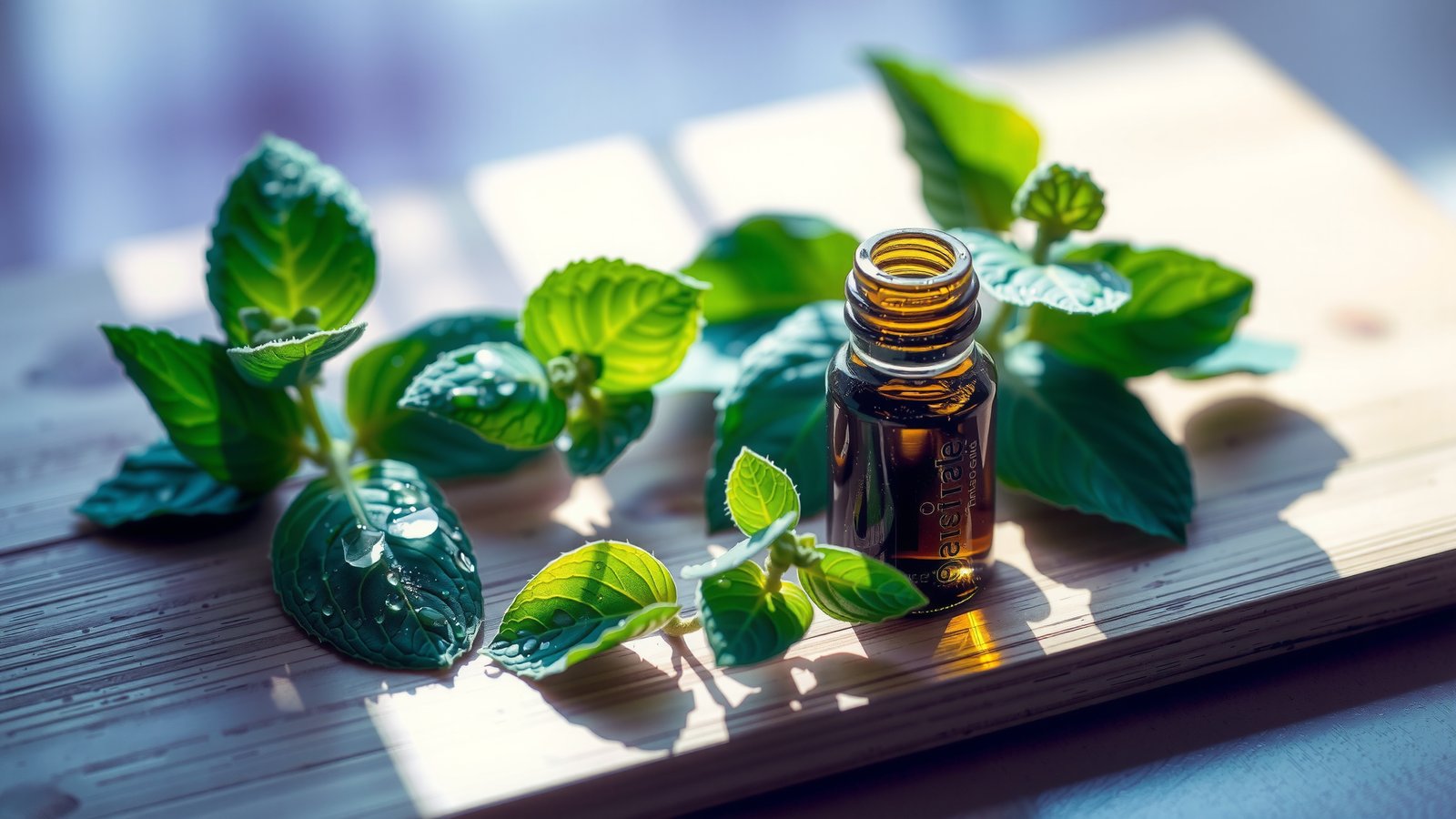
“Which oil should I buy first?“
I’m asked this constantly.
My answer is consistent:
“Lavender and peppermint.”
If lavender is the Queen of the Night,
peppermint is the King of the Day.
- Brain fog → Clear in 30 seconds when inhaled
- Headache → Apply to temples, 15-minute relief
- Indigestion → Inhale, settles the stomach
- Stuffy nose → Opens instantly
- Low focus → Immediate alertness
No other essential oil offers this breadth of effect.
If you’re choosing just one,
peppermint belongs in every household first aid kit.
💎 Key takeaway
Peppermint = “a natural stimulant in 55% menthol.” One drop changes your world immediately.
30-second summary
- Primary compound: menthol (35–55%)
- Focus boost: brain wave studies confirm increased α and β waves
- Headache relief: temple application = 15-minute effect (comparable to acetaminophen)
- IBS evidence: enteric capsules accepted as alternative first-line therapy
- Nasal congestion: instant breathing relief on inhalation
- US-grown is standard; Japanese mint is a different species
- Forbidden for under 6 and early pregnancy
- One bottle (10ml, 15–35 USD) lasts months
1. What is peppermint essential oil?
1-1. Basics
| Item | Detail |
|---|---|
| Latin name | Mentha × piperita |
| Common name | English peppermint |
| Plant part | Leaves and flower spikes |
| Extraction | Steam distillation |
| Origin | US (Oregon/Washington), India, Japan |
| Scent | Sharp, cool, slightly sweet |
1-2. A hybrid
Surprisingly:
– Water mint (Mentha aquatica)
– × Spearmint (Mentha spicata)
– = Peppermint
Discovered in 18th-century England, then bred.
1-3. Global production
- US: 70%+ of world production
- India: growing
- China: leader in Japanese mint
- Japan: limited Hokkaido production
2. Peppermint vs. Japanese mint oil
Most asked question:
2-1. Bottom line
| Item | Peppermint EO | Japanese mint oil |
|---|---|---|
| Latin name | Mentha × piperita | Mentha arvensis |
| Menthol % | 35–55% | 70–90% |
| Scent | Complex, sweet | Sharp, linear |
| Use | Aromatherapy, medical | Repellent, deodorizing |
| Price | 10ml: 15–35 USD | 20ml: 7–15 USD |
| Application | Versatile | Household-focused |
2-2. How to choose
- Aromatherapy, body care → Peppermint EO
- Bug repellent, deodorizing, cleaning → Japanese mint oil
- Both can be food-grade, check label
3. Chemistry — kingdom of menthol
3-1. Main components
| Compound | Content | Action |
|---|---|---|
| l-Menthol | 35–55% | Cooling, analgesic, antibacterial |
| Menthone | 14–32% | Nerve stimulation |
| Menthyl acetate | 3–10% | Calming, aroma |
| 1,8-Cineole | 3–6% | Respiratory support |
| Isomenthone | 2–8% | Menthone isomer |
3-2. Science of menthol
TRPM8 receptor activation:
– Skin’s cold-sensing receptors
– Doesn’t actually cool — brain perceives cold
– Important distinction
Pain modulation:
– TRPM8 inhibits pain signals
– Local anesthetic-like effect
Respiratory action:
– Cool sensation in airways = “easier breathing” feeling
– Actually causes vasodilation in mucosa
4. Scientific effects — what’s researched
4-1. ✅ Strong evidence: focus and cognition
2008 US study: High schoolers + peppermint scent during tests
– 15% improvement in correct answers
– 28% increase in computation speed
2018 Iran study: Night-shift nurses
– Significant improvements in focus and fatigue
→ Strong ally for remote workers
4-2. ✅ Strong evidence: headache
1996 German classic study:
– 10% peppermint oil on temples
– For tension headaches: equivalent to acetaminophen
– Effect within 15 minutes
4-3. ✅ Strong evidence: irritable bowel syndrome (IBS)
Meta-analyses:
– Enteric-coated peppermint capsules show significant IBS symptom improvement
– Effective for abdominal pain, bloating
– American Gastroenterology Association recognizes as alternative first-line treatment
4-4. ✅ Moderate evidence: indigestion
- Reduces post-meal bloating
- Stimulates bile production
- Mild nausea relief
4-5. ✅ Moderate evidence: nasal congestion
- Improves sinus airflow perception
- Cold-symptom adjunct therapy
4-6. ✅ Moderate evidence: muscle pain
- Localized application improves blood flow
- DOMS (delayed onset muscle soreness) reduction
4-7. ⚠️ Weak evidence: antimicrobial/antiviral
- Effective in vitro
- Clinical use still researched
5. Usage by purpose
5-1. Focus boost
Desk work: Aroma pendant or tissue, 1 drop, 3 deep breaths 20cm away
– Effect: 30 minutes to 2 hours
Long drives: Car diffuser, 3 drops
– Drowsiness relief
5-2. Headache relief
Tension headache: Jojoba 1 tsp + 3 drops (5% dilution)
– Apply to temples, avoid eyes
– Peak effect in 15 minutes
Emergency kit: Small bottle of wheat germ oil 5ml + peppermint 5 drops
5-3. Digestive support
Post-meal discomfort: Jojoba 10ml + 5 drops (2.5%)
– Clockwise abdominal massage
Motion sickness: 1 drop on tissue, inhale
5-4. Nasal congestion / cold
Steam inhalation: 500ml hot water + 2 drops, towel cover, 5 min
Diffuser: Bedroom, 3 drops overnight
5-5. Muscle pain / stiffness
Massage oil: Sweet almond 20ml + peppermint 5 + rosemary 5 + lavender 5 drops
5-6. Summer cooling spray
Water 90ml + ethanol 10ml + peppermint 10 drops
– Spray on neck/arms in heat
5-7. Focus aid for kids (6+)
- Aroma pendant: 1 drop only
- 1 meter from study desk
6. Safe dilution
6-1. By age
| Group | Max dilution | Notes |
|---|---|---|
| Adult (body) | 3% | Face: ≤2% |
| Adult (face) | 1–2% | Avoid eyes |
| Elderly | 1–2% | |
| Early pregnancy | Contraindicated | |
| Mid-late pregnancy | 1%, with doctor | Uterine stimulation |
| Under 6 | Contraindicated | Respiratory risk |
| 6–12 | 0.5% | |
| 12+ | 1–2% | Adult-like |
6-2. Why under 6 is forbidden
Menthol can cause laryngospasm in young children.
Cold remedies similarly contraindicated under 4 in many countries.
Breathing arrest has been reported.
6-3. Other cautions
- ✅ Avoid in pregnancy (especially early)
- ✅ Caution with epilepsy
- ✅ Caution with heart disease
- ✅ Contraindicated for G6PD deficiency
- ✅ May cancel homeopathic remedies
7. Top 3 blend recipes
7-1. Ultimate focus blend
Diffuser: Peppermint 2 + Rosemary 2 + Lemon 3 drops
→ Desk-work focus
7-2. Emergency headache blend
Jojoba 10ml + Peppermint 5 + Lavender 3 + Frankincense 2 drops
→ Apply to temples and back of neck
7-3. Digestive support blend
Sweet almond 20ml + Peppermint 5 + Ginger 3 + Fennel 2 drops
→ Post-meal abdominal massage
8. Internal use considerations
8-1. Position
DIY internal use not recommended.
8-2. Why
- Essential oils are highly concentrated phytochemicals
- Risk of gastric mucosa damage
- Drug interactions possible
- “Edible” labeling needs careful interpretation
8-3. If you must
- Use enteric-coated capsules (medical-grade IBS treatment)
- Start small (0.2ml/capsule)
- Avoid on empty stomach
- Always with medical supervision
8-4. Food use
- 1–2 drops for tea flavoring acceptable
- Only with food-grade certification
- “Aromatherapy grade” generally not for ingestion
9. Case study: 3 months of remote work
42-year-old Mark (pseudonym).
Complaints
- Loss of focus after starting remote work
- Strong 2 PM drowsiness
- Increased headaches
What he tried
Week 1: Basic setup
– 10ml peppermint EO (18 USD)
– Aroma stone on desk
– 1 drop at morning start
Week 2: Headache response
– DIY rollerball: jojoba 10ml + peppermint 5 drops
– Apply to temples on headache
– Painkiller use: 3/week → 1/week
Month 1:
– Nasal inhalation for afternoon drowsiness → instant clarity
– Coffee: 3 cups → 2 cups
Months 2–3:
– Steam inhalation for seasonal nasal congestion
– Used for middle schooler’s stuffy nose too
3-month results
- “Absurd value for money“
- 10ml = 3 months, half still left
- Monthly cost: 3 USD
- “Cheaper than painkillers”
Lessons
Peppermint serves as a partial replacement for:
– Coffee
– Painkillers
– Cold medicine
Reduces long-term pharmaceutical dependence.
Economical and healthy.
10. FAQ
Q1. Can I substitute Japanese mint?
A. Scent and cooling: close. But scent quality and balance beyond menthol differ. For aromatherapy, choose peppermint EO.
Q2. Cheapest source?
A. Most aromatherapy brands offer 10ml at 15–25 USD. Indian-grown can be cheaper.
Q3. For children’s focus?
A. Ages 6+, diffuser indirect inhalation only. No skin contact.
Q4. Pregnancy: absolute no?
A. Yes in early pregnancy. Mid-late: avoid for safety. Use lavender, lemon, orange instead.
Q5. Effect on pets?
A. Forbidden for cats (cannot metabolize menthol). Dogs: avoid high concentration.
Q6. How often per day?
A. Topical: 3x/day max. Inhalation: unlimited, but prolonged headache use may reduce effect.
Q7. Direct facial skin OK?
A. NO. Always dilute to 1% or less with carrier oil. Eye area: 0.5%.
Q8. Are all “mint oils” the same?
A. No. Check Latin name:
– Mentha × piperita = Peppermint
– Mentha arvensis = Japanese mint
– Mentha spicata = Spearmint (less menthol, milder)
Q9. Premium vs cheap oils?
A. Quality (organic certification, source) and freshness. The difference between 15 USD and 50 USD is often noticeable.
Q10. Organic worth it?
A. For long-term use, recommended. For skin application, avoiding pesticide residue matters.
11. Three ways to live with peppermint
11-1. As first-aid only (minimal)
- 10ml × 1 bottle
- Use: headache, congestion, indigestion
- Annual use: about 5ml
11-2. As daily ritual (moderate)
- 10ml × 2–3 bottles/year
- Use: focus, post-exercise care, seasonal colds
- Monthly equivalent: 5 USD
11-3. As professional practice (advanced)
- 30ml × 1 + related oils
- Use: home products, family care
- Monthly equivalent: 20 USD
12. Closing — the first bottle, the last bottle
If someone asks “which one oil to buy first” in aromatherapy,
I always say peppermint.
Because:
– Effect is immediate (you feel it work)
– Application is broad
– Cost-effective beyond belief
– Hard to fail with
Lavender is for night and heart;
peppermint is for day and body.
These two cover 80% of essential oil life.
If you doubt aromatherapy works,
apply peppermint to your temples during a headache.
Fifteen minutes later,
you’ll believe in essential oils.
And gradually,
painkiller use decreases,
coffee intake decreases,
clear-headed hours increase.
You’ll quietly step into the world of natural medicine.
Peppermint is your first bottle —
and, 20 years later,
your last bottle.
References
- Göbel, H. et al. (1996). “Effectiveness of Oleum menthae piperitae and paracetamol in therapy of headache.” Der Nervenarzt.
- Khanna, R. et al. (2014). “Peppermint oil for the treatment of irritable bowel syndrome.” Journal of Clinical Gastroenterology.
- Moss, M. et al. (2008). “Modulation of cognitive performance and mood by aromas of peppermint and ylang-ylang.” International Journal of Neuroscience.
- Meamarbashi, A. & Rajabi, A. (2013). “The effects of peppermint on exercise performance.” Journal of the International Society of Sports Nutrition.
- Tisserand, R. & Young, R. (2014). Essential Oil Safety (2nd ed.). Churchill Livingstone.
MuZenCosmos — Where cosmos meets silence | Life with the universal oil
This article does not guarantee any medical or health benefit and is not a substitute for professional medical care. If you have any health concerns, please consult a physician or other qualified professional.