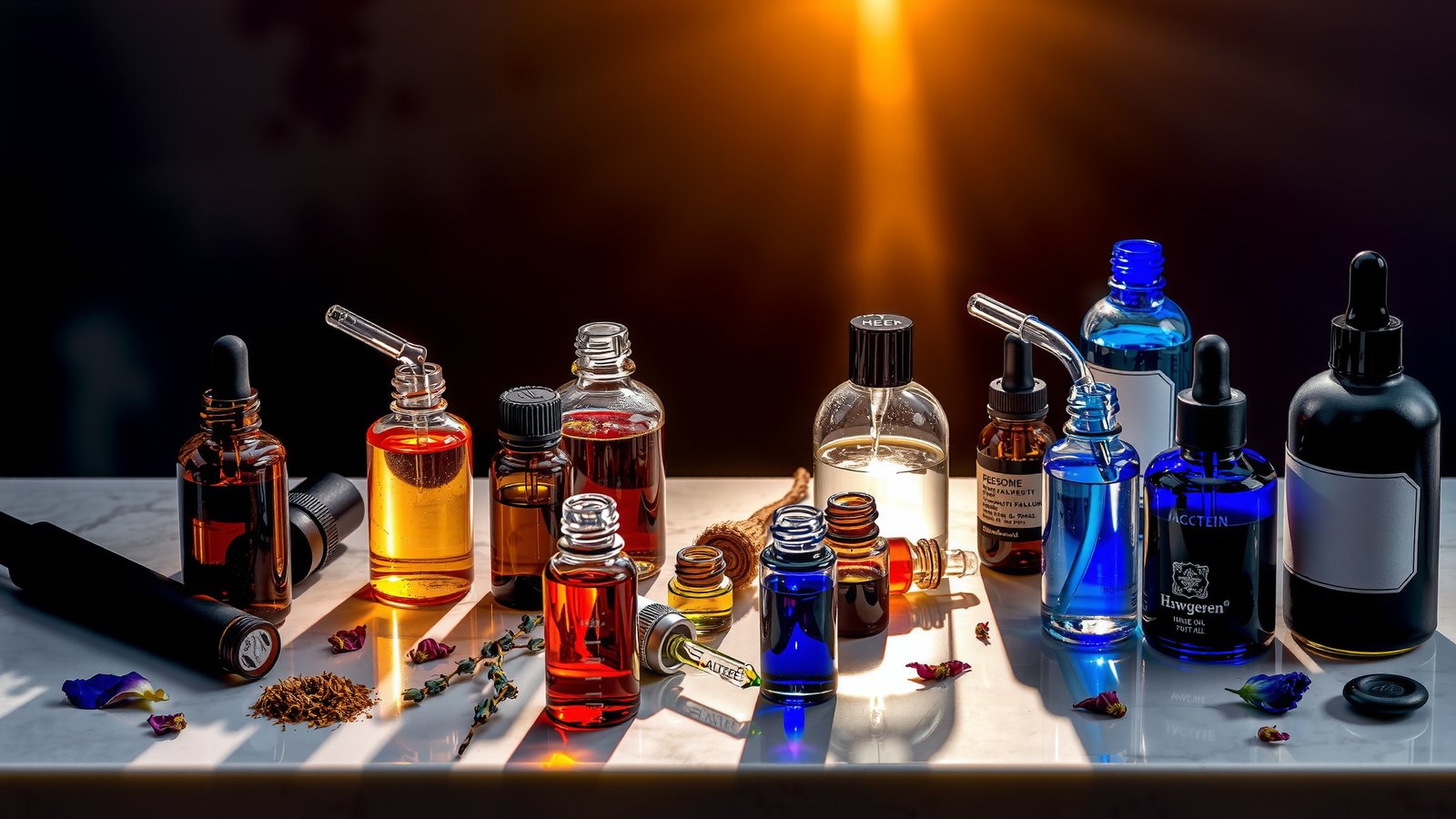
Once you have 3 essential oils,
the next step is blending.
Lavender alone is wonderful.
Peppermint alone is wonderful.
But —
lavender + bergamot + frankincense,
in correct proportions,
create effects greater than the sum of the parts.
This is synergy.
It’s like cooking:
salt, pepper, olive oil —
each delicious alone.
But properly combined,
a new universe of flavor is born.
Essential oils are the same.
Learn the theory of blending,
and you’ll create
your own daily prescriptions.
Before you know it,
through scent,
creativity and self-discovery
deepen each day.
💎 Key takeaway
Blending = “1+1=3” aromatic alchemy. Knowing note theory unlocks infinite formulas in your own hands.
30-second summary
- Basics: note theory (top/middle/base)
- Golden ratio: 3:5:2 (base:middle:top)
- Drop formula: carrier oil (ml) × dilution % × 2 = drops
- Synergy: compounds interact to exceed the sum
- Main failure: too many oils (start with 3-4)
- Carrier oil choice matters
- 1-week maturation deepens blends
- Have courage to trust your nose
1. Foundational theory — three notes
Traditional perfumery classification:
1-1. Top notes (fast evaporation)
- First scent on opening
- Duration: 30 min–2 hours
- Impression: vivid, bright
Examples:
– Lemon, lime, grapefruit
– Bergamot, orange
– Peppermint, eucalyptus
– Tea tree
→ First impression
1-2. Middle notes (medium evaporation)
- After top fades, lead role
- Duration: 2–4 hours
- Impression: pleasant, stable
Examples:
– Lavender, rose
– Geranium, chamomile
– Rosemary, clary sage
– Jasmine, neroli
→ Blend’s essence
1-3. Base notes (slow evaporation)
- Remains until the end
- Duration: 6+ hours
- Impression: deep, warm
Examples:
– Sandalwood, cedarwood
– Frankincense, myrrh
– Vetiver, patchouli
– Vanilla, benzoin
→ Lingering depth
2. Golden ratio — 3:5:2
2-1. Basic ratio
| Note | Ratio | Role |
|---|---|---|
| Base | 3 | Foundation, lasting |
| Middle | 5 | Lead role |
| Top | 2 | First impression |
In 10 drops total, it’s easy to grasp.
2-2. Example: relaxation blend
In 10 drops:
– Base: sandalwood 3 drops
– Middle: lavender 5 drops
– Top: bergamot 2 drops
→ Perfect balance.
2-3. Variations by purpose
| Purpose | Ratio (base:middle:top) |
|---|---|
| Relax | 4:5:1 (base-heavy) |
| Energize | 1:4:5 (top-heavy) |
| Meditation | 5:4:1 (base-primary) |
| Focus | 2:4:4 (balanced) |
| Female hormonal | 3:6:1 (middle-dominant) |
2-4. Trust your nose over the rule
Golden ratio = starting line.
With practice, adjust by your own sense.
3. Synergy — scientific basis
3-1. What is synergy?
1 + 1 = 3
When essential oils combine,
effects exceed the individual sum.
3-2. Scientific explanation
1. Complementary action
– Lavender (sedation) + bergamot (anti-anxiety)
– Attack anxiety from multiple angles
2. Enhancement
– Tea tree (antimicrobial) + lavender (antimicrobial)
– Antimicrobial power 1+1>2
3. Mitigation
– Peppermint (strong) + lavender (mild)
– Strength softened
4. Complementation
– Compounds fill in for each other
– “Whole” completeness
3-3. Classic synergy research
1990s onward:
– Antimicrobial: tea tree + lavender → MRSA synergy
– Calming: lavender + bergamot → anxiety synergy
– Hair growth: cedarwood + lavender + rosemary → Aberdeen formula
3-4. Decide one “lead”
When mixing,
decide which scent is the axis.
The blend will cohere.
4. Family-based compatibility
4-1. Seven families
| Family | Examples | Character |
|---|---|---|
| Citrus | Lemon, orange | Bright, fresh |
| Floral | Lavender, rose | Refined, feminine |
| Herbal | Rosemary, basil | Fresh, medicinal |
| Wood | Cedarwood, cypress | Deep, masculine |
| Resin | Frankincense, myrrh | Sacred, meditative |
| Spice | Ginger, cinnamon | Warm, stimulating |
| Exotic | Ylang-ylang, sandalwood | Sensual, unique |
4-2. Good pairings
Floral × Citrus (most foolproof)
– Lavender + bergamot
– Rose + orange
Wood × Citrus (masculine)
– Cedarwood + lemon
– Cypress + grapefruit
Resin × Floral (sacred)
– Frankincense + rose
– Myrrh + jasmine
Herbal × Citrus (refreshing)
– Rosemary + bergamot
– Peppermint + lemon
Spice × Exotic (sensual)
– Cinnamon + ylang-ylang
– Ginger + patchouli
4-3. Poor pairings
Strong × Strong
– Peppermint + eucalyptus + rosemary
– → Headache source
Opposite families
– Rose + ginger
– → Hard to integrate
Too many oils
– 7+ varieties
– → Chaos
5. Dilution math — failure-proof formula
5-1. Basic formula
Carrier oil (ml) × dilution % × 2 = drops
5-2. Examples
Ex 1: 30ml at 2% → 30 × 2 × 2 = 12 drops
Ex 2: 10ml at 3% → 10 × 3 × 2 = 6 drops
Ex 3: 50ml at 1% → 50 × 1 × 2 = 10 drops
5-3. Why “× 2”?
- 1 drop ≈ 0.05ml
- 1% in 1ml (0.01ml) = 0.2 drops
- Practical rule: “2 drops per 1ml = 1%“
5-4. Standard dilution by use
| Use | Dilution |
|---|---|
| Face (sensitive) | 0.5–1% |
| Face (normal) | 1–2% |
| Body (massage) | 2–3% |
| Spot (acne etc.) | 5–10% |
| Diffuser | No math, 3–5 drops |
| Bath | 2–5 drops in salt etc. |
5-5. Think in “drop ratios”
In 10 drops:
– Base: 3 drops
– Middle: 5 drops
– Top: 2 drops
→ Put in 30ml = overall 1.5% dilution.
6. Carrier oils
6-1. Main carriers
| Carrier | Character | Use |
|---|---|---|
| Jojoba | Versatile, oxidation-resistant | All uses |
| Sweet almond | Smooth | Massage |
| Coconut (fractionated) | Light | Face/body |
| Argan | Premium, beauty | Facial care |
| Olive | Heavy | Hair care |
| Grapeseed | Light, affordable | All uses |
| Rosehip | Beauty, anti-aging | Facial care |
| Avocado | Heavy, moisturizing | Dry skin |
6-2. Selection guide
Daily: Jojoba (versatile, stable)
Massage: Sweet almond (smooth)
Face: Jojoba or argan (light)
Hair care: Olive or coconut
For oxidation-prone oils: Jojoba (most stable)
6-3. Other base options
- Plant oils (above)
- Anhydrous ethanol (for sprays)
- Aloe vera gel (gel)
- Shea butter (balm)
- Oil balm base (beeswax + oil)
7. Twenty blend recipes by purpose
7-1. Relaxation
No.1: Ultimate relax
– Jojoba 30ml + lavender 6 + bergamot 3 + sandalwood 3 (2%)
No.2: Anxiety relief
– Jojoba 30ml + bergamot 5 + lavender 4 + frankincense 3
No.3: Meditation
– Jojoba 30ml + frankincense 6 + sandalwood 4 + juniper 2
7-2. Energy
No.4: Morning wake-up
– Jojoba 30ml + lemon 6 + peppermint 3 + rosemary 3
No.5: Focus boost
– Jojoba 30ml + rosemary 5 + peppermint 4 + basil 3
No.6: Creativity booster
– Jojoba 30ml + orange 5 + bergamot 4 + frankincense 3
7-3. Sleep
No.7: Sleep onset
– Jojoba 30ml + lavender 6 + Roman chamomile 3 + vetiver 3
No.8: Night-waking prevention
– Jojoba 30ml + lavender 5 + marjoram 4 + vetiver 3
No.9: Kid’s safe sleep (6+)
– Jojoba 30ml + lavender 3 + mandarin 3 (1%)
7-4. Female care
No.10: PMS support
– Jojoba 20ml + lavender 4 + clary sage 3 + geranium 2 + rose 1
No.11: Menopause
– Jojoba 30ml + clary sage 5 + geranium 4 + rose 2 + bergamot 1
No.12: Postpartum
– Jojoba 30ml + rose 3 + bergamot 4 + frankincense 3 + jasmine 2
7-5. Male care
No.13: After morning shower
– Jojoba 30ml + cedarwood 5 + bergamot 4 + cypress 3
No.14: Hair growth (Aberdeen)
– Jojoba 20ml + cedarwood 6 + lavender 6 + rosemary 6 + thyme 2
No.15: After shave
– Jojoba 15ml + lavender 3 + cedarwood 2 + sandalwood 1
7-6. Body care
No.16: Shoulder/back pain
– Jojoba 30ml + rosemary 5 + peppermint 4 + lavender 4 + ginger 2
No.17: Cold prevention spray
– Water 90ml + ethanol 10ml + tea tree 15 + eucalyptus 10 + lavender 5
No.18: Digestion support
– Jojoba 30ml + peppermint 5 + ginger 3 + fennel 2
7-7. Beauty
No.19: Anti-aging face oil
– Rosehip 20ml + jojoba 10ml + frankincense 4 + rose 2 + neroli 2 (1%)
No.20: Dry skin body oil
– Sweet almond 30ml + rose 3 + geranium 4 + lavender 4
8. Blending workflow
8-1. Prepare
- Amber bottle (30 or 50ml)
- Carrier oil
- Essential oils (3-4 varieties)
- Measuring cup or syringe
- Label
8-2. Steps (30ml, 2% dilution)
- Add 30ml carrier oil to amber bottle
- Add base notes: 3-4 drops
- Add middle notes: 5-6 drops
- Add top notes: 2-3 drops
- Cap tightly
- Warm between hands (30 sec)
- Roll gently (10 times)
- Label (ingredients, date, dilution)
- Mature 1 week in cool dark place (optional)
8-3. Maturation effect
- Molecular interaction stabilizes
- “Settled” feeling
- Optional, but pros mature
8-4. Storage
- Cool, dark
- Amber bottles
- Anti-oxidation: add 1 drop vitamin E
- Shelf life: 3–6 months
9. Professional techniques
9-1. “Scent pyramid”
- Base: wide, deep
- Middle: rich
- Top: light
→ Visualize the ratio.
9-2. Define the “core”
Pick one essential oil as the center,
build with complementary oils.
9-3. Give it a “story”
- Morning forest walk
- After-rain garden
- Christmas Eve room
→ Image makes oils self-select.
9-4. Courage to “subtract”
- Tendency: mix 7 oils
- 3–4 is enough
- More = chaos
9-5. “Reset the nose”
When sniffing:
– Smell coffee beans
– Smell inner arm (natural baseline)
– Pause for minutes
9-6. “24-hour rule”
Right after blending vs 24 hours later: true scent emerges.
“Today’s dislike often becomes tomorrow’s love.“
11. FAQ
Q1. Where do beginners start?
A. 3 essential oils. “Lavender + bergamot + frankincense” relax blend = classic.
Q2. How many oils to mix?
A. 3–5 = golden. More = chaos.
Q3. If a blend fails?
A. Dilute with more carrier oil to recover. Or use as “bath only.”
Q4. If scent weakens?
A. Possible oxidation. Safer to make a fresh blend.
Q5. OK to gift?
A. OK, but check for allergies. Caution for pregnant recipients.
Q6. Use without carrier?
A. Diffuser, handkerchief inhalation: OK. Always dilute for skin.
Q7. Mix oils directly?
A. OK (make 10-drop premix). Add to carrier later.
Q8. Best bottle size?
A. 30ml universal. Trial: 10ml. Serious: 50ml.
Q9. Mix expensive with cheap oils?
A. No problem. Price ≠ effect.
Q10. Make a perfume?
A. Yes, with alcohol base. Concentrations: parfum 20%, eau de toilette 8%.
12. Closing — trust your own nose
Blending’s biggest secret:
“Trust your own nose.“
Note theory = map.
Synergy research = guidebook.
But what finally decides “this is what I love“
is your nose
and your soul.
With 3 oils → blending.
With 5 → make a signature.
With 10 → your personal oil studio.
With 20 → entry point to aromatherapist.
The journey to discover
what lies beyond lavender alone, bergamot alone —
a new universe —
continues for life.
And at the journey’s end
awaits
“yourself” —
the deepest scent.
Tomorrow, take out 3 essential oils.
Drop 10 into 10ml of jojoba,
by your own sense.
That is
the first step of your one-of-a-kind oil.
References
- Tisserand, R. & Young, R. (2014). Essential Oil Safety (2nd ed.). Churchill Livingstone.
- Battaglia, S. (2003). The Complete Guide to Aromatherapy. The International Centre of Holistic Aromatherapy.
- Worwood, V. A. (2016). The Complete Book of Essential Oils and Aromatherapy (Revised). New World Library.
- Lawless, J. (1995). The Encyclopedia of Essential Oils. Element Books.
- Schnaubelt, K. (2011). The Healing Intelligence of Essential Oils. Healing Arts Press.
MuZenCosmos — Where cosmos meets silence | Your nose and infinite blending
This article does not guarantee any medical or health benefit and is not a substitute for professional medical care. If you have any health concerns, please consult a physician or other qualified professional.