【SEO Settings】
- Title: Citrine Crystal: Complete Guide to Meaning, Benefits & Natural vs. Heat-Treated [With Buying Checklist]
- Slug:
citrine-crystal-complete-guide - Meta Description: A complete, honest guide to citrine — November’s birthstone. Why it’s yellow (iron), how to tell natural citrine from heat-treated amethyst, the “Merchant’s Stone” history, abundance and confidence symbolism, morning rituals, why sunlight fades it, a stone-pairing comparison table, a 5-point buying checklist, and 10 FAQs.
- Focus Keywords: citrine crystal / citrine meaning / natural vs heated citrine / citrine benefits / how to cleanse citrine
- Category: Healing Beyond Sound
- Tags: citrine, crystals, birthstone, crystal buying guide, abundance
Hold one up to the light, and you’ll find a small afternoon trapped inside.
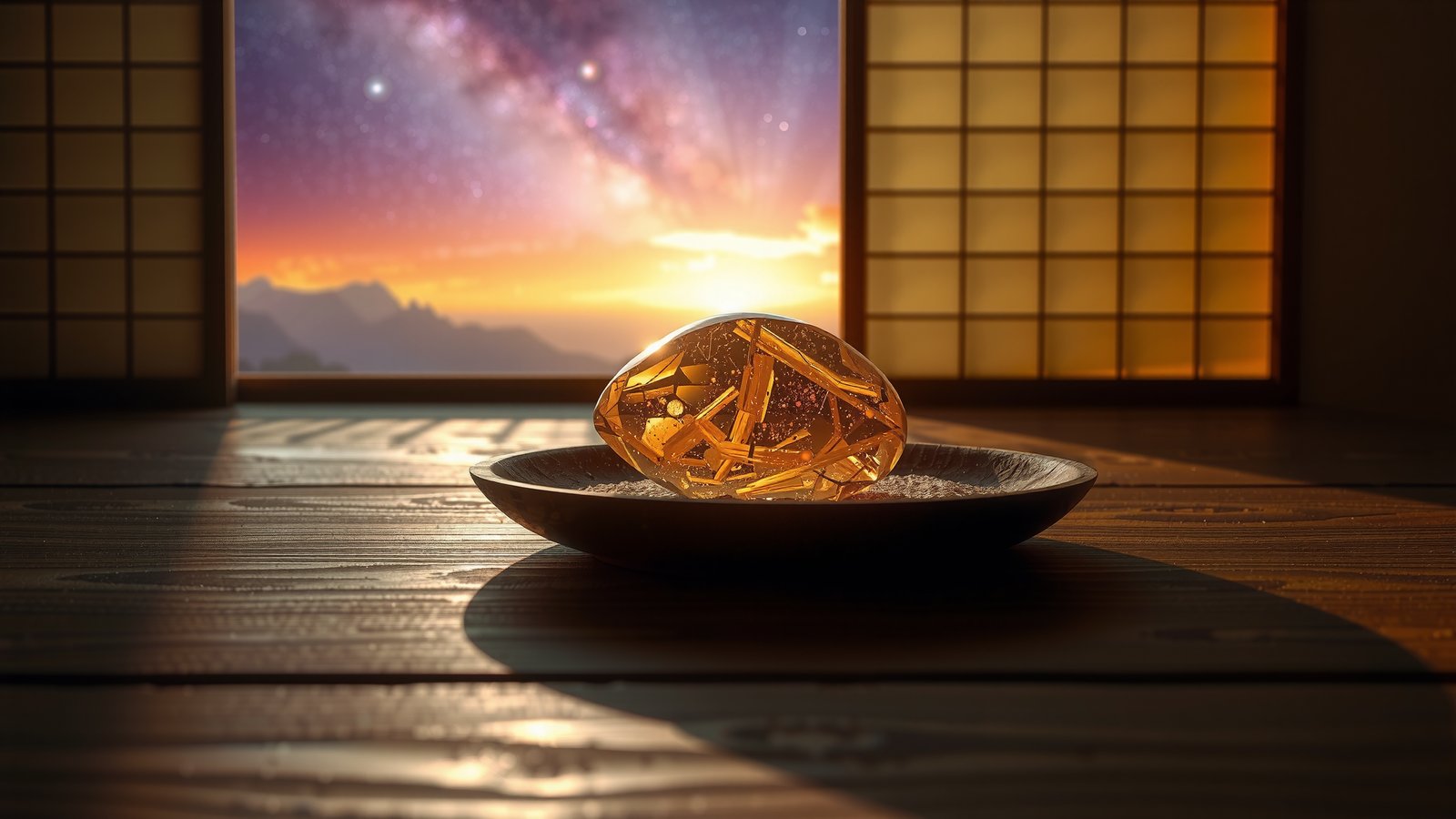
The color of honey. Of wheat fields. Of winter light through paper screens.
Citrine — yellow quartz, named from the Latin citrus.
For centuries it has been called the Merchant’s Stone, tucked into cash drawers and shop counters and wallets.
But this guide is not going to tell you that carrying it will make money appear.
It’s going to tell you something quieter, and more useful.
And it will tell you something the market rarely mentions out loud: a great deal of the citrine sold today is amethyst that has been heated.
A stone you choose knowingly tends to stay with you far longer than one you bought in the dark.
💎 The One Line That Matters
The abundance citrine symbolizes isn’t more — it’s the state of believing you have something worth offering. The sun-colored stone doesn’t deliver luck from outside; it reminds you of a warmth that was already there.
✅ The Answer in Three Lines
Citrine is quartz colored yellow-to-orange by trace iron, and it is November’s birthstone. Tradition ties it to abundance, confidence, and the will to act.
There is no scientific evidence that stones affect wealth or health. What is well established is that the moment you decide something can change your behavior — and this guide keeps that line visible.
When buying: ask whether it’s natural or heat-treated, and never leave it in direct sunlight. Do those two things and your citrine will hold its color for decades.
The 30-Second Summary
- Citrine is quartz (SiO₂) colored by trace iron (Fe³⁺). Mohs hardness 7 — tough enough for daily wear.
- It is the November birthstone (alongside topaz) and the 13th-anniversary gem.
- Worn since Greek and Roman times; in 17th-century Scotland it decorated dagger hilts and brooches.
- The nickname “Merchant’s Stone” comes from the habit of keeping one near the till.
- Much commercial citrine is heat-treated amethyst. Deep orange color is the tell.
- Natural citrine tends toward pale lemon to champagne; sources include Brazil, Bolivia, Madagascar, and Zambia.
- Symbolically it maps to the third chakra (Manipura, solar plexus) — will, self-worth, agency.
- No proven effect on money or healing. Used honestly, it works as an intention marker, not a charm.
- Prolonged sunlight fades it. “Charging in the sun” is the one method citrine cannot take.
- Traditional pairings: amethyst (calm), tiger’s eye (decisiveness), rose quartz (receiving).
What Is Citrine? The Mineralogy of a Sun-Colored Quartz
Citrine is a variety of quartz — chemically identical to clear rock crystal, silicon dioxide.
What makes it yellow is a small guest: trace iron sitting inside the crystal lattice.
So citrine isn’t a different mineral at all.
It’s clear quartz that let a little iron in.
The essentials:
- Mineral: Quartz, SiO₂
- Mohs hardness: 7 — practical for everyday wear
- Color cause: iron (Fe³⁺)
- Color range: pale lemon → honey → deep “Madeira” orange
- Main sources: Brazil, Bolivia, Madagascar, Zambia, Spain
That hardness of 7 matters more than it sounds. Ordinary household dust is largely quartz — so a stone at hardness 7 resists the scratching that would slowly cloud a softer gem.
That is why citrine has survived in rings and bracelets, in human hands, for centuries.
For the wider context, see our complete guide to crystal healing.
The History of Citrine: From Ancient Greece to the Merchant’s Stone
People have kept company with this stone for a very long time.
In ancient Greece and Rome, yellow quartz was carved into intaglios and ornaments. Without modern mineralogy, it was frequently confused with topaz — a confusion that persisted for centuries.
In 17th- and 18th-century Scotland, citrine set the hilts of dirks and the shoulders of brooches. In a land of long grey weather, this stone was a portable piece of sun.
The Victorians loved it in large, showy cuts. In the Art Deco years, Hollywood stars — Greta Garbo among them — wore it in bold statement pieces.
And somewhere along the way it acquired its working nickname: the Merchant’s Stone.
Shopkeepers kept one by the register, in the safe, in the money box.
Here is the honest reading of that tradition.
It is not a record of demonstrated effects. It is a record of what people hoped for.
Commerce is uncertain. Anyone who has ever opened a shop knows that. And a small bright object you touch each morning, before the uncertainty starts, is not nothing.
Why Citrine Is Yellow: The Science of the Color
This part has a real answer.
Iron substitutes into the quartz structure in trace amounts. It absorbs certain wavelengths of light, and what reaches your eye is the remainder — yellow to orange.
Here is the fascinating part: amethyst gets its purple from the same element.
The same iron, in a different oxidation and radiation history, produces violet instead of gold.
Which is exactly why heating amethyst turns it into citrine.
At roughly 470–560 °C, the iron centers change and purple shifts to yellow-orange. The same thing happens naturally underground, given geothermal heat and time.
Purple and gold are not opposites.
They are the same stone in two different seasons.
The purple side of the story is in our complete guide to amethyst.
Natural vs. Heat-Treated Citrine: What to Know Before You Buy
This may be the most useful section in this guide.
A substantial share of stone sold as “citrine” is heat-treated amethyst or pale quartz.
Natural citrine is genuinely uncommon in the ground. Heat treatment is a standard, widely practiced technique in the gem trade — not a scandal.
Say this clearly: treated does not mean fake.
The material is real quartz. The color is stable. It will last.
The only real problem is treatment that goes undisclosed and is sold as “natural.”
| Aspect | Natural citrine | Heat-treated (from amethyst) |
|---|---|---|
| Hue | Pale lemon, champagne, smoky yellow | Deep orange, reddish amber |
| Color distribution | Generally even throughout | Saturated tips, whitish bases |
| Typical form | Single crystals, tumbled pieces | Clusters and geode sections |
| Base of crystal | Natural gradation | Often chalky white |
| Price | Higher | Affordable |
| Labeling | Locality usually stated | Should say “heat-treated” |
One rule of thumb worth memorizing:
A vividly orange citrine cluster is almost certainly heat-treated.
Natural citrine is quieter than most people expect.
One beautiful footnote: at Bolivia’s Anahí mine, purple and gold occur together in a single crystal — a stone called ametrine. It may be the loveliest proof that amethyst and citrine are siblings.
For general buying judgment, see our complete guide to choosing crystals.
Citrine Meaning and Symbolism: Abundance, Confidence, the Solar Plexus
Line up the traditional associations and a direction emerges:
- Abundance — prosperity, circulation, harvest
- Confidence — self-worth, will, decision
- Drive — the courage to begin
- Brightness — joy, optimism, warmth
In energy-work traditions, citrine corresponds to the third chakra (Manipura, the solar plexus) — the seat of “I am allowed to move my own life.”
When that place goes cold and tight, decisions get hard.
Placing a sun-colored stone there is, at the very least, an elegantly designed symbol.
The full system is covered in our complete chakra guide.
A word about “abundance,” though.
The abundance citrine points to isn’t accumulation.
It’s the felt sense that you have something worth offering.
People in that state do tend to become more prosperous — not because a stone attracted anything, but because that feeling changes what they do.
Citrine Benefits and the Evidence: What Can and Cannot Be Claimed
Here is the line, drawn plainly.
What cannot be claimed:
- That citrine improves financial fortune
- That citrine treats or cures any condition
- That stones emit a measurable healing energy
No scientific evidence supports these claims.
In one well-known study, participants handling real quartz reported no significantly different sensations than those handling visually identical fakes (French et al., 2001). The reported experiences were consistent with expectation — placebo.
What can honestly be said:
- Declaring an intention (“I’m carrying this for X”) can measurably shape subsequent behavior
- A small tactile ritual returns attention to the present moment
- Looking at something beautiful each morning is a mild but real mood input
Placebo does not mean “nothing happened.” It means something real happened, produced by the mind.
So use citrine not as a luck switch, but as a marker for a promise you made to yourself.
That, we think, is the most honest way to keep this stone.
How to Use Citrine in the Morning: A 30-Second Ritual
Citrine belongs to the morning.
Nothing elaborate is required.
- On waking, close your hand around the stone.
- Three slow breaths, in and out.
- Name one thing you will move today. “Today I send that message.”
That’s the whole practice. Thirty seconds.
The stone does not grant the wish.
The sentence you said out loud is what changes the day. The stone is only the textured reminder that you said it.
If you’re building a morning practice, our morning routine guide pairs well with this.
Citrine for Work and Money: The Merchant’s Stone in Practice
Following the old nickname, here’s how to actually use citrine at work.
- Front-left of your desk — in peripheral vision, within reach
- Beside the register or in your wallet — touched whenever money moves
- Before sending an invoice, pick it up once: my work may ask to be paid for
- On negotiation or interview days, in a pocket; squeeze it when nerves rise
Nothing supernatural is happening here.
What’s happening is that a pause has been inserted before every financial decision.
If you habitually underprice yourself — if the invoice email sits in drafts for four days — that single pause is startlingly effective.
For a stone traditionally tied to decisive action, see our complete guide to tiger’s eye.
Meditating with Citrine: Place It at the Solar Plexus
If you meditate with citrine, put it on your solar plexus.
Lie on your back. Set the stone just below the ribs.
Close your eyes and imagine that spot as a patch of sunlight on a floor.
With each breath, the warmth spreads a little further.
Five minutes is plenty.
Many people find the experience deepens with sound — a soft tone or a slow drone at low volume. (Our science-based guide to 528 Hz covers how to use these tones with the evidence kept straight.)
Before you open your eyes, choose one sentence to carry out with you:
“Today, I’m all right.”
How to Cleanse and Care for Citrine: Please Don’t Sun-Charge It
There is one care rule that genuinely matters.
Prolonged direct sunlight fades citrine.
You will often hear that crystals should be “charged in the sun.” Citrine is the exception. Yellow stones left on windowsills have been known to come out nearly colorless years later.
| Method | Safe for citrine? | Note |
|---|---|---|
| Brief rinse under running water | ◎ Yes | Hardness 7; avoid long soaking |
| Wipe with a soft dry cloth | ◎ Yes | Safest, best for daily care |
| Moonlight | ◎ Yes | No fading risk — a windowsill at full moon |
| Resting on a quartz cluster | ◎ Yes | Traditional and gentle |
| Sound (bell or bowl) | ◎ Yes | No handling required |
| Prolonged direct sunlight | ✕ No | The one thing to avoid |
| Burying in salt | △ Caution | Can damage settings and coatings |
| Ultrasonic cleaners | △ Caution | Risky for treated or included stones |
Mineralogically, “cleansing” means removing dirt.
But the few minutes you spend caring for a stone are also a few minutes spent settling yourself — and that value sits outside the reach of science.
Citrine Crystal Pairings: What Works With What
Citrine has a strong personality. It pairs best with stones that supply what it lacks.
| Pairing | What it balances | When to reach for it |
|---|---|---|
| Citrine × Amethyst | Drive and calm | You want to move, but you’re anxious |
| Citrine × Tiger’s Eye | Decision and follow-through | You need to take the step |
| Citrine × Rose Quartz | Giving and receiving | You over-give and can’t accept help |
| Citrine × Clear Quartz | Clarity of intention | Your goal is still fuzzy |
| Citrine × Smoky Quartz | Brightness with grounding | You feel scattered or floaty |
If receiving is the harder half for you, our complete guide to rose quartz is a good companion read.
There’s no correct combination.
Holding two stones and noticing which one you need today — that noticing is the practice.
How to Choose Citrine: A 5-Point Checklist
Before you buy, in a shop or online, check these five things.
- Is treatment disclosed? This is the most important item. Heat-treated citrine is fine — a seller who hides the treatment and calls it “natural” is not. Honest dealers always state it.
- Do you actually like the color? Some people love deep Madeira orange; others are drawn to pale lemon. Choose the color you’ll be glad to see every morning, not the one that’s rarer.
- Is the locality stated? Brazil, Bolivia, Madagascar, Zambia — naming the source signals a seller willing to disclose. If it’s missing, just ask.
- Any deep surface-reaching cracks? Internal inclusions are natural and fine. Fractures that break the surface are where a stone splits when dropped. Check it against a light.
- Does the description promise outcomes? “Guaranteed prosperity,” “cures illness” — such claims are a reason to doubt the seller’s honesty in general. Choose the modest, accurate voice.
This article does not guarantee any medical or health benefit and is not a substitute for professional medical care. If you have any health concerns, please consult a physician or other qualified professional.
📚 Related Articles
- Essential Oils & the Four Elements: How to Choose Oils by Fire, Earth, Air & Water (With Element Chart & Selection Checklist)
- Sandalwood Essential Oil: Complete Guide to Benefits, Uses & the Science Behind Meditation (With Buying Checklist)
- The Complete Guide to Holistic Wellness for Men | Aligning Body and Mind With Your Daily Rhythm
- The Complete Guide to Women’s Holistic Wellness | Living in Harmony with Your Hormonal Rhythm
Frequently Asked Questions
Q1. Does citrine really attract money?
There’s no scientific evidence for that. No study shows stones influencing finances. What does happen is that a pause before financial decisions can change how you price, invoice, and negotiate — and that can change outcomes. Use it as a habit marker, not a charm.
Q2. Is heat-treated citrine fake?
No. It’s genuine quartz with stable color, and heat treatment is standard practice across the gem trade. The only problem is undisclosed treatment sold as natural. Buy from sellers who label honestly.
Q3. Can I tell natural from heat-treated by eye?
There are reliable hints. Natural tends to be pale lemon or champagne with even color; treated tends to be deep orange with saturated tips and whitish bases. Vividly orange clusters are almost always treated. Certainty requires a gemological lab.
Q4. Can citrine go in water?
A short rinse is fine — hardness 7 handles water well. Avoid long soaking, especially for cracked pieces or set jewelry. For routine care, a soft dry cloth is best.
Q5. Can I charge citrine in sunlight?
Please don’t. Extended direct sun fades the color permanently. Use moonlight, a quartz cluster, or sound instead — none of which carry any fading risk.
Q6. Where should I keep it?
Traditionally, wherever business happens — desk, register, wallet. Practically, somewhere you see and can touch it daily. A stone in a drawer can’t function as a reminder.
Q7. Can anyone wear citrine, or only November birthdays?
Anyone. Birthstone assignments are a cultural convention, not a rule. If you’re drawn to it, that’s reason enough.
Q8. Can I carry citrine and amethyst together?
Yes — and it’s a classic pairing, balancing drive with calm. Nature even makes the combination itself: ametrine, a single crystal that is both.
Q9. Is it durable enough for a daily-wear bracelet?
Yes, at hardness 7. It can pick up fine scratches from harder gems and metal, so store it in a soft pouch — and not on a sunny windowsill.
Q10. I don’t feel anything. Am I doing it wrong?
You’re not. Stones don’t generate effects on their own, so feeling nothing isn’t a failure. If you want something to shift, attach a specific sentence when you hold it — “today I send that quote.” The sentence is what does the work.
Closing: The Sun Was Never Outside
Citrine is not a stone that brings luck.
Framing it that way loses what’s actually beautiful about it.
What it points to is quieter.
You have something worth offering.
When someone genuinely believes that, there is a small sun already lit inside them.
Citrine doesn’t light it. It reminds you it was lit.
So if you hold one and feel nothing at all, don’t worry. The stone was never the point — the step you take afterward is.
Today, set a small piece of yellow at the front-left of your desk.
And the next time you hesitate — sending the quote, saying no, asking for help — pick it up once.
Three seconds on your own side.
Whatever the weather outside, for those three seconds your hand holds a small afternoon.
References
- Walter Schumann, Gemstones of the World, Sterling Publishing — standard reference on quartz varieties, citrine’s color cause, and localities.
- Cornelis Klein & Barbara Dutrow, Manual of Mineral Science, John Wiley & Sons — crystal structure of quartz and trace-element coloration mechanisms.
- Judy Hall, The Crystal Bible, Godsfield Press — a compendium of traditional crystal symbolism, cited here as a record of tradition.
- Robert Simmons & Naisha Ahsian, The Book of Stones, North Atlantic Books — the lineage of citrine’s “Merchant’s Stone” associations.
- French, C. C., O’Donnell, H., & Williams, L. (2001). Hypnotic susceptibility, paranormal belief and reports of “crystal power.” British Psychological Society Centenary Annual Conference — the placebo study finding no significant difference between real quartz and imitation stones.
MuZenCosmos — Where the Cosmos Meets Stillness | A small afternoon in the palm of your hand