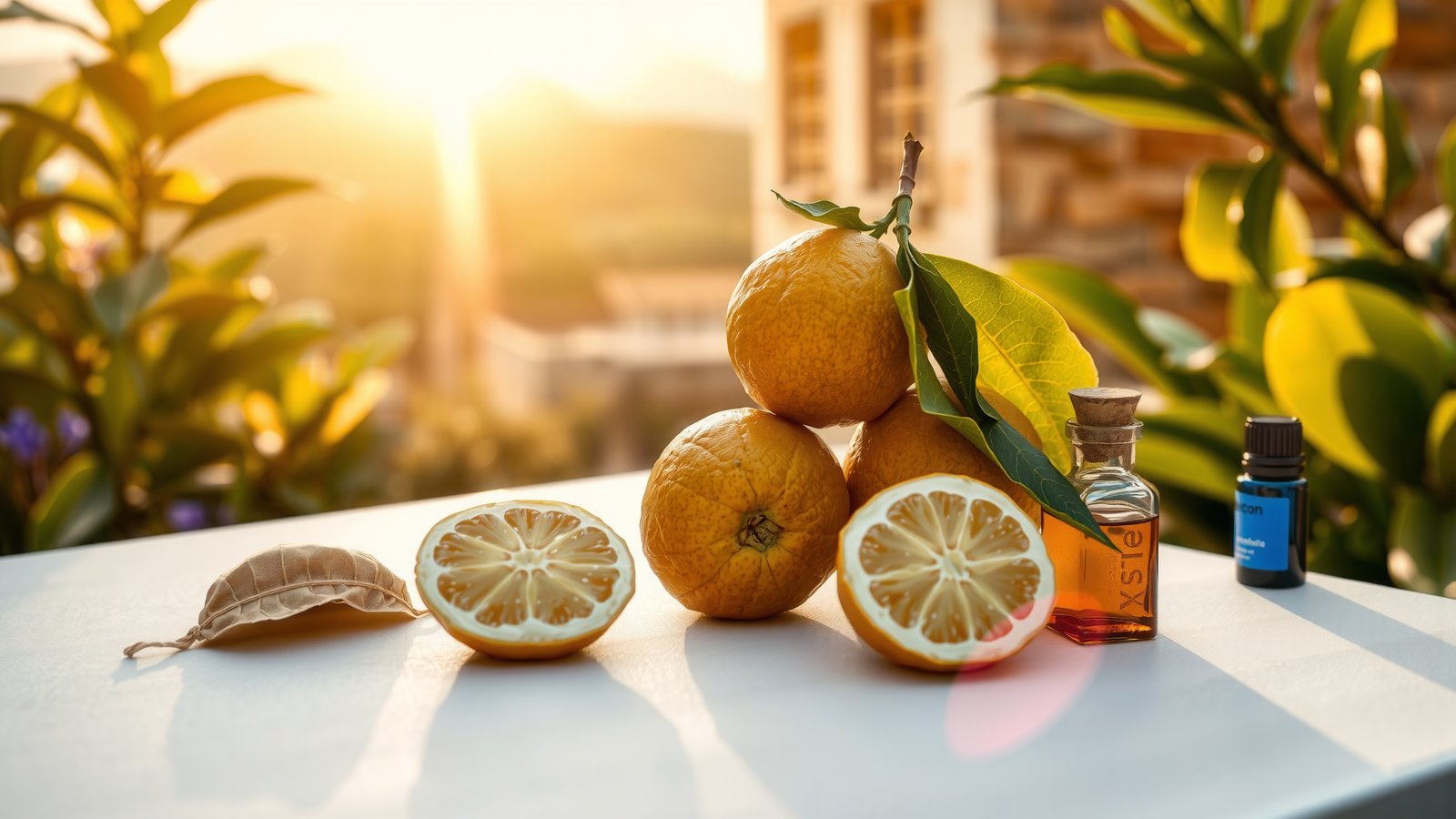
Bergamot is a citrus fruit grown mainly in southern Italy. Its peel gives an essential oil with a bright, slightly floral citrus scent, the same scent that flavors Earl Grey tea.
This guide covers what bergamot oil is, what the research on its scent actually shows, and the one safety point everyone should know: some bergamot oils can make skin burn in sunlight. Studies were checked against their original abstracts and are linked (checked November 2026).
The short answer
- What research shows: a few small trials found that people who smelled bergamot felt less anxious or slept and woke better. In these trials people knew they were smelling an oil, so expectation may play a part.
- What it does not show: that bergamot treats depression or anxiety disorders. If you have those, talk to a doctor.
- Safety: ordinary cold-pressed bergamot oil can cause skin reactions in sunlight. Dilute it, avoid sun on treated skin, or choose a product labeled bergapten-free (FCF).
1. What Is Bergamot Oil?
- Plant: bergamot orange, Citrus bergamia
- Part used: the peel, usually cold-pressed
- Scent: bright citrus with a soft floral note
- Main components: limonene, linalyl acetate and linalool, in amounts that vary by harvest
- Also contains: bergapten, a compound that makes skin sensitive to sunlight (section 4)
2. A Little History
Bergamot has long been grown along the coast of Calabria in southern Italy. Its oil became a classic ingredient of eau de cologne and is used to flavor Earl Grey tea.
3. What Research Shows
| Study | What was done | What was found | Keep in mind |
|---|---|---|---|
| Wakui et al. 2026 | 57 university students used aroma stones with bergamot oil or water for 3 days before exams | Lower state anxiety in the bergamot group; more relaxation | Open-label (students knew which stone they had), one university, small |
| Wakui et al. 2023 | 48 university students used a bergamot or placebo spray before bed and on waking, each for one week | Better ratings of waking up and sleep length, and lower depression, anxiety and stress scores | Open-label crossover; self-reported outcomes |
| Reven et al. 2025 | 100 adults in outpatient treatment for substance use disorder; bergamot inhaler three times a day for a week vs standard care | Small improvements in ease, and in depression and anxiety scores | No placebo scent; mainly a feasibility study |
What this adds up to: many people find the scent pleasant and relaxing, and small studies support that. They do not show that bergamot treats any condition.
What we changed: an earlier version cited a 2015 US study in which bergamot cut exam anxiety by 33%, a meta-analysis showing it helps antidepressants, and "strong evidence" for anxiety, depression and stress. We could not find or support these, so we removed them.
4. Sunlight and Skin: The Most Important Safety Point
Cold-pressed bergamot oil contains bergapten, a compound that reacts with ultraviolet light. On skin that is then exposed to the sun, it can cause redness, blistering or dark patches. A study testing bergamot oils from four suppliers found that some had phototoxic potential and others did not, so it depends on the product (Kejlová et al. 2007).
- Dilute it well if you put it on skin, and test a small patch first
- Do not expose treated skin to strong sunlight or tanning lamps for the rest of the day
- For skin use, look for "bergapten-free" or "FCF" on the label
- Keep it away from the faces of babies and young children, and from cats
5. Everyday Use
- For the scent: a drop on a tissue or a few drops in a diffuser, for a short time, in a ventilated room
- Mixed with other scents: it pairs easily with lavender, other citrus oils and woody oils
- Not for drinking: the flavor in tea is a food-grade flavoring, not aromatherapy oil
6. FAQ
Q1. Does bergamot help depression?
A. Small studies found better mood scores, but none shows it treats depression. If you are struggling, please talk to a doctor.
Q2. Can I put it on my skin in the morning?
A. Only a bergapten-free (FCF) oil, well diluted. Ordinary bergamot oil should not go on skin that will be in the sun.
Q3. Is it safe around children and pets?
A. Use only a little scent in a ventilated room, away from young children's faces, and not in a room with a cat.
Q4. Is the bergamot in Earl Grey the same?
A. It comes from the same fruit, but tea uses food-grade flavoring. Do not drink essential oil.
7. Closing
Bergamot oil has a cheerful citrus scent that many people find relaxing, and a few small studies agree. Enjoy it as a scent, keep it off sun-exposed skin unless it is bergapten-free, and leave the treatment of anxiety or depression to proper care.
10 November 2026: We rewrote this guide using studies we could check against the original sources, removed unsupported claims, and put the sunlight safety point first.
References
- Wakui N, et al. (2026). Evaluation of the anxiety-reducing effects of aroma stones with bergamot essential oil before examinations: a randomized controlled trial. Journal of Integrative and Complementary Medicine. doi:10.1177/27683605261488658
- Wakui N, et al. (2023). Relieving psychological stress and improving sleep quality by bergamot essential oil use before bedtime and upon awakening: a randomized crossover trial. Complementary Therapies in Medicine 77:102976. doi:10.1016/j.ctim.2023.102976
- Reven ME, et al. (2025). Using an aromatherapy intervention with Citrus bergamia (bergamot) essential oil in adults in treatment for substance use disorder: a randomized controlled trial. International Journal of Nursing Sciences 12:311-319. doi:10.1016/j.ijnss.2025.04.011
- Kejlová K, et al. (2007). Phototoxicity of bergamot oil assessed by in vitro techniques in combination with human patch tests. Toxicology in Vitro 21:1298-1303. doi:10.1016/j.tiv.2007.05.016
- Tisserand R, Young R. (2014). Essential Oil Safety (2nd ed.). Churchill Livingstone.
This article does not guarantee any medical or health benefit and is not a substitute for professional medical care. If you have any health concerns, please consult a physician or other qualified professional.