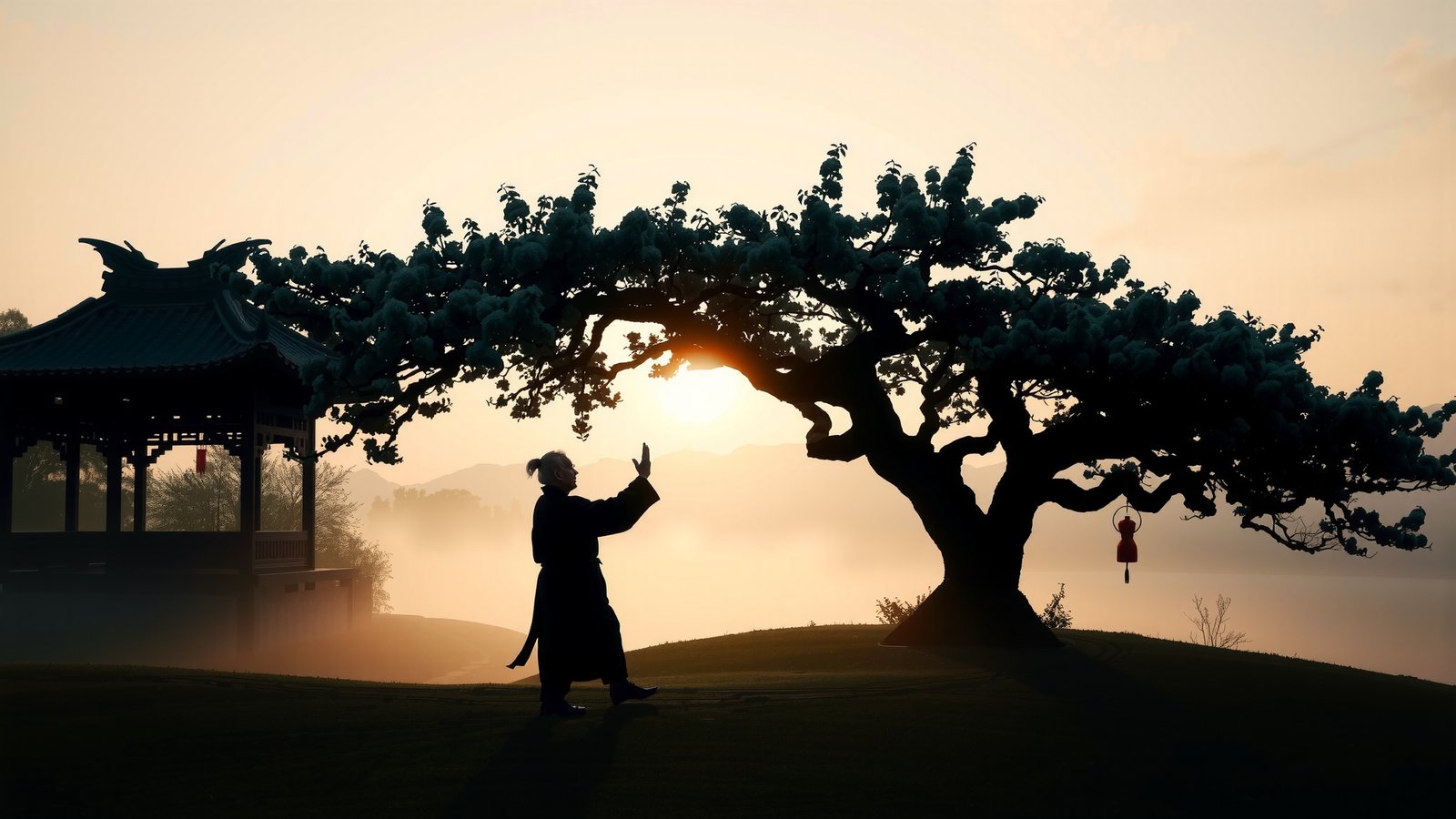
Have you seen them?
The morning practitioners in Chinese parks,
moving with flowing slowness?
That motion was born over 400 years ago
in a small Chinese village,
Chenjiagou.
Originally —
it was a martial art.
A soft-and-firm combat system
for battlefield survival.
But its effects on longevity and health
proved enormous —
generations of practitioners
verified this.
In the late 20th century,
the world discovered tai chi.
Harvard Medical School proved its
fall-prevention effect.
The WHO recommends it as
the senior’s gold-standard exercise.
Today, over 100 million people worldwide practice tai chi —
one of “humanity’s finest health practices.”
💎 Key takeaway
Tai chi is “400 years of martial intelligence solving the modern problem of aging.” Ancient yet cutting-edge body science.
30-second summary
- Tai chi originated in 17th-century China
- Trinity of martial art + philosophy + health cultivation
- Main styles: Chen, Yang, Wu, Wu (Hao), Sun
- Most popular: 24-form tai chi (Yang-based, 1956 official)
- Effects (verified by Harvard, etc.): fall prevention, balance, chronic disease management
- Learning timeline: 3 months to learn 24 forms
- Effective even starting at age 70+
- Class cost: 30–80 USD/month typical
1. What is tai chi?
1-1. Meaning of the name
Tai chi:
– “Supreme” or “ultimate“
– Daoist concept of “root of yin and yang“
– Symbolized by the taijitu (yin-yang fish)
Quan / Chuan: martial art, fist
→ “Supreme martial art” / “Yin-yang martial art“
1-2. Three facets
| Facet | Content |
|---|---|
| Martial art | Self-defense, combat technique |
| Philosophy | Embodiment of Daoist thought |
| Health cultivation | Health, longevity |
→ Your focus changes how you learn.
1-3. “Moving meditation”
- Slow motions
- Focused awareness
- Rhythmic breathing
- → Same brain activity as meditation
2. 400 years of history
2-1. Origin: Chenjiagou (17th century)
- Small village in Henan province
- Martial artist Chen Wangting (1580–1660) systematized
- Practical combat for battlefield survival
2-2. Chen family secret (17th–19th c.)
- For 200+ years, Chen family secret
- Never taught outside
2-3. Yang Luchan’s transmission (19th c.)
- Yang Luchan (1799–1872) gained entry to Chen family
- Mastered the art, took it to Beijing
- Taught royalty and aristocracy
- Founded Yang style tai chi
2-4. Branches emerge (late 19th – early 20th c.)
- Wu Jianquan (1870–1942) → Wu style
- Wu Yuxiang (1812–1880) → Wu (Hao) style
- Sun Lutang (1860–1933) → Sun style
2-5. Simplified tai chi (1956)
- PRC government codifies 24 forms
- For national health
- Drove global spread
2-6. Global expansion (1970s–80s)
- Spreads to US
- Joins the health movement
- Symbol of West Coast culture
2-7. Serious scientific research (1990s–)
- Harvard, Mayo Clinic begin studies
- Fall-prevention effects in journals
- Hailed as saving grace for aging societies
2-8. Olympic recognition movement (2020s)
- International martial arts standardization
- Demonstrated at 2008 Beijing Olympics
3. Five major styles
3-1. Chen style | Original, vigorous
- Oldest
- Sudden-slow rhythm
- Fajin (explosive force) moves
- Strongest martial character
→ For young people, martial enthusiasts
3-2. Yang style | Most popular
- Founded by Yang Luchan
- Large, soft, circular
- Even, slow movements
- Easy to learn
→ For seniors, health-focused
3-3. Wu style | Mid-speed
- Yang derivative
- Small movements
- Balance-focused
3-4. Wu (Hao) style | Compact
- Small, compact movements
- High philosophical depth
- Advanced
3-5. Sun style | Beautiful flow
- Sun Lutang integrated xingyi and bagua
- Distinctive stepping
- Newest of the major styles
3-6. Simplified tai chi (24 forms)
- 1956 Chinese government standardization
- Yang-style based, simplified
- Global standard
- 3-month learning
4. The 24-form structure
4-1. Eight groupings
From opening to closing, 24 movements.
4-2. Notable forms
- Opening
- Parting wild horse’s mane
- White crane spreads wings
- Brush knee and push
- Playing the lute
- Reverse reeling forearms
… - Closing
4-3. Total duration
- Full sequence: 4–6 minutes
- Practice involves repetition
- Session: 20–30 minutes
4-4. Learning milestones
| Stage | Duration | Content |
|---|---|---|
| 1 | 1–2 weeks | Stance, standing |
| 2 | 2–4 weeks | Forms 1–8 |
| 3 | 5–8 weeks | Forms 9–16 |
| 4 | 9–12 weeks | Forms 17–24 |
| 5 | 3–6 months | Smooth flow-through |
| 6 | 1+ years | Depth, inner work |
5. Scientific effects — world-validated
5-1. ✅ Strongest evidence: fall prevention (seniors)
Meta-analyses:
– 20–45% fall reduction in 65+
– Significant balance test improvements
– Harvard School of Public Health recommends
Real outcomes:
– 12 weeks: balance test improvement
– 6 months: fall count reduction
– Most effective exercise against hip fracture
5-2. ✅ Strong evidence: cardiovascular
- BP reduction (systolic 10–15 mmHg)
- Cholesterol improvement
- HRV improvement
- Used in cardiac rehab
5-3. ✅ Strong evidence: Parkinson’s
- Reduces bradykinesia
- Improves balance
- Quality of life gains
- Major complementary therapy
5-4. ✅ Moderate evidence: chronic pain
- Fibromyalgia
- Arthritis
- Chronic low back pain
5-5. ✅ Moderate evidence: mental health
- Depression reduction
- Anxiety reduction
- Cognitive maintenance/improvement
- Alzheimer prevention research
5-6. ✅ Moderate evidence: diabetes
- Improved blood sugar control
- Reduced insulin resistance
5-7. ✅ Senior overall wellbeing
- Extended independent years
- Social connection (classes)
- Self-efficacy
6. How it works
6-1. Balance mechanism
Vestibular function:
– Inner ear balance activation
– Slow motion = vestibular rehab
Proprioception:
– Joint and muscle position sense
– Sharpened by weight shifts
Visual system:
– Movement awareness improves visual tracking
Strength:
– Especially lower limbs, core
→ All four integrate for fall prevention.
6-2. Cardiovascular mechanism
- Abdominal breathing = parasympathetic activation
- Improved systemic circulation
- Steady load, no acute strain
- Slows arteriosclerosis
6-3. Cognitive mechanism
- Memorizing complex sequences
- Sequencing movements
- Multitasking training
- Hippocampus and prefrontal cortex activation
6-4. Stress mechanism
- Rhythmic breathing → HRV improvement
- Mindfulness through focus
- Cortisol reduction
- Serotonin increase
7. Three approaches to starting
7-1. Approach 1: Take a class (recommended)
Pros:
– Correct form
– Community
– Easier to stick with
– Q&A available
Cost:
– Community center: 15–30 USD/month
– Private studio: 50–100 USD/month
– Individual lesson: 30–50 USD/session
Finding classes:
– Local community center programs
– Tai chi association chapters
– Search “tai chi class [city]”
7-2. Approach 2: Online video
Pros: Free–affordable, your pace
Cons: No form correction, motivation challenge
Recommended:
– YouTube: “24 forms tai chi for beginners“
– Official Chinese sources
– Dr. Paul Lam materials
7-3. Approach 3: Hybrid
- Class for basics
- Home video for review
- Most effective
7-4. Gear
- Tai chi shoes: light, flexible sole (under 50 USD)
- Loose clothing: easy movement
- Indoor: 1 tatami mat worth of space
8. Three super-basic moves to start
8-1. Horse stance (Ma Bu): foundation
- Feet 1.5× shoulder-width
- Knees bend in line with toes
- Straight back, chin tucked
- Hold 30 seconds
→ Foundation of all tai chi. 30 seconds daily to start.
8-2. Cloud hands (Yun Shou)
- Horse stance
- Right hand at face, left hand at belly
- Body turns left, hands “stroke clouds“
- Mirror right
- 5 times each side
→ Iconic tai chi movement.
8-3. Brush knee push (Lou Xi Ao Bu)
- Horse stance
- Step forward with right foot
- Left hand pushes forward
- Right hand brushes past right knee
- Mirror
- 5 times each side
8-4. Practice plan
| Week | Content | Time |
|---|---|---|
| 1–2 | Horse stance only | 5 min |
| 3–4 | + Cloud hands | 10 min |
| 5–6 | + Brush knee | 15 min |
| 7+ | Class or video for full form | 20+ min |
10. FAQ
Q1. Starting at 70 — too late?
A. In time. This may be when effects are strongest. Many start at 80 and prevent falls.
Q2. Useful for younger people?
A. Absolutely. Chen style is martial and energetic; great for posture and stress in desk workers.
Q3. Tai chi or qigong first?
A. Seniors: qigong first (Eight Brocades), then tai chi. Young: tai chi directly is fine.
Q4. Yoga vs tai chi?
A. Yoga: pose perfection and flexibility; tai chi: continuous movement and balance. Complementary.
Q5. When will effects appear?
A. Balance: 4 weeks, cardiovascular: 12 weeks, cognition: 24 weeks.
Q6. Safe with illness?
A. Generally safe. Severe heart disease, advanced osteoporosis, recent surgery: doctor first.
Q7. Solo practice possible?
A. Possible, but strongly recommend class for first 3 months. Bad form is hard to fix later.
Q8. Rainy days?
A. Indoor practice works. 24 forms fit in 1 tatami mat of space.
Q9. What to wear?
A. Anything comfortable. T-shirt + loose pants fine. No need for tai chi uniforms.
Q10. Shy about classes?
A. Start with online videos, then small classes.
11. Closing — 400 years of wisdom, starting tomorrow
My grandmother started tai chi at 87.
“It’s too late at this age,” she muttered
as she joined the community class.
3 months later, she told me:
“Mornings feel lighter.“
1 year later, she shared joyfully
how she caught herself from falling.
3 years later, at 90,
she was walking without a cane.
Tai chi didn’t change her life.
Tai chi gave her
the 10-minute daily ritual
through which she changed her own life.
The martial wisdom from a Chinese village 400 years ago
enriches your 21st-century retirement.
Tomorrow,
call your community center.
“I’d like to observe a tai chi class.“
That one phone call
shapes your independent life 20 years from now.
References
- Wayne, P. M. & Fuerst, M. L. (2013). The Harvard Medical School Guide to Tai Chi. Shambhala.
- Wolf, S. L. et al. (2003). “Intense tai chi exercise training and fall occurrences in older, transitionally frail adults.” Journal of the American Geriatrics Society.
- Wang, F. et al. (2014). “The effects of tai chi on depression, anxiety, and psychological well-being.” International Journal of Behavioral Medicine.
- Lan, C. et al. (2013). “Tai chi chuan in medicine and health promotion.” Evidence-Based Complementary and Alternative Medicine.
- Yang, J. M. (2001). Tai Chi Chuan Martial Power. YMAA Publication Center.
MuZenCosmos — Where cosmos meets silence | 400 years of movement, meeting you today
This article does not guarantee any medical or health benefit and is not a substitute for professional medical care. If you have any health concerns, please consult a physician or other qualified professional.