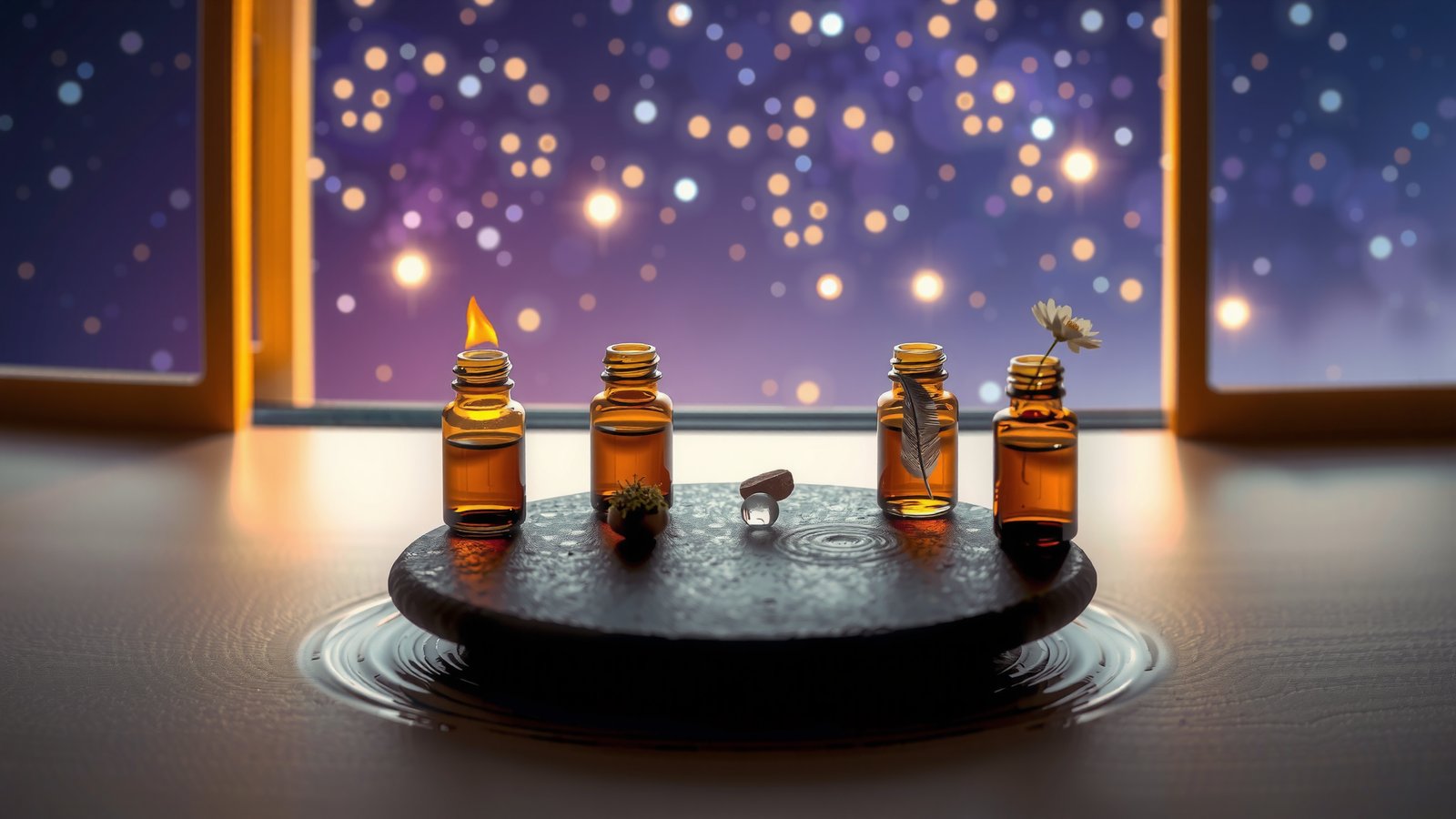
Have you ever stood frozen in front of a shelf of essential oils?
Lavender, bergamot, rose, geranium, peppermint —
they all look good, and each one feels like exactly what you need right now.
So you leave the shelf without choosing anything.
If that sounds familiar, this article offers you a map.
It’s a way of seeing fragrance through four elements: fire, earth, air, and water.
This framework began in ancient Greek natural philosophy, passed through alchemy, and was quietly inherited by modern aromatherapy.
It is not a “scientifically proven effect.”
But it can become a surprisingly practical compass for finding, by intuition, the scent you actually need.
In this guide, we’ll teach you to read that map honestly — separating, as always, what can be said from what cannot.
💎 The one-line key to this article
The four elements aren’t the “scientific identity” of a scent — they’re a poetic question that helps you notice what you’re missing. Fire, earth, air, and water are less a chart of effects than a mirror of your inner state.
✅ The answer, in three lines
The four elements of essential oils is an ancient, practical way of sorting scents by four qualities: fire (warming, activating) / earth (stabilizing, grounding) / air (clarifying, lightening) / water (emotion, softening).
This is not a scientifically validated classification. But since scent genuinely influences mood, it’s an excellent organizing tool for choosing oils based on “the quality I’m currently missing.”
Learn each element’s signature oils, find the element you lack, and welcome one or two of its scents into your life. Your time frozen at the shelf will shrink dramatically.
The 30-Second Summary
- The four elements is an ancient Greek-derived aromatherapy framework that views scent through fire, earth, air, and water.
- Fire oils warm and move — citrus and spices (orange, ginger, black pepper).
- Earth oils root and support — woods and soil scents (vetiver, patchouli, cedarwood, sandalwood).
- Air oils clarify and lighten — herbs and mints (peppermint, eucalyptus, rosemary).
- Water oils flow and soften — florals (rose, geranium, chamomile).
- This is symbolism, not science. This article won’t blur that line.
- Still, scent’s effect on mood and alertness has some research support. A symbolic map can still lead to real experience.
- The heart of it is choosing the element you currently lack — water if you’re burned out, earth if you’re ungrounded.
- Blending across the four elements gives fragrance depth and harmony.
- It is not a substitute for medical care. Scent is a doorway to seeing yourself — not a treatment.
What Are the Four Elements of Essential Oils? A Map of “Quality”
The four elements is a way of sorting oils by four root “qualities”: fire, earth, air, and water.
Which element’s character does each oil most strongly carry? That becomes your clue for choosing.
Broadly:
- Fire: scents that warm, energize, and move you forward
- Earth: scents that settle you down and bring you back to the ground
- Air: scents that clear the head and open airflow
- Water: scents that loosen emotion, let it flow, and moisten
The crucial point: this is not a chemical classification by molecular content.
Even among citruses, some are placed in fire and others closer to water, and the sorting shifts a little between traditions and authors.
In other words, the four elements aren’t chemistry — they’re a map of experience for organizing “how a scent seems to work on you.”
That’s exactly why it helps most not to memorize right answers, but to ask: “Which quality am I missing right now?”
For the wider landscape of aromatherapy, see our Complete Guide to Aromatherapy.
A Brief History — From Ancient Greece to Aromatherapy
The idea of four elements is very old.
Around the 5th century BCE, Greek philosophers held that everything in the world was made of four roots: fire, earth, air, and water.
Empedocles proposed it; Aristotle systematized it.
In time, these elements were linked to the “four humors” that explained human temperament — hot, dry fire for passion; cold, wet water for emotion.
Medieval alchemists treated the four elements as keys to transformation, carrying them into the world of fragrances and herbs.
Then, in the 20th century, as modern aromatherapy was being organized, some practitioners rediscovered this old elemental theory as an intuitive framework for choosing oils.
Let me be honest here.
The four elements did not survive because they were “proven by experiment.”
They are a grand system of metaphor, devised by people who lived before atoms and molecules, to make sense of the world.
But there’s no need to discard it for that reason.
For thousands of years, people have tended themselves by saying “my fire is strong” or “I’m short on water.”
On a level separate from scientific correctness, this map has worked well on the human heart.
That long practical history is the framework’s real résumé.
Is It “Science”? What Can and Cannot Be Said
The core of MuZenCosmos is refusing to blur this line.
⚠️ Unproven / Caution — About the Four Elements Themselves
- Oils do not literally possess physical properties of “fire” or “water.” This is symbolic classification.
- Definitive claims like “fire oils raise your body temperature” or “water oils purify emotion” are not scientifically verified.
- Diagnosing or treating illness by elemental theory is not medicine. If symptoms persist, see a professional — not a scent.
No high-quality clinical study has validated the four-element classification itself.
More accurately than “not yet researched,” it’s that this isn’t the kind of claim science is built to test — much like “the universe is made of four elements.”
🟡 Moderate to Limited Evidence — Scent and Mood
Here, though, the story is different.
- That aroma can influence mood, anxiety, alertness, and a sense of relaxation has been reported across multiple studies.
- Tendencies like citrus lifting mood and lavender leaning toward relaxation have some support.
- So the experience of “fire scents energizing me, water scents calming me” is not merely imagination.
✅ The More Certain Part — The Act of Asking Yourself
The most certain part is the plainest.
The real power of the four elements lies not in the chemistry of scent, but in letting you ask, “What am I missing right now?”
Burned out, you reach for water. Ungrounded, you long for the scent of earth.
That question itself is the first step toward self-understanding.
Scent is only a quiet trigger for turning toward it.
But a good trigger has real value.
Fire Oils — Scents That Warm and Move
Fire is the element of energy, passion, will, and transformation.
When you’re cold, sunken, and can’t summon the drive to begin — fire scents quietly light a flame inside.
Fire oils tend to be warm, spicy, bright, and forward.
Signature fire oils:
- Sweet orange: bright and innocent — the citrus most likely to lift the mood.
- Ginger: warm and strong, for coldness and stagnation.
- Black pepper: spicy and enlivening.
- Cinnamon (use with care at low dilution — strong skin irritant): sweet and warm.
- Rosemary: a crisp, activating scent that puts fire in the head (it carries air’s character too).
You crave fire when your energy has run dry — mornings you can’t get moving, long winters, low spirits.
Two or three drops of sweet orange in the diffuser, and the room’s air turns, just slightly, to face forward.
Earth Oils — Scents That Root and Support
Earth is the element of stability, safety, the body, and the real.
When you’re overthinking, up in your head, and losing your footing — earth scents draw you gently back to the ground.
Earth oils tend to be heavy, deep, and reminiscent of dry soil or wood.
Signature earth oils:
- Vetiver: the scent of damp soil — the deepest, most “earth” grounding note.
- Patchouli: rich and earthy, settling the hips low.
- Cedarwood: the quiet stability of forest and temple.
- Sandalwood: the deep, sweet wood of meditation and prayer.
You need earth when anxiety has you restless and your thoughts spin in place — before a big decision, or during unsettled seasons like a move or a job change.
Rub a drop of diluted earth oil into your wrist and take three slow breaths.
The feeling of “I am here” slowly returns.
To go deeper into woody scents, see our Cedarwood Essential Oil Complete Guide and Sandalwood Essential Oil Complete Guide.
Air Oils — Scents That Clear and Lighten
Air is the element of thought, clarity, communication, and breath.
When your head is foggy, you can’t focus, and the air feels stale — air scents let a breeze through your mind.
Air oils tend to be clear, sharp, and lightly cutting.
Signature air oils:
- Peppermint: cool and sharp, blowing away drowsiness and mental fog.
- Eucalyptus: a clear scent that opens the breath.
- Rosemary: a focusing scent that sharpens the head.
- Tea tree: clean and clear-cutting.
- Lemon: bright and light, clarifying (it also carries fire’s brightness).
Air scents help when you want to focus or switch gears — a heavy-headed afternoon, or thoughts caught in a loop with no ventilation.
One drop of peppermint on a tissue, one deep breath, and your view clears, just a little.
For more on cooling scents, see our Peppermint Essential Oil Complete Guide.
Water Oils — Scents That Flow and Soften
Water is the element of emotion, intuition, connection, and flow.
When you’ve bottled feelings up, gone rigid, and can’t even cry — water scents gently open the heart’s channels.
Water oils tend to be soft, sweet, floral, and enveloping.
Signature water oils:
- Rose: a deep floral of love and tenderness that softly unknots emotion.
- Geranium: a fresh, rose-like scent that restores balance.
- Chamomile: a calm, soothing sweetness.
- Ylang ylang: rich and sensual, loosening feeling.
- Bergamot: a citrus, but soft, that keeps company with low spirits (between water and fire).
You crave water when emotion has hardened and won’t flow — when you’ve pushed too hard and lost track of how you feel, or when connection itself has worn you out.
At night, lights low, two drops of rose or geranium, and the scent loosens the heart like permission to feel.
Scents that keep company with emotion appear in our Rose Essential Oil Complete Guide.
The Four-Element Matrix — The Map of Scent at a Glance
Here is everything so far in a single table.
When you’re lost among scents, come back to this.
| Element | Quality / Keywords | How “lacking it” feels | Signature oils | Scent character |
|---|---|---|---|---|
| Fire 🔥 | energy, passion, momentum | cold, listless, sunken | orange, ginger, black pepper | warm, spicy, bright |
| Earth 🌍 | stability, safety, body | anxious, restless, ungrounded | vetiver, patchouli, cedarwood, sandalwood | heavy, deep, soil & wood |
| Air 🌬️ | clarity, thought, breath | confused, unfocused, stale | peppermint, eucalyptus, rosemary, tea tree | clear, sharp, light |
| Water 💧 | emotion, intuition, flow | rigid feelings, worn by connection | rose, geranium, chamomile, ylang ylang | soft, sweet, floral |
The column worth lingering on is “how lacking it feels.”
Which row is closest to you right now?
That tells you the element you need.
How to Find the Element You’re Missing — Three Questions
That hesitation — “I don’t know which to choose” — unravels with three questions.
Question 1: What’s troubling you most right now?
- No energy → fire
- Unsettled, anxious → earth
- Can’t focus, heavy head → air
- Feelings frozen → water
Question 2: What scent do you find yourself drawn to?
Curiously, people are often drawn to the scent of the element they’re missing.
The exhausted are soothed by florals; the ungrounded are eased by the scent of soil.
Your “somehow I like this” may be a signal from within.
Question 3: Conversely, is any quality too strong right now?
If fire runs so hot you’re near burnout, cool it with water.
If you overthink (excess air), settle it with earth.
Not only adding, but restoring balance — that too is how the four elements work.
To understand your constitution through an Eastern / Ayurvedic lens, our Ayurveda Dosha Quiz is a close cousin — another “map for tuning yourself.”
Blending by the Four Elements — Giving Fragrance Dimension
A single element is plenty, but combining several gives scent depth and harmony.
As in nature, fragrance is richest when multiple qualities resonate together.
Example element blends:
- Morning vitality (fire + air): 3 drops sweet orange + 1 drop peppermint. Warmth and clarity.
- Grounding (earth + water): 2 drops cedarwood + 2 drops geranium. Stability, and emotional softening.
- Balance (all four): 1 drop orange (fire) + 1 drop cedarwood (earth) + 1 drop rosemary (air) + 1 drop bergamot (water). Whole-system harmony.
The knack: make the element you lack the lead, and keep the excess elements quiet.
The fundamentals of blending — top, middle, and base notes — are in our Aromatherapy Blending Fundamentals.
Layer the element view over the note view, and your own signature scent becomes much easier to build.
Safety and Dilution for the Four Elements
To enjoy scent, hold to a few basic lines.
- Always dilute. For skin, aim for 1–2% on the body and 0.5–1% on the face. Never apply neat oil directly.
- Take special care with fire scents. Spice oils like cinnamon, ginger, and black pepper irritate skin strongly. Start low.
- Citrus phototoxicity. Some citruses (bergamot, lemon) can cause pigmentation if applied to skin then exposed to UV (furocoumarins). Avoid daytime skin use, or choose phototoxicity-free products.
- Patch test. Especially for sensitive skin — watch the inner forearm for about 24 hours first.
- Do not ingest. Never take essential oils internally without professional guidance.
- Pregnancy, breastfeeding, chronic conditions, infants: consult a doctor or professional first.
- Homes with cats: take care with diffusion (cats are thought to metabolize essential oils poorly).
- Scent is not a substitute for medical care. If serious symptoms persist, see a professional — not a scent.
Selection Checklist — Finding the Right Oil for Your Element (5 Points)
To pick the one oil that fits your element from among so many, check these five.
- Decide the element you’re missing first. Before choosing by name, settle on which of fire/earth/air/water you lack — then you won’t freeze at the shelf. The matrix table above is your map.
- Is the botanical name stated? Not just “rosemary” but
Rosmarinus officinalis. The same common name shifts in scent by species and origin. - Does it say “100% pure essential oil”? “Aroma oil” or “fragrance oil” may be synthetic. To feel an element’s quality, choose a true essential oil.
- Put “do I find this pleasant?” first. More than the logic of elements, whether your nose says “I like this” comes first — because the scent that pulls you is often a signal of the element you’re missing.
- Does it avoid definitive claims? A product that promises “cures for certain” or “purification” gives you reason to doubt its honesty. Choose modest, truthful makers.
This article does not guarantee any medical or health benefit and is not a substitute for professional medical care. If you have any health concerns, please consult a physician or other qualified professional.
📚 Related Articles
- Sandalwood Essential Oil: Complete Guide to Benefits, Uses & the Science Behind Meditation (With Buying Checklist)
- The Complete Guide to Holistic Wellness for Men | Aligning Body and Mind With Your Daily Rhythm
- The Complete Guide to Women’s Holistic Wellness | Living in Harmony with Your Hormonal Rhythm
- The Ultimate Self-Care Routine: 30 Minutes (Morning + Night) to Reset Your Mind and Body
FAQ (10 Questions)
Q1. Are the four elements scientifically correct?
They are not a scientifically validated classification. The four elements is an ancient Greek-derived symbolic idea; oils don’t physically possess “fire” or “water.” But since scent influences mood, it works as a practical organizing tool for finding “the quality you lack.”
Q2. Which element’s oil should I start with?
Start from what’s troubling you most. No energy → fire (orange). Unsettled → earth (cedarwood). Can’t focus → air (peppermint). Feelings frozen → water (geranium). One bottle is enough to begin.
Q3. Why is the same oil sorted into different elements in different books?
Because the four elements isn’t a scientific definition — the sorting shifts by author and tradition. Citrus lands in both “fire (brightness)” and “water (softness).” Rather than memorizing answers, honor how you yourself experience the scent.
Q4. Is the scent I’m drawn to the element I’m missing?
Many people find so. The exhausted are soothed by florals (water); the ungrounded are eased by soil scents (earth) — “somehow I like this” is often a signal from within. It’s not absolute, so treat it as one clue.
Q5. Are the four elements the same as Ayurveda or Chinese five phases?
Related in spirit, but different systems. Ayurveda uses five great elements (earth, water, fire, air, ether); Chinese medicine uses five phases (wood, fire, earth, metal, water). This article uses the Western four elements (fire, earth, air, water) common in aromatherapy. All share the idea of “a map for tuning yourself.”
Q6. How many drops when blending?
For a diffuser, aim for 3–6 drops total. Make the lacking element the lead (more drops), the others fewer — e.g., for “earth + water,” 2 drops cedarwood + 2 drops geranium. Start on the lower side.
Q7. Do fire oils raise body temperature?
Not in a physical sense. “Fire” is symbolic classification, meaning warm, spicy scents that psychologically energize. Don’t take it as a definitive effect — enjoy it as “a scent that feels enlivening.”
Q8. Can I apply oils directly to skin?
Avoid neat oil. Always dilute (1–2% body, 0.5–1% face) in a carrier like jojoba. Spicy fire oils irritate strongly, and citrus needs phototoxicity care (UV pigmentation). Patch test first.
Q9. Can the four elements reveal my personality or fate?
It is not fortune-telling. The four elements is a tool for considering “what am I missing right now.” Not diagnosis or prophecy — use it lightly, as a prompt for self-understanding.
Q10. Should I collect all four elements?
Not required. Start with the one or two elements you lack. Once you’re comfortable and want to choose by the day’s mood, keeping one bottle per element gives you a little “tuning bench” of scent.
Closing — Fragrance Is a Mirror of the Self
Fire, earth, air, water.
These four words are not a science that explains what a scent truly is.
But they are a quiet mirror of you.
What am I missing right now?
Am I energized? Am I settled? Is my head clear? Is my heart flowing?
The small act of choosing a scent carries you, gently, toward that question.
The answer is always inside you.
Scent is only the doorway there.
But a good doorway truly helps a person —
just as, for thousands of years, people have tended themselves in the language of fire, earth, air, and water.
Tonight, stand before your shelf.
And instead of by name, ask: “Which quality am I missing right now?”
One scent, surely, will quietly raise its hand.
That is the element you need tonight.
References
- Robert Tisserand & Rodney Young, Essential Oil Safety, 2nd ed., Churchill Livingstone, 2014. (The standard reference on safe dilution, phototoxicity, and use.)
- Salvatore Battaglia, The Complete Guide to Aromatherapy, 3rd ed., Black Pepper Creative, 2018. (A comprehensive treatment of aromatherapy and elemental/energetic views.)
- Gabriel Mojay, Aromatherapy for Healing the Spirit, Healing Arts Press, 2000. (A classic linking Eastern thought and elemental theory to oil selection.)
- Herz RS. “Aromatherapy facts and fictions: a scientific analysis of olfactory effects on mood, physiology and behavior.” International Journal of Neuroscience, 2009;119(2):263–290. (A scientific review of scent’s effects on mood and physiology.)
- G.E.R. Lloyd, Early Greek Science: Thales to Aristotle, W.W. Norton, 1970. (A historical account of ancient Greek natural philosophy, including four-element theory.)
MuZenCosmos — Where the Cosmos Meets Stillness | Fragrance is a mirror of the self