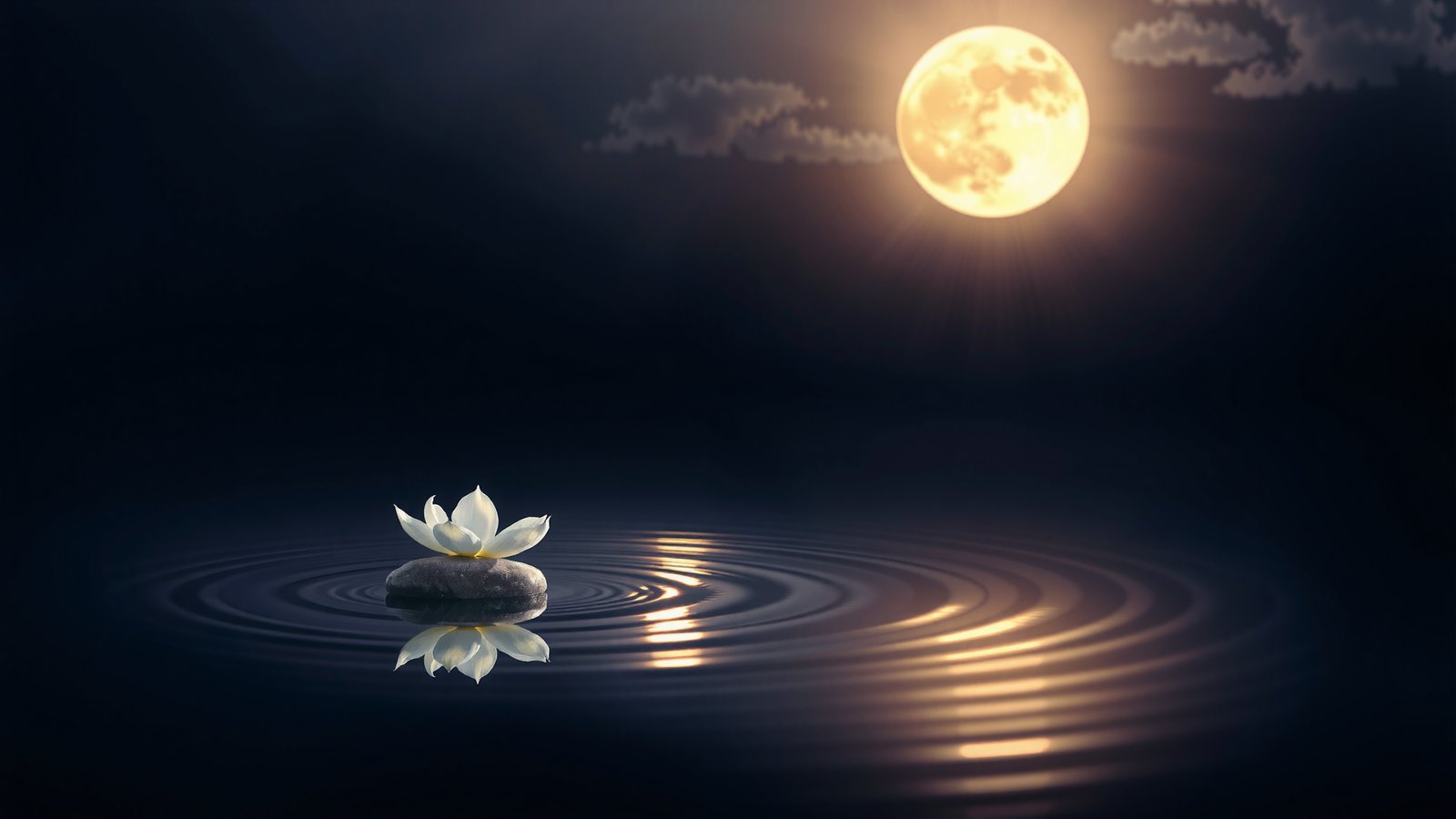
A woman’s body does not live in a straight line.
It lives in a circle.
Filling, waning, filling again.
The same quiet ritual the moon performs in the sky, our bodies trace on the inside.
Yet modern life tends to treat that circle as if it were a line.
“Same output every day.” “Same energy as yesterday.” We are asked for it — and we ask it of ourselves.
That quiet strain slowly accumulates as the “vaguely off” feeling so many women know.
Holistic wellness gently reverses the current.
It looks at the body not as a set of parts, but as one living whole — mind, body, and the deeper self, woven together.
And above all, it means not fighting the rhythm your body already carries, but leaning into it.
This article is a quiet map for exactly that.
💎 The one-line heart of this article
Women’s wellness isn’t about keeping every day identical — it’s about honoring a changing rhythm. Adapting your care to your cycle and life stage: that is the heart of holistic living.
✅ The answer, in three lines
Women’s holistic wellness means not resisting the “lunar rhythm” your hormones trace, but adapting your care to each phase of the cycle.
Picture the menstrual cycle as four seasons — menstruation (winter), follicular (spring), ovulation (summer), luteal (autumn) — and alternate between seasons to rest and seasons to act.
Build on the strong evidence of sleep, breath, food, and movement, and enjoy scent and crystals as gentle “additions.” That is the honest, sustainable design.
The 30-Second Summary
- A woman’s body carries an ~monthly hormonal rhythm. The very idea of staying identical every day can itself become a source of imbalance.
- The menstrual cycle divides into four phases (menstrual, follicular, ovulatory, luteal), each asking for different care.
- Holistic means never separating body, mind, lifestyle, and environment — tending them as one connected whole.
- With each life stage (adolescence, maturity, menopause), what the body asks for quietly changes.
- The foundation is the strong evidence of sleep, food, breath, movement. Scent, crystals, and frequencies are enjoyed as “additions.”
- Keeping the body warm is wisdom especially treasured in women’s self-care.
- Any real symptom should first be brought to medical care. Holistic wellness is not a replacement for medicine, but a companion to daily life.
What Women’s Holistic Wellness Means | Seeing Connection, Not Parts
The word holistic comes from the Greek holos — “whole.”
Rather than isolating a symptom as “a problem in that one part,” it looks at the whole: body, mind, lifestyle, relationships, even environment.
Take “irritability before a period.”
Do we treat it only as “a mood problem”? Or as one connected picture that includes sleep, nutrition, hormones, stress, and even how much light you receive?
Stand in the second view, and the options multiply.
And for women, at the center of that “whole” sits the hormonal rhythm that turns roughly once a month.
Making that rhythm an ally rather than an enemy — that is the starting point of women’s holistic wellness.
Please note: this article does not diagnose or treat any specific condition.
When symptoms are distressing, reaching out to gynecological or other medical care first is the most important self-care of all.
The “Lunar Rhythm” Within | Hormones and the Nervous System
In a woman’s body, two hormones — estrogen and progesterone — wax and wane across roughly one month.
Estrogen tends to lift the mind and body toward activity.
Progesterone tends to protect, turn inward, and invite rest.
As these two waves cross, they quietly move your mood, temperature, appetite, sleep, even the condition of your skin.
Which is why —
“I felt great yesterday, but today I don’t want to do anything.”
Even a day like that is not weakness of will.
More often, it is your body honestly keeping its rhythm.
The relationship between this lunar turning and daily life is explored in depth in The Complete Guide to Living with the Moon’s Rhythm.
The Four Phases of the Cycle | Living Your Inner Seasons
In holistic circles, the menstrual cycle is often likened to “inner seasons.”
Sleeping in winter, budding in spring, blooming in summer, harvesting in autumn — that turning, repeated within the body.
First, let’s see the whole in a single table.
Four Cycle Phases × Self-Care Comparison
| Phase | Inner season | Tendency | Care that fits | Best avoided |
|---|---|---|---|---|
| Menstrual (days 1–5) | Winter | Inward, easily tired | Rest, warmth, gentle stretching | Overpacking your schedule |
| Follicular (days 6–13) | Spring | Rising, light | New challenges, exercise, planning | Doing nothing at all |
| Ovulatory (~day 14) | Summer | Most outward, social | Meeting people, speaking up, big decisions | Carrying it all alone |
| Luteal (days 15–28) | Autumn | Turning inward, wavering | Tidying, letting go, staying warm | Perfectionism, overcommitment |
Day ranges are approximate. Cycle length varies greatly from person to person.
The point of this table: stop trying to be “the same self” all the time.
Move fully in the seasons when you can move; nest quietly in the seasons that ask you to.
That honest alternation is the spine of women’s holistic care.
Care by Phase | Seasons to Rest, Seasons to Act
Let’s unfold the table into softer language.
Menstrual (Winter) | Put Yourself First, and Nest
Energy turns inward.
Make warmth the priority — don’t let your belly, lower back, or ankles get cold.
Slow breathing and gentle stretching feel far kinder than intense exercise.
It’s also the season to practice giving yourself permission: “Today, it’s okay to rest.”
Follicular (Spring) | Begin New Things
Estrogen rises; mind and body grow lighter.
This is the season best suited to starting new habits and challenges.
Raise your exercise intensity, take on what you’d been putting off.
Use the tailwind of energy without hesitation.
Ovulatory (Summer) | Bloom and Connect
The peak. Sociability rises, and words come more easily.
A fitting time to meet people, share, have the important conversations.
Just remember: bloom too hard, and fatigue can follow. A quiet awareness of not overdoing the summer sun helps.
Luteal (Autumn) | Tidy, and Let Go
Progesterone dominates, and moods waver more.
This is the season when PMS (premenstrual syndrome) is most likely.
Lighten your schedule; layer on warmth and sleep.
Instead of counting “what you couldn’t do,” turn toward “what you can release,” and the heart grows lighter.
For the irritability and low moods of the luteal phase, the perspective in The Science of Stress and the Nervous System can help.
Care Across Life Stages | From Adolescence to Menopause
A woman’s body travels not only the “small circle” of the cycle, but also a “great circle” spanning a lifetime.
- Adolescence & 20s: Cycles are still settling. Crash diets and lost sleep easily disturb the rhythm. The season to grow foundational habits.
- Maturity & 30s–40s: Work, home, and caregiving overlap, and the self gets pushed aside. Deliberately protecting “time for yourself” becomes the greatest care.
- Menopause & late 40s onward: The season of change as estrogen falls sharply. Hot flashes, insomnia, mood shifts may arise. Tend breath, sleep, warmth, and connection with care — and when it’s hard, don’t hesitate to lean on medicine.
Menopause is not an “ending,” but a season in which the circle is redrawn into a new shape.
Many cultures around the world see it as a time of freeing oneself from social roles and returning to one’s own self.
Women’s Stress and the Nervous System | Unknotting the Overdoing
Much of women’s imbalance arises at the crossroads of hormones and the autonomic nervous system.
Modern women often carry many roles at once, leaving the sympathetic nervous system (activity mode) stuck “on.”
What helps here is holding a conscious “switch for calming.”
- Lengthen the exhale (inhale 4, exhale 8) to shift toward the parasympathetic
- Drink something warm, soak in a bath to soften from the core
- Protect five minutes a day of producing nothing, without guilt
For breath-based ways to settle, The Complete Introduction to Yoga & Breathing (Pranayama) is practical.
Resting is not slacking.
It is a legitimate preparation for meeting the next cycle in good health.
Balancing with Scent | Aromatherapy for Women
Smell is one of the few senses that reaches emotion and the nervous system directly, without passing through thought.
That’s exactly why scent can be a tool that leans gently into the waves of the cycle.
- Menstrual (winter): rounded scents like geranium or clary sage, for a sense of warmth
- Follicular & ovulatory (spring–summer): bright, opening scents like bergamot or citrus, to lift the mood
- Luteal (autumn): calming scents like lavender or neroli, to soften the wavering
But essential oils carry cautions too.
If you are pregnant or have a medical condition, always consult a doctor or professional.
Follow the basics, too — never apply undiluted oil directly to skin.
How to choose scents and use them safely is covered in detail in The Complete Guide to Aromatherapy.
Crystals, Sound, Food | Enjoying the “Additions” Well
On top of the foundational care (sleep, food, breath, movement), adding elements that heighten comfort makes self-care far easier to sustain.
Crystals are not scientifically proven to produce effects.
Yet as a quiet switch of intention — “today, I care for myself” — they can serve. Rose quartz and moonstone have long been cherished in women’s self-care.
Sound and frequencies, too, vary by individual. Nothing can be asserted, but time wrapped in quiet sound can itself become a signal to rest.
For food, there is plain, time-worn wisdom to sync with the cycle:
- During menstruation, favor iron (foods that support circulation)
- Throughout, treasure warming foods
- In the luteal phase, avoid blood-sugar spikes (snack in small amounts)
More than flashy supplements, a warm, plain, sustainable table is your greatest ally.
Drawing the Evidence Line | The Integrity of Honesty
In women’s wellness, the reliable and the unreliable are mixed together.
MuZenCosmos values drawing that line honestly.
| Method | Main action | Strength of evidence |
|---|---|---|
| Sufficient sleep | Regulating hormones & nervous system | Strong |
| Balanced diet & warmth | Foundation for wellbeing & circulation | Strong |
| Breathwork & moderate exercise | Reducing the stress response | Strong to moderate |
| Aromatherapy | Supporting mood & relaxation | Moderate |
| Crystals & specific frequencies | Comfort & intention-setting | Weak to unproven (subjective, varies) |
Place sleep, food, breath, and movement — with their strong evidence — at the foundation.
Enjoy scent, crystals, and frequencies as small flowers blooming on top.
As long as you keep this order, holistic wellness is not “something suspect,” but honest wisdom that supports daily life.
For a wider integrating view, see Complete Holistic Wellness Integration.
A Checklist for Choosing Self-Care Tools That Fit You
When choosing tools like scents or crystals, these five questions untie the hesitation.
- [ ] ① Which phase of the cycle am I in now? Winter (menstrual) calls for calming and warmth; spring–summer (follicular/ovulatory) for bright, opening scents — choose what fits the current season.
- [ ] ② Is the labeling honest? For oils, check the botanical name, country of origin, and extraction method. Step back from products that overclaim benefits.
- [ ] ③ Can I use it safely? If pregnant, nursing, or managing a condition, always confirm suitability. Consult a professional about combining with medical care.
- [ ] ④ Which sense does it fill? Rather than a sense already satisfied, choose what fills the sense you lack — scent, warmth, quiet.
- [ ] ⑤ Can I sustain the price without guilt? Over a costly full set, choose the affordable thing you’ll reach for daily.
Tools are not the star — they are the spark.
Please never forget: your breath, and the time you spend listening to your body, are the greatest tools of all.
This article does not guarantee any medical or health benefit and is not a substitute for professional medical care. If you have any health concerns, please consult a physician or other qualified professional.
📚 Related Articles
- The Ultimate Self-Care Routine: 30 Minutes (Morning + Night) to Reset Your Mind and Body
- Crystal Selection: Complete Guide from Beginner to Advanced
- Bergamot Essential Oil: Complete Guide to the Science of Depression & Anxiety
- Lemon Essential Oil: Complete Guide to the King of Citrus
FAQ (10 Common Questions)
Does women’s holistic wellness replace medical care?
No, it does not. Holistic wellness is complementary care that supports daily wellbeing. When you have pain, strong symptoms, or lingering issues, connecting with gynecological or other medical care comes first.
I always get irritable before my period. Is that abnormal?
It’s a natural variation many women experience, and not abnormal in itself. But if it’s strong enough to disrupt daily life (as in PMDD), medical support can bring significant relief. Don’t just endure it — reach out.
My cycle is irregular and I can’t tell which phase I’m in.
Start simply by recording your period dates or basal temperature in an app or planner. The act of recording is itself the first step to knowing your rhythm. If irregularity persists, a gynecologist is worth consulting.
Do aromatherapy and crystals really work?
Scent has moderate evidence for supporting mood and relaxation. Crystals and specific frequencies remain largely unproven scientifically, and experience varies. Keep sleep, food, and breath as the foundation, and enjoy these as “comforting additions” — that’s the honest approach.
I’m too busy to sync with my cycle.
You don’t need to sync everything. Just lightening your schedule in the luteal phase (before your period) already eases the body considerably. Begin with one phase.
Why is “keeping warm” so important for women?
Cold slows circulation and is often a backdrop to various forms of imbalance — a view held in both traditional Eastern medicine and modern perspectives. Simply keeping the belly, lower back, and ankles warm helps many people feel lighter.
I’m afraid of menopause. How should I face it?
Menopause is not an ending, but a season in which the body shifts to a new rhythm. Tend breath, sleep, warmth, and connection with care — and distressing symptoms can often be greatly eased with medicine (such as hormone therapy). Please don’t carry it alone.
I’m on the pill. Can I still do holistic care?
Yes, you can. But while on the pill, the natural phases shift, so the “inner seasons” framework fits less directly. Center your care on the foundations — sleep, food, breath, and scent. Check with a professional before combining essential oils, just in case.
How can I help my partner or family understand?
One idea is to show them the four-phase table in this article, framing it as “body rhythm,” not “moodiness.” A visible map makes it much easier for those around you to offer concrete support.
I don’t know where to start.
Simply recording your cycle and mood for one month is enough. Once your waves come into view, add one “rest plan” to your hardest phase. Holistic care begins quietly, from that small step.
In Closing | Don’t Try to Straighten the Circle
A woman’s body lives in a circle.
There are days of fullness, and days of waning.
Seasons to bloom, and seasons to nest.
It is precisely when we try to stretch that circle into a straight line that the body grows most tired.
Holistic wellness is not a difficult technique.
It is noticing your own rhythm — and, rather than resisting, leaning in.
On days you can move, move without hesitation.
On days you long to nest, nest with a full heart.
And allow yourself to see that not as “weakness,” but as “wisdom.”
Tonight, before you sleep, open your planner gently and note where you stand in your “inner seasons” today.
That single line becomes the beginning of a new conversation between you and your body.
Your circle is not broken.
You are simply in the quiet middle — on the way to filling again.
References
- Vitti, A. (2020). In the FLO: Unlock Your Hormonal Advantage and Revolutionize Your Life. HarperOne.
- Northrup, C. (2020). Women’s Bodies, Women’s Wisdom (Revised ed.). Bantam.
- Hendrickson-Jack, L. (2019). The Fifth Vital Sign: Master Your Cycles & Optimize Your Fertility. Fertility Friday Publishing.
- World Health Organization. (2022). WHO guideline on self-care interventions for health and well-being. WHO Press.
- Zaccaro, A., et al. (2018). How Breath-Control Can Change Your Life: A Systematic Review on Psycho-Physiological Correlates of Slow Breathing. Frontiers in Human Neuroscience, 12, 353.
MuZenCosmos — where the cosmos meets stillness | Honoring the lunar rhythm your body keeps