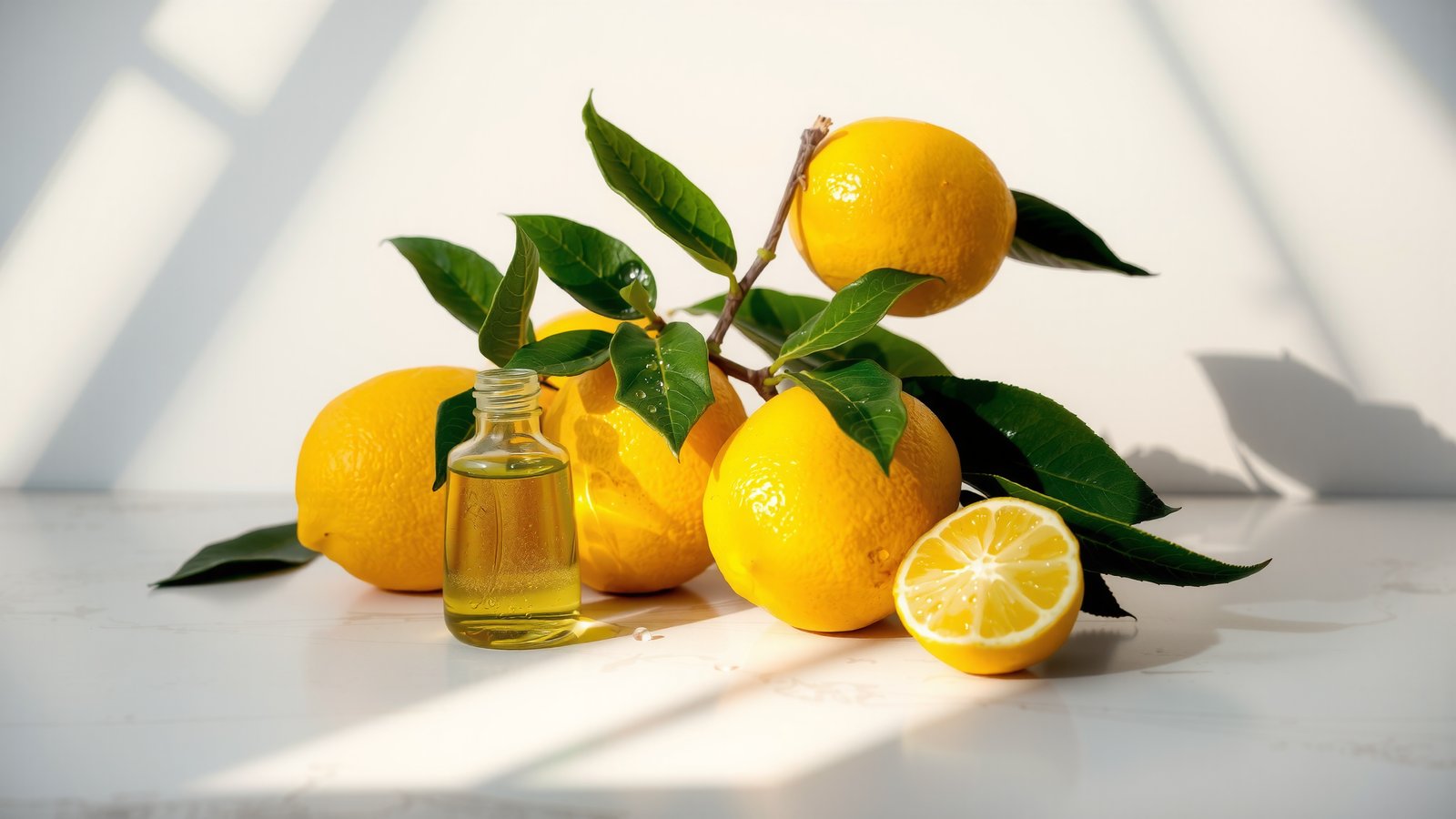
“What’s the best-selling essential oil in the world?“
Lavender? Peppermint?
Actually — it’s lemon.
The most heavily consumed citrus essential oil
across homes, hotels, offices, restaurants worldwide.
Three reasons:
- Affordable (among the cheapest)
- Versatile (broad applications)
- Fail-safe (universally liked scent)
3 drops in the morning diffuser
brightens the whole house.
1 sniff when focusing
clears the head.
10 drops in a cleaning spray
= antimicrobial + great scent.
No other essential oil is this accessible yet deep.
💎 Key takeaway
Lemon = “the most cost-effective universal oil.” 15 USD per bottle changes morning mood and clears the head.
30-second summary
- Main compound: limonene (60–80%)
- Triple crown: focus, mood, antimicrobial
- Used as food flavoring for 100+ years
- Price: 9–20 USD per 10ml (cheapest tier)
- Photosensitive (no sun for 12hr after skin application)
- Main origin: Italy, California
- Use within 6 months (oxidation)
- Pet caution (cat = no)
1. What is lemon essential oil?
1-1. Basics
| Item | Detail |
|---|---|
| Latin name | Citrus limon |
| Common name | Yellow lemon |
| Plant part | Peel (not juice) |
| Extraction | Cold-pressed (not distilled) |
| Origin | Italy, California, Spain |
| Scent | Fresh, sharp, bright |
1-2. The peel is the treasure
- Only a few drops per lemon
- Peel oil sacs concentrated
- Just press by machine
- Hence “cold-pressed“
1-3. Pressed vs distilled
| Item | Cold-pressed | Distilled |
|---|---|---|
| Scent | Real lemon | Slight change |
| Photosensitivity | Yes | No |
| Market share | Dominant | Some |
→ 95%+ of market is cold-pressed.
1-4. Citrus family
- Lemon: sharp, bright
- Orange: sweet, gentle
- Grapefruit: slight bitter, light
- Bergamot: refined, complex
- Mandarin: sweet, gentle
- Yuzu: Japanese citrus
- Lime: stimulating, fresh
→ Lemon = “citrus standard.“
2. History — 100+ years of trust
2-1. Ancient and medieval
- Ancient Egypt: preservative, scent
- Ancient Rome: as medicine
- Arab world (10th c.): widely cultivated
2-2. Age of exploration
- Scurvy prevention with lemon juice
- British Navy adopted lime
- Origin of “Limey” (British nickname)
2-3. Perfume industry (17–18th c.)
- Sicily begins cultivation
- Eau de Cologne centerpiece
- Top note standard
2-4. Food industry (19–20th c.)
- Coca-Cola etc. flavoring
- Largest-scale food additive
- World production 5,000+ tons/year
2-5. Aromatherapy (late 20th c.)
- Reevaluated for focus/mood
- Office and hotel use
- “World’s bestselling EO“
2-6. Modern (2020s)
- Pandemic boost as antimicrobial
- Remote worker focus aid
- Organic certification standard
3. Chemistry — power of limonene
3-1. Main components
| Compound | Content | Action |
|---|---|---|
| d-Limonene | 60–80% | Antimicrobial, focus, mood |
| β-Pinene | 7–17% | Anti-inflammatory |
| γ-Terpinene | 6–13% | Antioxidant |
| Citral | 1–5% | Strong scent |
| Furocoumarins | 0.3–2% | Photosensitivity |
3-2. Science of d-limonene
Focus/memory:
– β waves increase in EEG
– Memory test improvements
Mood:
– Dopamine increase
– Antidepressant research
– “Smile molecule“
Antimicrobial:
– Both Gram-positive and negative
– Also molds/yeasts
Digestion:
– Stomach acid control
– Bile secretion
3-3. Furocoumarins (photosensitivity cause)
- Bergapten, ethoxypsoralen
- React with UV → skin damage
- No sun for 12 hours after application
- “FCF (furocoumarin-free)” products exist
4. Scientific effects
4-1. ✅ Strong evidence: focus
2008 Japanese research:
– Office diffusion of lemon oil
– 54% reduction in typing errors
– 33% fewer calculation errors
2008 UK research:
– Students + lemon scent
– Significant test improvement
→ Major ally for remote workers
4-2. ✅ Strong evidence: mood/anti-anxiety
2006 Ohio State University:
– Lemon EO inhalation → cortisol decrease
– Norepinephrine increase
– Objectively proven “mood lifting“
4-3. ✅ Strong evidence: antimicrobial
Multiple studies:
– S. aureus, E. coli
– Effective against MRSA
– In vitro results
4-4. ✅ Moderate evidence: nausea
- Pregnancy morning sickness relief
- Post-chemotherapy nausea
- Effective by inhalation alone
4-5. ✅ Moderate evidence: digestion
- Appetite regulation
- Post-meal bile secretion
- Bloating relief
4-6. ✅ Moderate evidence: weight management
- Appetite control (olfactory)
- Limonene’s lipid metabolism boost
- Not a solo weight-loss tool
4-7. ⚠️ Partial: antiviral
- Effective in vitro against influenza
- Clinical application researched
5. Usage by purpose
5-1. Focus (remote work)
Desk diffuser
– Lemon 3 drops
– At workday start
– Effect: 2–3 hours
Aroma pendant
– Lemon 1 drop
– For focus moments, deep breath
5-2. Morning mood
Bedside diffuser
– Lemon 3 drops + orange 2 drops
– Sub for alarm clock
– Timer 30 min before waking
Shower spray
– 90ml water + 10ml ethanol + lemon 15 drops
5-3. Antimicrobial / deodorizing
Household cleaner
– 500ml water + 1 tbsp baking soda + lemon 20 drops
– Kitchen, bathroom, sink
Fridge deodorizer
– Drop 5 drops on baking soda in container
– Lasts 1 month
Laundry
– 3–5 drops instead of fabric softener
– Fresh clothes
5-4. Kitchen
Dish soap
– Add 3 drops
– Better grease cutting
Cutting board sanitizer
– Diluted lemon EO spray
– Antimicrobial + scent-free
5-5. Skincare (caution)
- ⚠️ Night only (photosensitivity)
- No sun for 12 hours
Acne care
– Jojoba 10ml + lemon 3 drops
– Night only
– Wash off next morning
5-6. Cold prevention
Steam inhalation
– 500ml hot water + 2 drops
– 5-min inhalation
Diffuser
– Whole room 3–5 drops
5-7. Kids’ study support
- Diffuser during study: 2 drops
- Focus boost
- Age 2+
6. Safe dilution and photosensitivity
6-1. By age
| Group | Max dilution | Notes |
|---|---|---|
| Adult (body) | 2–3% | Night only on skin |
| Adult (face) | 0.5–1% | Night only |
| Elderly | 0.5–1% | Night only |
| Pregnancy | 1%, with doctor | Relatively safe |
| 6–12 | 0.5–1% | Diffuser preferred |
| 2–6 | Diffuser only | Below 0.5% |
| Under 2 | Not recommended |
6-2. Photosensitivity is serious
12-hour rule:
– No sun for 12 hours after skin contact
– UV causes burn-like skin reaction
– Can leave pigmentation
Mitigation:
– Night-only application
– Wash off next morning
– Choose “FCF” lemon
6-3. Photosensitivity-free uses
- ✅ Diffuser (inhalation only)
- ✅ Sniffing
- ✅ Cleaning (no prolonged skin contact)
- ✅ Mouthwash (rinse + spit)
6-4. Other cautions
- Oxidation-sensitive: use within 6 months
- Cat = contraindicated, dog with caution
- Store cool and dark
7. Top 3 blends
7-1. Focus blend
Diffuser: lemon 3 + peppermint 2 + rosemary 1 drops
→ Desk work
7-2. Morning mood blend
Diffuser: lemon 3 + orange 2 + bergamot 1 drops
→ From waking to breakfast
7-3. All-purpose household spray
90ml water + 10ml ethanol: lemon 20 + tea tree 15 + eucalyptus 10 drops
→ Whole-house antimicrobial
8. Why lemon is the “most cost-effective” oil
8-1. Price
- 10ml: 9–20 USD
- Per drop: ~0.02–0.05 USD
- 1/3 of lavender, 1/100 of rose
8-2. Usage frequency
- Daily use
- Diffuser easy
- Household chores
8-3. Failure rate
- Almost no one dislikes it
- Kids enjoy it
- Safe with guests
8-4. Complementarity
- Pairs well with others
- Blending bridge
- Lead or supporting role
→ Best choice for 3rd essential oil for beginners.
10. FAQ
Q1. Same as squeezing lemons?
A. No. Juice is different. Only peel oil = essential oil. Different scent too.
Q2. Use food-grade lemon peel?
A. Scent exists, but EO concentration is weak. OK for cooking, but for aromatherapy use the EO.
Q3. Photosensitivity is really scary?
A. Yes. Dermatologists treat burns from this. Strict adherence to the 12-hour rule.
Q4. Diffuser is OK for photosensitivity?
A. Yes. Unrelated when not on skin.
Q5. Organic better?
A. Strongly recommended. Citrus has significant pesticide residue issues.
Q6. Expired lemon EO?
A. High oxidation risk. Source of skin irritation. Discard and get fresh.
Q7. Pregnancy OK?
A. Relatively safe. Many studies on nausea relief. Below 1%.
Q8. Use for kids studying?
A. 6+, diffuser only. Experimental data on learning improvement exists.
Q9. Difference from orange?
A. Lemon = sharp, focus, orange = sweet, relax. Different roles.
Q10. Pet effects?
A. Cat = contraindicated (can’t metabolize limonene). Dog: low concentration. Birds: caution.
11. Closing — the reason it’s the bestseller
Why is lemon the bestselling essential oil?
Because — it’s the “doesn’t fail” essential oil.
- Scent is liked
- Effect is felt easily
- Price is affordable
- Use is broad
- Few side effects (besides photosensitivity)
Not 100/100, but a reliable 80/100.
If you keep getting 80 every day,
life definitely changes.
Morning: diffuser on, wake to lemon.
Work: 3 drops at desk.
Cleaning: 10 drops in spray.
Night: hand off to other oils.
Such days,
repeated for a year = 365 × focus boost
= massive productivity leverage.
Buy a 12 USD bottle of lemon tomorrow
at a drugstore or specialty shop.
“1 minute of daily self-investment“
becomes “1 year of life leverage” —
the most modest, most certain
entry to natural medicine.
References
- Kiecolt-Glaser, J. K. et al. (2008). “Olfactory influences on mood and autonomic, endocrine, and immune function.” Psychoneuroendocrinology.
- Akpinar, B. (2005). “The role of aromatherapy on workplace performance.” International Journal of Aromatherapy.
- Komiya, M. et al. (2006). “Lemon oil vapor causes an anti-stress effect via modulating the 5-HT and DA activities in mice.” Behavioural Brain Research.
- Tisserand, R. & Young, R. (2014). Essential Oil Safety (2nd ed.). Churchill Livingstone.
- Battaglia, S. (2003). The Complete Guide to Aromatherapy.
MuZenCosmos — Where cosmos meets silence | The world’s most beloved yellow fruit
This article does not guarantee any medical or health benefit and is not a substitute for professional medical care. If you have any health concerns, please consult a physician or other qualified professional.