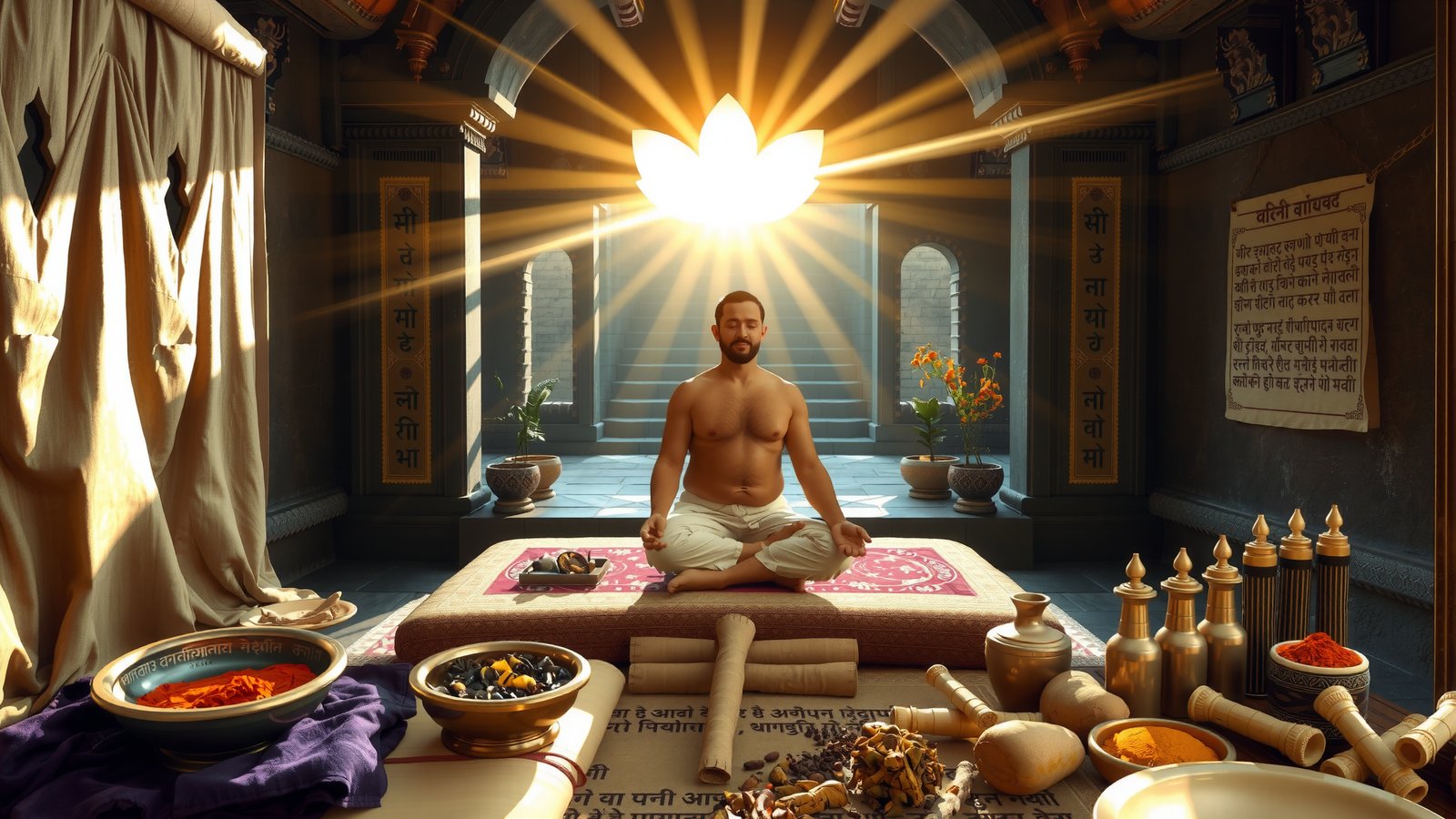
“Why do people react differently to the same food?“
“I want to know my optimal life rhythm.“
“I want to address my health at its root.“
Ayurveda answers these.
Ayur = life, Veda = knowledge.
So: “knowledge of life.”
A 5,000-year-old Indian traditional medicine, WHO-recognized.
Alongside TCM, one of the world’s two great traditional medicines. In India today, Ayurvedic doctors (BAMS) hold national licenses.
Ayurveda’s defining feature:
“One-size-fits-all health doesn’t exist“
Your dosha (constitution) determines your optimal diet, exercise, and lifestyle — an individualizing philosophy.
This article fully explains Ayurveda’s foundations and practice.
By the end you’ll know which of the three doshas you’re reading this as — and why that changes almost everything downstream.
💎 The One-Line Takeaway
“What suits you” differs from others. Ayurveda is 5,000-year wisdom for knowing your dosha and designing constitution-appropriate living.
30-Second Summary
- Ayurveda = Indian traditional medicine (5,000 years)
- 3 doshas: Vata, Pitta, Kapha
- Premise: no universal health method exists
- Constitution-specific diet, exercise, rhythm
- Practices like Abhyanga (oil massage)
- Sister science to yoga
- WHO-recognized complementary medicine
1. What Ayurveda Is
1-1. Origin and History
- Developed from 3,000 BCE
- Rooted in Vedas (ancient Indian scriptures)
- Systematized by Agnivesha, Charaka, Sushruta
- Charaka Samhita (~2nd century) is the oldest medical text
1-2. Differences From TCM
| Item | Ayurveda | TCM |
|---|---|---|
| Origin | India | China |
| Basic elements | 5 elements → 3 doshas | 5 phases → Yin-Yang |
| Constitution | Doshas | 9 types |
| Treatment | Diet, herbs, oil | Acupuncture, herbs, qigong |
| Philosophy | Vedic | Taoist |
1-3. Today’s Ayurveda
- Part of India’s national medical system
- WHO-recognized traditional medicine
- Globally noted as integrative medicine
- Many Ayurvedic salons in Japan
2. Five Elements (Pancha Mahabhuta)
The universe and all existence consist of 5 elements:
| Element | Quality | Example |
|---|---|---|
| Space (Akasha) | Space | Body cavities |
| Air (Vayu) | Movement | Breath, circulation |
| Fire (Tejas) | Transformation | Digestion, metabolism |
| Water (Jala) | Fluidity | Blood, body fluids |
| Earth (Prithvi) | Solidity | Bones, muscle |
These combine to form the 3 doshas.
3. The Three Doshas
3-1. Vata (Air-Space)
Principle of movement and nervous system.
Physical traits:
– Thin, bony
– Dry skin
– Thin, dry hair
– Joint cracking
– Cold extremities
Mental traits:
– Creative, imaginative
– Quick thinking
– Loves change
– Irregular
– Worrier, anxious
Balanced:
– Energetic, creative
– Highly adaptable
Imbalanced:
– Anxiety, insomnia
– Constipation, gas
– Joint pain
– Poor focus
3-2. Pitta (Fire-Water)
Principle of transformation and metabolism.
Physical traits:
– Medium build, muscular
– Reddish, sensitive skin
– Thin hair, early graying/balding
– Higher body heat
– Strong appetite
Mental traits:
– Intellectual, logical
– Leadership
– Competitive
– Perfectionist
– Quick to anger
Balanced:
– Clear, decisive
– Efficient
Imbalanced:
– Anger, irritability
– Hyperacidity, ulcers
– Skin conditions, acne
– Burnout
3-3. Kapha (Earth-Water)
Principle of structure and stability.
Physical traits:
– Sturdy, weight gain prone
– Smooth, moist skin
– Thick, abundant hair
– High endurance
– Slow movements
Mental traits:
– Calm, gentle
– Loyal, devoted
– Stability-seeking
– Slow learner but doesn’t forget
– Dislikes change
Balanced:
– Peaceful, content
– Strong love
Imbalanced:
– Depression, lethargy
– Weight gain
– Congestion, phlegm
– Attachment
4. Dosha Types
4-1. Single Dosha
- Pure Vata
- Pure Pitta
- Pure Kapha
Minority (~20%)
4-2. Dual Dosha (Most Common)
- Vata-Pitta
- Pitta-Kapha
- Vata-Kapha
In traditional Ayurvedic teaching, this is considered the most common pattern.
4-3. Tri-Doshic
All three balanced:
- Rare (5-10%)
- Healthy constitution
4-4. Prakriti vs Vikriti
- Prakriti: birth dosha balance (unchanging)
- Vikriti: current balance (changes)
Health = returning to Prakriti.
5. Dosha Diagnosis
5-1. Self-Check
Choose your best match in each category:
Body Type
- A: Thin, bony → Vata
- B: Medium build, muscular → Pitta
- C: Weight-gain prone, sturdy → Kapha
Skin
- A: Dry, thin → Vata
- B: Reddish, sensitive → Pitta
- C: Smooth, moist → Kapha
Appetite
- A: Irregular → Vata
- B: Strong → Pitta
- C: Regular, slow → Kapha
Personality
- A: Energetic, worried → Vata
- B: Ambitious, competitive → Pitta
- C: Calm, slow → Kapha
Sleep
- A: Light, insomnia-prone → Vata
- B: Regular, deep → Pitta
- C: Deep, long → Kapha
Most chosen = primary dosha.
5-2. Professional Diagnosis
For accuracy, an Ayurvedic doctor uses:
- Pulse diagnosis (Nadi Pariksha)
- Tongue diagnosis
- Detailed interview
6. Dosha-Specific Diet
6-1. Vata Diet
Principle: warm, oily, heavy
Good:
– Warm meals
– Healthy fats (ghee, coconut oil)
– Sweet, salty, sour
– Heavy grains (brown rice)
– Root vegetables
– Warming spices (ginger, cinnamon)
Avoid:
– Cold meals
– Excessive raw vegetables
– Too-light meals
– Excessive bitter, pungent, astringent
6-2. Pitta Diet
Principle: cooling, light, dry
Good:
– Cold or room-temp meals
– Sweet, bitter, astringent
– Leafy greens
– Rice, oats
– Cooling herbs (coriander, fennel)
– Dairy (moderate)
Avoid:
– Hot, spicy meals
– Excessive spice
– Excess sour
– Fried foods
6-3. Kapha Diet
Principle: warm, light, dry
Good:
– Warm and spicy meals
– Bitter, pungent, astringent
– Leafy greens
– Legumes
– Warming spices (black pepper, chili)
– Honey
Avoid:
– Heavy, oily meals
– Excess dairy
– Excess sweet
– Cold meals
6-4. Six Tastes (Rasa)
Ayurveda’s six tastes:
| Taste | Effect | Excess |
|---|---|---|
| Sweet | Nourishing | Kapha ↑ |
| Sour | Digestive | Pitta ↑ |
| Salty | Stabilizing | Pitta, Kapha ↑ |
| Pungent | Stimulating | Pitta, Vata ↑ |
| Bitter | Purifying | Vata ↑ |
| Astringent | Tightening | Vata ↑ |
Ideal: all six in each meal.
7. Daily Ayurvedic Practice
7-1. Dinacharya (Daily Routine)
Morning:
- Early rising (before sunrise)
- Tongue scraping
- Warm water
- Abhyanga (oil massage)
- Bathing
- Yoga, meditation → The Science of Yoga
- Breakfast (light)
Daytime:
- Focused work
- Lunch as main meal (peak digestion)
- Brief walk
Evening:
- Early dinner (light)
- Bath
- Reading, meditation
- Bed within 3 hours of sunset
7-2. Ritucharya (Seasonal Routine)
Diet and lifestyle change by season:
- Spring: Kapha-pacifying
- Summer: Pitta-pacifying
- Autumn: Vata-pacifying
- Winter: Kapha-Vata balance
7-3. Abhyanga (Oil Massage)
Morning self-massage:
- Dosha-specific medicated oils
- Full body 5-10 minutes
- Shower after
Effects:
– Nervous system soothing
– Skin health
– Joint flexibility
– Vata stability
8. Panchakarma (Purification Therapy)
8-1. What Is Panchakarma
Five purification treatments:
- Vamana (emesis)
- Virechana (purgation)
- Basti (enema)
- Nasya (nasal)
- Raktamokshana (bloodletting)
8-2. Modern Panchakarma
- At Ayurvedic centers in India
- Typically 2-4 weeks
- Eliminates ama (toxins)
- Constitutional improvement
8-3. Simplified Version
Mini-panchakarma at home:
- Monthly mini-fast
- 5-day cleanse at season changes
- Abhyanga + sweating
9. Ayurvedic Herbs
9-1. Major Ayurvedic Herbs
| Herb | Effects |
|---|---|
| Ashwagandha | Stress, anxiety |
| Brahmi | Focus, memory |
| Triphala | Digestion, detox |
| Turmeric | Anti-inflammatory |
| Neem | Antimicrobial, skin |
| Tulsi | Immunity |
| Shatavari | Women’s hormones |
9-2. Cautions
- Drug interactions possible
- Consult doctors/specialists
- Self-judgment risky
9-3. Adaptogens
Stress-resilience herbs:
- Ashwagandha (Himalayan)
- Rhodiola
- Siberian Ginseng
10. Yoga and Ayurveda
10-1. Sister Sciences
Yoga and Ayurveda are sister sciences:
- Yoga: spirit/mind
- Ayurveda: body/health
- Integration → complete health
10-2. Dosha-Specific Yoga
| Dosha | Yoga Type |
|---|---|
| Vata | Slow, grounding |
| Pitta | Cooling, non-competitive |
| Kapha | Dynamic, warming |
10-3. Integrative Approach
- Morning yoga
- Ayurvedic diet
- Meditation → Meditation and Neuroscience
11. Ayurveda and Mind
11-1. Mind Classification
- Sattva: purity, harmony
- Rajas: activity, passion
- Tamas: inertia, ignorance
Healthy people aim for Sattva dominance.
11-2. Increasing Sattva
- Fresh food
- Meditation
- Quiet environment
- Nature contact
- Healthy relationships
11-3. Mental Health
- Avoid excessive media
- Quality information
- Compassion practice
12. Starting Ayurvedic Practice
12-1. Week 1 — Basics
- Determine dosha
- Begin warm water on waking
- Tongue scraping
12-2. Weeks 2-4 — Diet
- Dosha-appropriate breakfast
- Six tastes awareness
- Lunch as main meal
12-3. Weeks 5-8 — Self-Care
- Abhyanga 2-3 times weekly
- 1-2 Ayurvedic herbs
12-4. 2-3 Months — Evaluation
- Health changes
- Energy level
- Mental state
- Consult specialist if needed
13. Working With Professionals
13-1. Ayurvedic Doctor (BAMS)
- 5-year Indian degree holders
- Few practicing in Japan
- Comprehensive diagnosis
13-2. Ayurvedic Therapist
- Abhyanga and treatments
- Constitution diagnosis
- Lifestyle guidance
13-3. Online Consultation
- India clinics
- Domestic therapists
- Video sessions
14. Checklist: Choosing Ayurvedic Oils and Herbs
Five things worth checking before choosing an Abhyanga oil or herb that suits you.
- Dosha compatibility: Is it warming or cooling? The right base oil or herb depends on which dosha (Vata, Pitta, or Kapha) you’re trying to pacify.
- Ingredient transparency: Are botanical names and origin clearly listed? Labels like “organic” or “cold-pressed” are useful indicators.
- Purity and additives: Simple formulations without added fragrance or coloring tend to be gentler on skin.
- How your own skin and constitution react: Patch-test any new oil on a small area before using it on your whole body.
- A price you can sustain: Ayurveda is a daily habit, not a one-time ritual. Choosing something you can afford to use consistently matters more than a single expensive product.
15. FAQ
Q1. Can my dosha change?
A. Prakriti (birth) is unchanging. Vikriti (current) shifts.
Q2. Is Ayurveda scientific?
A. WHO-recognized. Some research confirms effects. But different framework from modern medicine.
Q3. Combine with Western medicine?
A. Possible. But consult doctor. Beware herb-drug interactions.
Q4. For children?
A. Dietary wisdom applicable. But avoid fasting and full panchakarma.
Q5. Expensive?
A. Basic practice is low-cost. Treatments and full panchakarma are expensive.
Q6. What if I match more than one dosha?
A. Dual doshas (e.g. Vata-Pitta) are considered the most common pattern in traditional Ayurvedic teaching. Observe both sets of traits and prioritize care for whichever one is more out of balance at the time.
Q7. How is an Ayurvedic diet different from how I normally eat?
A. The core difference is that it doesn’t assume one “correct” diet for everyone. The same ingredients get prepared and combined differently depending on your dosha, the season, and your digestive strength. A simple starting point: include all six tastes in one meal.
Q8. Do I have to do Abhyanga every day for it to work?
A. Not necessarily. Many people notice calmer nerves and better skin even starting with 2-3 times a week. Consistency matters more than daily perfection, so choose a frequency you can sustain.
Q9. Can I buy Ayurvedic herbs at a regular pharmacy?
A. Some, like ashwagandha and triphala, are available at general retailers and online, but quality varies widely. Look for specialty sellers that clearly list botanical names and country of origin.
Q10. Can I practice Ayurveda while pregnant?
A. Certain herbs and intensive cleanses (like panchakarma) are contraindicated during pregnancy, so don’t self-prescribe. Gentler dietary practices are usually fine, but always check with both your obstetrician and an Ayurvedic practitioner first.
16. Conclusion — Find What “Suits” You
“One-size-fits-all health doesn’t exist“
is Ayurveda’s most revolutionary insight.
You have your own constitution.
Vata-leaning, Pitta-leaning, Kapha-leaning —
each needs different food, exercise, rhythm.
5,000-year wisdom
respects your individuality
and guides you to your unique health and happiness.
Today, diagnose your dosha.
And start one constitution-appropriate practice.
In 3 months,
you’ll be starting to know
your real body.
This article does not guarantee any medical or health benefit and is not a substitute for professional medical care. If you have any health concerns, please consult a physician or other qualified professional.
Related Articles (Internal Links)
- Holistic Wellness Integration — for rethinking self-care as one connected whole
- Aromatherapy & Essential Oils Complete Guide — using scent and oils to support your dosha
- Crystal Healing Complete Guide — another lens on self-care through stones
- Chakra Complete Guide — an energetic complement to dosha work
References
- Lad, V. (2002). Textbook of Ayurveda.
- Frawley, D. (2000). Yoga and Ayurveda.
- Svoboda, R. (1992). Ayurveda: Life, Health, and Longevity.
- Sharma, H. & Clark, C. (2011). Contemporary Ayurveda.
- WHO. (2010). Benchmarks for Training in Ayurveda.
MuZenCosmos — Where stillness meets the cosmos.