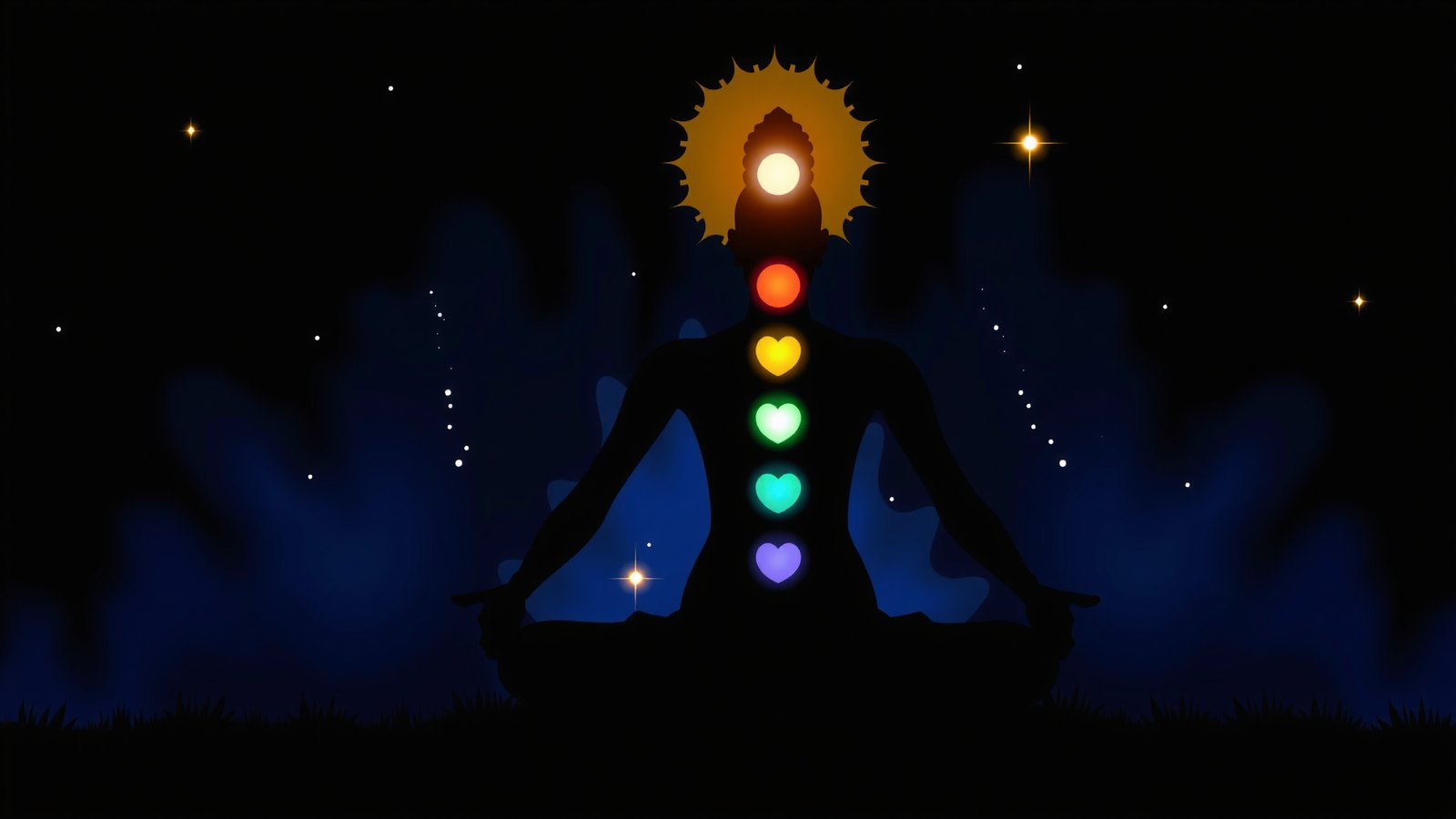
Have you heard the word “chakra“?
A diagram of 7 colored circles
along the body’s central axis —
a map
that 5,000-year-old Indian sages used
to understand the human being
as layers of energy.
Scientifically you might be told
“chakras don’t exist.”
They don’t show on CT, MRI, or blood tests.
Yet 5,000 years later,
yoga practitioners, therapists, and seekers worldwide
still use this system.
Why?
Because —
chakras aren’t physical entities,
they’re a map of consciousness.
The moment you understand this map,
your mental and physical experiences
become surprisingly organized.
💎 Key takeaway
Chakras = “a 5,000-year map for reading human existence as 7 layers of energy.” Not physical, but a powerful self-understanding tool.
30-second summary
- Chakra = Sanskrit for “wheel“
- 7 main chakras along the spinal axis
- Each: color, sound, element, deity correspondences
- Origin: Vedas (1500 BC+)
- Function: self-understanding map, healing, meditation
- No scientific proof of existence, but powerful psychological framework
- Balancing: yoga, meditation, crystals, oils, sound, color
- The basic language of all spiritual practices
1. What is a chakra?
1-1. Meaning
Chakra (Sanskrit: चक्र):
“Wheel,” “disk,” “vortex“
→ A center where energy rotates
1-2. “Existence” defined
| View | Interpretation |
|---|---|
| Anatomy | Doesn’t physically exist |
| Neurology | Related to nerve plexuses? |
| Yogic tradition | Exists in subtle body (Sukshma Sharira) |
| Psychology | Effective map of mind |
→ “Psychological framework” is the modern view.
1-3. 7 chakra basics
| No. | Name | Location | Color | Keywords |
|---|---|---|---|---|
| 1 | Muladhara | Perineum | Red | Stability, survival |
| 2 | Svadhisthana | Sacral | Orange | Emotion, creativity |
| 3 | Manipura | Solar plexus | Yellow | Confidence, decision |
| 4 | Anahata | Heart | Green | Love, relationships |
| 5 | Vishuddha | Throat | Blue | Expression, truth |
| 6 | Ajna | Brow | Indigo | Intuition, insight |
| 7 | Sahasrara | Crown | Purple/white | Spirituality, cosmos |
1-4. Why “7”?
- 7 = sacred number (7 rainbow colors, 7 musical notes, 7 planets, etc.)
- Bottom to top: matter to spirit
- Continuous development stages
2. 5,000 years of history
2-1. Vedic era (1500 BC–)
- Earliest mention in Rig Veda
- Concept of prana (life energy)
- Not yet “7 chakras”
2-2. Upanishad era (800 BC–)
- Yoga-Yajnavalkya has early chakra theory
- Subtle body theory established
2-3. Patanjali (~200 BC)
- Yoga Sutras
- Doesn’t directly say “chakra” but provides basis
2-4. Tantric era (500–1000 AD)
- Tantra Yoga establishes 7 chakras
- “Shat-Chakra-Nirupana” (description of the 6 chakras)
- Modern system’s foundation
2-5. Hatha Yoga (1100–1500 AD)
- Concept of Kundalini energy
- “Serpent energy” rising from below
2-6. Western transmission (19–20th c.)
- Theosophical Society (Blavatsky)
- Charles Leadbeater’s The Chakras (1927)
- Vivekananda’s Western lectures
2-7. New Age (1960s–70s)
- Merges with West Coast culture
- Link to 7 colors standardized
- Used in healing practice
2-8. Contemporary (2000–)
- Integration with psychology
- Anahata center scientific research
- Fusion with mindfulness
3. The 7 chakras in detail
3-1. 1st: Muladhara (Root)
| Item | Detail |
|---|---|
| Location | Perineum (base of spine) |
| Color | Red |
| Element | Earth |
| Seed sound | LAM |
| Governs | Survival, stability, grounding, family, finances |
| Imbalance | Anxiety, fear, financial problems, chronic fatigue |
| Excess | Materialism, attachment, stubbornness |
| Crystal | Garnet, red jasper, hematite |
| Oil | Vetiver, cedarwood, patchouli |
| Yoga | Tadasana (mountain), warrior poses |
Balance signs:
– Sense of stability
– “Being here” feeling
– Financial security
How to balance:
– Walk barefoot on earth (earthing)
– Gardening
– Red foods (beets, tomatoes)
– Perineum lock (yoga bandha)
3-2. 2nd: Svadhisthana (Sacral)
| Item | Detail |
|---|---|
| Location | Sacral (below navel) |
| Color | Orange |
| Element | Water |
| Seed sound | VAM |
| Governs | Emotion, sexuality, creativity, joy, adaptation |
| Imbalance | Emotional suppression, sexual issues, creative drought |
| Excess | Emotional instability, addiction, excessive sexual energy |
| Crystal | Carnelian, moonstone, orange calcite |
| Oil | Jasmine, ylang-ylang, rose |
| Yoga | Baddha Konasana, pelvic circles |
Balance signs:
– Healthy emotional expression
– Creativity flowing
– Healthy relationships
How to balance:
– Dance
– Engage with water (bathing, swimming)
– Creative activities
– Pelvic floor exercises
3-3. 3rd: Manipura (Solar Plexus)
| Item | Detail |
|---|---|
| Location | Solar plexus |
| Color | Yellow |
| Element | Fire |
| Seed sound | RAM |
| Governs | Confidence, will, decision, ego, digestion |
| Imbalance | Lack of confidence, indecisiveness, digestive issues |
| Excess | Domination, aggression, excessive ambition |
| Crystal | Citrine, tiger’s eye, yellow topaz |
| Oil | Lemon, bergamot, ginger |
| Yoga | Navasana (boat), Warrior III |
Balance signs:
– Healthy confidence
– Clear decisiveness
– Strong digestion
How to balance:
– Sunlight
– Watch fire (bonfire, candles)
– Strong core exercises
– Yellow foods
3-4. 4th: Anahata (Heart)
| Item | Detail |
|---|---|
| Location | Heart center |
| Color | Green (also pink) |
| Element | Air |
| Seed sound | YAM |
| Governs | Love, empathy, relationships, self-acceptance, forgiveness |
| Imbalance | Jealousy, loneliness, resentment, self-rejection |
| Excess | Codependency, excessive devotion, self-sacrifice |
| Crystal | Emerald, rose quartz, malachite |
| Oil | Rose, geranium, bergamot |
| Yoga | Ustrasana (camel), cobra |
Balance signs:
– Deep love and empathy
– Healthy relationships
– Self-acceptance
How to balance:
– Chest-opening poses
– Ho’oponopono practice
– Green plants around you
– Love-and-gratitude meditation
3-5. 5th: Vishuddha (Throat)
| Item | Detail |
|---|---|
| Location | Throat |
| Color | Blue |
| Element | Ether (space) |
| Seed sound | HAM |
| Governs | Expression, communication, truth, creative expression |
| Imbalance | Can’t express, lying, communication issues |
| Excess | Overspeaking, critical, domineering |
| Crystal | Aquamarine, turquoise, lapis lazuli |
| Oil | Peppermint, eucalyptus, chamomile |
| Yoga | Sarvangasana (shoulder stand), fish pose |
Balance signs:
– Natural self-expression
– Honest communication
– Courage to speak truth
How to balance:
– Singing, vocalizing
– Journaling
– Mantra chanting
– Blue foods (blueberries)
3-6. 6th: Ajna (Third Eye)
| Item | Detail |
|---|---|
| Location | Brow |
| Color | Indigo |
| Element | Light |
| Seed sound | OM |
| Governs | Intuition, insight, imagination, vision, wisdom |
| Imbalance | Lack of intuition, confusion, low imagination, headaches |
| Excess | Delusion, excessive fantasy, escapism |
| Crystal | Amethyst, lapis lazuli, fluorite |
| Oil | Frankincense, sandalwood, clary sage |
| Yoga | Child’s pose (forehead down), downward dog |
Balance signs:
– Sharp intuition
– Clear insight
– Having vision
How to balance:
– Meditation (especially Trataka: candle gazing)
– Cold fingers on third eye
– Look at stars
– Meditation in darkness
3-7. 7th: Sahasrara (Crown)
| Item | Detail |
|---|---|
| Location | Crown |
| Color | Purple/white/rainbow |
| Element | Consciousness |
| Seed sound | Silence (echo of OM) |
| Governs | Spirituality, oneness with cosmos, enlightenment, transcendence |
| Imbalance | Spiritual lostness, emptiness, isolation |
| Excess | Escapism, excessive spirituality |
| Crystal | Amethyst, clear quartz, selenite |
| Oil | Frankincense, lotus, myrrh |
| Yoga | Sirsasana (headstand), seated meditation |
Balance signs:
– Cosmic connection
– Deep stillness
– Meaningful life
How to balance:
– Silent meditation
– Nature time
– Prayer
– Fasting (with medical guidance)
4. Kundalini — the serpent energy
4-1. What is Kundalini?
- “Sleeping serpent” at Muladhara
- Rises through practice
- Activates 7 chakras sequentially
- Reaches Sahasrara = enlightenment
4-2. “Awakening” phenomenon
- Many practitioners report
- Intense physical/mental experience
- Unprepared awakening = dangerous
4-3. Safe path
- Gradually open chakras
- Start from foundation (Muladhara)
- Don’t rush
- Reliable guide important
5. Modern psychology correspondences
5-1. Maslow’s hierarchy comparison
| Maslow | Chakra |
|---|---|
| Physiological | 1st (Muladhara) |
| Safety | 1st–2nd |
| Belonging/love | 4th (Anahata) |
| Esteem | 3rd (Manipura) |
| Self-actualization | 6th–7th |
| Self-transcendence | 7th (Sahasrara) |
→ Surprising correspondence.
5-2. Developmental psychology correspondences
- 1st: Infancy (basic trust)
- 2nd: Early childhood (emotional development)
- 3rd: School age (self-esteem)
- 4th: Adolescence (relationships)
- 5th: Adulthood (self-expression)
- 6th: Middle age (wisdom)
- 7th: Old age (transcendence)
5-3. CBT / cognitive therapy correspondences
- Classify “thought patterns” by chakra
- “3rd is weak” = confidence issue
- “4th closed” = relationship issue
→ Excellent as intuitive self-understanding tool.
6. Practice — chakra meditation
6-1. Basic chakra meditation (20 min)
Preparation:
– Quiet place
– Comfortable seat
– Spine erect
Steps:
3 min: settle the breath
2 min × 7: focus on each chakra in sequence
– Feel the location
– Visualize the color
– Mentally chant the seed sound
– Feel warmth/pulse in that area3 min: integration
– Connect the 7 with light
– Feel the whole body as one light
6-2. One-chakra-per-day meditation
7-day program:
– Monday: 1st
– Tuesday: 2nd
– Wednesday: 3rd
– Thursday: 4th
– Friday: 5th
– Saturday: 6th
– Sunday: 7th
→ Each day, focus activities around that chakra.
6-3. Meditation with crystals + aromatherapy
Example: 4th chakra (heart) day
– Rose quartz on chest
– Rose oil 1 drop on handkerchief
– Green plant in view
– Heart pose in morning
– Silently repeat “I love you“
→ Multi-sensory chakra stimulation.
8. FAQ
Q1. Do chakras really exist?
A. Physically unproven. Psychologically/symbolically powerful tool. That’s enough.
Q2. Must open all of them?
A. Balance matters. “Over-opening” is also problematic. Harmony is the aim.
Q3. Want to awaken Kundalini
A. Don’t rush. Gradual from the base. Rapid awakening = dangerous experiences.
Q4. Where to start?
A. 1st chakra (Muladhara). Foundation matters.
Q5. What’s most effective?
A. Individual. Combine meditation, yoga, crystals, oils.
Q6. Some “see” chakras?
A. Rarely. Question of visualization ability. Effects exist without seeing.
Q7. Relationship with Western medicine?
A. Complementary. Don’t treat serious illness with chakra theory. Use as self-understanding.
Q8. Teach kids?
A. Welcome. Children often understand intuitively better than adults.
Q9. OK as a Christian?
A. Yes. Religious/philosophical framework. Doesn’t conflict with faith.
Q10. Not feeling effects?
A. Continue 3 months. Don’t expect immediacy.
9. Closing — a 5,000-year map within you
Chakras are invisible.
They don’t show on CT, MRI, blood tests.
Yet —
5,000 years ago, Indian sages
organized human complexity
into 7 simple circles.
And that map
teaches us “who we are“
more intuitively,
more integrally,
than even modern psychology.
“What am I lacking now?“
“Why do I feel this way?“
“What should I cherish?“
For such questions,
the chakra map gives
a hint in just 1 minute.
From 1st to 7th, in sequence,
ask within yourself:
“Am I grounded?“
“Are my emotions flowing?“
“Do I have confidence?“
“Is love full?“
“Can I speak truth?“
“Is intuition sharp?“
“Am I connected to the cosmos?“
Those 7 questions
are the shortest, deepest prayer
delivering 5,000 years of wisdom
to today’s you.
References
- Avalon, A. (1924). The Serpent Power. Ganesh & Co.
- Anodea, J. (2004). Eastern Body, Western Mind: Psychology and the Chakra System as a Path to the Self. Celestial Arts.
- Pond, D. (1999). Chakras for Beginners. Llewellyn.
- Hall, J. (2003). The Crystal Bible. Walking Stick Press.
- Iyengar, B. K. S. (1985). Light on Pranayama. Crossroad.
MuZenCosmos — Where cosmos meets silence | Seven circles and yourself
This article does not guarantee any medical or health benefit and is not a substitute for professional medical care. If you have any health concerns, please consult a physician or other qualified professional.