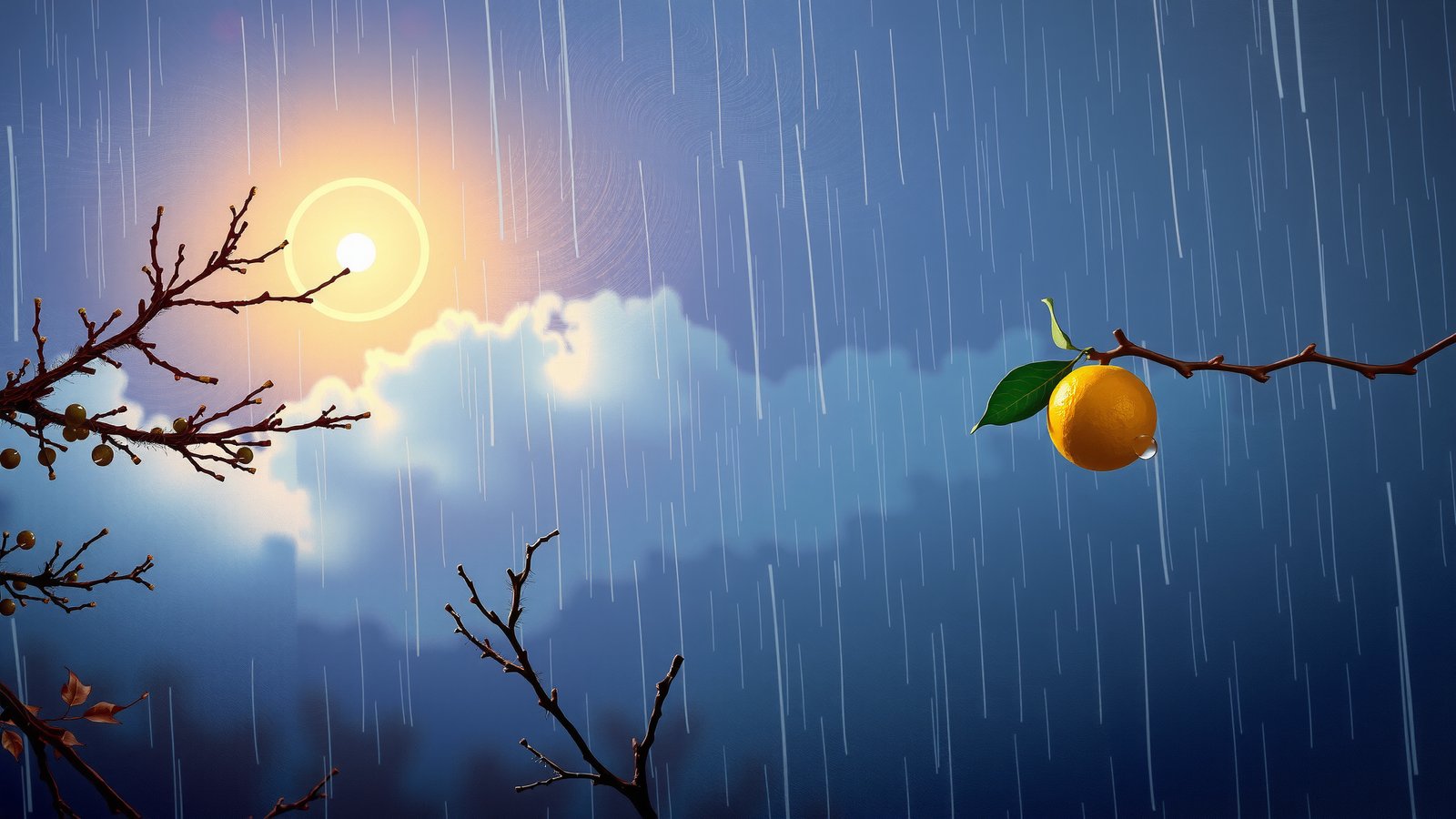
Sometime in late November,
you notice that
something has gone missing
from the sky.
It still rains.
The wind still blows.
But when the rain lifts
and you look up,
there is no rainbow.
You cannot remember
the last one you saw.
You did not even notice
that you had stopped noticing.
The name given
to that stretch of the year
is Shousetsu —
literally,
“small snow.”
Snow, the word says.
But not yet
enough to settle.
What follows is the story
of the solar term Shousetsu.
And its slow resonance
with 285Hz —
the Solfeggio tone
traditionally said
to stand for
repair.
The answer, in three lines
Shousetsu is the twentieth of the 24 solar terms, the day the sun reaches 240° of celestial longitude (around November 22 in 2026). It marks the first light snow of the year: rainbows stop appearing, the north wind strips the last leaves, and the tachibana citrus turns gold. Solfeggio 285Hz is traditionally associated with regeneration and repair — which sits poetically alongside a season whose changes are already finished before they become visible. There is no historical link between the two, and nothing here claims an effect.
💎 The one line of this article
What Shousetsu teaches is that what has stopped being visible has not been lost. The rainbow, the leaves — only the conditions changed.
The 30-Second Summary
- Shousetsu is the twentieth of the 24 solar terms — the day the sun reaches 240° of celestial longitude, around November 22 in 2026 (dates shift by a day depending on the year, so an annual almanac is the reliable source)
- Despite the “snow” in its name, it describes snow that falls lightly and does not yet accumulate
- Its three micro-seasons are “the rainbow hides” → “the north wind sweeps the leaves” → “the tachibana begins to yellow”
- Rainbows disappear not because of the sun, but because large raindrops and direct sunlight stop occurring together. Winter belongs instead to halos and sun dogs, made by ice crystals
- The wind does not tear the leaves off. The tree builds an abscission layer, withdraws the nutrients, and cuts the leaf loose itself. The wind only carries away what was already released
- The mild, windless days of early winter are called koharu-biyori — “little spring weather.” It is a winter term, not a spring one
- 285Hz is traditionally described as the tone of regeneration, repair and restoration
- In equal temperament at A=440Hz, it sits about 48 cents above C♯4 (277.18Hz) and 52 cents below D4 (293.66Hz) — a tone that falls into the gap between two keys
- All of this is symbolic language, not a claim of scientific effect
1. What Shousetsu Is — A Name for Snow That Has Not Arrived
Shousetsu is the twentieth of the 24 solar terms,
the traditional East Asian division
of the year into 24 parts
based on the position
of the sun.
It marks the day the sun passes
240° of celestial longitude —
around November 22 in 2026.
(Because the dates follow the sun rather than the civil calendar, they can shift by a day from year to year. An annual almanac is the reliable source.)
As a term, Shousetsu covers
not just that single day
but the roughly fifteen days
until Taisetsu — “great snow” —
arrives around December 7.
What is striking
is how it was named.
Not “it snows.”
But “the snow is still small.”
The old calendar
kept giving names
to states of not-yet.
Small snow.
Small heat.
Small cold.
Before the full thing.
Partway there.
This was, I think,
a technology for waiting.
Winter does not
arrive all at once.
Someone tells you first:
it is still small.
And with that one sentence,
you can walk into the season
without bracing.
For the previous term, see
Rittou and 639Hz — The Day the Fire Is Opened
2. The 72 Micro-Seasons of Shousetsu — The Rainbow Hides, the Wind Sweeps, the Citrus Turns Gold
Each solar term divides again
into three micro-seasons —
the 72 kō of the old almanac.
For Shousetsu, they run:
- Niji kakurete miezu … “the rainbow hides and is not seen”
- Sakufū konoha o harau … “the north wind sweeps away the leaves”
- Tachibana hajimete kibamu … “the tachibana citrus begins to yellow”
Read them in order
and a shape appears.
Vanishing (the rainbow).
Swept away (the leaves).
Turning gold (the citrus).
Two losses,
and then —
one thing that arrives.
The 72 micro-seasons
almost never describe
a season as
subtraction alone.
Where something leaves,
they place the name
of what remains.
One more detail:
the character saku in sakufū,
the north wind,
is the same character used for
the first day of the lunar month.
North, and beginning,
shared a single word.
3. Why the Rainbow Disappears — Nothing Was Lost, the Conditions Changed
“The rainbow hides and is not seen”
is often quoted
as the most poetic name
in the entire calendar.
But it is not a mood.
It is an observation.
A rainbow needs
at least two things
at the same time:
- Reasonably large water droplets in the air — real raindrops
- Direct sunlight striking them
Summer produces rainbows easily
because a shower falls
in one part of the sky
while the sun shines beside it.
As winter approaches,
that arrangement breaks down.
Under a winter pressure pattern,
one side of Japan lies
under continuous cloud,
while the other turns
dry, with far less rain at all.
What does fall tends to be
drizzle, or snow,
rather than the large-dropped
convective showers of summer.
Droplets that fine
do not make a rainbow.
And ice crystals
do not make one at all.
Here is the beautiful part.
The winter sky that lost its rainbow
gains another kind of light.
When ice crystals align
in high thin cloud,
a great ring can appear
around the sun —
a halo.
And about 22 degrees
to either side,
two bright points
sometimes ignite:
sun dogs.
The round water drop left.
The angular ice crystal arrived.
So light bends differently.
That is all
that happened.
The rainbow was not lost.
The conditions changed.
— And we make
the same mistake
about ourselves.
When something no longer works
the way it used to,
we conclude that it is
gone.
Often, it is not gone.
The conditions
are different.
4. The North Wind Sweeps the Leaves — But the Wind Is Not What Drops Them
Read literally,
the second micro-season
sounds like the wind
tearing leaves from branches.
The actual order
is the reverse.
As daylight shortens
and temperatures fall,
a deciduous tree builds
an abscission layer
at the base of each leaf stalk.
Before that,
it withdraws the valuable
nitrogen and phosphorus
inside the leaf
back into trunk and root.
Autumn color appears
because the green pigment
breaks down first,
revealing what was already there.
Which means the color
is not the ending.
It is the recovery process,
made visible.
Once the withdrawal is complete,
the cells at the abscission layer
lose their hold,
and the leaf is
already released.
Then the north wind blows.
The wind is only
**carrying away
what was let go
some time ago.**
I find this
a very quiet fact.
From outside, it looks like
one strong day
stripped the tree bare —
as though the wind
did it.
But the tree had finished
weeks earlier.
Long before the moment
that looks like loss,
the recovery
was already done.
— Letting go
usually happens
in that order.
5. Koharu-biyori — Why Early Winter Has Warm Days
Shousetsu also hides
startlingly gentle days.
No wind.
Soft light.
An afternoon
that does not need a coat.
Japanese calls this
koharu-biyori —
“little spring weather.”
Koharu, “little spring,”
was an old name for
the tenth lunar month,
roughly our November.
So the phrase does not
belong to spring at all.
It is a term for
the beginning of winter.
(Using it for a mild day in March is, strictly, a misuse.)
Meteorologically, it tends to occur
when a slow-moving
migratory high-pressure system
settles over the region:
light winds, little cloud,
sunlight arriving unobstructed.
And the same high pressure
often brings
strong radiative cooling
that night —
a sharply colder morning after.
The warm afternoon and the cold dawn
come from one cause.
Which is very much
a Shousetsu idea.
Recovery and chill
are not two separate events.
Sometimes they are
two faces of one state.
6. What 285Hz Is — The Frequency of Repair
285Hz is the second tone
in the nine-tone Solfeggio set
commonly listed as
174, 285, 396, 417, 528, 639, 741, 852 and 963.
Traditionally, it is linked with:
- Repair of tissue
- Regeneration, restoration
- Settling the foundation
Along with 174Hz,
it is often described
as one of the
“foundation tones.”
One honest note
belongs here.
Of the nine tones
in circulation today,
the six from 396Hz to 852Hz
are the older, classic set.
174Hz and 285Hz
were added later.
So 285Hz is, even within
this tradition,
a relatively new tone.
For more on 285Hz, see
285Hz — The Frequency of Cellular Regeneration
and
285Hz Complete Guide
A word on tuning.
In equal temperament at A=440Hz:
- C♯4 is about 277.18Hz
- D4 is about 293.66Hz
285Hz falls between them —
roughly 48 cents above C♯,
roughly 52 cents below D.
A semitone is 100 cents,
so 285Hz lands
almost exactly halfway
between two adjacent keys.
It is neither.
Not yet D.
No longer C♯.
Repair, I suspect,
lives in a place like that.
Not before the damage.
Not after the healing.
We rarely give names
to the middle.
And yet most of our time
is spent there.
7. What 285hz Is Said to Do — Drawing the Line Honestly
Here is how MuZenCosmos
reads the claims around 285Hz.
What is said (traditional framing)
- In modern Solfeggio practice, 285Hz is presented as a tone of restoring tissue and laying the groundwork for recovery
- With 174Hz, it is positioned as a foundation beneath the six classic tones
- A quiet sound environment can support restful behavior — going to bed earlier, closing the screen. That is the effect of a cue and a habit, not of a frequency
- That physical repair advances during sleep — with growth hormone release peaking in deep non-REM sleep — is a broadly shared finding in sleep science. But that is a finding about sleep, not about 285Hz
What cannot be said (not a scientific claim)
- There is no established scientific evidence that 285Hz regenerates cells or tissue
- Claims that it speeds the healing of wounds or boosts immunity lack peer-reviewed support
- No causal relationship between listening and recovery has been demonstrated
- The Solfeggio system itself is a relatively modern reconstruction from the late twentieth century onward — not an unbroken ancient tuning
So 285Hz is best understood
not as a tone that heals the body,
but as a symbolic tone for allowing yourself to still be in the middle of something.
And the feeling itself —
that recovery takes longer
as the cold arrives —
is an entirely
natural one.
8. The Symbolic Link Between Shousetsu and 285Hz
To be straightforward:
there is no historical or documentary connection
between the solar term Shousetsu
and Solfeggio frequencies.
The 24 solar terms were systematized
in ancient China.
The 72 micro-seasons were rewritten
for Japan’s climate in the Edo period.
The modern Solfeggio framework spread
from the late twentieth century onward.
Entirely different eras,
entirely different cultures.
But laid over each other
as structures of theme,
a quiet resonance appears:
- The rainbow vanishes because conditions changed, not because it was lost → recovery is not returning to before; it is arranging conditions
- The tree finishes withdrawing before the leaf ever falls → the repair is complete before it becomes visible
- 285Hz falls into the gap between two keys → repair is neither “before” nor “after,” but the middle
So the suggestion —
“play 285Hz quietly, and let the not-yet-recovered version of yourself simply be there, unhurried” —
is offered as a way of holding two symbols together,
echoing the way Shousetsu names a season
as still small.
It is a reading,
not an academic claim.
9. Rittou / Shousetsu / Taisetsu × Frequency — A Symbolic Comparison
Per the v2.6 rule, one comparison table:
| Aspect | Rittou (before, ~Nov 7) | Shousetsu (~Nov 22) | Taisetsu (after, ~Dec 7) |
|---|---|---|---|
| Felt season | Winter begins on the calendar; the air dries and clears | First light snow; rain no longer makes rainbows | Snow begins to fall and settle in earnest |
| Signs in nature | Sasanqua blooms, the earth begins to freeze, narcissus opens | The rainbow hides, the north wind sweeps leaves, tachibana turns gold | The sky closes, bears den, salmon run upstream |
| Rites and work | Robiraki, Inoko, opening the kotatsu, Shichi-Go-San | Niinamesai / Labor Thanksgiving Day, winter wrapping of trees | Kotohajime, preparations for the New Year |
| Symbolic tone (example) | 639Hz (connection) | 285Hz (repair) | — |
| Inner posture | Knowing you may draw closer, in proportion to the cold | Letting the unfinished version of yourself stay unhurried | Seeing closing-in as storage, not retreat |
※ This mapping is a poetic aid only, not a claim that a frequency changes a season.
10. How to Spend Shousetsu with 285Hz — Small Habits for Tending the Invisible
A few concrete suggestions.
- Say “it is still small” out loud. Fatigue, low mood, a body not quite back — do not treat them as finished states. Naming something as still small, in advance, can make it possible to face without bracing. This is simply borrowing the calendar’s own naming method
- Play 285Hz quietly at night, and do not count what you failed to do today. Mid-recovery, the undone is far more visible than the done. This low, unhurried tone suits that hour. Fifteen minutes of judging nothing is enough
- Look up once after the rain stops. There will probably be no rainbow. Confirming its absence is itself the observation. If thin cloud has moved in, you may find a faint halo ringing the sun instead
On recovery and sleep, see
And for a lower tone to rest with,
174Hz — The Frequency of Deep Rest
These are offered as habits of relaxation and reflection.
They do not guarantee improvement in health or symptoms.
11. Safety and Cautions
A few lines worth holding
in this particular season.
- Do not make the sound carry “I must recover.” 285Hz is presented as a tone of repair, but listening guarantees nothing. Turned into a reason to hurry, it stops being rest
- Treat dryness before sound. Heating lowers humidity, taxing throat, nose and skin barrier. The same sound also grates more easily in a dry room. Humidify and hydrate first
- Do not blame every lingering symptom on the season. “It’s just the time of year” can delay a needed visit. Persistent pain, fever or heavy fatigue belong with a clinician, not a playlist
- Do not push through sudden cold. Shousetsu swings widely between mild and cold days. Dress from today’s forecast, not yesterday’s weather
- Keep the volume low. Thinking about “repair” tempts people to turn the sound up so it “reaches.” For long listening, stay at a level where normal conversation is still possible
12. Cultural Background — Tachibana, the Land Beyond, and Niinamesai
The tachibana of the third micro-season
is one of the very few citrus species
native to Japan.
Its fruit is small
and so sour it is
nearly inedible
as it is.
And yet ancient Japan
treated this tree
as something special.
The reason is that it is
evergreen.
It does not drop its leaves
in winter.
The Kojiki and Nihon Shoki record
a figure named Tajimamori,
sent by Emperor Suinin
to Tokoyo no kuni —
the land beyond the sea —
to bring back the
tokijiku no kaku no konomi,
“the fragrant fruit
that knows no season.”
That fruit has long been
identified with the tachibana.
But when Tajimamori returned,
the emperor had
already died.
The fruit of endless life,
arriving too late.
That story gave the tachibana
its particular place —
and it appears today
in the design of the
Order of Culture.
— And on November 23 comes
Niinamesai,
the ancient rite in which
the year’s new grain
is offered in thanks
before it is eaten.
In 1948 the date became
the national holiday now called
Labor Thanksgiving Day.
Placed inside a season of subtraction,
this day carries an order of operations:
what was received
is returned first.
In the middle of the diminishing,
one day of
offering is set.
Perhaps preparing for winter
was never only
about closing in.
13. Sound in a Dry Season — A 5-Point Checklist
After Shousetsu, indoor air
turns distinctly dry.
Five points for tuning
sound and humidity together.
- Are you measuring humidity before adjusting sound? Roughly 40–60% is the usual comfort guide. A single hygrometer makes heating and humidifying decisions concrete
- Can what you play at bedtime stop by itself? As nights lengthen, falling asleep with sound on becomes routine. Decide the timer before you press play
- Is the volume set for tomorrow’s you? Tired people reach for louder sound. The right level for an ear that is already half asleep is lower than it is when awake
- Is the heater blowing directly on you? Forced air brings dryness and chill at once. Redirecting it steadies both comfort and the room’s sound
- Have you switched bedding and bedroom temperature? Autumn bedding leaves you cold before dawn. See Setting Up Your Bedroom
No expensive equipment is required.
Measure the humidity, lower the volume, let it stop on its own —
those three are enough
for a Shousetsu night.
About This Article (Disclaimer & Advertising Notice)
This article is informational content introducing the symbolic meanings of culture, calendar and frequency. It is not a substitute for medical care. Nothing written here about 285Hz or the 24 solar terms is intended to guarantee recovery from illness, symptoms or injury, and individual experience varies. If pain, fever or heavy fatigue persists, please consult a medical professional rather than relying on sound. Those with existing conditions or hearing concerns should consult a specialist first. When using heaters or humidifiers, follow each product’s instructions and safety guidance.
[Advertising] This article may in future contain affiliate links. Purchases made through such links never incur additional cost to the reader.
14. For Example, Consider a Situation Like This
To make it concrete,
here is one general scene
(a deliberately fictional generalization,
not anyone’s real account).
Suppose there is a state of
being cleared, but not
back to normal.
The fever is gone.
Medically,
nothing is wrong.
And yet the same workload
as before
leaves you
useless by evening.
At this point,
most of us
begin doubting
ourselves.
Maybe I am imagining it.
Maybe I am being soft.
Maybe the period in which
this was excusable
has ended.
But look up
at the Shousetsu sky
and something registers.
There is no rainbow.
It rained.
The sun is out.
Still, none.
Nothing is broken.
The conditions changed.
And look at the tree:
the leaves were already
cut loose.
Weeks before the wind,
the withdrawal
was complete.
Visible change always arrives
late.
— “I am not back to normal yet”
is not a verdict of failure.
It is a report that says
still in the middle.
Play 285Hz quietly,
and close the day
without counting
what you did not finish.
What matters is this:
the sound does not
produce the recovery.
285Hz is only
**a background
for allowing yourself
to still be partway.**
This article does not guarantee any medical or health benefit and is not a substitute for professional medical care. If you have any health concerns, please consult a physician or other qualified professional.
📚 Related Articles
- Rittou and 639Hz | The Day Winter Is Named — Japan’s Solar Term of Fire and Gathering
- Soukou and 417Hz | When Dew Becomes Frost — What Japan’s Last Autumn Solar Term Really Means
- Kanro and 174Hz | When the Dew Turns Cold — What Japan’s “Cold Dew” Solar Term Really Means
- Shuubun and 528Hz | The Day Light and Dark Weigh the Same — What Japan’s Autumn Equinox Solar Term Really Means
FAQ (10 Questions)
Q1. What kind of day is Shousetsu?
It is the twentieth of the 24 solar terms, the day the sun passes 240° of celestial longitude. It marks the season of light snow that does not yet accumulate, and as a term it covers roughly fifteen days until Taisetsu around December 7.
Q2. When is Shousetsu in 2026?
Around November 22, 2026. Because the solar terms follow the sun’s position, dates can shift by a day from year to year; an annual almanac is the reliable source.
Q3. Why is it called “small snow” when many regions get no snow at all?
The 24 solar terms were originally organized around the climate of China’s Yellow River basin, so they do not always match conditions in Japan. In Japan they have been received as names for a stage of the season — here, “winter proper has not started yet.”
Q4. What are the three micro-seasons of Shousetsu?
“The rainbow hides” → “the north wind sweeps the leaves” → “the tachibana begins to yellow.” Two vanishings, followed by one thing that arrives.
Q5. Why do rainbows disappear in winter?
A rainbow needs fairly large raindrops and direct sunlight at the same time. Winter brings fewer convective showers, and what falls tends to be drizzle or snow. Ice crystals make no rainbow at all — they produce halos and sun dogs instead.
Q6. What does the character saku in “north wind” mean?
It means north. It is the same character used for the first day of the lunar month, so in older usage “beginning” and “north” shared one word. Sakufū simply means the north wind.
Q7. Does the wind tear the leaves off?
No. A deciduous tree forms an abscission layer at the leaf base, withdraws the nutrients, and severs the leaf itself. The wind only carries away what has already been released.
Q8. Is koharu-biyori a spring term?
It is a term for early winter. Koharu, “little spring,” was a name for the tenth lunar month, and the phrase describes the mild, calm, sunny days of late autumn and early winter — typically under a migratory high-pressure system.
Q9. What is Solfeggio 285Hz?
The second of the nine tones, traditionally associated with regeneration, repair and restoration. In equal temperament at A=440Hz it sits almost exactly between C♯4 (277.18Hz) and D4 (293.66Hz), matching no key on the piano.
Q10. Does listening to 285Hz help the body recover?
There is no established scientific evidence for that. The finding that physical repair advances during sleep is well shared, but it concerns sleep, not 285Hz. It is more honest to receive the tone as a symbol for not rushing a recovery still underway.
Conclusion — What Stopped Being Visible Was Not Lost
We tend to count
what we can no longer see
as lost.
The rainbow that stopped appearing.
The leaves that fell.
The stamina
that has not returned.
Which makes this stretch of the year
look like
a season of subtraction.
But the Shousetsu sky
says otherwise.
The rainbow did not vanish.
**The round water drop
was replaced by
the angular ice crystal.**
So the light bends
somewhere else now —
into a pale ring
around the sun.
And the leaves
were not taken.
The tree had finished
**its withdrawal
weeks before.**
The wind only carried off
what no longer had a use.
A season that looks like it is emptying
is usually a season
of quiet sorting
on the inside.
Tonight, if you are not recovering
as fast as you think you should,
play 285Hz quietly
and go to sleep
without counting
what you did not finish today.
You are allowed to name it
“still small,” in advance.
And the next time the rain lifts,
look up once.
Confirming that no rainbow is there
is one of the observations
this season offers.
References
- Leonard G. Horowitz & Joseph S. Puleo, Healing Codes for the Biological Apocalypse, Tetrahedron Publishing, 1999. (The source through which the current Solfeggio numbers were popularized; the derivation is numerological and was not established acoustically.)
- Okada Yoshiro, Koyomi o Shiru Jiten (An Encyclopedia of the Calendar), Tokyodo Shuppan. (On the lunisolar calendar, the 24 solar terms, the 72 micro-seasons and annual observances.)
- National Astronomical Observatory of Japan, ed., Rika Nenpyo (Chronological Scientific Tables), Maruzen (annual). (Authoritative dates and times for each year’s solar terms, plus climate normals.)
- Shirai Akehiro, illus. Aruga Kazuhiro, Nihon no Shichijuni-kō o Tanoshimu (Enjoying Japan’s 72 Micro-Seasons), Toho Shuppan, 2012. (An accessible guide to the nature, rites and seasonal foods of each micro-season.)
- Robert Greenler, Rainbows, Halos, and Glories, Cambridge University Press, 1980. (The classic systematic account of how rainbows, halos and sun dogs form.)
MuZenCosmos — Where the Cosmos Meets Silence | What stopped being visible was not lost