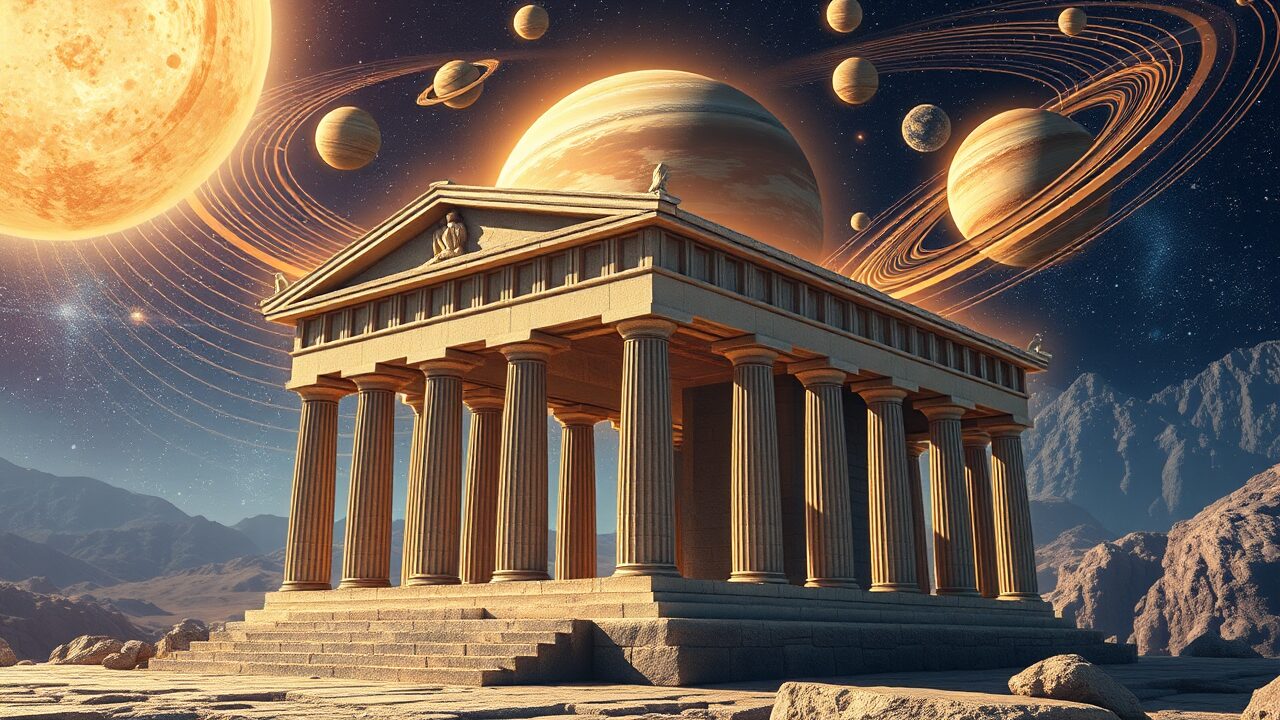
In the 6th century BCE, one Greek man changed how humanity relates to sound, permanently.
His name was Pythagoras. The mathematician famous for the “Pythagorean theorem” was, more importantly perhaps, the first person to discover the relationship between sound and number. A walk past a blacksmith — the famous story — where he noticed that the weights of hammers determined the harmony of their sounds. Whether that account is literal is debated, but the discovery that “sound is made of numbers” became the source of modern frequency therapy, Western music, and Solfeggio frequencies.
This article gently bridges Pythagoras’s grand vision of “the music of the spheres” to modern acoustic science.
💎 Key insight in one line Pythagoras’s discovery still lives 2,500 years later. The premise “sound is a manifestation of the universe’s mathematical structure” is the deep root of contemporary interest in Solfeggio frequencies and 528 Hz.
Quick Summary (30 seconds)
- Pythagoras (c. 570–495 BCE) was the ancient Greek mathematician and philosopher who discovered that musical consonance arises from integer ratios.
- A string ratio of 1:2 produces an octave; 2:3, a perfect fifth; 3:4, a perfect fourth — simple integers form music’s foundation.
- “Musica Universalis” — the music of the spheres — the idea that planets too move in integer ratios and the universe sings a vast hymn.
- Modern frequency therapy, Solfeggio, and the 432 Hz debate all extend from this insight.
- Distinguish scientific fact from mystical interpretation, but the core — “sound is made of numbers” — remains.
1. Pythagoras’s Discovery
1-1. The Blacksmith Legend
Walking past a blacksmith’s shop, Pythagoras heard hammers sounding pleasingly and unpleasingly together. Returning home, he experimented with string tension and length, discovering that harmony arose from integer ratios.
Whatever the literal accuracy of this tale, his role as the first person to analyze sound mathematically is uncontested.
1-2. Integer Ratios in Music
Pythagoras measured the relationship between string length and pitch using a monochord (single-string instrument).
| Ratio | Interval | Musical meaning |
|---|---|---|
| 1:1 | Unison | Same pitch |
| 1:2 | Octave | Same note name, octave apart |
| 2:3 | Perfect fifth | “C and G” |
| 3:4 | Perfect fourth | “C and F” |
| 4:5 | Major third | “C and E” |
| 5:6 | Minor third | “C and E♭” |
The remarkable thing: every one of these integer ratios corresponds to intervals the human brain perceives as “pleasing.”
1-3. Pythagorean Tuning
By stacking perfect fifths (2:3), Pythagoras developed the Pythagorean tuning system, which became the starting point of Western music theory — and the ancestor of later just intonation and equal temperament.
🔬 Acoustic column Modern pianos are tuned in 12-tone equal temperament (12-TET). Pythagorean and equal temperament differ slightly; Pythagorean is closer to the natural harmonic series, especially in perfect fifths.
2. The Music of the Spheres (Musica Universalis)
2-1. A Grand Cosmology
Pythagoras and his school proposed that music wasn’t only earthly — the entire cosmos was music.
Each planet moves at its own characteristic speed; the ratios of these speeds, they reasoned, conform to integer ratios — so the cosmos performs a flawless harmony (the music of the spheres).
Humans cannot hear it, but the universe’s structure itself is music — a philosophy.
2-2. Kepler Inherited the Idea
Two thousand years later, Johannes Kepler (1571–1630) picked up the thread. From planetary observations he derived Kepler’s three laws, and in his Harmonices Mundi (1619) he calculated a musical scale corresponding to actual planetary motion.
It sat at the boundary of science and mysticism, but the underlying idea — “natural laws consist of mathematical harmony” — remains a deep current in physics.
2-3. Modern Physics Connection
💎 Key insight in one line Pythagoras’s intuition “the cosmos is music” sits surprisingly close to modern string theory, where the universe’s fundamental ingredient is vibrating strings.
In string theory, the true identity of elementary particles is tiny vibrating strings, and the differences in vibration determine particle properties. In a sense, this is the modern version of Pythagoras’s 2,500-year-old intuition.
But this is poetic analogy, not a scientifically confirmed correspondence.
3. Pythagoras and Solfeggio Frequencies
3-1. Historical Lineage
Solfeggio frequencies (528 Hz etc.) descend from medieval Gregorian chant — a system that arrived via the lineage of Pythagorean tuning theory.
That said, claims that specific Solfeggio frequencies (528 Hz) are directly derivable from Pythagoras are academically weak.
3-2. Number Correspondence (Reference Material)
Horowitz (1998) and others proposed numerical correspondences:
- 528 = 5+2+8 = 15 → 1+5 = 6
- 396 = 3+9+6 = 18 → 1+8 = 9
- Adding digits of any Solfeggio frequency yields 3, 6, or 9.
This is the “3-6-9 pattern”, linked to Tesla’s saying “If you understood 3, 6, and 9, you would have the key to the universe.”
These numerical correspondences belong to numerology, not proven physiology or physics.
3-3. Honest Assessment
🔬 Key insight in one line Pythagoras found “sound is made of integer ratios” — a scientific fact. The claim “specific frequencies correspond to cosmic truth” is a poetic extension that shouldn’t be taken literally.
4. Influence on Western Music
4-1. Tuning’s History
| Era | Tuning | Character |
|---|---|---|
| Ancient | Pythagorean | Perfect fifths stacked, fifth is exact |
| Medieval | Meantone | Pure thirds, limited modulation |
| Baroque | Just intonation | Harmonic series-based |
| Classical onward | Equal temperament | 12 equal divisions, free modulation |
| Modern | Equal temperament + 432 Hz debate | 440 Hz is standard |
4-2. The 432 Hz Debate
The recent 432 Hz vs. 440 Hz discussion echoes the older Pythagorean–equal temperament tension: mathematical and natural-harmonic beauty versus industry standardization.
See the companion article: “432 Hz Music Playlist.”
5. Modern Applications — Sound Therapy and Pythagoras
5-1. Integer Ratios and Consonance
Research on the harmonic series (covered in article 39) shows that virtually all intervals humans perceive as consonant correspond to Pythagorean integer ratios. This likely reflects a shared evolutionary biological and neurological foundation.
5-2. In Sound Therapy
In music therapy and sound healing, the impact of “consonant acoustic structures built on integer ratios” on the autonomic nervous system, brainwaves, and mood is actively studied.
- Chords with near-integer ratios support parasympathetic activity
- Dissonant intervals (irrational ratios) trigger alertness responses
- May have evolved as a basis for safety/threat discrimination
5-3. Daily Use
- Hear Solfeggio and alternative tunings as music made of integer ratios.
- Use classical music with Pythagorean structure (Bach, Mozart) for meditation.
- Experience handmade instruments closer to the natural harmonic series (singing bowls, tingsha, flutes).
6. Persona Guide
A. Philosophy / history lovers
- Read books like The Music of the Spheres (Jamie James).
- Continue to Kepler’s Harmonices Mundi.
- Enjoy where music history meets math history.
B. Music practitioners
- Compare just intonation and equal temperament on a piano.
- Listen to early instruments (lute, viola da gamba).
- Build a monochord yourself.
C. Solfeggio practitioners
- Deepen the bodily sense of “integer ratio consonance.”
- Try combinations (528 + 396 + 639) rather than 528 alone.
- Bring acoustic-historical perspective into your meditation.
7. Reader Voices
“After learning about Pythagoras, 528 Hz stopped seeming like a special number. But listening through the lens of integer ratios, a different kind of depth appeared.” — Man, 50s, former math teacher (Tokyo, 1 year)
“The idea of ‘music of the spheres’ makes me love looking at stars during meditation. The richness of ancient imagination amazes me nightly.” — Woman, 30s, astronomy fan (Sapporo, 6 months)
“As a music teacher, I built a music history class beginning with Pythagoras. Student engagement jumped. ‘Music began as mathematics’ is a powerful frame.” — Man, 40s, high school music teacher (Kyoto, 3 years)
8. FAQ
Q1. Does Solfeggio feel different with Pythagorean tuning? A. Subjective. Listening with attention to integer-ratio beauty can deepen the experience.
Q2. Does the music of the spheres really exist? A. As a physical phenomenon, no — vacuum doesn’t transmit sound. Treat it as poetic/philosophical.
Q3. Is Tesla’s “3-6-9” really the key to the universe? A. Numerological speculation; no scientific basis. Beautiful as inspiration; not literal truth.
Q4. Can I build a Pythagorean instrument? A. Yes — a one-string monochord lets you replicate his experiments with 1:2, 2:3, 3:4 ratios.
Q5. Is Kepler’s Harmonices Mundi readable? A. Old language and jargon make it dense. Start with an introduction (e.g., The Music of the Spheres by Jamie James).
Q6. Equal temperament vs. Pythagorean — which is better today? A. Depends on purpose. Free modulation = equal temperament; purest consonance = Pythagorean.
Q7. Did Pythagoras himself play instruments? A. He worked with the monochord (an experimental device); he was a theorist, not a performer.
Q8. Did the Pythagoreans really heal disease with music? A. Ancient sources mention musical treatment. Loosely an ancestor of modern music therapy.
Q9. What’s the link between Pythagoras and Plato? A. Plato was deeply influenced by Pythagorean thought; in Timaeus he argues the world is built on musical harmony.
Q10. Is there a real mathematical basis for Solfeggio frequencies? A. Historical correspondence exists; physiological/physical evidence is thin. Best appreciated as “beautiful numbers” rather than literal truth.
9. Closing
Pythagoras’s discovery is still alive 2,500 years later.
- 6th century BCE: musical consonance arises from integer ratios.
- “Music of the spheres” — the universe as cosmic harmony.
- Source of Western music theory, frequency therapy, Solfeggio.
- Poetic resonance with modern string theory.
- Integer-ratio consonance has deep correspondences with human physiology.
The simple fact: sound is made of numbers.
On top of that fact, we have built 2,500 years of music. Bach, Mozart, jazz, Solfeggio — every one of them is a beautiful building constructed on Pythagoras’s integer ratios.
The next time you put on a favorite track and feel that pleasure — remember that pleasure’s true source is a single Greek philosopher’s discovery, 2,500 years ago.
Music is humanity’s oldest mathematics.
References:
- James, Jamie. The Music of the Spheres: Music, Science, and the Natural Order of the Universe
- Various translations of Pythagorean writings on theorem and tuning
- Kepler, J. Harmonices Mundi (1619)
Disclaimer: Philosophical, music-historical, and acoustic educational content. Interpretations of ancient philosophy vary across scholars.