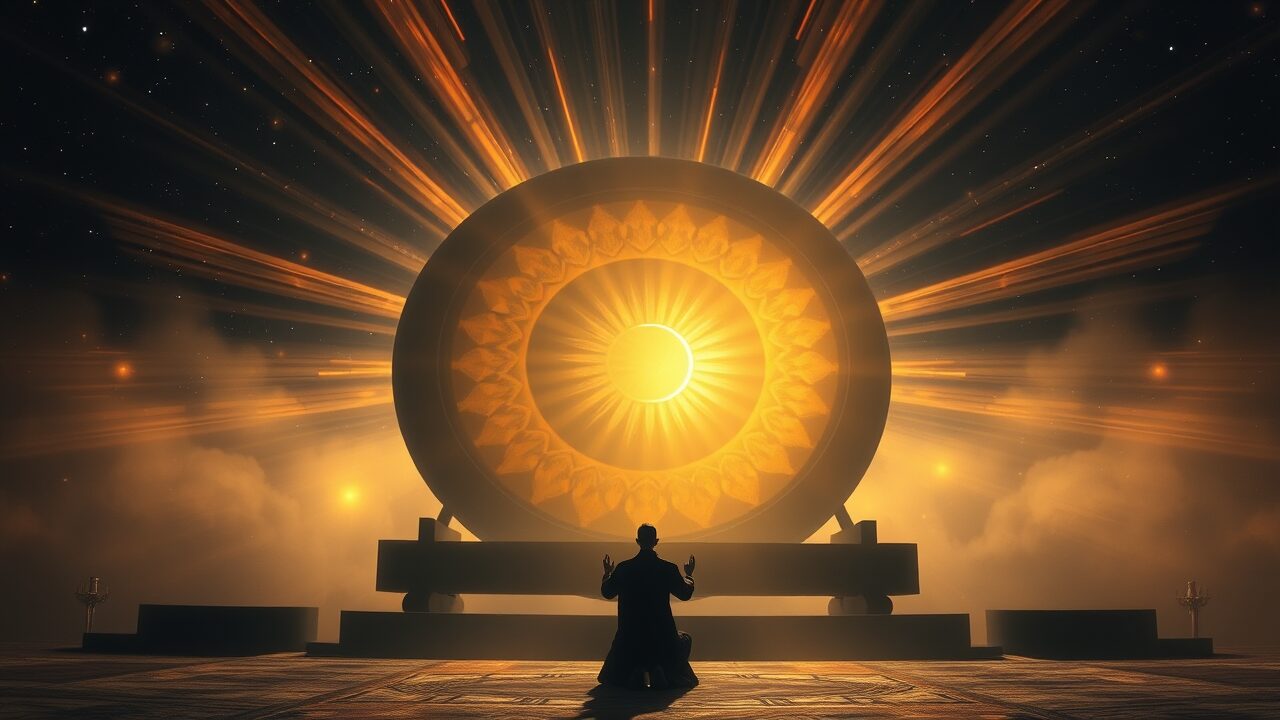
In one yoga class, the teacher struck a gong nearly one meter in diameter with a mallet—
The entire space became sound itself. Not through my ears — through chest, abdomen, bones — my whole body received the gong’s vibration, and my sense of “self as boundary” dissolved in an instant.
When the 90 minutes ended, I was in a state of “I cannot explain what just happened, but I am clearly more whole.” This was different from singing bowls or sound baths — a more direct, more shocking experience.
Gong meditation (Gong Meditation / Gong Bath) is an acoustic practice rooted in ancient Indian Kundalini yoga. This article honestly explains its science, effects, and practice.
💎 Key insight in one line Gong meditation is not “listening to sound” but “sinking into sound.” Unlike the delicacy of singing bowls, the overwhelming sea of vibration can shift consciousness instantly.
Quick Summary (30 seconds)
- Gong meditation = acoustic meditation with large gongs (50 cm to 1.5 m diameter).
- Traditional in ancient Indian Kundalini yoga, introduced to the West by Yogi Bhajan.
- Extraordinarily rich overtones produce cellular-level whole-body vibration experience.
- Reports include stress release, emotional cleansing, rapid induction of deep meditative states.
- Sessions of 45–90 minutes; fees approximately $40–80 in the US.
- Home recordings recreate only partially; live experience is far more intense.
1. What Gong Meditation Is
1-1. Gong History and Types
Gongs have been used as ritual instruments worldwide for millennia:
- China: ceremonial and military
- Indonesia: center of Gamelan music
- India: sacred ritual
- Europe: orchestral percussion
Main yoga gongs:
- Paiste gongs (Swiss manufacturer, the standard)
- Symphonic gongs: rich overtones, the typical choice
- Planet gongs: specially tuned to solar system orbital periods
1-2. Kundalini Yoga and the Gong
Yogi Bhajan (1929–2004) brought Kundalini yoga to the West in 1969 and introduced gong meditation as a core practice.
Yogi Bhajan’s teachings:
- “The gong destroys and recreates everything in the mind.”
- “Gong sound helps the ego be released.”
- “The most powerful tool to dissolve boundaries of consciousness.“
1-3. Typical Session Flow
0:00–10:00 Opening Kundalini breathing (pranayama), brief mantra.
10:00–20:00 Yoga / body prep Some sessions include physical yoga.
20:00–70:00 Gong meditation core (50 minutes) Participants lie supine. The practitioner plays the gong continuously. Sound intensity rises in waves; at peaks, the body vibrates throughout.
70:00–80:00 Silence and integration The gong stops; participants remain in stillness.
80:00–90:00 Closing Gradual return. Closing with mantra or short meditation.
2. Acoustic Characteristics
2-1. Why Gongs Differ from Singing Bowls
| Instrument | Size | Sound character | Quality of experience |
|---|---|---|---|
| Singing bowl | 8–40 cm | Delicate, warm | Quiet, subtle |
| Crystal bowl | 15–60 cm | Transparent, high | Spatial, expansive |
| Gong | 50–150 cm | Overwhelming, complex | Immersive, destruction and rebirth |
With its overwhelming size and vibrational energy, the gong creates not “listening to sound” or even “bathing in sound” — but “being swallowed by sound.”
2-2. Richness of Overtones
Gong sound has extraordinarily inharmonic overtone structure:
- Massive non-integer-multiple overtones from the fundamental
- Continually shifting “wow” and “beating”
- The same gong sounds completely different with different strokes
- More than “music” — an “acoustic life form“
2-3. Practitioner Skill
Professional gong players:
- Use mallets of different materials (felt, leather, wood)
- Strike different locations on the gong
- Modulate dynamics, speed, rhythm with great care
- Read the room intuitively and play accordingly
3. Effects of Gong Meditation
3-1. Reported Effects
Physical:
- Deep relaxation
- Release of muscular tension
- Reduced blood pressure and heart rate
Emotional:
- Rapid reduction of stress and anxiety
- Emotional release (tears, laughter, old memories)
- Improvement in depressed mood
Conscious:
- Sense of “ego boundary dissolving”
- Altered time perception
- Deep theta and delta brain wave states
- Spiritual experience
3-2. Research Evidence
Studies of gong meditation alone are limited, but sound-bath research applies:
- Goldsby et al. (2017): mood, tension, depression improvements in singing-bowl-inclusive sound meditation
- Stanhope & Weinstein (2021): sound-meditation group surpassed silent-meditation group
🔬 Key insight in one line Gong meditation effects can be understood as an extension of sound-bath research. Strong clinical evidence specifically for “unique gong effects” remains limited.
3-3. “Destruction and Rebirth”
Yogi Bhajan’s phrase “the gong destroys and recreates the mind” can be neurologically interpreted as:
- Temporary suspension of the default mode network (self-awareness)
- Formation of new neural patterns
- Psychological reorganization through intense emotional experience
4. What Participants Experience
4-1. Possible Experiences
- Intense emotional release: tears, laughter, anger
- Surfacing of past trauma memories
- Dramatic body sensations: floating, trembling, warmth
- Visions: colors, geometric patterns, symbolic images
- Loss of time perception
- Deep sleep
- Moments of “awakening”: rare but reported
4-2. Handling Negative Experiences
Gong is a powerful stimulus and not for everyone:
- If you have trauma, inform the practitioner in advance
- You can leave mid-session if uncomfortable
- Allow full integration time afterward
- For psychiatric conditions or epilepsy, consult a physician first
4-3. “Gong Hangover”
For 1–3 days after the session, strong emotions or fatigue may continue. This represents:
- Processing of released emotions
- Autonomic system recalibration
- Deep detoxification
Usually resolves within a few days.
5. Approximating the Experience at Home
5-1. Limits of Recordings
Honestly, recordings deliver only 30–40% of the gong meditation experience. Reasons:
- Low-frequency vibration is lost in recording
- Spatial resonance can’t be reproduced
- The practitioner’s intuitive playing is gone
5-2. Home Attempts
Quality gong recordings:
- YouTube “Gong Bath 90 Minutes”
- Choose live recordings of professional sessions
- Large speakers (preferably floor-placed)
Practice:
- Lie supine in a dark room
- Play at the largest tolerable volume (mind your neighbors)
- 90 minutes uninterrupted
- Eye mask and blanket
5-3. Owning Your Own Gong
- Beginner gongs: $200–700
- Pro-grade (Paiste): $1,500–7,000
- Space and practice time required
- Noise considerations (volume)
6. Finding Gong Meditation
6-1. In English-Speaking Countries
- Kundalini yoga studios: in most major cities
- Sound bath healers: programs often include gongs
- Events / retreats: special events held throughout the year
6-2. Search Keywords
- “Gong Meditation [city]”
- “Gong Bath [city]”
- “Kundalini Yoga [city]”
- “Sound Bath Gong”
6-3. Choosing a Good Practitioner
- KRI-certified Kundalini Yoga Teacher
- Completed Gong Master Training
- Multiple years of experience
- Description of gongs used (Paiste, symphonic, etc.)
- Responsive to pre-session questions
7. Persona Guide
A. Complete beginner
- Start with a short gong segment within a yoga class (10–20 min)
- Save 90-minute full sessions for the second visit
- Avoid driving afterward
B. Meditation practitioner
- Monthly full session × 1–2
- Use home recordings between
- Journal each experience
C. Aspiring practitioner / therapist
- KRI Kundalini Yoga Teacher Training (multi-year)
- Gong Master Course
- Own your own gong
8. Reader Voices
“After my first gong meditation, I cried for three days. I feel something I had been holding for years was released.” — Woman, 40s, counselor (Tokyo, 2 sessions)
“I’ve been doing gong meditation as part of Kundalini yoga for a year. It clarified my life’s direction.” — Man, 30s, executive (Osaka, 1 year)
“I’ve been a gong practitioner for 5 years. Every session, I am newly made.” — Woman, 50s, yoga teacher (Kyoto, 8 years)
9. FAQ
Q1. Singing bowls or gong — which is better? A. Depends on goal. Singing bowls for gentle daily meditation; gong for deep transformative experience.
Q2. Can I leave if it gets scary? A. Always. Confirm with the practitioner in advance.
Q3. During pregnancy? A. Consultation with physician is essential. Usually avoided in early pregnancy.
Q4. Hearing damage from loud volume? A. Professionals use appropriate volume. Bring earplugs if concerned.
Q5. Children? A. 13+ recommended. Some practitioners offer gentler sessions for younger kids.
Q6. With PTSD or trauma? A. Work in parallel with a trauma therapist. Inform the practitioner.
Q7. “Gong hangover”? A. Strong emotions or fatigue post-session. Normal response, resolves in days.
Q8. Does online gong work? A. Limited without physical vibration. OK as introduction.
Q9. How many effects per session? A. Highly individual. From “life-changing in 90 minutes” to “felt nothing.”
Q10. Standard pricing? A. $40–80 in the US. Retreats cost more.
10. Closing
Gong meditation is the most powerful and direct form of acoustic meditation.
- Rooted in ancient Indian Kundalini yoga
- Overwhelming sea of vibration from a large gong
- Deep transformation called “destruction and rebirth”
- Reports of emotional release, stress reduction, expanded awareness
- Home recordings: 30–40% of the live experience
- Realistic frequency: monthly studio experience
The first day I received a 90-minute gong meditation, I had the experience of my outline dissolving once and then re-forming.
It was not “relaxation.” It was, rather, “being taken to some deep place, becoming new, and returning.” A journey.
Not everyone needs gong meditation. But when you feel “I want to go somewhere deeper,” the gong is one of the ancient ships waiting to take you there.
That ship may be waiting for you.
References:
- Bhajan, Yogi. Kundalini Yoga Teachings
- KRI (Kundalini Research Institute) Resources
- Sound healing research compilations
Disclaimer: Informational and experiential. People with psychiatric conditions, epilepsy, or serious physical conditions must consult a physician before participation. Caution during pregnancy.