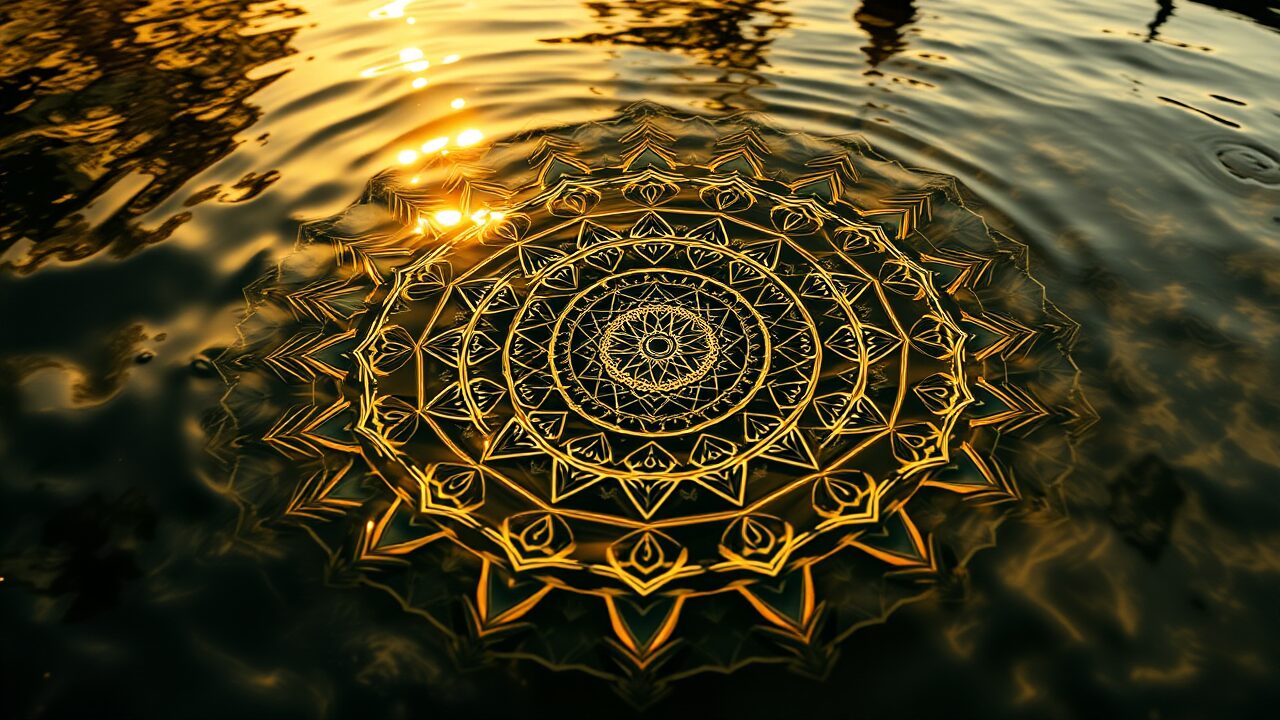
When I first watched a cymatics video on YouTube, I held my breath.
A sound starts, and a geometric pattern appears on the water. Change the frequency and the pattern transforms. Sound has a visible “form” — that was the moment I learned it for the first time.
Cymatics (cymatics) is the science studying the visual patterns sound vibration creates in matter. It looks mystical, but it is a real physical phenomenon, reproducible at home.
This article gently explains the science, history, experiments, and the larger question — “sound and the structure of the universe” — that cymatics gestures toward.
💎 Key insight in one line Cymatics is the science of “seeing sound.” Not a mystical phenomenon but a natural manifestation of vibration physics — yet its beauty truly touches the realm of poetry.
Quick Summary (30 seconds)
- Cymatics studies patterns that sound vibration creates in matter (water, sand, powders).
- 18th-century German physicist Ernst Chladni documented this with sand on metal plates (Chladni figures).
- Changing frequency produces a continuous transformation of geometric patterns.
- Visual similarity to sacred geometry (Flower of Life, mandalas) is often noted.
- Scientific reading: standing waves moving matter — a physical phenomenon.
- Poetic reading: resonates with the ancient idea that the cosmos was born from sound.
1. What Cymatics Is
1-1. The Basic Principle
Cymatics observes visual patterns created by sound vibration in matter. The most famous experiment:
- Sprinkle sand on a metal plate; vibrate the plate at a specific frequency
- Sand collects at the vibration’s “nodes” (motionless areas), forming geometric patterns
- Change the frequency and the pattern changes
The German physicist Ernst Chladni (1756–1827) documented this, and the resulting patterns are called Chladni figures.
1-2. Modern Cymatics Experiments
Today, more complex experiments are possible:
- Water in a shallow container, vibrated from below
- Cornstarch + water mixtures
- Metal powder or salt on a flat plane
Searching “Cymatics” on YouTube reveals enormous quantities of breathtaking video.
1-3. Why the Patterns Appear
🔬 Physics column Sound vibration creates standing waves. Standing waves have “nodes” (motionless) and “antinodes” (maximum vibration). Small particles like sand or water collect at the low-energy nodes, forming patterns. This is a predictable natural phenomenon described by mathematics.
2. A Brief History
2-1. Ancient Intuitions
The idea that “sound creates form” has existed since antiquity:
- Pythagoras (6th c. BCE): discovery of mathematical harmony in sound
- Plato: in Timaeus, “the cosmos is built on musical harmony”
- Kepler: in Harmonices Mundi, planetary motion as musical scale
These were abstract, philosophical arguments. Cymatics made them visible.
2-2. Chladni’s Discovery (1787)
Ernst Chladni systematized the sand on metal plate, bowed with a violin experiment, demonstrating that different patterns appear at each frequency. He called them “Klangfiguren (sound figures).”
This became a foundation of acoustics and continues to influence the design of modern stringed and percussion instruments.
2-3. Hans Jenny Modernized It (1967)
The Swiss physician Hans Jenny (1904–1972) coined the term “Cymatics” in the 20th century and systematized modern cymatics, documenting many experiments in his book Cymatics (1967, 1974).
Jenny was a physician with a leaning toward mysticism; his work is often discussed at the boundary between science and spirituality.
3. Cymatics and Sacred Geometry
3-1. Visual Similarities
Cymatic patterns resemble traditional sacred geometries from around the world in striking ways:
- Flower of Life (ancient Egypt, medieval Europe)
- Mandalas (Indian, Tibetan Buddhist)
- Arabesques (Islamic culture)
- Kagome (Japan)
Is this coincidence, or does it reveal common structure? Researchers, artists, and mystics each weigh in from their own positions.
3-2. Scientific Reading
🔬 Key insight in one line Cymatic patterns resemble sacred geometries because both arise from the mathematical structures of symmetry and periodicity — not because of mysterious meaning. Beauty emerges from structural necessity.
3-3. Poetic Reading
Literal mystical interpretations aren’t supported. But it is true that the ancient idea — “the universe was born from sound” (Nāda Brahman in Indian philosophy, where sound is god) — gains a visual reality through cymatics.
Poetry and science don’t oppose; they are different expressions of the same phenomenon.
4. Home Cymatics Experiments
4-1. What You Need
- Smartphone or speaker (for pure tone)
- A flat metal plate or food-grade plastic wrap
- Shallow container (~15 cm diameter)
- Salt, sand, cornstarch, or flour
- Tone generator app (free)
4-2. Steps (10 minutes)
- Stretch wrap over the container (like a drum head)
- Sprinkle salt thinly
- Touch the speaker directly to the wrap (or vibrate from below)
- Play 100 Hz from a tone generator app
- Observe the salt as you change frequency
- Try 200 Hz, 300 Hz, 400 Hz…
4-3. Frequencies for Beautiful Patterns
- 174 Hz (the lowest Solfeggio)
- 285 Hz
- 396 Hz
- 528 Hz (often considered the most beautiful)
- 741 Hz
💎 Key insight in one line Seeing cymatics with your own eyes brings the fact “sound is real” to bodily understanding. Video can’t convey it.
5. Cymatics in the MuZenCosmos Worldview
5-1. Visualizing Solfeggio
Solfeggio frequencies (528 Hz etc.) can be made visible through cymatics experiments. This:
- Lets you see Solfeggio effects before believing in them
- Makes sound’s physicality bodily comprehensible
- Deepens awareness during meditation
5-2. Personal Solfeggio Experiment Kit
- Simple kits available on Amazon and elsewhere for $20–80
- Search: “Cymatics kit”
5-3. Applications in Art and Education
- Music school classes using Chladni figures
- Artists creating acoustic installations
- Popular science material for children
6. Persona Guide
A. Complete beginner
- Watch YouTube “Cymatics 528 Hz” first
- Try a $20 home experiment on a weekend
- When listening to Solfeggio, recall “sound has form”
B. Science enthusiast
- Read Chladni’s original papers
- Build a serious home setup
- Learn the standing-wave physics
C. Artist / educator
- Use cymatic visuals in artwork
- Run workshops for children
- Curate exhibits combining sacred geometry and cymatics
7. FAQ
Q1. Is cymatics spiritual or scientific? A. The phenomenon is scientific. Interpretations connecting it to sacred geometry are personal. Keep the two separated for clarity.
Q2. Is home cymatics hard? A. Simple experiments are kid-friendly. From a few dollars to a few hundred.
Q3. Is it related to “DNA” or “water memory”? A. No scientific basis. Cymatics is vibration physics — medical and spiritual effects are separate questions.
Q4. Do Solfeggio frequencies produce beautiful patterns? A. Beautiful patterns appear at certain frequencies, but 528 Hz isn’t uniquely “special” — it’s about the wavelength-container relationship.
Q5. Educational use? A. Excellent for science education — sound physics made visible.
Q6. Professional cymatics setups? A. CymaScope (UK, hundreds of thousands of dollars) is famous in research.
Q7. Sacred geometry vs cymatics differences? A. Sacred geometry = traditional symbols. Cymatics = patterns physically created by sound. They can resemble each other visually.
Q8. Artists using cymatics? A. Andy Gilmore and other cymatic artists work worldwide.
Q9. iPhone cymatic apps? A. “Sound Vibrations,” “Cymatic Magic” — simulated experiences.
Q10. How to study seriously? A. Read Hans Jenny’s Cymatics. Browse academic sites.
8. Closing
Cymatics is the science where you can see, with your own eyes, that “sound creates form.”
- Geometric patterns sound creates in water, sand, and powder
- From Chladni’s 18th-century discovery to Jenny’s 20th-century modernization
- Visual resemblance to sacred geometry (explained by symmetry)
- Home experiments for $20–80
- Useful as a way to “see” Solfeggio effects
- A rare topic where poetry and science genuinely coexist
The first moment I watched that cymatics video, my trust in sound deepened a step.
Sound is not “vibration” as an abstraction. It is something with form — and to know that is, for anyone who lives with sound, a small revelation.
Remember today, when you put on music, that in some invisible place, beautiful geometry is being drawn.
References:
- Chladni, E.F.F. Entdeckungen über die Theorie des Klanges (1787)
- Jenny, Hans. Cymatics (Vol. 1: 1967, Vol. 2: 1974)
- Modern Cymatics Research (CymaScope archives)
Disclaimer: Scientific and educational content. Cymatics experiments are safe; children should perform them under adult supervision.