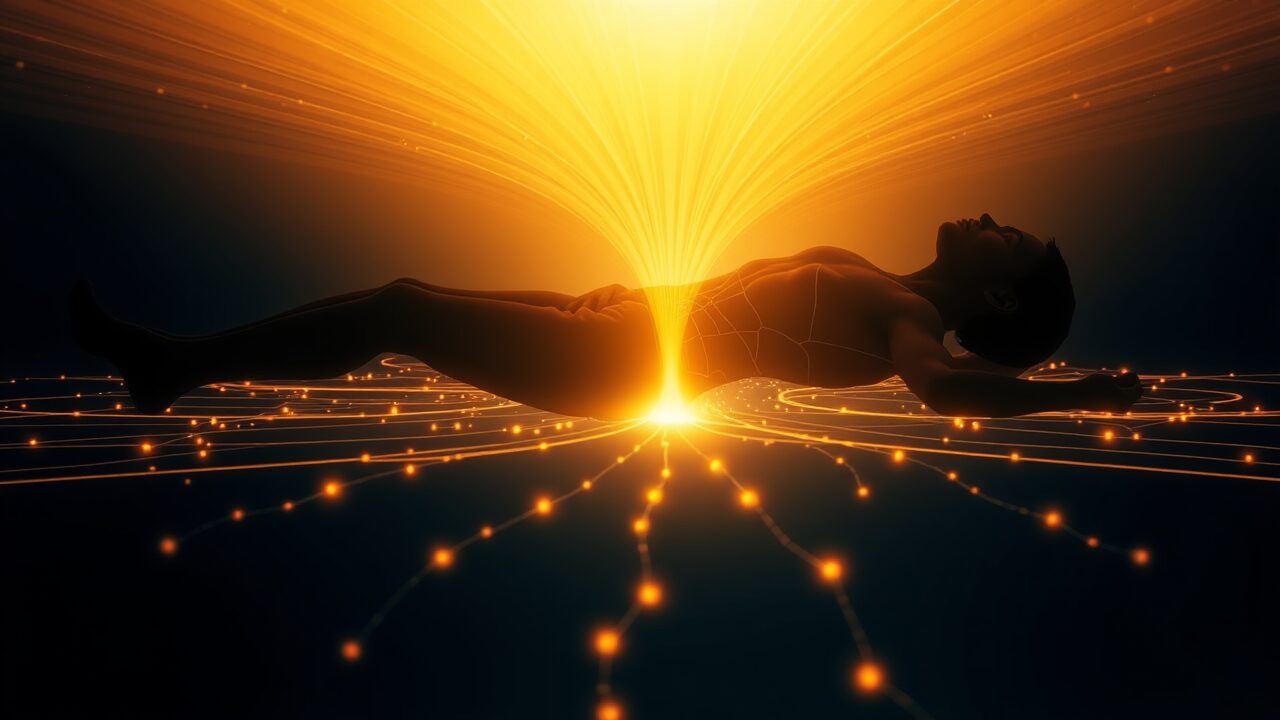
One night I couldn’t sleep for hours.
Thoughts wouldn’t stop. The harder I tried to sleep, the less I could. Then I tried the body scan meditation I’d been taught — lie on my back, slowly move attention from head to toes through bodily sensations — just that.
Fifteen minutes later, I was deeply asleep. I realized: I had been trying to sleep while still “thinking.”
Body scan meditation is the central practice of MBSR (Mindfulness-Based Stress Reduction), used in medical institutions worldwide. This article explains the science and offers complete 10, 20, and 30-minute scripts.
💎 Key insight in one line The body scan is the simplest, strongest meditation for “moving attention from thought to bodily sensation.” For insomnia, stress, chronic pain — there is scientific evidence for all of them.
Quick Summary (30 seconds)
- Body scan meditation: directing attention through each body part in sequence, head to toes.
- The core practice of MBSR (Mindfulness-Based Stress Reduction).
- Strong scientific evidence for insomnia, chronic pain, anxiety, depression.
- Practiced in 10, 20, or 30-minute versions.
- Lying down (supine) is the standard; chair or seated also work.
- “Falling asleep is fine” — sleep is also an outcome.
1. What Body Scan Meditation Is
1-1. The Basic Concept
Body scan meditation directs attention sequentially to body parts, observing sensations:
- Begin at the crown, end at the toes (or reverse)
- Don’t try to change anything
- Just notice “this is here”
- When thoughts arise, don’t follow them
1-2. Jon Kabat-Zinn and MBSR
Modern body scan meditation is at the heart of Mindfulness-Based Stress Reduction (MBSR), developed by Dr. Jon Kabat-Zinn in 1979:
- MBSR: an 8-week program
- Body scan practiced 30–45 minutes daily
- Standard practice in medical institutions for chronic pain, stress, depression, anxiety
- Adopted worldwide
1-3. Buddhist Roots
The body scan’s prototype lies in Theravada Buddhist Vipassana meditation. Specifically:
- Teachings of U Sayadaw (Myanmar)
- Goenka (India) 10-day retreats
- MBSR translated these to a medical context
🔬 Neuroscience column During the body scan, the brain’s insular cortex activates. The insula handles “interoception” (sensing your own body), and strengthening it has been shown to improve emotional self-regulation and stress tolerance.
2. Scientific Evidence
2-1. Key Studies
Kabat-Zinn et al. (1985) 90 chronic pain patients in an MBSR program. Body-scan-centered practice significantly reduced subjective pain intensity and related anxiety.
Carmody & Baer (2008) 174 MBSR participants. Body scan practice time correlated with improvements in mindfulness and psychological health.
Sevinc et al. (2018) fMRI research. Body scan meditators show structural changes in the insula and prefrontal cortex.
Cochrane Review MBSR/MBCT showing significant effects on anxiety, depression, chronic pain.
2-2. Main Effects
- Insomnia improvement: better sleep onset, better sleep quality
- Chronic pain: reduced subjective pain intensity
- Stress: lower cortisol
- Anxiety / depression: symptom reduction
- Emotional regulation: via strengthened insula
- Focus: improved attention
3. Preparation
3-1. Environment
- Quiet room (mild quiet, not absolute silence)
- Comfortable temperature (slightly warm)
- Yoga mat or futon (supine preferred)
- Dim light (indirect lighting at night)
- Phone on airplane mode
3-2. Clothing
- Loose, comfortable clothes
- Warm feet (socks recommended)
- Eye mask is optional since eyes will be closed
- Blanket provides reassurance
3-3. Timing
Morning:
- Within 30 min of waking
- Effect: focus and clarity at the start of the day
Midday:
- 20 minutes during lunch
- Effect: reset afternoon fatigue
Evening:
- 30 minutes before sleep
- Effect: improved sleep quality, insomnia improvement
💎 Key insight in one line “Falling asleep is not failure.” The body scan is also the best tool to fall asleep for people with insomnia.
4. 10-Minute Body Scan Script
Practice supine. About 30 seconds to 1 minute per area.
【0:00-0:30 Preparation】
Lie on your back; three slow deep breaths.
Close your eyes.
Say in your mind: "The next 10 minutes are mine."

【0:30-1:30 Head】
Bring attention to the crown.
Surface of head, scalp, hair roots.
Forehead, eyebrows, around the eyes.
Sense something? Sense nothing?
Either is correct. Just "be aware."

【1:30-2:30 Face and neck】
Nose, cheeks, mouth, jaw, tongue, teeth.
Observe each sensation in turn.
Front of neck, back, both sides.
If there's tension, allow it to soften.

【2:30-3:30 Shoulders and arms】
Both shoulders, upper arms, elbows, forearms, wrists.
Palms, fingertips.
Weight, warmth, sensation.

【3:30-5:00 Chest and back】
Center of chest, ribcage movement.
Breath filling and leaving lungs.
Upper back, middle, lower.
The sense of contact with the floor.

【5:00-6:30 Stomach】
Around the navel, abdomen rising and falling.
Stomach, intestines, internal organs (if present).
Warmth, air's motion.

【6:30-7:30 Lower back and pelvis】
Lower back left/right, pelvis sensations.
Contact surface with the floor.
Surrender gravity here.

【7:30-9:00 Legs】
Both thighs, knees, calves.
Shins, ankles, both feet tops.
All the way to both feet's toes.

【9:00-10:00 Whole body】
Feel the whole body as one being.
"One body" from head to toes.
Three slow breaths; gently open the eyes.
5. 20-Minute Script
Twice the time per area compared to the 10-minute version.
【0:00-1:00 Preparation】
Supine, three breaths, set intention.

【1:00-3:00 Head】(2 min)
Crown, scalp, forehead, around eyes, cheeks, nose, mouth, jaw.
15–20 seconds per area.

【3:00-5:00 Neck and shoulders】
Front of neck, back, both sides, both shoulders, shoulder blades.

【5:00-8:00 Arms】
Both upper arms, elbows, forearms, wrists, palms, all 10 fingers.

【8:00-11:00 Chest and back】
Ribcage, area around the heart, ribs.
Each part of the back.

【11:00-13:00 Stomach】
Stomach, intestines, down to the pelvic floor.

【13:00-16:00 Legs】
Thighs, knees, calves, ankles, each part of the foot.

【16:00-19:00 Whole-body integration】
Sense of the whole body, breath's movement, weight, lightness.

【19:00-20:00 End】
Slow awakening, three breaths, open eyes.
6. 30-Minute (MBSR Standard) Outline
The 30-minute version is the official MBSR length. Jon Kabat-Zinn’s audio guide is the global standard.
Concise structure:
- 0–2 min: preparation
- 2–5 min: breath awareness
- 5–10 min: left foot through left leg
- 10–15 min: right foot through right leg
- 15–20 min: pelvis, abdomen, chest
- 20–25 min: both arms, both hands
- 25–28 min: shoulders, neck, head
- 28–30 min: whole-body integration, end
7. Common Difficulties and Solutions
7-1. “I can’t feel anything” in some areas
Solution: That’s also awareness. “Noticing that I notice nothing” is itself meditation.
7-2. Thoughts won’t stop
Solution: “The moment you notice a thought arose, that too is meditation.” Gently return to bodily sensation.
7-3. Falling asleep
Solution: Sleep is an outcome too. Evidence of deep relaxation. With practice, you can enter deep states without sleeping.
7-4. Tears come
Solution: Don’t suppress. Accumulated emotion is releasing.
7-5. A body part is uncomfortable
Solution: Don’t force the scan. Move on. Observing the discomfort itself is advanced.
8. Persona Guide
A. Complete beginner
- Start with 10-min daily for one week
- Best before sleep
- Don’t seek perfection; value “having done it”
B. For insomnia improvement
- 30-min version every night before sleep
- Sleep is fine; awake is fine
- 3 weeks of practice for noticeable effect
C. Chronic pain / body issues
- Initially during times of less pain
- “Observe pain without trying to change it”
- Consider working with MBSR-certified instructor
D. Stress / anxiety
- 20-min morning to lay the day’s foundation
- Short version (5 min) during work breaks
- Consider formal MBSR/MBCT programs too
9. After-Body-Scan Feelings
9-1. Common Sensations
- Sense of resting in gravity
- Feeling the body has flattened (tension release)
- Mental clarity
- Sleepiness or alertness (varies)
- Emotional stability
9-2. Post-Session Care
- Don’t move immediately (stay quiet 5 min)
- Drink water
- Avoid intense exercise / caffeine (especially at night)
- Journal insights (optional)
10. Reader Voices
“Twenty years of insomnia, but after three months of nightly 30-min body scans, more nights I sleep without medication.” — Woman, 50s, homemaker (Tokyo, 6 months)
“On leave for depression, I joined MBSR. The body scan let me rediscover my body. Two years post-return, still doing it.” — Man, 40s, employee (Yokohama, 3 years)
“Chronic lower back pain — I depended on painkillers. The body scan changed my relationship with pain. My medication dropped by half.” — Woman, 30s, nurse (Kobe, 1 year)
11. FAQ
Q1. How many minutes should I do? A. Start with 10 min. Then 20 min, ideally 30 (MBSR standard).
Q2. Do I have to practice daily? A. 8 weeks of daily practice is most effective (research-confirmed). 3–4 days a week also helps.
Q3. Can I sit in a chair? A. Yes. Recommended if sleepiness is strong, to reduce supine sleep risk.
Q4. Can I play music (BGM)? A. Silence is preferred (for pure sensation observation). Soft music OK while adjusting.
Q5. Should I use guided audio? A. Strongly recommended for beginners. Switch to silent / your own pace as you progress.
Q6. What about painful body parts? A. Just observe. Don’t try to change. For serious pain, consult a physician.
Q7. Can I teach children? A. Yes. 5-minute version as a game. Helpful for falling asleep.
Q8. During pregnancy? A. Safe and recommended. A good time to deepen awareness of bodily change.
Q9. With depression? A. Adopted in MBCT. Ideal under physician guidance.
Q10. Body scan vs other meditations? A. Focus of attention is “body sensation.” Different from breath meditation (breath) or loving-kindness (emotion).
Q11. When will I feel effects? A. Initial change in 1–2 weeks, stable effects after 8 weeks (MBSR research).
Q12. How to choose a recorded guide? A. Jon Kabat-Zinn’s direct recordings are world standard. Many guided versions on Insight Timer.
12. Closing
Body scan meditation is the strongest method for moving attention from thought to bodily sensation.
- Core MBSR practice, adopted in medical institutions worldwide
- Strong evidence for insomnia, chronic pain, anxiety, depression
- 10/20/30-minute versions
- Supine or seated, both OK
- “Falling asleep is fine”
- 8 weeks of practice = stable effects
That night, what put me to sleep was the body scan that let me stop trying to sleep.
Turning attention to the body is stepping down from the head. On nights the head can’t solve things, the body has always been waiting for you.
If you can’t sleep tonight, start at the crown. Crown, forehead, eyes, cheeks, the heartbeat in the chest…
Before you reach your toes, you’ll probably already be asleep.
References:
- Kabat-Zinn, J. Full Catastrophe Living (1990, updated 2013)
- Kabat-Zinn et al. MBSR for chronic pain (1985)
- Sevinc et al. Neuroimaging body scan meditation (2018)
- Carmody & Baer MBSR practice outcomes (2008)
Disclaimer: Informational. Severe physical or psychiatric conditions should be practiced under physician and certified MBSR teacher guidance.