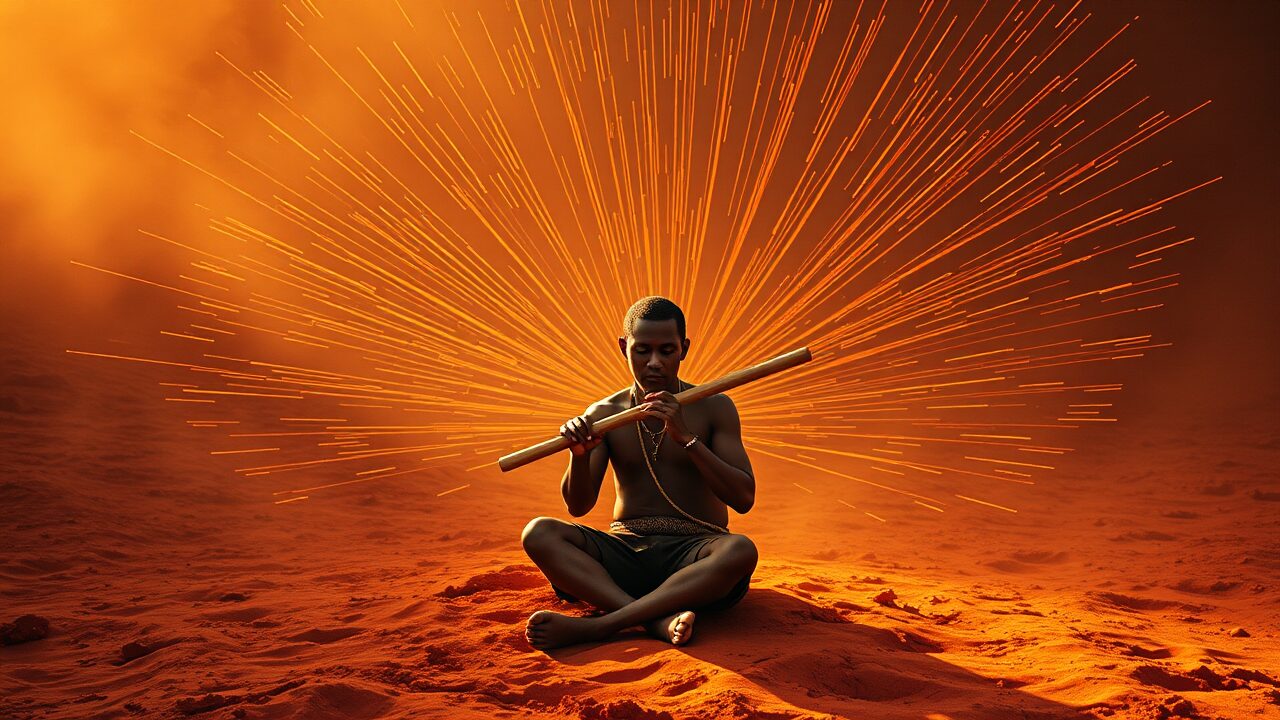
The first time I heard a didgeridoo, I thought: “This isn’t music. This is the voice of the Earth.”
A low, deep, unceasing overtone. Unlike ordinary wind instruments, it never breaks for breath; for minutes, sometimes hours, the same sound continues to emerge as if welling from the earth itself. This is the world’s oldest wind instrument, a tradition the Aboriginal people of Australia have played for over 40,000 years.
And remarkably, modern medical research has demonstrated its effectiveness in treating obstructive sleep apnea syndrome.
This article explains, honestly, the culture, science, and practice of the didgeridoo.
💎 Key insight in one line The didgeridoo is “the world’s oldest, and one of the few indigenous instruments with scientifically proven medical effects.” Evidence supports its role in sleep apnea and respiratory function improvement.
Quick Summary (30 seconds)
- The didgeridoo is the traditional instrument of Aboriginal Australians, with 40,000+ years of history as the world’s oldest wind instrument.
- Crafted from eucalyptus wood naturally hollowed by termites.
- Circular breathing (inhaling through the nose while continuously exhaling through the mouth) sustains continuous sound.
- A 2006 BMJ-published study confirmed its effectiveness against obstructive sleep apnea syndrome.
- Research evidence also exists for asthma, respiratory function improvement, and stress reduction.
- Entry-level instruments start around $70–250; basics learnable in 1–3 months.
1. What the Didgeridoo Is
1-1. Origins and History
The didgeridoo (also Yidaki, Mago, and other regional names):
- Originates in Australia’s Arnhem Land
- Played for 40,000+ years (estimated)
- Recognized as the world’s oldest wind instrument (per some researchers)
- At the heart of Aboriginal culture: ritual, storytelling, healing
1-2. Instrument Structure
- Made from eucalyptus branches naturally hollowed by termites
- Length: 1–2.5 meters
- Diameter: 5–15 cm
- Surface often features traditional Aboriginal painting
- No Western-style precise tuning: natural is best
1-3. Why “World’s Oldest”
- Rock paintings of didgeridoo players date back ~2,000 years
- Archaeological evidence suggests an origin 40,000+ years ago
- The oldest recorded musical instrument in human history
🔬 Acoustic column The didgeridoo’s abundance of inharmonic overtones produces texture unlike any other instrument. The player can control complex overtones with mouth, tongue, and voice above a constant fundamental — a unique characteristic.
2. The Astonishing Technique of Circular Breathing
2-1. What Circular Breathing Is
The most remarkable feature of the didgeridoo: continuous sound without breath breaks. This relies on circular breathing:
- Store air in your cheeks
- While producing sound from the cheek-stored air, rapidly inhale fresh air through the nose
- Switch continuously
The result: sound can continue for minutes — or tens of minutes — uninterrupted.
2-2. Health Effects
Circular breathing practice produces:
- Strengthening of respiratory muscles (diaphragm, intercostals, abdominals)
- Increased lung capacity
- Improved autonomic control of breathing
- Promotion of parasympathetic activity
2-3. Learning Curve
- Producing a basic tone: 5–30 minutes
- Sustaining the sound: 1–2 weeks
- Basic circular breathing: 2–3 months
- Free overtone control: 1+ years
3. Medical Research
3-1. Sleep Apnea Research
Puhan et al. (2006, BMJ) A randomized controlled trial in Switzerland (25 participants). Moderate obstructive sleep apnea patients received 4 months of didgeridoo training.
Results:
- Daytime sleepiness scores significantly improved
- Apnea/Hypopnea Index (AHI) reduced
- Partners’ sleep quality also improved
Mechanism: Didgeridoo playing strengthens upper airway muscles (soft palate, tongue, pharynx), reducing airway collapse during sleep.
3-2. Other Research
Asthma research Small studies suggest didgeridoo respiratory training links to improved respiratory function and peak flow in asthma patients.
Stress / autonomic Circular breathing itself activates parasympathetic activity, contributing to stress reduction.
3-3. What Can and Can’t Be Said
🔬 Key insight in one line The didgeridoo is “one of the few indigenous instruments with medically proven treatment effects.” Especially for sleep apnea, BMJ-published RCT evidence exists.
But “effective for all diseases” or “spiritual healing power” claims lack scientific support.
4. Starting the Didgeridoo
4-1. Choosing an Instrument
For beginners:
- Entry-level wooden didgeridoo: $70–250
- Agave didgeridoo (South America): lightweight, easy
- Plastic / PVC: $30–80 (practice instruments)
Pitch:
- Long ones (2 m+): low notes, deep meditation
- Short ones (1–1.5 m): high notes, energetic
- Beginners: medium range (1.3–1.5 m, fundamental C–D)
Note:
- Genuine Aboriginal craftsman instruments: $350–2,500 (expensive)
- Tourist-grade items: may be acoustically inferior
4-2. Playing Basics (Self-Study)
Step 1: Produce a fundamental tone (5–30 min)
- Vibrate lips with “buh-buh-buh”
- Apply to mouthpiece of didgeridoo
- Continuous sound through lip trill
Step 2: Sustain the tone (1–2 weeks)
- Stabilize lip vibration
- Use abdominal breathing
- Continuous sound for 1–5 minutes
Step 3: Circular breathing (2–3 months)
- Practice storing air in cheeks (with water)
- Sound from cheek-stored air while inhaling through nose
- Master switching timing
4-3. Learning Resources
- YouTube: “Didgeridoo Lessons for Beginners”
- Online courses: Udemy, Skillshare
- Local didgeridoo teachers: in many cities
- Books: introductory materials
5. Didgeridoo in the MuZenCosmos Worldview
5-1. The Pinnacle of Overtones
The didgeridoo is among the most overtone-rich instruments in the world. Unlike singing bowls’ inharmonic overtones, it produces dynamically shifting overtones.
5-2. Earth Grounding
- The didgeridoo’s low frequencies create a bodily sense of “connecting to the earth”
- Optimal for grounding meditation
- Overlaps with the 174 Hz (deep rest) frequency range
5-3. Cultural Respect
The didgeridoo is a sacred instrument of Aboriginal culture:
- Traditionally, in some regions, only men played it
- Women playing remains discussed in modern contexts
- Genuine instruments are best purchased from traditional craftspeople
- Avoid learning ceremonial / sacred melodies (to avoid cultural appropriation)
💎 Key insight in one line Learning the didgeridoo means touching 40,000 years of human acoustic culture. A special instrument that deserves to be experienced with cultural reverence.
6. Persona Guide
A. Complete beginner
- Experience the sound on YouTube
- Start with a plastic practice didgeridoo
- 10 minutes daily for 3 months
B. Yoga / meditation practitioner
- Purchase a wooden entry-level ($70–250)
- 10-minute pre-meditation play
- Integrate circular breathing into breath meditation
C. Health improvement (sleep apnea, etc.)
- Consult a physician
- Training program (~4 months)
- Establish continuous playing habit
7. Reader Voices
“I had sleep apnea and was using CPAP. After a year of playing didgeridoo, I can sleep without CPAP. Can’t say it was only the didgeridoo, but it has definitely helped.” — Man, 50s, salaryman (Tokyo, 2 years)
“Three months into practice, I could do circular breathing. My relationship with breath has completely changed.” — Man, 30s, yoga teacher (Sapporo, 1 year)
“I fell in love with Aboriginal culture and started playing. It feels like touching 40,000 years of history through sound.” — Woman, 40s, anthropology fan (Kyoto, 3 years)
8. FAQ
Q1. Can women play? A. Female players are increasing in modern times. But carry respect for the traditional cultural background.
Q2. Will it disturb neighbors? A. Low frequencies surprisingly don’t carry, but avoid nighttime. Choose practice space carefully.
Q3. Can kids play? A. Possible from around age 5. Use short instruments.
Q4. During pregnancy? A. Use caution — abdominal pressure is involved. Consult a physician.
Q5. Is a genuine Aboriginal craftsman instrument necessary? A. Not necessary for playing, but culturally meaningful.
Q6. Does PVC produce real effects? A. Acoustically inferior, but sufficient for practice.
Q7. Can it be used in yoga classes? A. Yes. Before and after Shavasana, or as meditation BGM.
Q8. Can I become a professional? A. People work as performers and teachers. World didgeridoo festivals exist.
Q9. Reeds or tools needed? A. Nothing. Just the instrument and your lips.
Q10. Can recordings substitute? A. You can listen but won’t gain the physical benefits of playing.
9. Closing
The didgeridoo is an instrument that carries 40,000 years of human acoustic culture.
- Aboriginal Australia’s traditional instrument
- World’s oldest wind instrument (40,000+ years)
- Astonishing circular breathing technique
- Medical effectiveness for obstructive sleep apnea (BMJ 2006)
- Entry $70–250; 3 months to learn basics
- Must be approached with cultural respect
That the didgeridoo’s sound seems like “the Earth’s voice” is probably no coincidence.
For 40,000 years, humans have lived with this instrument. Its vibration carries the prayers, stories, and healing of the oldest humanity, still inscribed in the wood.
If you have a moment tonight, search YouTube for “Didgeridoo Meditation.” The world’s oldest instrument may support your sleep deeply in ways nothing newer can.
References:
- Puhan, M.A. et al. Didgeridoo playing as alternative treatment for obstructive sleep apnoea syndrome: randomised controlled trial (BMJ, 2006)
- Aboriginal culture and didgeridoo research papers
- Australian National University didgeridoo studies
Disclaimer: Informational and instrumental learning reference. Sleep apnea and other medical conditions require physician consultation. Approach with respect for Aboriginal cultural heritage