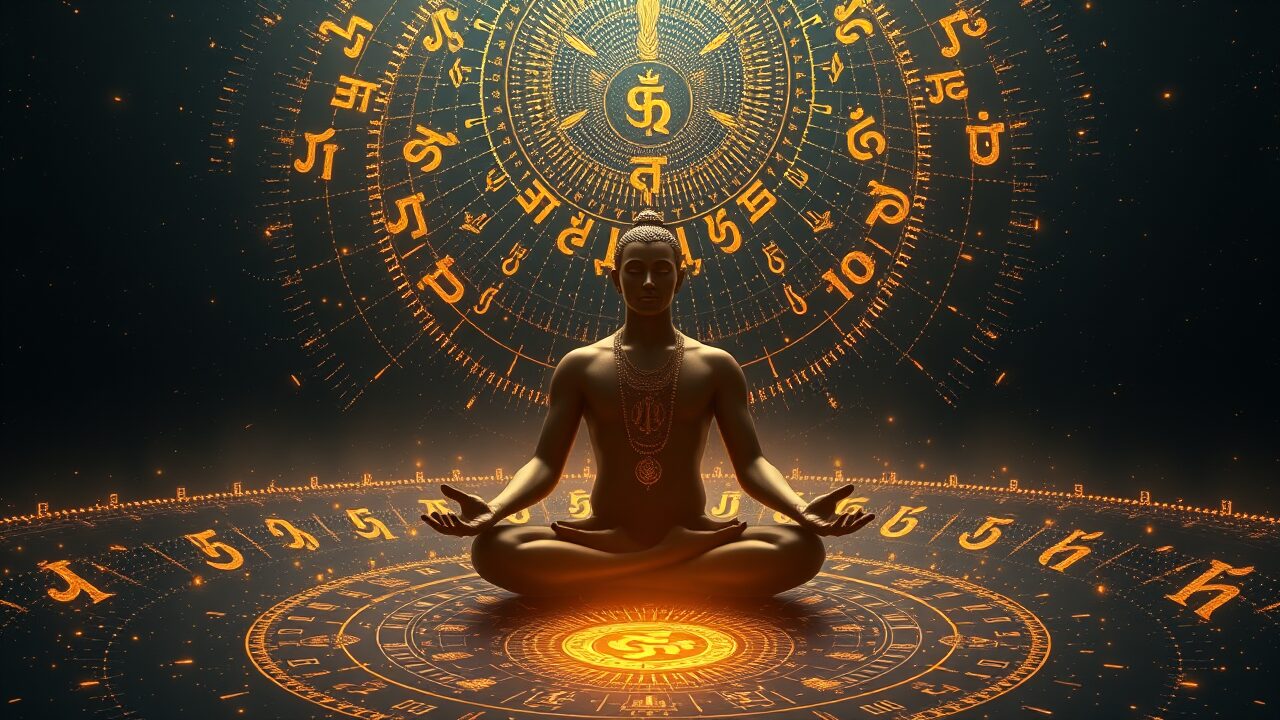
“Om,” “So-Hum,” “Nam Myoho Renge Kyo” —
Why do these words have the power to settle the mind?
Mantra meditation is a ~5,000-year-old tradition rooted in ancient Indian Vedic philosophy. “Mantra” in Sanskrit means “that which liberates the mind.” By repeating specific sounds or words, the practitioner enters deep states of awareness.
In modern research, hundreds of papers on TM (Transcendental Meditation) confirm stress reduction, lower blood pressure, and improved brain function.
This article explains mantra meditation’s science, history, and practice — honestly.
💎 Key insight in one line Mantra meditation is the ancient technique of “escaping thought-loops by repeating a specific sound vibration.” The most-studied meditation type — supported by modern science.
Quick Summary (30 seconds)
- Mantra meditation = repeating specific sounds / words.
- ~5,000-year history; rooted in Vedic philosophy.
- Famous mantras: Om (AUM), So-Hum, Gayatri.
- TM (Transcendental Meditation) is the most-researched form (hundreds of papers).
- Standard practice: 2× daily for 20 minutes.
- Used across religions, in medical institutions and corporations worldwide.
1. What Mantra Is
1-1. Etymology
Sanskrit “mantra“:
- man: “to think, mind”
- tra: “instrument, protection”
So: “an instrument that liberates the mind” / “a sound that protects the mind.”
1-2. Why “Sound”?
Vedic philosophy holds that the universe was born from sound:
- Nāda Brahman: “sound is god”
- Shabda Brahman: “sound itself is ultimate reality”
Certain sounds (mantras) are held to resonate with the universe’s vibration; repeating them leads consciousness into higher states — this is mantra meditation’s philosophical foundation.
1-3. Three Practice Levels
Mantras are chanted three ways:
| Level | Method | Effect |
|---|---|---|
| Aloud (Vaikhari) | Normal voice volume | Beginner-friendly, body-felt vibration |
| Whisper (Upāmśu) | Lips move, voice soft | Intermediate, internal focus |
| In the mind (Mānasika) | Fully internal | Advanced, deepest |
Tradition deepens from Vaikhari → Upāmśu → Mānasika.
🔬 Acoustic column Audible mantras create physical vibration in throat, chest, and nasal cavity. This stimulates the parasympathetic nervous system, shifts mood, and changes brain waves. fMRI research shows auditory cortex activates when chanting mentally too.
2. Major Mantras
2-1. Om (AUM / ॐ)
The most universal mantra. Detailed in Article 47.
- Three syllables: A-U-M
- Beginning, continuation, end of the universe
- ~136.1 Hz (mathematical calculation)
2-2. So-Hum
The best mantra for integrating with breath:
- “So” = inhale (I am That)
- “Hum” = exhale (I am That)
- Matches natural breath
- Means “I am That” / “I am the universe itself”
2-3. Gayatri Mantra
The most sacred mantra in the Vedas:
Om Bhūr Bhuvah Svah
Tat Savitur Vareṇyaṃ
Bhargo Devasya Dhīmahi
Dhiyo Yo Naḥ Prachodayāt
“Prayer to the all-pervading light of the sun.” Traditionally chanted morning, evening, and noon in India.
2-4. Om Namah Shivaya
A 6-syllable mantra meaning “I bow to Shiva.” A mantra of purification and transformation.
2-5. Buddhist Mantras
- Om Mani Padme Hum (Tibetan Buddhism, Avalokiteśvara)
- Nam Myoho Renge Kyo (Nichiren Buddhism, devotion to the Lotus Sutra)
- Om Tare Tuttare Ture Svaha (Green Tara)
2-6. Christian “Mantras”
Mantra meditation crosses religious boundaries:
- Ave Maria (Catholic)
- Jesus Prayer: “Lord Jesus Christ, Son of God, have mercy on me”
- Amen: “so it is“
2-7. TM Bija Mantras
In Transcendental Meditation (TM), an authorized teacher assigns a personal mantra:
- Syllables like Shīram, Shāma, Shūram
- Pure vibration, no semantic meaning
- Typically delivered through paid formal training
3. The Science of TM (Transcendental Meditation)
3-1. What TM Is
Maharishi Mahesh Yogi (1918–2008) systematized it in 1957:
- Practiced by the Beatles, Steve Jobs, and others
- Standard: 2× daily, 20 minutes
- Hundreds of scientific papers
- AHA supports it for cardiovascular risk reduction
3-2. Key Studies
Schneider et al. (2012) Published in the American Heart Association journal. 201 cardiovascular patients RCT. TM group showed 48% reduction in mortality, heart attack, and stroke risk.
Orme-Johnson & Walton (1998) TM meditation meta-analysis. Significant improvements in cortisol, blood pressure, anxiety.
Travis et al. (2010) Brain wave research during TM. Increased frontal alpha coherence, linked to creativity and problem-solving.
3-3. TM vs Other Mantra Meditation
TM features:
- Personalized mantra
- Standardized protocol
- Transmission from certified teacher (paid: thousands of dollars)
- Extensive research base
Other mantra meditation:
- Practicable for free yourself
- Diverse traditions
- Less standardized than TM
- Effect depends on practitioner’s consistency
💎 Key insight in one line TM is “strongest in research record.” But traditional free mantra meditation, with consistency, can match it. More than money, practice quality and continuity matter.
4. Practice
4-1. Preparation
- Quiet room
- Comfortable seated (cross-legged or chair)
- Spine upright
- Eyes closed
- 20-minute timer
4-2. 20-Minute Basic Practice
【0:00-2:00 Preparation】
Adjust posture, three deep breaths
"For the next 20 minutes, I am with the mantra"

【2:00-3:00 Choose the mantra】
Confirm today's mantra in mind
(Om, So-Hum, or your chosen mantra)

【3:00-18:00 Repeat the mantra (15 min)】
Mentally (or softly aloud), repeat
Match breath rhythm (for So-Hum: exhale and inhale)

Thoughts arise → return to mantra
Gently, again and again

Don't try to "chant perfectly"
"Just being with the mantra" is enough

【18:00-19:00 Silence】
Stop the mantra
Stay in the residue

【19:00-20:00 Awaken】
Slowly open eyes
Three deep breaths
Gently move the body
4-3. Using Japa Mala (Beads)
Traditionally uses 108 beads:
- One bead advances per mantra
- Once around = 108 repetitions
- Aids focus
- Wood, crystal, Rudraksha (sacred seed), etc.
4-4. Recommended Frequency
Beginner:
- 1× daily, 10–15 min
- 2 weeks
Once accustomed:
- 2× daily (morning, evening), 20 min each
- Same as TM standard
Advanced:
- 2× daily, 30 min each
- Vary mantras for diversity
5. Choosing a Mantra
5-1. For Beginners
So-Hum:
- Naturally integrates with breath
- Meaning is deep
- No religious flavor
Om (OM):
- Most universal
- Simple, single-syllable
- Vibration easy to feel in the body
5-2. By Purpose
| Purpose | Recommended mantra |
|---|---|
| Stress reduction | So-Hum, Om |
| Creativity | Saraswati’s mantra |
| Healing / health | Buddhist healing mantras |
| Self-love | Loka Samasta Sukhino Bhavantu |
| Focus | Gayatri |
| Compassion | Om Mani Padme Hum |
5-3. Finding Your Mantra
- Choose what intuitively resonates
- Choose by understanding the meaning too — fine
- Stick with one mantra for at least 3 weeks
- Change if it doesn’t fit
6. Persona Guide
A. Complete beginner
- Begin with So-Hum
- 10 min daily for 3 weeks
- Use guided audio
B. Yoga practitioner
- Integrate mantra with breath techniques
- Three Oms before class
- 30 min home mantra session
C. With religious background
- Practice with your faith’s prayer / scripture
- Use rosary or beads
- Systematize as mantra meditation
D. Business / science-oriented
- Consider TM
- Certified teacher training (thousands of dollars)
- Based on research evidence
7. With Solfeggio Frequencies
| Frequency | Mantra compatibility |
|---|---|
| 528 Hz | 528 Hz + So-Hum = heart meditation |
| 963 Hz | 963 Hz + Om = cosmic consciousness meditation |
| 741 Hz | 741 Hz + Gayatri = expression and creativity |
Suggested session:
Morning mantra meditation (30 min):
1. 528 Hz audio in background, low volume
2. So-Hum with breath
3. After 20 min, 3 min silence
4. Set the day's intention
8. Reader Voices
“Recommended during depression leave. A year of morning and evening So-Hum meditation — two years post-return, still doing it. I’ve been able to taper off medication completely because of this.” — Man, 40s, former engineer (Tokyo, 3 years)
“Took the TM certification course 10 years ago. Focus, creativity, life satisfaction — everything changed. Best investment of my life.” — Woman, 50s, executive (Sapporo, 10 years)
“Catholic, but I practice the Ave Maria as a mantra meditation. Traditional prayer meets modern meditation science — that synthesis fits me.” — Woman, 60s, retired teacher (Kobe, 5 years)
9. FAQ
Q1. Does it work if I don’t know the mantra’s meaning? A. Yes, the vibration alone has effect. Knowing the meaning deepens it.
Q2. Which mantra is best? A. The one you’re drawn to. Intuition, not trend.
Q3. I don’t want to be religious A. Practicable entirely secular. So-Hum and Om have minimal religious flavor.
Q4. Aloud or mental? A. Beginners aloud for easier focus. Advanced internally.
Q5. How often? A. 2× daily, 20 min each is TM standard. Minimum 1× daily.
Q6. Can I change mantras? A. Stick with the same mantra at least 3 weeks before switching.
Q7. Teach children? A. Yes. Start with simple Om, about 10 minutes.
Q8. During pregnancy? A. Completely safe. Gentle vibration believed to reach the fetus.
Q9. When do effects appear? A. Days for felt experience, 3 weeks for stability, 1 month for life impact.
Q10. Is TM really different? A. Stronger in standardization and research record, but free traditional mantra meditation with consistency can match it.
10. Closing
Mantra meditation is a “meditation of sound” with ~5,000 years of history.
- Ancient Vedic philosophy origin
- “Sound is the instrument of liberating the mind”
- TM supported by hundreds of studies
- Cross-cultural universality (Buddhism, Christianity, Hinduism)
- 2× daily 20 min is standard
- Start with the mantra your intuition selects
“Om,” “So-Hum” —
These are not mere sounds. They are vibrations with deep memory, repeated by humanity for 5,000 years.
You can join that vibration today.
When you wake tomorrow morning, chant “Om” once in your mind.
5,000 years ago, humans were chanting the same sound.
A future version of you, one minute from now, will also chant the same sound.
That “repeated sound” will, over time, certainly change something inside you.
References:
- Schneider et al. Stress reduction in cardiovascular disease (2012)
- Orme-Johnson & Walton TM meta-analysis (1998)
- Travis et al. TM brain wave research (2010)
- Maharishi Mahesh Yogi’s writings
- Various Vedic and Tantric classics
Disclaimer: Informational and meditation practice content. People with serious psychiatric conditions should practice under specialist guidance.