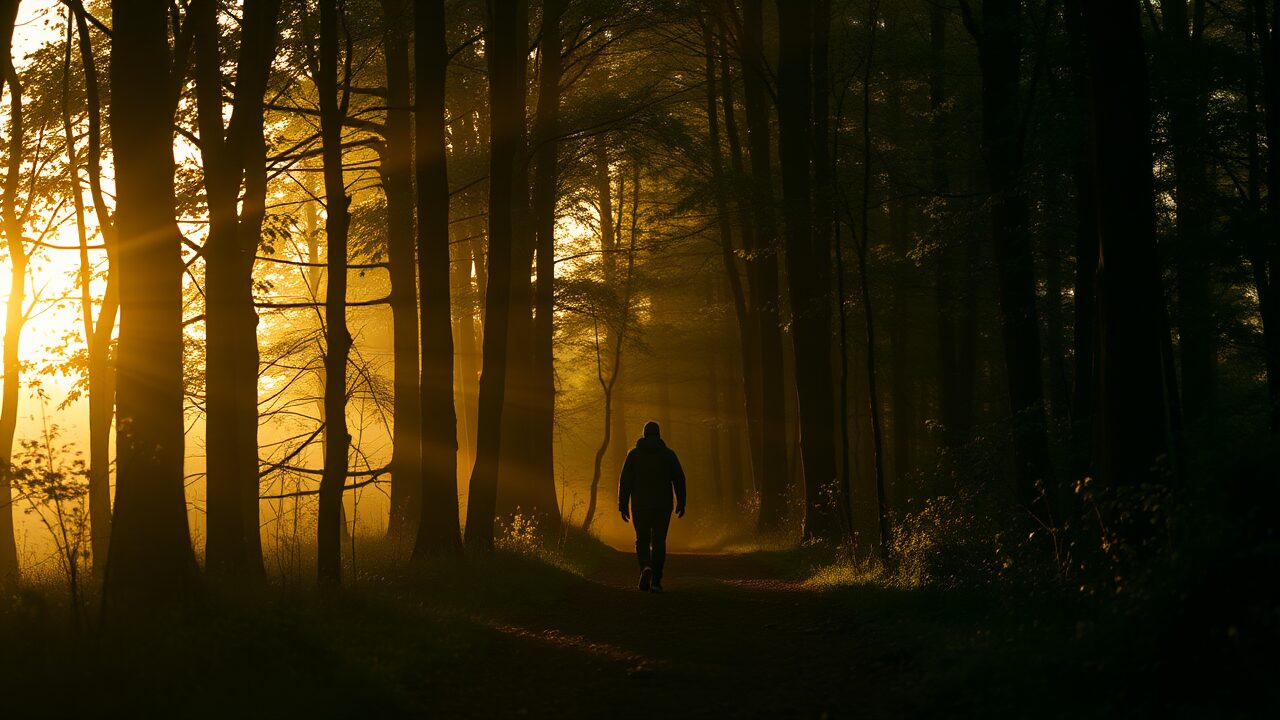
“Sitting meditation just doesn’t stick” — I hear this often.
Years ago I was the same. Try to sit for 15 minutes and my legs went numb, my back ached, my thoughts wouldn’t stop. “Maybe meditation isn’t for me,” I started to think. Then in a Thich Nhat Hanh book I encountered walking meditation.
“Walking” — something I already do every day — done consciously. That was all. And yet those 10 minutes took me into “here, now” deeper than 30 minutes of seated meditation.
This article honestly explains the science, history, and practice of walking meditation.
💎 Key insight in one line Walking meditation teaches “you can still be here, now, even while moving.” If sitting meditation doesn’t fit you, this is the first one to try.
Quick Summary (30 seconds)
- Walking meditation = doing your walking mindfully.
- Buddhist origin; spread globally especially by Thich Nhat Hanh.
- Practiced in Vietnamese Buddhism, Theravada, and Zen traditions.
- Begin with just 10 minutes daily — the most accessible meditation.
- Practicable indoors, outdoors, in nature.
- Best for those who can’t sit, or who want to combine exercise and meditation.
1. What Walking Meditation Is
1-1. Basic Concept
Walking meditation is doing your everyday walking consciously and mindfully:
- Attention on the soles of the feet
- Observe weight shift
- Integrate breath and step rhythm
- Be aware of scenery, sound, air
- When thoughts arise, don’t chase them
1-2. Buddhist Traditions
Theravada Buddhism: Caṅkama — traditional walking meditation. Slowly walking ~10 m back and forth.
Zen: Kinhin — walking meditation between seated sessions.
Vietnamese Buddhism (Plum Village): Thich Nhat Hanh’s lineage. Emphasizes walking meditation in daily life.
1-3. Thich Nhat Hanh’s Teaching
The Vietnamese monk Thich Nhat Hanh (1926–2022) spread walking meditation globally:
- “Walk as if you are kissing the ground“
- “Arrive at here-now with each step“
- “Happiness is already in the feet that are walking“
- A central figure who brought mindfulness to the West
🔬 Neuroscience column Walking meditation combines physical movement + attention concentration. This simultaneously activates the brain’s motor cortex, attention networks, and insular cortex — yielding a more integrative brain activation pattern than seated meditation.
2. Scientific Evidence
2-1. Key Studies
Edwards et al. (2018) Continuous walking-meditation groups showed lower stress hormones (cortisol), improved mood, better sleep quality.
Gainey et al. (2016) Type-2 diabetes patients, 12 weeks of Buddhist-style walking meditation. Significant improvements in blood glucose, vascular function, stress markers.
Yang et al. (2018) systematic review Walking meditation research reviewed. Effects on depression, anxiety, chronic fatigue, balance in older adults.
2-2. Synergy of “Walking × Meditation”
Walking alone:
- Cardiovascular health
- Weight management
- Mood improvement (light natural lift)
Meditation alone:
- Stress reduction
- Improved attention
- Emotional regulation
Walking meditation (both):
- All of the above
- Easier to sustain (less boredom than sitting)
- Easy integration into daily life
3. Three Styles
3-1. Traditional Slow Walking (Caṅkama, Kinhin)
Features:
- Very slow (1 step = 2–5 seconds)
- 10–20 m straight line
- Back and forth
- Typically indoors
Suits:
- Seeking deep meditation
- Building focus
- Learning traditional practice
3-2. Medium Speed, Natural (Thich Nhat Hanh style)
Features:
- Slightly slower than a usual stroll
- Integrate breath and step
- Outdoors or in nature is ideal
- 2–4 steps per breath
Suits:
- Integrating into daily life
- Enjoying nature
- Beginners
3-3. Normal Speed, Awareness-Focused
Features:
- Regular walking speed
- Practicable during commute or shopping
- Awareness of surroundings
- Effective even briefly
Suits:
- No spare time
- Already walks a lot
- Wants “walking time = meditation time”
4. 10-Minute Script (Thich Nhat Hanh Style)
Outdoor recommended. Indoors (hallway, room) also OK.
【0:00-1:00 Standing】
Stand still, three deep breaths
Whole sole touches the ground
"For the next 10 minutes, I bring attention to walking"

【1:00-2:00 First steps】
Lift the right foot
Slowly bring it forward
Set it down
Sense the weight shift

Left foot the same
Slowly

【2:00-5:00 Build rhythm】
One step per inhale → one step per exhale
(or two steps per breath)

Attention on the soles
"Foot touches ground"
"Weight transfers"
"Foot lifts"
"Carries forward"

【5:00-7:00 Awareness of environment】
Walking, open the five senses:
- Wind sounds
- Bird calls
- Air's scent
- Movement of leaves
- The ground beneath

No judging — just noticing

【7:00-9:00 Whole-body awareness】
The whole body moves as one being
From head to feet, rhythmically integrated
Breath, step, awareness become one

【9:00-10:00 Stop】
Slowly stop
Three deep breaths
Confirm "I have arrived in here-now"
5. Walking Meditation by Scene
5-1. Commute
Use the walk from station to office:
- Don’t look at phone
- Remove earbuds (or play very quiet music)
- Direct attention to the feet
- Awareness of buildings, sky, signs
- At traffic lights, take 3 breaths
5-2. In Nature
Parks, forests, beaches:
- Allow more than an hour
- Phone on airplane mode
- Minimize photos
- Fully open the five senses
- “Forest bathing × meditation” synergy
5-3. Indoor (Hallway, Room)
Rainy days, evenings at home:
- 3–5 m straight line
- Barefoot is ideal
- Very slow
- Back and forth
- 20–30 minutes traditionally
5-4. Walking Pets
Turn your dog walk into meditation:
- Match the dog’s pace
- Observe the dog
- Your own breath–step rhythm
- Practice returning from thought to here-now
6. Walking Meditation × Other Tools
6-1. With Music
Walking meditation is fundamentally silent, but beginners may benefit:
| Music | Effect |
|---|---|
| Nature sounds (birds, river) | Deepens nature unity |
| 432 Hz music | Relaxation |
| Solfeggio 528 Hz | Integrates with heart meditation |
| Ambient | Immersion |
When wearing earbuds, remain safe and aware of surroundings.
6-2. With Loving-Kindness
Internally repeat Metta while walking:
"May I be happy" (one step)
"May I be healthy" (one step)
...
Or directed at people you pass:
"May you be happy" (passing person)
💎 Key insight in one line Walking meditation × loving-kindness × nature sound — this combination is “the pinnacle of moving meditation,” strongly recommended.
7. Persona Guide
A. Sitting meditation doesn’t last
- Start with walking meditation
- Convert 10-min daily walks outdoors
- Try sitting meditation after 3 months
B. Need more exercise
- 30 min daily of walking meditation
- Measure heart rate (moderate exercise zone)
- Both meditation and exercise effects
C. Stressed business professional
- 10 min during lunch
- 5 min between meetings
- Convert your commute into meditation time
D. Older adults
- Slow and safe
- Near cane or handrail
- Also helps prevent falls (improved balance)
8. Reader Voices
“Couldn’t sustain sitting meditation for 10 years; walking meditation, 3 years and counting. Half an hour in the park every morning has changed my life.” — Man, 50s, executive (Tokyo, 3 years)
“During depression leave, going outside hurt. Started walking meditation indoors at home. Gradually I could walk outside. A big step in recovery.” — Woman, 30s, former employee (Sapporo, 1 year)
“Found walking meditation through Thich Nhat Hanh’s book; 5 years of practice. Walking the dog has become my sacred daily time.” — Man, 40s, writer (Kobe, 5 years)
9. FAQ
Q1. How many minutes? A. Start with 10 min. Then 30–60 min.
Q2. Do I have to be alone? A. Groups are fine too. Plum Village tradition emphasizes group walking meditation.
Q3. Can I count it as meditation while listening to music? A. Strictly, silence is ideal but soft music is OK for beginners. Move to silence as you progress.
Q4. With a step counter on my phone? A. Avoid. Meditation is time to step aside from numbers.
Q5. Rainy days? A. Indoors with hallway pacing, or walk with an umbrella (becomes rain meditation).
Q6. Jogging / running? A. Running meditation is its own category. Both work. Walking meditation is closer to static meditation.
Q7. Can I do it with kids? A. Yes. Teach as “the slow walking game.” Children easily slip into meditative states.
Q8. When do effects appear? A. Mood shift in a week, habit in a month, life impact in three months.
Q9. With yoga? A. Perfect combination. Yoga settles the body; walking meditation integrates motion.
Q10. Can’t concentrate? A. Return to sole sensation. Just mentally saying “left, right, left, right” is enough.
10. Closing
Walking meditation is the most accessible meditation.
- Buddhist origin, ~2,500-year tradition
- Spread globally by Thich Nhat Hanh
- Easier to continue than seated meditation
- Evidence for stress reduction, mood, blood glucose
- Practicable indoors, outdoors, on commute
- Powerful combined with loving-kindness and nature sounds
The core of meditation — “here, now” — arrives whether you are sitting or lying down or walking, in that very moment.
Thich Nhat Hanh’s words:
“Happiness is not in the future. It is already in the feet that are walking now.“
Tomorrow morning, when you leave the house, consciously walk the first five steps. With each step, you arrive at “here, now.”
That small arrival, accumulated, will change your life quietly.
References:
- Thich Nhat Hanh. The Long Road Turns to Joy: A Guide to Walking Meditation (1996)
- Gainey et al. Buddhist walking meditation on glycemic control (2016)
- Edwards et al. Walking meditation stress effects (2018)
- Plum Village resources
Disclaimer: Informational practice reference. People with mobility or balance issues should practice under physician guidance.