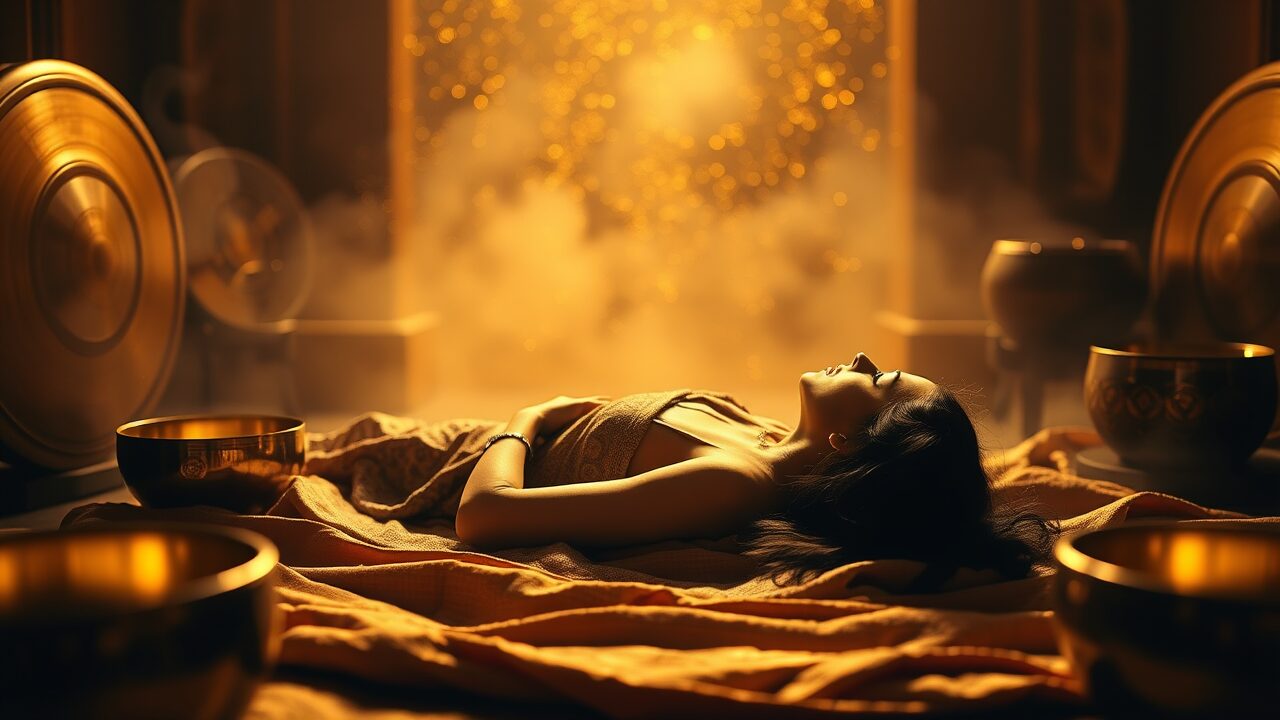
The moment I lay down, the world transformed into sound.
The low resonance of Tibetan singing bowls. The transparent notes of crystal bowls. The vast undulations of a gong. They passed over my body like waves, and at some point the boundary between myself and the sound dissolved.
When the 90-minute session ended, it felt like waking from a deep sleep. I couldn’t have told you what had happened. But a stillness — there’s no other word — sat in my chest, as if something had been set right.
This experience, called a “sound bath,” has rapidly spread across the West in recent years. This article explains what a sound bath is, what effects it has, and how to recreate it at home — honestly.
💎 Key insight in one line A sound bath is an experience of “being bathed in sound.” Surrounded by the harmonics of singing bowls, gongs, tuning forks, and more, consciousness is naturally guided into a state where awareness merges with sound.
Quick Summary (30 seconds)
- A sound bath is a group meditation in which space is filled with singing bowls, gongs, tuning forks, and similar instruments.
- Sessions typically last 60–90 minutes; participants lie down and listen passively.
- 2024 systematic review (19 trials, 9 RCTs) reports reduced stress and anxiety, lower blood pressure, improved HRV.
- The “sound bath” has been a rising trend in the West since the late 2010s and is now spreading in Japan.
- At home: recordings + dark room + supine posture recreate about 50–70% of the experience.
- Studio session prices: roughly $25–60 per session (Japan; varies elsewhere).
Quick Summary (3 minutes)
A sound bath is a group meditation practice in which participants lie still while one or more sound healers play instruments (singing bowls, crystal bowls, gongs, tuning forks, chimes, voice) continuously for 60–90 minutes, filling the space with sound.
“Bath” describes the sensation of sound filling space and body. Unlike “listening” actively, this is the receptive experience of immersing yourself in sound.
A 2024 systematic review covering 19 clinical studies (9 of them RCTs) confirmed reductions in anxiety/depression scores, improved HRV, lower blood pressure, and increased delta/theta brain wave activity. A sense of “strong detachment” and “loss of time” emerge as common subjective experiences.
Historically, the group use of singing bowls has roots in Tibetan Buddhist ritual. The modern sound bath grew out of the 1960s–70s New Age movement and exploded in popularity in Western wellness in the late 2010s. Yoga studios and meditation centers in Japan now widely offer it.
Full recreation at home is difficult, but recordings + dark room + supine + 60 minutes uninterrupted capture 50–70% of the essence.
1. What Is a Sound Bath?
1-1. Typical Instruments
A typical sound bath setup might include:
- Tibetan singing bowls (multiple, large and small) — mid-range overtones
- Crystal singing bowls — transparent high tones
- Gong (large) — low oceanic waves
- Tingsha (small cymbals) — sharp highs
- Tuning forks — pure tones
- Chimes / bells — decorative highs
- Voice / chant — human vibration
1-2. A Typical 90-Minute Flow
0:00–10:00 Introduction The healer greets the room, offers brief meditation guidance, and describes the supine posture.
10:00–15:00 Breath settling 3–5 minutes of breath meditation prepares mind and body to receive sound.
15:00–70:00 The bath itself (55 min) The healer plays instruments sequentially and continuously.
- Gentle low tones at first
- Layers thicken toward the middle
- Peak (around 30–40 min) reaches maximum complexity and volume
- Then settles slowly
70:00–85:00 Silence and integration Instruments stop; participants stay in silence. Observe the residue of sound and your own state.
85:00–90:00 Closing The healer gently signals returning awareness and time to rise.
1-3. Why “Bathing in Sound”
🔬 Acoustic column Singing bowls, gongs, and similar instruments are extraordinarily rich in overtones. As they resonate in the room, multiple waves overlap, creating a sound field of omnidirectional acoustic immersion. You receive sound not just through ears, but through skin, bone, and chest.
2. Research — What Can We Say?
2-1. Key Studies
Goldsby et al. (2017) 62 participants in singing bowl meditation. Significant reductions in tension, anger, and depressed mood (p < .001). Improved spiritual well-being scores.
Sicari et al. (2024) Systematic Review A 2024 systematic review covering 19 clinical studies (9 RCTs) found reproducible improvements in stress markers, HRV, and negative mood.
Stanhope & Weinstein (2021) Comparing Himalayan singing bowl meditation to silent meditation: the sound bath group showed significantly greater stress reduction and mood improvement.
2-2. What’s Supported
- Reduced cortisol (stress hormone)
- Improved HRV (parasympathetic activation)
- Lower blood pressure (especially diastolic)
- Reduced tension, anxiety, depression scores
- Subjective relaxation and “settledness”
2-3. What’s Not Yet Supported
- That specific frequencies cure specific diseases
- That chakras are physically “opened”
- Quantum-level claims
🔬 Key insight in one line Sound baths are supported across multiple clinical studies as adjuncts for relaxation, autonomic balance, and mood improvement. Be cautious of stronger medical claims.
3. What You May Experience
3-1. Common Patterns
From participant reports, common experiences include:
- Loss of time sense: 30 minutes feels like 10, or the reverse.
- Altered body sense: floating, sinking, boundaries dissolving.
- Color and light: closed-eye visions of color and geometric patterns.
- Emotional release: tears, laughter, old memories.
- Deep sleep: many participants fully sleep through portions.
- Lucid awareness: awake but dreamlike.
3-2. Strong Experiences Aren’t Necessary
💎 Key insight in one line You don’t need dramatic experiences to benefit. Body and mind quality often shift across the days following a sound bath. Stay open to the result instead of demanding one.
3-3. Possible Negative Experiences
- Intense emotional surfacing (when touching old trauma)
- Physical discomfort (if volume is excessive)
- Inability to sleep (for some participants)
- Reactivation of grief
These aren’t “bad experiences” — they are often the release of unprocessed feelings. If you have known trauma, inform the healer in advance.
4. First Time — Mindset and Checklist
4-1. Before You Go
- Avoid eating 2 hours before (digestion interferes with meditation).
- Avoid caffeine and alcohol.
- Wear loose clothes (comfortable layers, socks, a blanket).
- Hydrate before and after.
- Arrive early to settle.
4-2. What to Bring
- Yoga mat (some venues provide).
- Blanket (temperature regulation).
- Eye mask (light reduction).
- Water.
- Notebook and pen (to record the experience).
4-3. During the Session
- Don’t try to “feel something.”
- It’s fine to fall asleep.
- Move if you need to.
- Let tears come if they come.
- Don’t fight the sound. Stay receptive.
4-4. After the Session
- Don’t talk immediately. Hold 30+ minutes of silence if possible.
- Hydrate; eat lightly.
- Avoid intense exercise.
- Sleep early that night.
- Observe the next day — sleep quality, mood, body state.
5. How to Recreate at Home
5-1. What You Need
- High-quality audio source (YouTube/Spotify/dedicated app)
- Yoga mat or futon
- Dark room (or blackout curtains)
- Comfortable temperature
- 60–90 uninterrupted minutes
- Earbuds or a good speaker
5-2. Home Sound Bath Flow
0:00–5:00 Setup Darken the room; lie down. Cover yourself with a blanket.
5:00–10:00 Breath Three deep breaths → settle into natural breath. “The next 60 minutes are entirely for me.”
10:00–70:00 The bath itself Play a quality sound bath recording. Choose audio used in research (e.g., Goldsby) or recordings by reputable sound healers.
70:00–85:00 Silence When the recording ends, don’t rise immediately. Stay in silence.
85:00–90:00 Rise slowly Bring awareness back to the body; rise gradually.
5-3. Recommended Home Audio
- YouTube: “Sound Bath 60 Minutes” and many variants
- Insight Timer: dedicated sound bath category
- Calm / Headspace: meditation sessions with sound bath features
- Spotify: “Healing Sound Bath” playlists
💎 Key insight in one line The home version captures 50–70% of the live experience. A realistic rhythm: “real” once a month, “home” once or twice a week.
6. Persona Guide
A. Complete beginner
- Try a 60-min recording at home first.
- Save group studio attendance for 3–6 months later.
- Don’t economize on participation fees — choose well-reviewed healers.
B. High-anxiety / high-stress
- Email or call the healer in advance.
- Consider 1:1 private sessions.
- If you have trauma, work in parallel with a therapist.
C. Yoga / meditation practitioners
- 1–2 studio sessions per month.
- Home audio 2–3 times per week.
- Consider becoming a sound healer yourself.
D. Chronic illness / under treatment
- Always consult your physician.
- Use as adjunct relaxation only.
- Inform the healer of your medical situation.
7. Pricing and How to Choose
7-1. Price Ranges (Japan, 2026)
| Format | Price per session |
|---|---|
| Group (10–20 people) | ¥3,000–5,000 (~$20–35) |
| Small group (5–8 people) | ¥5,000–8,000 (~$35–55) |
| Private session | ¥10,000–25,000 (~$70–170) |
| Private group at home | ¥30,000–80,000 (~$200–550) |
US and EU prices are typically 1.5–3× these.
7-2. Choosing a Good Healer
- Credentials: certification from organizations like the International Sound Healing Association (ISSA).
- Experience: 3+ years.
- Instrumentation: uses multiple instrument types.
- Reviews: Google reviews, social proof.
- Pre-session communication: answers questions thoroughly.
7-3. Red Flags
- Promises “treatment.”
- Unusually high fees ($350+ per session warrants caution).
- Aggressive product/subscription pitches.
- Offers medical advice.
- Recruitment to religious groups.
8. Reader Voices
“At my first sound bath I cried hard. Nothing was sad, but the tears wouldn’t stop. When it ended, something inside had simply ordered itself.” — Woman, 30s, tech employee (Tokyo, 3 sessions)
“I had been on medication for depression. After a year of monthly sound baths, I reduced my prescription. It hasn’t been the only thing helping — but it’s been helping for sure.” — Man, 40s, teacher (Yokohama, 1 year)
“I became a certified sound healer as a yoga teacher. Moving from receiver to provider has only deepened my respect for the power of sound.” — Woman, 30s, yoga teacher (Kobe, 3 years)
9. FAQ
Q1. How does this differ from regular meditation? A. Regular meditation = active focus. Sound bath = passive immersion. Both have value.
Q2. Can I leave if I get scared? A. Yes — confirm with the healer in advance.
Q3. Are kids welcome? A. Most studios recommend age 12+. Some offer short sessions for kids.
Q4. During pregnancy? A. With physician approval, yes. Inform the healer ahead.
Q5. Does sleeping through it ruin the effect? A. No. Sound is received even in sleep. Don’t blame yourself.
Q6. Can I bring my partner? A. Yes for group sessions. Some studios offer couples private sessions.
Q7. How often is ideal? A. Once or twice a month is realistic and effective. More than weekly is probably excessive.
Q8. What if I don’t feel an effect? A. Judge after 3–5 experiences. A single session isn’t enough to know.
Q9. Can I become a healer? A. Start with 1–3 singing bowls. Professional certification programs range from a few thousand to tens of thousands of dollars.
Q10. Are online sound baths effective? A. About 30–50% of the in-person effect. Not a complete substitute, but a useful introduction.
Q11. What if I don’t like music? A. Fine. A sound bath isn’t “music” — it’s an acoustic experience. Musical taste is largely irrelevant.
Q12. Can I attend on medication? A. No alcohol. Prescription medications usually fine — inform the healer.
10. Closing
A sound bath is a new kind of meditation: the meditation of being bathed in sound.
- A group experience filling space with singing bowls and gongs.
- 60–90 minutes of passive immersion.
- 2024 systematic review confirms stress, anxiety, and HRV improvements.
- 50–70% of the experience is recreatable at home.
- A realistic rhythm: monthly studio + weekly home practice.
- Don’t expect; remain open.
After a 90-minute session, sometimes I cannot explain what happened.
That’s fine. Without understanding, something has settled — that, to me, is the gift of a sound bath.
Sound does not require explanation. Sound only needs to be bathed in.
May your day today be set right, even a little, inside sound.
References:
- Goldsby T.L. et al. Effects of Singing Bowl Sound Meditation (2017)
- Sicari et al. Singing Bowl Systematic Review (2024)
- Stanhope & Weinstein Sound Bath Comparison Study (2021)
- International Sound Healing Association (ISHA)
Disclaimer: Informational and relaxation-oriented. People with serious psychiatric or physical conditions should consult a physician before participation.